The message arrived at 8:06 on the first morning of the month.
I was sitting at my kitchen table, drinking coffee and looking through the mail when my phone vibrated.
It was from my mother.
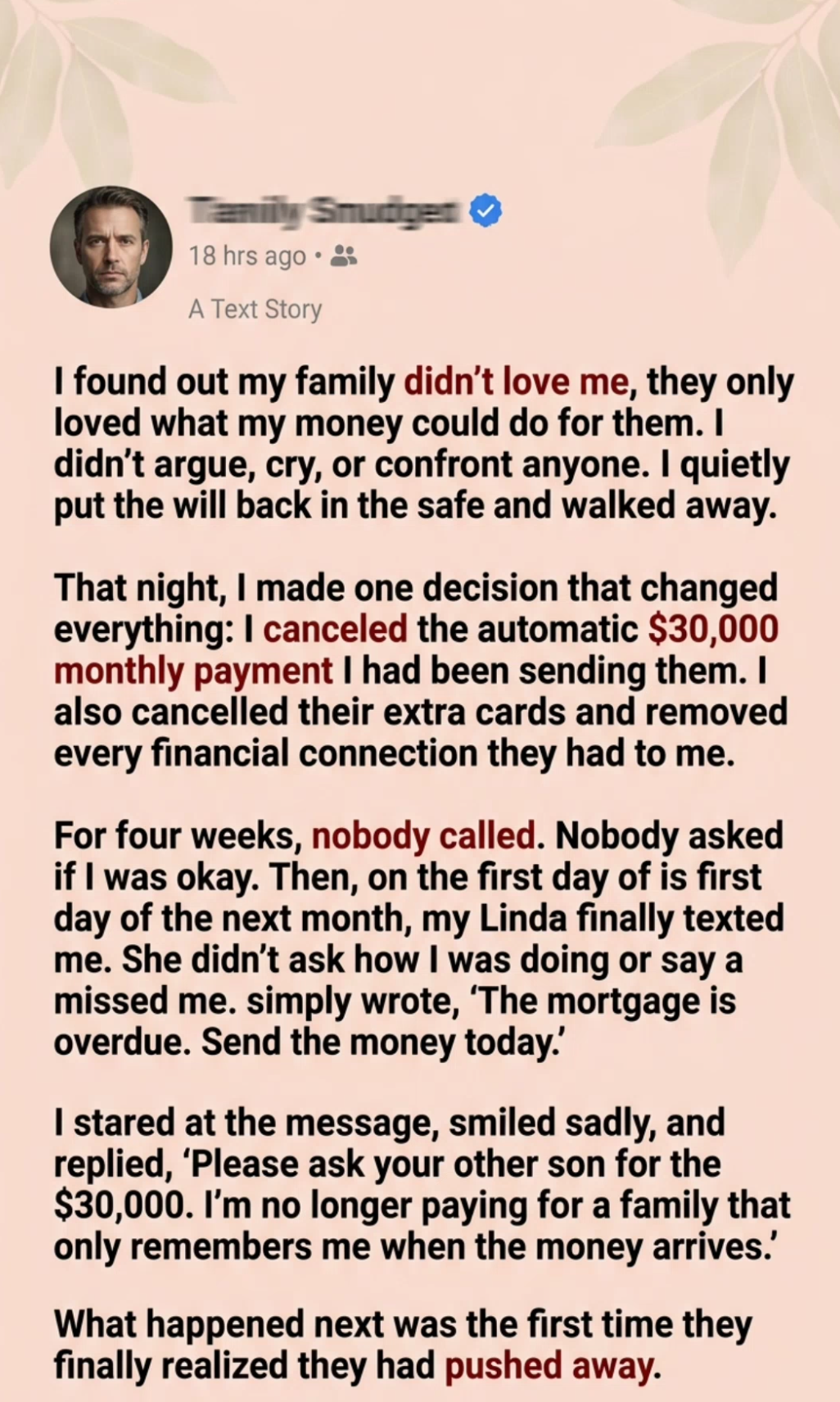
The mortgage is overdue. Send the money today.
Not Good morning.
Not How are you?
Not We haven’t heard from you.
Just a demand.
I read it twice.
Then I put my phone down and stared out the window.
For the first time in years, I didn’t feel panic when my family needed something.
I didn’t rush to open my banking app.
I didn’t calculate how quickly I could transfer the money.
I didn’t feel guilty.
I simply smiled sadly and typed:
Please ask your other son for the $30,000. I’m no longer paying for a family that only remembers me when the money arrives.
I pressed send.
Then I turned my phone face down.
Within four minutes, it began ringing.
My mother.
Then my older brother, Daniel.
Then my younger sister, Rebecca.
I didn’t answer any of them.
Because the truth was, I had been waiting for that moment for a very long time.
Not because I wanted revenge.
But because I finally understood that the people I had spent years supporting had forgotten something important.
I was their daughter.
Their sister.
A person.
Not a monthly payment.
And the day I stopped being useful to them financially was the day I discovered how little they knew about me.
My name is Claire Bennett. I was forty-two years old when I finally stopped paying for my family’s life.
I had built a successful commercial property management company from almost nothing.
When I started, I had one office, two employees, and a small loan I was terrified I wouldn’t be able to repay.
I worked weekends, missed holidays, and spent years answering calls at midnight because a tenant’s building had flooded or a contractor had disappeared.
There were months when I paid employees before paying myself.
There were years when I drove an old car because every spare dollar went back into the business.
Eventually, the company grew.
We managed office buildings, shopping centers, and residential developments across three states. I hired competent managers, built a reliable team, and learned how to step away from daily operations without everything collapsing.
By forty, I was financially comfortable.
Not a billionaire.
Not someone who could buy anything without looking at the price.
But I had enough to live well, save for retirement, help people I loved, and enjoy the life I’d worked so hard to build.
My family knew I was successful.
At first, I was proud that I could help them.
My father, Richard, had retired early after a series of health and financial difficulties. My mother, Linda, wanted to remain in the family home. My older brother Daniel had a family of his own and struggled to maintain a business that never seemed to make consistent money.
My younger sister Rebecca was raising two children and frequently needed help with school expenses and household bills.
I started by helping with small things.
A medical bill here.
A car repair there.
A few months of mortgage payments when my parents were struggling.
Then the requests became regular.
Eventually, I agreed to send my parents $30,000 every month.
The amount was supposed to cover their mortgage, household expenses, insurance, property maintenance, and a comfortable retirement.
I also gave my mother an additional card for emergencies.
Daniel had a card for business travel and necessary expenses.
Rebecca received help with childcare, school fees, and medical costs.
I paid for family vacations occasionally, covered unexpected repairs, and helped whenever someone called.
I told myself that was what successful family members did.
I had been fortunate.
They had not.
Why shouldn’t I share?
But I failed to notice when helping became an obligation.
And when an obligation became an expectation.
The first warning came during my birthday dinner.
I had booked a private dining room at a restaurant overlooking the river.
My family arrived dressed beautifully. My mother brought a cake. Daniel brought his wife, Melissa. Rebecca brought her children.
Everyone seemed happy.
Until my father raised his glass.
“To Claire,” he said. “Our family’s retirement plan.”
Everyone laughed.
I laughed too, although something about the toast made me uncomfortable.
Daniel leaned toward me.
“Speaking of retirement plans, I need to talk to you about something.”
I smiled.
“Can’t it wait until tomorrow?”
“It’s important.”
He explained that his company needed another $120,000 to finish a commercial renovation project.
He had already invested heavily, but the contractor had increased the price and the bank was refusing to extend more credit.
“I just need a bridge,” he said. “Three months, maybe four.”
I told him I would look at the numbers.
His smile faded.
“Why do you need to look at the numbers? It’s family.”
“I still need to understand what I’m financing.”
He leaned back.
“Forget it. I’ll figure something out.”
My mother heard him.
“Claire, your brother has worked very hard. You know how expensive everything is now.”
I nodded.
“I know.”
She sighed.
“Sometimes I think you’re so focused on business that you forget we’re family.”
I looked at the cake in front of me.
It was my birthday.
And somehow I was being criticized because I hadn’t immediately agreed to finance another business project.
I let it pass.
I always did.
The second warning came three months later.
My father needed a new vehicle.
His old one had become unreliable, and he no longer felt comfortable driving it long distances.
I offered to help him purchase a safe, dependable car.
I found a model he liked and arranged for a dealership to deliver it.
The next day, I discovered that my mother had also asked me to pay for an expensive renovation to their kitchen.
When I asked why the renovation couldn’t wait, she replied:
“Your father deserves to enjoy his retirement. He’s worked his whole life.”
I agreed that he deserved comfort.
But I was beginning to feel as though no amount of money was ever enough.
Then Rebecca called.
She needed help with a private school payment.
Daniel wanted a loan.
My mother needed a new refrigerator.
My father wanted to replace the patio.
Every conversation seemed to end with a number.
And I began noticing something else.
When I visited without bringing a gift or discussing money, nobody seemed particularly interested in my life.
If I talked about a business expansion, they listened only long enough to ask whether it would increase my income.
If I mentioned being exhausted, my mother told me everyone was tired.
If I said I was lonely, Daniel joked that I should buy a vacation home and invite people over.
I laughed because I didn’t know what else to do.
I was surrounded by family.
But I increasingly felt alone.
The moment everything changed happened on a Sunday afternoon.
I had gone to my parents’ house to discuss their estate planning.
My father had recently updated his medical documents, and my mother wanted to make sure their will was organized.
They had asked me to bring a copy of the financial information I had helped them prepare.
I arrived earlier than expected.
The front door was unlocked, and I heard voices from the study.
My mother was speaking to Daniel.
I wasn’t trying to listen.
But then I heard my name.
“Claire will keep paying,” my mother said.
Daniel laughed.
“Of course she will. She always does.”
“What if she gets married?”
“She won’t change anything. She knows we depend on her.”
My mother lowered her voice.
“That’s why we need to make sure the arrangement stays in place.”
I stopped in the hallway.
Daniel said something that made my stomach tighten.
“She has more money than she knows what to do with. Besides, she doesn’t have children of her own. What else is she going to spend it on?”
I had never told them I didn’t want children.
I had once wanted a family of my own.
A serious relationship had ended years earlier, and after that I had concentrated on building my company.
My family had interpreted my single life as proof that I had no meaningful responsibilities.
Then my mother said something I would never forget.
“Just make sure she doesn’t change the will. Your father and I already agreed that the family house and the remaining investments should stay with the children.”
Daniel laughed.
“She won’t change it. She knows we need it.”
I felt something inside me go quiet.
I stepped backward.
Then I heard Daniel ask:
“What about the money she sends every month?”
My mother answered without hesitation.
“It’s not enough to make us comfortable forever, but it keeps things manageable.”
Daniel chuckled.
“Then we should be grateful she doesn’t have a husband telling her to stop.”
I stood there for several seconds.
I had spent years believing that my family needed me.
Now I understood that they had built their expectations around the assumption that I would never leave.
I walked into the study.
Both of them turned.
My mother smiled.
“Claire! We didn’t hear you come in.”
“I can see that.”
Daniel looked uncomfortable.
“What are you doing here so early?”
“I came to discuss the will.”
My mother pointed toward a chair.
“Good. We were just talking about it.”
I placed the folder on the table.
Then I looked at the documents.
My parents had prepared a draft will.
Their house and remaining investments were to be divided between Daniel and Rebecca.
My name appeared in a separate section.
I was listed as the person expected to continue providing financial support to my parents during their lifetime.
There was no corresponding provision for repayment, no defined limit, and no recognition of the money I had already contributed.
I looked at my mother.
“Is this what you want?”
She seemed confused.
“It’s what makes sense.”
“For whom?”
Daniel shifted in his chair.
“Don’t make this dramatic.”
I looked at him.
“I’m asking a question.”
My mother folded her hands.
“Your brother has children. Your sister has children. They need more stability than you do.”
I looked down at the document again.
“So my role is to keep paying for everyone, while whatever remains goes to them?”
“That’s not how you should look at it,” my mother said.
“How should I look at it?”
She sighed.
“Claire, you’ve always been fortunate. You have your business. You have your own house. You’re doing well. Your brother and sister have more responsibilities.”
I stared at her.
Then I understood something painful.
They weren’t simply asking me to help.
They had decided that my success made my sacrifices less important.
I didn’t argue.
I didn’t cry.
I didn’t ask them to explain themselves.
I closed the folder, returned the draft will to its envelope, and placed it in the safe where it belonged.
Then I stood up.
“I have to go.”
My mother frowned.
“Already?”
“Yes.”
Daniel looked annoyed.
“We haven’t finished talking.”
“I think we have.”
I walked out.
Neither of them followed me.
That night, I sat alone in my living room.
I turned off the television and opened my laptop.
I reviewed every recurring payment connected to my family.
The $30,000 monthly transfer.
The additional credit cards.
The utility accounts I had guaranteed.
The insurance premiums I had been paying.
The automatic payments for services at my parents’ house.
The business expenses Daniel had been charging to his supplementary card.
The school and childcare payments I had arranged for Rebecca.
For the first time, I saw the entire picture.
I wasn’t simply helping my family.
I had become the financial foundation of three separate households.
And none of them had asked whether I wanted that responsibility forever.
I called my financial adviser the next morning.
Then I spoke with my attorney.
I made sure every change was lawful and properly documented.
I canceled the automatic $30,000 monthly transfer.
I canceled the supplementary cards.
I removed my name from accounts where I was only a guarantor and where the relevant agreements allowed me to do so.
For accounts that required notice or formal procedures, I began the process.
I transferred my parents’ essential household bills back into their own names where possible and gave them written notice of the changes.
I did not empty their accounts.
I did not take anything that belonged to them.
I simply stopped using my money to pay for their lives.
I also updated my own estate documents.
My will would no longer contain vague promises about supporting people who had never considered what I needed.
Instead, I arranged for a portion of my estate to support a charitable organization that provided housing and education assistance to people rebuilding their lives after financial hardship.
I left specific personal gifts to people I trusted.
And I appointed an independent executor.
I didn’t do any of this to punish my family.
I did it because my financial future needed to belong to me.
When the paperwork was finished, I closed my laptop.
For the first time in years, I felt as if I could breathe.
The first week was quiet.
No calls.
No messages.
I assumed they were busy.
The second week passed.
Nothing.
I sent my mother a short message asking how she was feeling.
She replied with a thumbs-up.
I asked whether Dad had been sleeping better.
She said he was fine.
Then she stopped responding.
Daniel didn’t contact me at all.
Rebecca sent a photograph of her children at a school event but didn’t ask whether I could attend.
I began to understand that the silence wasn’t accidental.
They were waiting for the next payment.
The third week passed.
Still nothing.
I went to work, met friends for dinner, and spent a weekend visiting a coastal town I had wanted to see for years.
I didn’t tell anyone in my family.
It felt strange to make plans without considering whether someone would need money that weekend.
Then the first day of the next month arrived.
And my mother’s message came.
The mortgage is overdue. Send the money today.
I replied.
Please ask your other son for the $30,000. I’m no longer paying for a family that only remembers me when the money arrives.
The calls began immediately.
I ignored them.
Then a message arrived from Daniel.
What is wrong with you? Mom and Dad are counting on that money.
I typed:
Then you and Rebecca need to discuss how to support them.
He replied:
You can’t just abandon your parents.
I stared at the message.
Then I wrote:
I haven’t abandoned them. I’ve stopped paying for everyone. Those are not the same thing.
He sent no response.
Three days later, my parents came to my house.
My mother stood on the porch with her handbag held tightly in both hands.
My father was behind her.
I opened the door.
“Claire,” Mom said, “we need to talk.”
I stepped aside.
They entered.
My father sat on the sofa without removing his coat.
My mother remained standing.
“Why did you stop the payments?” she asked.
“Because I don’t want to continue paying $30,000 every month.”
“You know we need that money.”
“I know you have expenses. I also know you have retirement income and savings.”
“Not enough to live the way we’re accustomed to.”
I looked at her.
“Then we need to discuss a realistic budget.”
She frowned.
“Why are you making us feel poor?”
I was stunned.
“Mom, I’m not making you feel anything. I’m telling you that I can’t continue funding every expense.”
My father finally spoke.
“Your mother and I thought this was a family arrangement.”
“It was. But nobody ever asked whether I wanted it to continue forever.”
“You never complained,” he said.
I sat across from him.
“Because I loved you. I thought helping was something I could do freely. But when I heard you discussing my future as if I were a permanent source of income, I realized you didn’t see it that way.”
My mother looked away.
“You misunderstood what we were saying.”
“Then explain it.”
She said nothing.
I continued.
“I heard you say that if I got married, I would still keep paying. I heard you say my money should go to the family because I don’t have children. I read the draft will.”
My father’s expression changed.
He looked at my mother.
“You showed her that?”
“I didn’t show her anything,” Mom replied. “She must have seen it.”
I shook my head.
“I wasn’t upset because you planned to leave your estate to Daniel and Rebecca. It’s your money. You can leave it to whoever you want. I was upset because you treated my future income as something the family could claim while making decisions about your own money without considering me.”
My father stared at his hands.
For a moment, nobody spoke.
Then he said quietly:
“I didn’t realize you felt that way.”
I nodded.
“That’s because you never asked.”
The next week, Daniel called again.
This time, I answered.
He didn’t bother with greetings.
“You’re putting Mom and Dad in a terrible position.”
“I’m willing to help them make a budget.”
“They don’t need a budget. They need what you’ve always sent.”
“I can’t do that anymore.”
“You’re making enough money.”
“That’s not the point.”
He became angry.
“You have no idea what it’s like to raise children and run a business.”
I nearly laughed.
“I know what it’s like to run a business. I built mine without asking our parents to pay my bills.”
“That’s different.”
“Why?”
He didn’t answer.
Then he said something that made the conversation much clearer.
“If you don’t help, I’ll have to sell the equipment at the company.”
I paused.
“Is that why you want the money?”
“It’s part of it.”
“Daniel, I have helped your company before. I am not investing another dollar without a proper agreement and independent financial review.”
He scoffed.
“So now I’m a stranger?”
“No. You’re my brother. But that doesn’t mean I’m your bank.”
He hung up.
I didn’t call back.
Rebecca approached things differently.
She sent a long message explaining that she had been under stress, that raising children was expensive, and that she had assumed my financial help would continue.
She admitted that she had become accustomed to not worrying about certain bills because I always handled them.
Then she wrote:
I didn’t realize how much you were doing because you made it look easy.
I read that sentence several times.
I wanted to believe she understood.
I replied:
I wasn’t trying to make it look easy. I just didn’t want everyone worrying about money. But I need my own life too.
She sent another message.
Can we talk?
We met for lunch the following Saturday.
Rebecca looked tired.
She told me she had started reviewing her expenses and was considering moving to a less expensive house.
She had also asked her former employer about returning to full-time work.
“I thought you’d always be there,” she admitted.
I stirred my coffee.
“I was there. But I was never supposed to be responsible for everything.”
She nodded.
“I’m sorry.”
It wasn’t a dramatic apology.
It wasn’t perfect.
But it was the first time anyone in my family had acknowledged that my money came from my work, my time, and my sacrifices.
I told her I still loved her.
But I would no longer provide unlimited financial support.
If she needed advice, I would help.
If the children needed something essential, I would consider it case by case.
But I would not resume the automatic payments.
She accepted that.
For the first time, our conversation was about each other rather than her expenses.
The most difficult conversation came two months later.
My father asked me to visit.
I arrived at their house on a quiet afternoon.
The atmosphere felt different.
There were fewer lights on, and the large television had been replaced with a smaller one.
My mother had begun preparing meals at home rather than ordering food several times a week.
The household had adjusted.
Not comfortably.
But it had adjusted.
My father was sitting in his study.
He asked me to close the door.
“I owe you an apology,” he said.
I sat down.
He looked older than I remembered.
“When you started helping us, I thought it was a generous thing you wanted to do. Then we got used to it.”
He paused.
“Your mother and I stopped thinking about what it cost you.”
I listened.
“I should have asked whether you were happy with the arrangement. I should have thanked you more often. And I should never have assumed that your money was part of our retirement plan.”
My eyes filled.
“Thank you for saying that.”
He nodded.
“Your mother has been upset.”
“I know.”
“She feels as if you’ve rejected her.”
I looked at him.
“I haven’t rejected her. I just need her to love me without expecting a payment.”
He lowered his head.
“I understand.”
Then he reached into a drawer and removed a small envelope.
Inside was a handwritten list.
It contained the amounts I had contributed over the previous several years.
My father had gone through bank statements and old records.
He had calculated the total.
It was considerably more than either of us had realized.
He placed the paper on the desk.
“I want you to know that I see it now.”
I looked at the number.
I didn’t want the money back.
But I wanted them to understand that it had never appeared out of nowhere.
It had come from years of work, missed holidays, careful decisions, and opportunities I had sometimes postponed.
My father touched my hand.
“You were a good daughter long before you could afford to help us.”
I cried then.
Not because the money had stopped.
Because someone had finally remembered that I was their daughter first.
A few months later, my mother invited me to Sunday lunch.
I almost declined.
But I went.
She prepared the roast chicken I had loved as a child.
After dinner, she asked me to help her clear the table.
We stood together in the kitchen.
For a while, neither of us spoke.
Then she said:
“I miss the way things used to be.”
I looked at her.
“What do you mean?”
“When I could call you about something and know you would take care of it.”
I dried a plate.
“Mom, you can still call me.”
She looked hopeful.
“But?”
“But I need you to call because you want to talk to me, not because you need me to pay for something.”
She looked down.
“I didn’t think I was doing that.”
“I know. That’s why it took me so long to see it.”
She placed a dish towel on the counter.
“I was proud of you,” she said. “But perhaps I became too comfortable with what you could provide.”
I nodded.
“I wanted to help. I never wanted to be expected to help forever.”
She stepped closer.
“I’m sorry, Claire.”
It wasn’t a perfect moment.
There were still difficult feelings, and the relationship didn’t become magically repaired.
But it was honest.
And honesty was something we hadn’t had for a long time.
Over the next year, my family changed in ways I hadn’t expected.
Daniel sold part of his business and reorganized his finances. He eventually found a smaller commercial project that he could manage without constant outside funding.
Rebecca returned to work full-time and adjusted her family’s budget.
My parents refinanced their mortgage and downsized some of their expenses.
They didn’t lose their home.
They didn’t become homeless.
They simply stopped living as though my income belonged to them.
I remained willing to help in genuine emergencies, but I established clear boundaries.
Any significant financial assistance would be documented.
No supplementary credit cards.
No automatic transfers.
No business loans without independent review.
And no one would ever again be able to treat my financial support as an entitlement.
Daniel was the last to accept it.
For months, he barely spoke to me.
Then, on my birthday the following year, he sent a short message.
Happy birthday. Hope you have a good day.
I replied:
Thank you. I hope you’re doing well too.
It wasn’t much.
But it was the first birthday greeting from him that didn’t include a request for money.
On my forty-fourth birthday, I invited my family to dinner.
This time, I didn’t book a private room or arrange an expensive celebration.
I cooked at home.
My mother brought dessert.
My father brought flowers.
Rebecca came with her children.
Daniel arrived with Melissa.
We sat around the table, talking about ordinary things.
At one point, my father raised his glass.
“To Claire.”
Everyone looked at him.
He smiled.
“To my daughter. Not to her business. Not to her money. Just to her.”
My mother reached over and held my hand.
I felt tears in my eyes.
Daniel looked down before raising his glass.
I didn’t need a speech.
I didn’t need anyone to repay every dollar.
I didn’t need them to promise they would never ask for help again.
I only needed them to understand that my love had never been measured by what I could afford to give.
And neither should theirs.
Later that evening, after everyone had left, I sat alone in the kitchen.
I looked at the empty plates and the flowers on the counter.
For years, I had believed that being a good daughter meant making sure nobody in my family ever had to worry about money.
I had thought that if I provided enough, they would always feel close to me.
But love cannot be purchased through monthly transfers.
And gratitude cannot be demanded through financial sacrifice.
The most important decision I made wasn’t canceling the $30,000 payment.
It was deciding that I deserved relationships in which my presence mattered more than my bank account.
I still loved my family.
I still wanted them in my life.
But I finally understood that I could love them without financing them.
And when my mother called the following week, she didn’t ask about a bill.
She simply said:
“Claire, I was thinking about you. Would you like to come over for coffee?”
I smiled.
“Of course, Mom.”
For the first time in years, I knew she wanted me there.
Not my money.
Me.
THE END.