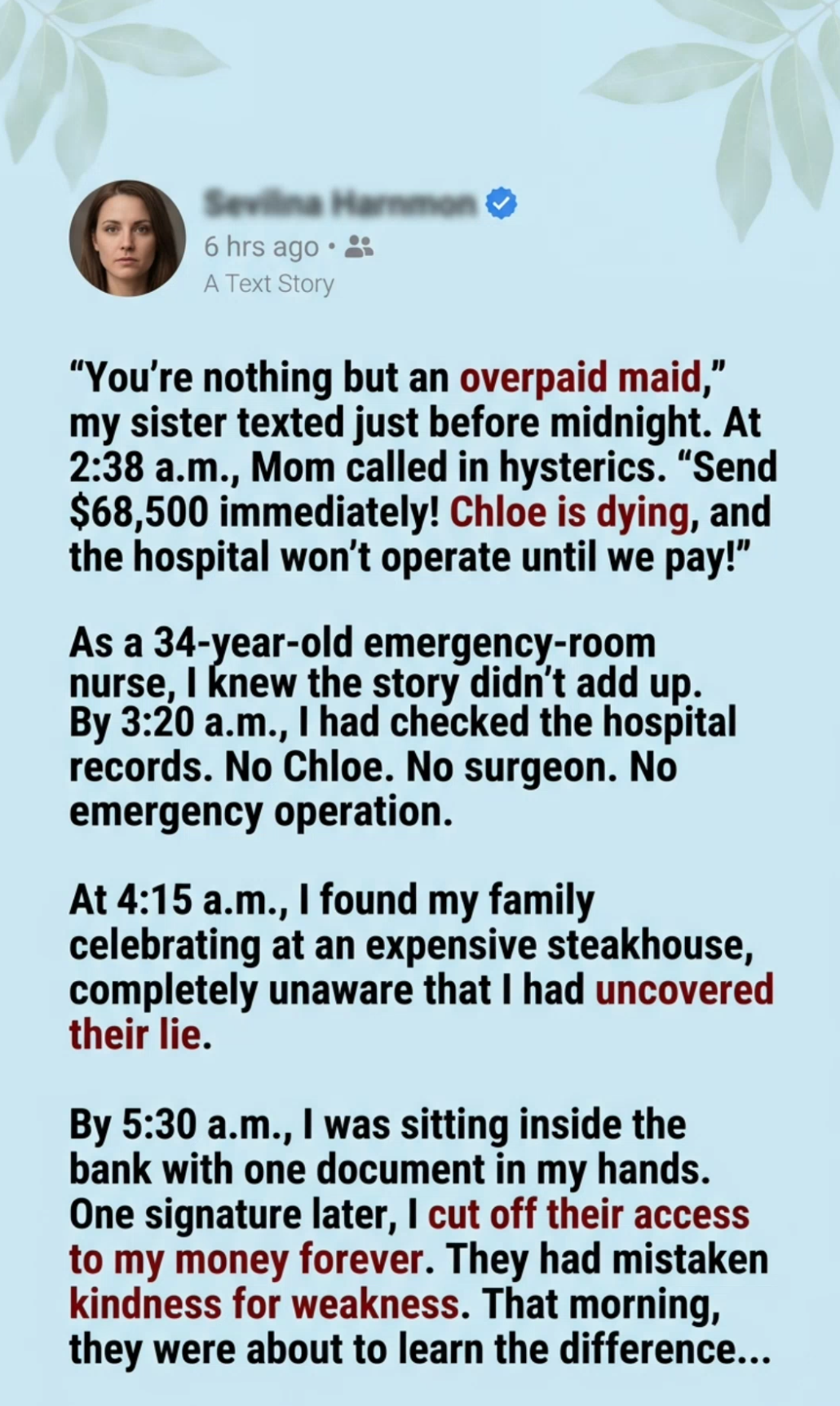
“You’re nothing but an overpaid maid.”
That was the message my younger sister, Vanessa, sent me at 11:47 p.m. on a Thursday night.
I was sitting in the break room of St. Catherine’s Medical Center, finishing a cup of coffee that had gone cold nearly an hour earlier. My twelve-hour emergency-room shift had been exhausting. Two ambulances had arrived within minutes of each other, a young construction worker had suffered a serious head injury, and an elderly woman had spent most of the evening asking whether her husband was still alive.
I had barely found time to eat.
When Vanessa’s message appeared, I stared at it for several seconds.
There was no explanation, no argument beforehand, and no indication of what had made her angry.
I typed a response.
What are you talking about?
She read it immediately.
Then another message appeared.
Don’t pretend you don’t know. Mom says you think you’re better than everyone because you have a nursing job and make good money.
I closed my eyes.
I was thirty-four years old. I had spent twelve years working toward my nursing qualifications, followed by years of night shifts, emergency calls, difficult patients, and responsibilities that followed me home long after I left the hospital.
I had never considered myself better than anyone.
But I had become the person my family called whenever something went wrong financially.
Vanessa needed rent.
I paid it.
My younger brother, Daniel, needed money to repair his car.
I transferred it.
My mother, Linda, needed help with household bills.
I covered them.
When my father died five years earlier, I had quietly taken responsibility for many expenses because I believed my mother needed time to adjust.
At first, I never expected repayment.
Eventually, however, my kindness became an expectation.
If I paid, I was a good daughter.
If I hesitated, I was selfish.
If I asked questions, I was disrespectful.
And if I refused, I was suddenly an overpaid maid.
I put my phone facedown and returned to work.
I thought the argument would end there.
I was wrong.
At exactly 2:38 a.m., my phone began vibrating repeatedly.
Mom.
I answered immediately.
“Hello?”
My mother’s voice was almost unrecognizable.
“Claire! Oh, sweetheart, please! You have to help us!”
I stood up from my chair.
“Mom, what’s happened?”
“It’s Chloe. It’s your niece. She’s dying!”
My stomach tightened.
Chloe was Vanessa’s seven-year-old daughter. She was a cheerful little girl who loved drawing animals and collecting stickers. I had seen her two weeks earlier at a family lunch.
“What happened to her?”
“She’s in the hospital. The doctors say she needs emergency surgery. Something is wrong inside her stomach. They won’t operate until we pay!”
I frowned.
“Which hospital?”
“St. Catherine’s. Your hospital.”
I went completely still.
“What?”
“They need sixty-eight thousand five hundred dollars immediately. The surgeon won’t proceed until the money is deposited. Claire, please! You work there. You know how these things happen. You have the money. Transfer it now!”
I lowered my voice.
“Mom, is Chloe conscious?”
“She’s very sick!”
“Is she breathing normally? Is she in intensive care?”
“I don’t know! Vanessa is crying. Everyone is terrified!”
“Let me speak to Vanessa.”
There was a brief silence.
Then my mother said, “She’s too upset.”
“Then put me on the phone with whoever is treating Chloe.”
“Claire, stop asking questions! Your niece is dying!”
I took a slow breath.
“Mom, emergency treatment is not supposed to depend on a relative transferring money before a doctor begins life-saving care. If Chloe is in immediate danger, the medical team must assess and stabilize her. I need to know what is actually happening.”
My mother’s voice changed.
“Are you saying you won’t help your own family?”
“I’m saying I need accurate information.”
“Sixty-eight thousand five hundred dollars, Claire. That’s all we’re asking!”
That amount was too specific to be a number someone had invented in the middle of a medical emergency.
And something else bothered me.
I worked in that hospital.
I knew the emergency department’s procedures. I knew how urgent surgical cases were escalated. I knew the difference between an actual emergency and a financial demand disguised as one.
I also knew that I could not simply access a relative’s private medical records because I was family.
My professional responsibilities mattered, especially when emotions were running high.
“Mom,” I said carefully, “I am not transferring anything until I know where Chloe is and what is happening.”
She began crying.
“You have become heartless.”
Then she hung up.
I looked at my phone.
A moment later, Vanessa sent me a message.
If Chloe dies, it will be your fault.
I felt a cold sensation move through my chest.
I loved my niece.
I would never gamble with her safety.
But I also refused to let panic replace facts.
I returned to the nurses’ station and spoke with my supervisor, Maria.
“Maria, I need to ask something. My family says my niece has been brought here for emergency surgery. They’re demanding money before treatment. I don’t want to access anything I’m not authorized to see. Can you tell me the proper way to verify whether there’s a genuine emergency without violating patient privacy?”
Maria looked at me seriously.
“First, don’t access her chart because you’re related to her. If your family believes she’s here, ask them for the emergency department registration confirmation or have the child’s legal guardian authorize the hospital to communicate with you. You can also contact the hospital’s patient information desk through the proper channel.”
She paused.
“Is your niece actually here?”
“I don’t know.”
“Then let’s establish that properly.”
I contacted the authorized patient information desk and provided the details my family had given me. The staff member followed the appropriate identification and privacy procedures.
After checking the relevant registration information, she gave me an answer that made my hands go cold.
There was no patient matching the information my family had provided.
No Chloe Bennett had been registered in the emergency department.
There was no surgical emergency under the name.
There was no scheduled emergency operation associated with her.
I asked whether another department might have received her.
The employee explained that she could not disclose unrelated patient information, but there was no record supporting the story my family had told me.
I thanked her and ended the call.
Then I checked the time.
3:20 a.m.
I had been told that my seven-year-old niece was dying in the hospital where I worked.
But the hospital had no record of her being there.
I called Vanessa.
No answer.
I called my mother.
No answer.
Then I received another message.
Stop wasting time. The payment deadline is 4:00 a.m.
I read it twice.
A payment deadline?
For emergency surgery?
I opened my banking application and checked the family payment arrangements I had established over the years.
There were recurring transfers to my mother’s account. Vanessa had access to a secondary card connected to an account I had opened to help her during a difficult period. Daniel had been authorized to use another account for occasional household expenses.
I had never considered those arrangements dangerous.
I had trusted them.
But suddenly, I wondered how much of my financial life had become accessible to people who believed they were entitled to it.
I still needed to know where Chloe was.
I remembered that Vanessa had mentioned taking her daughter to a birthday dinner earlier that evening.
Her social media account had been active shortly before midnight.
I opened it.
The last public post showed a photograph of a restaurant table decorated with flowers and expensive-looking glasses.
The caption read:
Family night. Finally, a reason to celebrate.
I looked closely at the photograph.
In the background, I recognized my mother.
I also recognized Daniel.
And beside him was a man named Marcus, Vanessa’s boyfriend.
The photograph had been posted at 10:36 p.m.
I enlarged it.
There was no sign of Chloe.
I checked the comments.
One of Vanessa’s friends had written:
Looks amazing! Enjoy the night.
Vanessa replied with a heart.
I felt my suspicion growing.
Then I noticed something in the photograph.
A distinctive brass wall decoration.
I had seen it before.
It belonged to Bellamy’s Prime, an expensive steakhouse downtown where my mother had celebrated her birthday the previous year.
I checked the restaurant’s public account.
A photograph posted earlier that night showed a private dining room with the same decoration.
The location matched.
I sat down.
My family had told me Chloe was dying.
They had told me she was waiting for emergency surgery.
They had demanded $68,500.
And while I was working an overnight shift, terrified that a little girl might be fighting for her life, they appeared to be enjoying an expensive evening together.
I didn’t want to believe it.
There was still a possibility that the photograph had been taken earlier.
There was still a possibility that something had happened afterward.
I needed confirmation before drawing conclusions.
At 4:02 a.m., I received a message from Daniel.
You need to stop being difficult. Mom is handling everything. Just send the money.
I replied:
Where is Chloe?
He answered:
At the hospital.
I wrote:
Which hospital entrance did you use?
He didn’t respond.
I sent another message.
I work at St. Catherine’s. There is no record of Chloe being registered here. If she is somewhere else, tell me where.
For several minutes, nothing happened.
Then he sent a voice message.
I played it.
“Claire, just do what Mom asked. You always make everything complicated. Vanessa is under enough stress already. If you transfer the money, we can deal with the rest later.”
I listened again.
He hadn’t mentioned Chloe’s condition.
He hadn’t told me where she was.
He hadn’t explained which doctor was involved.
He had only repeated the demand for money.
At 4:15 a.m., I made a decision.
I left the hospital after arranging my break with another nurse and drove toward Bellamy’s Prime.
The streets were quiet.
I parked across the road and looked through the restaurant’s large front windows.
For a moment, I couldn’t move.
There they were.
My mother sat at the center of the table wearing a beautiful dark-blue dress.
Vanessa sat beside Marcus.
Daniel was laughing at something a waiter had said.
There were plates of steak, seafood, and expensive desserts spread across the table.
A bottle of champagne stood near my mother.
Nobody looked frightened.
Nobody looked like they had spent the night beside a critically ill child.
Nobody was crying.
Then I saw Chloe.
She was sitting beside Vanessa, wearing a pink cardigan and happily coloring on a children’s activity sheet.
She was alive.
She was safe.
And she looked perfectly well.
I watched her reach for a piece of bread while Vanessa helped her cut something on her plate.
My entire body went cold.
I had spent hours imagining my niece in an emergency room.
I had worried that she might be frightened or in pain.
I had considered transferring money that represented years of hard work because I believed a child’s life was at stake.
Meanwhile, the people demanding that money were enjoying dinner.
I took several photographs from the public sidewalk, making sure I did not interfere with anyone or enter a restricted area.
Then I drove away.
I didn’t confront them.
I didn’t shout.
I didn’t walk inside and demand an explanation.
I was too angry to trust myself to have a useful conversation.
I needed to protect myself first.
At 4:42 a.m., my mother called again.
I answered.
“Claire, where are you? We need that money!”
I said nothing.
“Hello? Are you listening?”
“Mom, where is Chloe?”
A pause.
“She’s still being treated.”
“At which hospital?”
“You know perfectly well where.”
“I checked the hospital registration information through the proper channel. There is no record of her being there.”
My mother inhaled sharply.
“Don’t question me!”
“I saw her.”
Silence.
“I saw Chloe at Bellamy’s Prime. She was eating dinner with you, Vanessa, Daniel, and Marcus.”
My mother’s breathing changed.
“Claire, you misunderstood.”
“Misunderstood what?”
“She was feeling better.”
“Then why did you tell me she was dying?”
“We were trying to get the money together.”
“For what?”
Another silence.
“Your sister has expenses.”
“Sixty-eight thousand five hundred dollars in emergency surgery expenses?”
My mother started crying again.
“You know how difficult things have been for Vanessa. She has a child to raise. Marcus is trying to build his business. Daniel has debts. We thought you could help.”
I looked through the windshield at the empty street.
“Then you should have asked for help honestly.”
“We knew you would refuse if we told you the truth.”
Her words settled between us.
I felt something inside me break.
Not because my mother had asked for money.
Because she had deliberately used my love for a child to make me afraid.
She had taken the most frightening possibility a nurse could imagine—the possibility of a child dying—and turned it into a financial weapon.
“Mom, you told me my niece was dying.”
“We were desperate.”
“You told me a hospital was refusing surgery until I paid.”
“We needed the money immediately.”
“You lied about a medical emergency.”
My mother raised her voice.
“After everything I’ve done for you, this is how you speak to me?”
I closed my eyes.
There it was again.
The old argument.
The one that turned every act of generosity into a debt I could never finish repaying.
“I have helped you for years,” I said. “I paid bills. I paid rent. I helped Vanessa. I helped Daniel. I never asked for applause. I never demanded that anyone repay me.”
“Then why are you making such a big deal about this?”
“Because you used a sick child to steal money from me.”
“We weren’t stealing!”
“You lied to obtain a transfer of $68,500. What would you call it?”
My mother hung up.
At 5:06 a.m., Vanessa sent another message.
You really are a horrible sister. Mom told me you’re refusing to help us.
I answered with one sentence.
I saw Chloe eating dinner with you at Bellamy’s Prime.
The message was marked as read.
Then she blocked me.
I looked at the time.
5:18 a.m.
My shift was over.
But I wasn’t going home.
I drove directly to the bank.
The branch opened at 5:30 a.m. for its early business appointments, and I had arranged a meeting several days earlier to review my account security. I had postponed it twice because of work.
Now I was grateful I hadn’t canceled it.
I entered the branch and asked to speak with a senior account officer.
A woman named Helen greeted me.
“Good morning. How can I help you?”
“I need to remove several people from access to my accounts and review every authorization connected to my name.”
She invited me into a private office.
I explained that I had discovered a family member had attempted to obtain a large transfer through a fabricated medical emergency.
I showed her the messages.
I showed her the photographs taken from the public sidewalk.
I showed her the transfer request and the account information my family had supplied.
Helen studied everything carefully.
“Have you already sent the money?”
“No.”
“Have you shared your banking password or verification codes?”
“No.”
“Good. We should still review the security settings and every authorization.”
She opened my account records.
Over the next forty minutes, we reviewed the accounts one by one.
My mother was an authorized user on a household expenses account.
Vanessa had access to a secondary card.
Daniel had been given limited transaction authority on another account.
Several recurring transfers were scheduled.
There were also saved beneficiaries I no longer recognized.
I had approved these arrangements over the years because I wanted to make life easier for my family.
But there was no reason for any of them to remain in place.
Helen explained which documents were required to revoke each authorization, cancel cards, update access credentials, and prevent future transactions from being approved through those arrangements.
I read every page before signing.
Then she placed one final document in front of me.
It was the authorization revocation form.
One signature would remove the remaining access rights held by my family members.
I looked at the names.
Linda.
Vanessa.
Daniel.
Three people I had spent years trying to help.
I remembered my mother calling me at midnight when the electricity was about to be disconnected.
I remembered Vanessa crying because she couldn’t afford her apartment deposit.
I remembered Daniel promising that he would repay me after receiving his next paycheck.
I remembered all the times I had told myself that family members were supposed to help each other.
Then I remembered Chloe sitting safely in a restaurant while her mother used her name to frighten me into transferring $68,500.
I picked up the pen.
And signed.
Helen processed the paperwork.
She confirmed that the relevant access rights had been revoked, the cards had been canceled, the scheduled transfers were stopped, and additional security measures had been activated.
She also advised me to report any further unauthorized requests and keep copies of all communications.
At 6:24 a.m., I walked out of the bank.
For the first time in years, my money was accessible only to me.
I didn’t feel victorious.
I felt exhausted.
But I also felt something I hadn’t felt in a long time.
Safe.
The consequences began before I reached home.
At 7:03 a.m., Vanessa called from another number.
I let it ring.
She called again.
Then Daniel.
Then my mother.
Finally, a message appeared.
Why did my card stop working?
It was Vanessa.
I didn’t respond.
A second message followed.
You can’t just cancel my card without telling me!
Then Daniel:
My payment was rejected. Fix it immediately.
My mother called three times.
On the fourth attempt, I answered.
“Claire, what have you done?”
“I removed the access rights to my accounts.”
“You had no right to do that!”
“Those accounts belong to me.”
“Your sister needs that card!”
“Then she can open her own account and pay for her own expenses.”
“How are we supposed to manage?”
I was quiet for a moment.
“Mom, I have helped you for years. You can no longer treat my income as family property.”
She became furious.
“You have money sitting in the bank! What difference does it make if you help your own mother?”
“It makes a difference when you lie to me.”
“We didn’t lie about everything!”
“You lied about Chloe being critically ill.”
My mother began sobbing.
I had heard those tears before.
They had followed arguments about rent, utility bills, school expenses, and almost every request I had ever questioned.
For years, I had mistaken her distress for proof that I was doing something wrong.
This time, I understood something.
Her tears did not change what had happened.
“Mom, I love you,” I said quietly. “But I will not send you money because you frighten me.”
“You are abandoning your family!”
“No. I’m stopping a financial arrangement that has become unhealthy.”
I ended the call.
Two days later, Vanessa arrived at my apartment.
She was wearing sunglasses, although it was raining.
I opened the door but did not invite her inside.
“We need to talk,” she said.
“About what?”
“Your behavior.”
I almost laughed.
“My behavior?”
“You embarrassed Mom. You embarrassed me. You went to the bank and canceled everything without even giving us a warning.”
“You lied about Chloe being in the hospital.”
“She wasn’t sick, okay? She had a stomachache earlier, but she was fine by dinner.”
“Then why did you tell Mom she needed emergency surgery?”
Vanessa looked away.
“I didn’t say that.”
“Mom called me at 2:38 a.m. and told me Chloe was dying.”
“Mom exaggerated.”
“You sent me a message saying it would be my fault if Chloe died.”
She crossed her arms.
“Because you were refusing to help.”
I stared at her.
“Did you know how much money you were asking me for?”
“Sixty-eight thousand five hundred.”
“Why that amount?”
She hesitated.
“Marcus has business problems. We had some bills. Mom thought you could cover them.”
“So you invented surgery?”
“Nobody invented anything. We just needed the money.”
“Then why didn’t you ask honestly?”
Vanessa looked at me with an expression that was almost offended.
“Because you always make people feel bad when they ask you for money.”
I shook my head.
“No, Vanessa. I ask questions when someone wants tens of thousands of dollars. That’s not cruelty.”
She stepped closer.
“You have a good job. You live alone. You don’t have children. You don’t understand what it’s like to struggle.”
I felt my anger rising.
“I understand what it’s like to work overnight shifts while other people sleep. I understand what it’s like to see families waiting outside emergency rooms, terrified about the people they love. I understand what it means to be responsible for another human being.”
I paused.
“And I understand that Chloe should never have been used to manipulate me.”
Vanessa’s face tightened.
“Don’t act like you care more about Chloe than I do.”
“I never said that.”
“You think you’re better than me because you’re a nurse.”
“No. I think I deserve honesty because I’m your sister.”
She looked down.
For a moment, neither of us spoke.
Then she said something that revealed more than she probably intended.
“Marcus said you would eventually send the money. He said you always give in when Mom cries.”
I stared at her.
“So this was planned?”
Vanessa immediately shook her head.
“No. Not like that.”
“Then what did Marcus tell you?”
She rubbed her forehead.
“He said you had enough money. He said we could ask for a large amount and explain later. Mom agreed because she thought you wouldn’t question her if she said Chloe was in danger.”
I felt sick.
They hadn’t simply panicked.
They had discussed how to get the money.
And they had decided that my love for my niece was the easiest way to do it.
“Vanessa, I want you to leave.”
“Claire—”
“Not until you understand that I am not giving you another dollar.”
She stared at me for several seconds.
Then she turned and walked away.
I closed the door.
The following week, I received a call from my mother.
Her voice was quieter this time.
“Claire, can we meet?”
I considered refusing.
But I wanted one thing answered.
“Will you tell me the truth?”
She hesitated.
“Yes.”
We met at a small café near my apartment.
My mother arrived with Daniel.
Vanessa did not come.
My mother looked older than I remembered. Her hands shook slightly as she placed her purse on the table.
“I want to explain what happened,” she began.
I waited.
She told me that Marcus had accumulated debts connected to his business. Some suppliers had demanded payment, and he had fallen behind on rent for the commercial property he used.
Vanessa had been covering household expenses and was struggling.
Daniel had also borrowed money from Marcus and needed to repay it.
My mother had agreed to help them.
They had initially planned to ask me for a loan.
But Vanessa believed I would refuse because I had recently declined to pay for an expensive family holiday.
According to my mother, Marcus suggested making the request more urgent.
He said that if they told me Chloe needed emergency surgery, I would transfer the money immediately.
My mother admitted that she had agreed.
“Why?” I asked.
She looked down.
“Because I thought you would help.”
“That doesn’t answer my question.”
She wiped her eyes.
“I didn’t think you would find out.”
I felt a painful heaviness in my chest.
“Did you ever think about what would happen if I believed you? Did you think about what I would feel while imagining Chloe dying?”
My mother said nothing.
Daniel shifted in his chair.
“Claire, we all made mistakes.”
I turned toward him.
“You told me she was in the hospital.”
“I was just following what Mom said.”
“You knew she was at the restaurant.”
He looked away.
“Yes.”
“And you still demanded the money.”
He nodded.
I waited for an explanation.
None came.
“How much of the $68,500 was actually needed?” I asked.
My mother sighed.
“Marcus wanted forty thousand to settle some business debts. Vanessa needed money for household expenses. Daniel wanted help paying back what he owed.”
“So none of it was for Chloe’s treatment.”
“No.”
I stared at her.
“And how much did you spend at the restaurant that night?”
Daniel looked uncomfortable.
My mother answered.
“About two thousand dollars.”
I felt my throat tighten.
Two thousand dollars for dinner.
Sixty-eight thousand five hundred dollars demanded from me through a false medical emergency.
I leaned back.
“I need you both to understand something. I am not angry because you are struggling. I am angry because you decided my feelings were something you could manipulate.”
My mother reached for my hand.
I moved mine away.
“Please, Claire. We are still family.”
“Family doesn’t mean unlimited access to another person’s money.”
“We didn’t mean to hurt you.”
“But you did.”
My mother began crying.
This time, I didn’t rush to comfort her.
I let the silence remain.
I didn’t immediately file a police report.
I first spoke with an independent attorney about what had happened, including the attempted transfer, the false medical claims, and the use of Chloe’s identity in the demand.
The attorney advised me to preserve all messages, call records, payment requests, and photographs.
She explained that the precise legal consequences would depend on the evidence and applicable law. If money had been transferred, the case would be different. But the messages and coordinated request were still worth documenting.
I also contacted the bank’s fraud department.
They recorded the incident, reviewed the attempted transfer arrangements, and placed additional protections on my accounts.
I didn’t want revenge.
I wanted to make sure nobody could repeat the same trick.
Two weeks later, I received an unexpected message from Marcus.
You caused a lot of problems for everyone. You should have just helped.
I read it twice.
Then I saved it.
I did not reply.
A few minutes later, another message arrived.
Your sister is struggling because of you.
That was when I realized the story still hadn’t ended.
They were not sorry that they had lied.
They were angry that the lie had failed.
I blocked Marcus and sent the messages to my attorney.
Three weeks after the incident, I received a call from Chloe’s school.
The receptionist explained that Chloe had mentioned being upset about something that happened at home. They were not asking me to interfere in a family matter, but they wanted to make sure the child had appropriate support.
I thanked them and asked whether her mother knew.
They confirmed that Vanessa had been contacted.
I didn’t immediately assume Chloe was being neglected or that she was in danger. But I knew she deserved to be protected from adult conflicts.
I sent Vanessa one message.
I will not discuss money with you. But if Chloe needs me, I am still her aunt. Please don’t involve her in our disagreements.
Vanessa didn’t reply.
Several days later, I received a short message from Chloe through her mother’s phone.
Aunt Claire, can I show you my new drawing?
I stared at the screen for a long time.
Then I answered.
Of course, sweetheart. I would love to see it.
She sent a picture of a colorful house with a huge sun above it.
There were four people standing in front of the house.
Chloe.
Vanessa.
Marcus.
And a small girl holding a stuffed rabbit.
At the top, she had written:
My family.
I smiled sadly.
I told her the drawing was beautiful.
I didn’t ask questions about the restaurant.
I didn’t tell her what her mother had done.
She was seven years old.
She had no responsibility for the decisions adults made.
Months passed.
My family gradually adjusted to living without my automatic financial support.
Vanessa found a more affordable apartment and took additional work.
Daniel sold his expensive motorcycle and negotiated a repayment arrangement with Marcus.
My mother began reviewing her expenses and discovered that she could manage most of her household costs if she stopped paying other people’s bills.
None of it happened easily.
There were arguments.
There were accusations.
There were messages about how I had changed.
But I had changed.
I no longer believed that loving someone meant sacrificing my financial security whenever they demanded it.
I also stopped explaining every decision.
When my mother called asking for money, I calmly reminded her that I was no longer providing financial support.
When Vanessa complained about her expenses, I suggested that she speak with a financial adviser.
When Daniel asked whether I could lend him money, I told him I wasn’t available to do so.
Sometimes they became angry.
Sometimes they stopped calling.
And sometimes, after a few weeks, they called again as though nothing had happened.
I learned to recognize the pattern.
I could love them without participating in it.
Almost eight months after that night, Vanessa contacted me.
Her message was different.
Claire, can we talk? Just you and me.
I hesitated before replying.
We met at a quiet coffee shop.
She arrived alone.
For several minutes, she stirred her drink without speaking.
Then she said, “I owe you an apology.”
I looked at her.
She took a breath.
“I knew Chloe wasn’t dying. I knew she wasn’t in the hospital. I knew Mom was going to tell you something terrible so you’d send money.”
I waited.
“I agreed because I thought we deserved your help. I told myself you had enough and that it wasn’t a big deal.”
She looked down.
“But it was a big deal. You were at work, and you thought your niece might die. I made you feel that.”
Her eyes filled with tears.
“I’m sorry.”
For the first time, I believed that she understood at least part of what she had done.
I didn’t immediately forgive her.
“Why are you apologizing now?” I asked.
“Because Chloe asked me why I never let her call you.”
My heart tightened.
“What did you tell her?”
“I told her we had argued.”
Vanessa wiped her eyes.
“She said she missed you. She asked whether she had done something wrong.”
I looked away.
“She didn’t.”
“I know.”
Vanessa reached into her bag and placed a small envelope on the table.
“What is this?”
“Something I wanted you to have.”
Inside was a handwritten note and a drawing.
The note was from Vanessa.
It said:
I know an apology doesn’t repair what I did. I don’t expect you to trust me again just because I finally admitted the truth. I want you to know that I understand why you stopped helping us. I hope one day we can have a relationship that isn’t built around money.
I folded the note and put it back inside.
“Thank you for saying that.”
Vanessa nodded.
“Can I ask you something?”
“Yes.”
“Would you be willing to see Chloe sometimes?”
I thought about it.
“I would like that. But we need boundaries.”
“Of course.”
“She cannot be used to ask me for money. She cannot be told that I don’t love her because I won’t pay for something. And I won’t be placed in the middle of arguments between you and Marcus.”
Vanessa nodded.
“I understand.”
“And if you need financial help, you need to ask honestly. I may still say no, but I will never punish you for telling the truth.”
She gave a small, sad smile.
“I wish we had done that before.”
“So do I.”
A month later, Chloe came to visit me for an afternoon.
She ran through my front door holding a small backpack.
“Aunt Claire!”
I knelt and hugged her.
She smelled like strawberry shampoo and the sweet biscuits her mother had packed for her.
She showed me her schoolwork, her drawings, and a tiny collection of plastic animals.
We made sandwiches.
We watched an animated movie.
Then she asked a question that made me pause.
“Mom said you don’t help us with money anymore. Does that mean you don’t love us?”
I put down the plate I was holding.
I sat beside her.
“Chloe, listen to me. I love you very much. But money and love are two different things.”
She looked confused.
“Sometimes grown-ups have to make decisions about money. Those decisions don’t change how much they love children.”
“Even if they say no?”
“Even then.”
She considered that.
Then she nodded.
“Okay.”
I kissed the top of her head.
“You never have to worry about grown-up money problems. That’s not your job.”
She returned to her drawing.
I watched her for a moment and felt grateful that she had not been made responsible for the choices her family had made.
My mother and I eventually began speaking again, although our relationship was different.
She apologized privately.
She also admitted that she had become accustomed to depending on me because I had rarely said no.
“I thought you could handle everything,” she told me one afternoon.
“I could handle it,” I replied. “That doesn’t mean it was fair.”
She nodded.
“I know that now.”
I didn’t restore her access to my accounts.
I didn’t restart the automatic transfers.
I didn’t give her another card.
If she needed help understanding a bill, I was willing to sit with her.
If she needed someone to accompany her to an appointment, I could do that.
But my financial boundaries remained.
Trust, I had learned, was not restored by one emotional conversation.
It was rebuilt through consistent behavior over time.
And I was no longer willing to gamble my peace on promises.
One year after that terrible night, I was working another overnight shift in the emergency department.
A little girl was brought in with a broken arm after falling from a playground.
Her mother was crying.
Her father was trying to comfort her.
I helped the medical team prepare the child for assessment and treatment.
When everything was settled, the mother took my hand.
“Thank you,” she whispered. “I was so frightened.”
I smiled.
“Your daughter is being cared for. We’ll explain each step as we go.”
As I walked away, I thought about Chloe.
I thought about the night my family had used the idea of a dying child to demand money from me.
And I thought about the difference between real emergencies and manufactured ones.
I had spent years believing that being a good daughter and sister meant always answering the phone, always opening my wallet, and always finding a way to fix other people’s problems.
But that night had taught me something I should have understood much earlier.
My profession did not make me responsible for every person’s crisis.
My income did not make me responsible for every family’s debt.
And my love did not give anyone permission to deceive me.
I still loved my mother.
I still loved my sister.
I still loved my niece and wanted her to grow up feeling safe.
But I no longer confused love with obedience.
At 5:30 a.m., I had signed one document that removed my family’s access to my money.
It had not ended every relationship.
It had not erased every memory.
It had not made the hurt disappear.
What it did was give me back the right to decide what happened to the money I had worked so hard to earn.
And that was enough.
Because the people who once called me an overpaid maid had finally learned something important.
I was never their servant.
I was their daughter.
I was their sister.
I was Chloe’s aunt.
And I could love every one of them without allowing them to use me.
THE END.