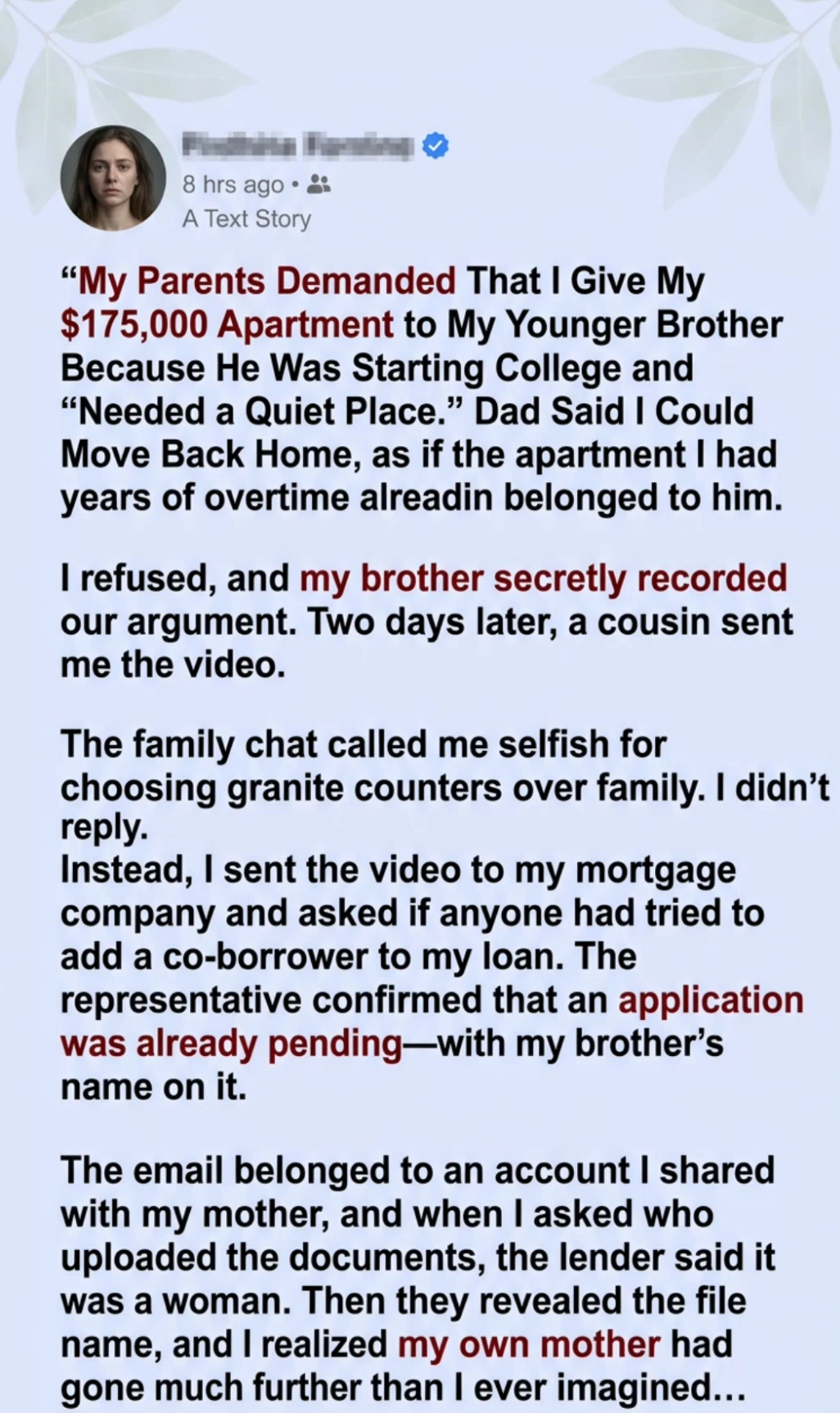
The first time my father told me to give my apartment to my younger brother, I thought he was joking.
We were sitting around my parents’ dining table on a Sunday afternoon. My mother had made roasted chicken, my father was watching a football game on his phone, and my younger brother, Ethan, was scrolling through college housing listings.
Then Dad put down his fork and said, “We’ve decided Ethan should move into your apartment when classes start.”
I looked at him.
“Excuse me?”
He repeated himself as if I hadn’t heard correctly.
“Ethan needs somewhere quiet to study. Your apartment is close to campus. You can move back home for a while.”
I laughed because I genuinely thought he was making a ridiculous suggestion.
My apartment was a two-bedroom property worth approximately $175,000. I had purchased it after eight years of working overtime, skipping vacations, and saving almost every spare dollar.
I had paid the deposit myself.
I paid the mortgage every month.
I had chosen the flooring, installed the kitchen cabinets, and spent three weekends painting the bedrooms.
It wasn’t a spare room.
It wasn’t a family vacation property.
It was my home.
And my father was talking about giving it to my brother as if he were assigning him an unused piece of furniture.
“No,” I said.
My mother’s expression changed.
“Don’t be difficult, Claire.”
“I’m not being difficult. It’s my apartment.”
Ethan finally looked up.
“You’re not even using the second bedroom.”
“It’s my office.”
“You could work at home.”
“I already do.”
Dad leaned back in his chair.
“Family helps family. You’re single. Ethan is starting college. He needs this more than you do.”
I looked at him.
“Then help him find an apartment.”
My father slammed his hand on the table.
“Don’t be selfish.”
I stood up, picked up my handbag, and left.
I thought that would be the end of it.
I was wrong.
Two days later, my cousin sent me a video that would expose what my family had been planning behind my back.
And the most disturbing part wasn’t that my brother wanted my apartment.
It was that my mother had already started trying to make it happen.
My name is Claire Bennett. I was thirty-four when this happened.
I worked as a senior payroll specialist for a regional manufacturing company. My job wasn’t glamorous, but it was steady. I was good at it, and I had built my career through years of careful work.
My younger brother, Ethan, was twenty-one.
He was charming, funny, and very good at convincing people that his problems were someone else’s responsibility.
Growing up, Ethan was always the one who needed extra help.
When he struggled in school, my parents hired tutors.
When he wanted a car, Dad helped him find one.
When he dropped out of a training program, Mom explained that he simply hadn’t found his passion yet.
When he accumulated credit card debt, my parents paid it off.
I was different.
I was expected to manage.
At sixteen, I worked weekends at a grocery store.
At nineteen, I paid for my own community college courses.
At twenty-three, I moved into a rented studio apartment.
At twenty-six, I started saving seriously for a home.
Nobody had given me money for the deposit.
Nobody had paid my bills.
And I had never expected them to.
When I finally purchased my apartment, I invited my parents over for dinner.
Mom admired the kitchen.
Dad inspected the balcony.
Ethan walked through the bedrooms and asked whether I planned to get a roommate.
I laughed.
“No. I bought it for myself.”
He shrugged.
“Must be nice.”
At the time, I thought he was just teasing.
I didn’t realize he had already started viewing my home as something he might eventually get.
The apartment had cost $158,000 when I bought it. After renovations and several years of rising property values, its estimated value had reached around $175,000.
I had worked hard for it.
There were months when I accepted every available overtime shift.
There were years when I drove an old car because I didn’t want a payment.
I brought lunch from home, avoided expensive holidays, and tracked every dollar.
My friends used to joke that I treated my savings account like a second job.
But I knew what I wanted.
A place where nobody could tell me to leave.
A home that belonged to me.
That mattered because I had spent much of my childhood feeling that my needs came second.
My parents weren’t cruel people in every way. They could be generous with neighbors, helpful to friends, and affectionate when things were going well.
But inside our family, Ethan’s problems became everyone’s emergencies.
Mine were considered personal responsibilities.
When I was twenty-eight, my car broke down.
I asked Dad whether he knew a reliable mechanic.
He told me to figure it out.
Six months later, Ethan damaged his car in a parking lot.
My parents paid for the repair.
When I asked why the rules were different, Mom said, “You’re more independent than your brother.”
I thought that was a compliment.
It took me years to understand that it was often an excuse to give him more and expect less from me.
The video arrived on Wednesday evening.
My cousin Rachel sent me a message.
“Claire, I think you should see this before everyone starts talking.”
Attached was a thirty-eight-second recording.
It had been filmed on Ethan’s phone during our argument at my parents’ house.
I pressed play.
The video showed me standing beside the dining table.
My father was seated with his arms crossed.
My mother was near the kitchen doorway.
Ethan was holding his phone.
The recording began just after Dad said I should move home.
Then I heard my own voice.
“I’m not giving you my apartment. I bought it. I pay for it. It’s mine.”
Dad replied:
“You’re choosing granite counters over your own brother.”
I shook my head.
“I’m choosing not to hand over a property I’ve spent years paying for.”
Then Ethan laughed.
“She’s acting like she’s some millionaire.”
I looked directly at him.
“You’re welcome to buy your own place.”
The video ended.
I stared at the screen.
The argument itself wasn’t surprising.
What surprised me was what happened next.
The family group chat had exploded.
My aunt wrote:
“Claire, this is not how family behaves.”
An uncle added:
“Your brother is trying to get an education. You should be proud to help.”
My mother wrote:
“Your father is heartbroken. I never thought you would become so selfish.”
Ethan posted a laughing emoji.
Then someone sent a photograph of my kitchen with the caption:
“Apparently these countertops are more important than family.”
I didn’t reply.
I didn’t defend myself.
I didn’t explain how much I had sacrificed to buy that apartment.
Instead, I watched the video again.
Something about Ethan’s behavior bothered me.
He hadn’t seemed surprised by my father’s demand.
He hadn’t asked what I thought.
He had simply recorded the conversation.
It felt less like a family disagreement and more like someone collecting evidence.
I decided to make a call.
My mortgage was with a regional lender called North Valley Home Finance.
I called the customer service number and explained that I wanted to verify the security of my loan.
The representative asked for my account information.
Then she placed me on hold.
When she returned, her tone had changed.
“Ms. Bennett, I need to ask you something. Have you recently submitted a request to add another borrower to your mortgage?”
I felt my stomach tighten.
“No.”
“Have you authorized anyone to submit documents on your behalf?”
“No.”
“Do you recognize the name Ethan Bennett?”
I stopped breathing for a second.
“That’s my brother. Why?”
The representative explained that an application had been submitted to add Ethan as a co-borrower.
It was still pending.
I asked who had submitted it.
She said the request had come through an online document portal associated with an email account that had access to some of my previous mortgage correspondence.
The email address was familiar.
It was an old account I had once shared with my mother for convenience when I was buying the apartment.
Mom had helped me organize paperwork because I was working long shifts at the time.
I had never thought to remove her access.
“Who uploaded the documents?” I asked.
The representative checked.
“The submission was made by a woman.”
“Can you tell me her name?”
“One moment.”
I waited.
Then the representative read the file name.
Claire_Bennett_Property_Consent_Mother_Authorization_Final.pdf
My hands went cold.
“Can you repeat that?”
She did.
The file had been uploaded under my mother’s email account.
The application included a consent form that appeared to authorize the addition of Ethan as a co-borrower.
I asked whether the lender had verified my signature.
The representative said the application had not yet been approved and that the document was under review.
I immediately told her I had not signed it.
She marked the application as disputed and advised me to submit a written fraud notice.
Before ending the call, I asked one more question.
“Does adding someone as a co-borrower give them ownership of my apartment?”
“Not automatically,” she explained. “A mortgage obligation and property ownership are separate legal matters. However, the documents submitted with this application also include a request for a review of the property’s ownership records.”
I felt dizzy.
My mother hadn’t simply tried to help Ethan get a place to study.
Someone had attempted to use my mortgage account to establish a financial connection between my brother and my property.
I thanked the representative and hung up.
Then I sat in silence.
My mother had access to my old email.
My brother had recorded our argument.
My father had demanded that I surrender the apartment.
And an application had appeared two days after I refused.
For the first time, I wondered whether the entire argument had been planned.
The next morning, I contacted a property lawyer named Martin Shaw.
I explained the situation and sent him the information from the lender.
He asked me not to confront my family until we had secured copies of the submitted documents.
“First, we need to establish exactly what was submitted,” he said. “Second, we need to protect your title and mortgage account. Don’t assume the application has changed ownership. It hasn’t been approved. But we need to understand the documents.”
He helped me prepare a formal dispute notice.
I also changed the password on the old email account, removed my mother’s access, updated my mortgage login, and added additional verification requirements wherever available.
Then Martin requested copies of the disputed application through the lender’s formal process.
Two days later, we received them.
I was sitting in his office when he opened the file.
The first page contained my personal information.
My address.
My mortgage account number.
The estimated property value.
Ethan’s name.
And a proposed change to the borrower structure.
The second page was worse.
It contained a document titled:
Family Occupancy and Financial Contribution Agreement.
According to the document, I had agreed that Ethan would occupy the apartment and contribute toward the mortgage.
It also claimed that I had authorized my mother to coordinate the arrangement.
I had never seen it before.
The third page contained a signature.
It looked similar to mine.
But it wasn’t mine.
Martin examined it carefully.
“Have you ever signed this document?”
“No.”
“Have you ever authorized your mother to sign anything related to your property?”
“No.”
He nodded.
“Then we need to treat this as a suspected forged authorization.”
I stared at the page.
There was another detail.
The document stated that Ethan would make monthly payments toward the mortgage for five years.
But it also included a clause describing him as an intended beneficial occupant with an expectation of future ownership consideration.
I looked at Martin.
“What does that mean?”
“It appears they were trying to create a paper trail suggesting your brother had a financial interest in the property. Whether that could ever support a valid claim would depend on the law and evidence. But the important thing is that you did not agree to it.”
I felt sick.
“Why would my mother do this?”
Martin didn’t speculate.
“We need to ask the person who submitted it.”
I went to my parents’ house that evening.
I took the disputed documents with me.
Mom opened the door.
She looked surprised.
“Claire. What are you doing here?”
“I need to talk to you and Dad.”
She stepped aside.
My father was in the living room.
Ethan was sitting on the couch.
The three of them looked at me.
I placed the documents on the coffee table.
“Who submitted this?”
Mom glanced down.
For a moment, nobody spoke.
Then she said:
“Where did you get that?”
“From my mortgage company.”
Dad stood up.
“What is this about?”
I turned the first page toward him.
“Someone submitted an application to add Ethan to my mortgage.”
Dad frowned.
“That’s just paperwork.”
“Who submitted it?”
Mom folded her arms.
“We were trying to find a solution.”
“A solution to what?”
“Ethan needs somewhere to live.”
“Then why did you use my mortgage account?”
She looked at me.
“Because you wouldn’t cooperate.”
I couldn’t believe what I was hearing.
“You tried to add him to my mortgage because I refused to give him my apartment?”
“Don’t exaggerate,” Dad said.
“I’m not exaggerating. The application is real.”
Ethan leaned forward.
“I thought you were going to let me live there.”
I stared at him.
“Who told you that?”
He looked at Mom.
She answered for him.
“We discussed it as a family.”
“No. You discussed it without me.”
Dad stepped between us.
“Your mother was trying to help everyone.”
“By submitting a document with my signature on it?”
Mom’s expression hardened.
“You were being unreasonable. We thought if Ethan had a financial arrangement, you would eventually accept it.”
I felt my voice rise.
“Did you forge my signature?”
Mom looked away.
“I used the signature from the old paperwork.”
“That isn’t an answer.”
Dad raised his voice.
“Watch how you speak to your mother.”
I looked at him.
“She used my information without permission.”
“She’s your mother.”
“And I’m her daughter. That doesn’t give her permission to use my identity.”
Ethan finally spoke.
“You’re making this sound like a crime.”
I turned toward him.
“Did you know about the application?”
He hesitated.
Then he said:
“Mom told me you would sign eventually.”
I stared at him.
“Did you know she had already submitted it?”
He looked down.
That was enough.
I left without another argument.
The next morning, Martin submitted the formal fraud report and contacted the lender’s investigation department.
The mortgage company froze the pending application.
They also flagged the account for additional identity verification.
The lender later confirmed that the application had been submitted using documents that did not carry my valid authorization.
A handwriting examiner reviewed the disputed signature and concluded that it was not consistent with my genuine signatures.
The matter was referred for further investigation.
Meanwhile, Martin reviewed the property records.
My apartment was registered solely in my name.
There was no valid transfer.
There was no co-ownership agreement.
There was no registered claim giving Ethan any rights to the property.
The mortgage remained mine.
The application had not changed any of that.
But the attempt was serious.
Martin advised me to preserve every message, email, recording, and document.
I did.
I also contacted my employer’s legal assistance program and arranged for identity monitoring.
For the first time in my life, I was taking precautions against my own family.
The family chat became unbearable.
My aunt called me and said I was trying to destroy my mother’s reputation.
My uncle accused me of involving lawyers over a misunderstanding.
A cousin said Ethan had already told everyone I had promised him the apartment.
I asked where he had heard that.
She said, “Your mother.”
Then she told me something else.
Apparently, Mom had been telling relatives for months that I intended to help Ethan with housing.
She had described the apartment as a family asset.
She had said I was considering letting him live there while he attended college.
I had never said any of those things.
The family had been told a version of events in which my decision to refuse was a sudden betrayal.
They didn’t know about the mortgage application.
They didn’t know about the disputed signature.
They didn’t know that my mother had attempted to make my brother a co-borrower.
I decided to stop arguing privately.
I sent one message to the family group.
It was short.
“I did not agree to give Ethan my apartment or add him to my mortgage. An application was submitted using documents and a signature I did not authorize. The lender has frozen it and is investigating. I have asked that nobody use my personal or financial information again. I will not discuss this further in the group.”
Then I attached the video of my original argument.
Not to humiliate anyone.
To show that I had clearly refused.
The group went silent.
For several hours, nobody replied.
Then my aunt sent a private message.
“Your mother says she didn’t mean any harm.”
I answered:
“Intent doesn’t make an unauthorized signature acceptable.”
She didn’t respond.
Three weeks later, the lender completed its initial review.
The application was rejected.
The lender confirmed that I had not authorized the submission and that the disputed document would not be used to change the mortgage.
The investigation into the false authorization continued separately.
My mother eventually admitted that she had uploaded the documents.
She claimed she believed she was arranging a temporary housing solution.
But she also admitted that she had copied my signature from an older document because she thought I would approve once everything was arranged.
Martin made it clear that her explanation did not make the signature legitimate.
The lender preserved the records.
The relevant authorities reviewed the evidence.
The legal consequences depended on the applicable law and the findings of the investigation, so I refused to make promises about what would happen next.
What I did know was that the apartment remained mine.
And Ethan was not moving into it.
A month later, Dad called.
I almost didn’t answer.
When I did, he sounded tired.
“Your mother is upset.”
I waited.
“She’s saying you won’t speak to her.”
“I’ve spoken to her.”
“You know what I mean.”
I looked out at the balcony.
“What do you want, Dad?”
He sighed.
“Can we put this behind us?”
I thought about the application.
The copied signature.
The years of overtime.
The family chat.
The way everyone had called me selfish for protecting something I had worked for.
“Did you know Mom submitted the application?”
He didn’t answer immediately.
Then he said:
“I knew she was trying to arrange something.”
“Did you know she used my signature?”
“I didn’t know the details.”
“Did you ask?”
Silence.
I understood then that he didn’t want to talk about what had happened.
He wanted me to stop talking about it.
“I need you to understand something,” I said. “My apartment is not family property. My mortgage is not a family account. And my identity is not something anyone can use because they think they know what’s best.”
He sounded offended.
“You’re still making this about money.”
“No. I’m making it about consent.”
He hung up.
Ethan contacted me a few days later.
His message was longer than I expected.
He said he had been under pressure because college was starting and he didn’t know where he would live.
He said Mom had told him I had agreed to help.
He admitted he had recorded our argument because he wanted proof that I had refused.
He claimed he hadn’t understood that the mortgage application had been submitted without my permission.
Then he wrote:
“I still don’t think you needed to make this such a big deal.”
I read the message twice.
He was sorry about the consequences.
He wasn’t sorry about what had been attempted.
I answered:
“You are responsible for knowing whether someone has permission to use another person’s property and financial information. I hope you understand that before you sign anything else.”
He didn’t reply.
Eventually, Ethan found a room in a student apartment building near campus.
My parents helped with the deposit.
He moved in before the semester began.
Life continued.
I changed my email address for financial accounts.
I updated my emergency contacts.
I removed shared access to documents.
I also created a folder containing every mortgage statement, title document, and legal notice connected to my apartment.
I didn’t do these things because I wanted to fight with my family.
I did them because I had finally understood that being related to someone doesn’t automatically make them trustworthy with your finances.
My parents didn’t lose their daughter because I protected my apartment.
They lost access to a part of my life because they tried to take control of something that wasn’t theirs.
Six months later, Mom sent me a handwritten letter.
It arrived in a plain white envelope.
Inside, she wrote that she had been frightened about Ethan’s future.
She said she thought I had more stability than he did.
She admitted she had become so focused on helping him that she stopped considering what I had sacrificed.
Then came the sentence that stayed with me.
“I thought you would eventually forgive me because I am your mother.”
I put the letter down.
I read it again later.
There was no direct apology for using my signature.
No acknowledgment that the document had suggested a future ownership interest.
No explanation of why she had allowed the family to call me selfish.
Just the assumption that our relationship would survive because of the title she held.
I wrote back.
I told her I loved her.
I also told her that trust could not be restored by asking me to forget what happened.
I said that if we were going to rebuild our relationship, it would have to begin with honesty, responsibility, and respect for boundaries.
I didn’t promise forgiveness.
I didn’t promise access to my home.
And I didn’t promise that everything would return to the way it had been.
Today, I still live in the apartment.
The granite counters are the same ones my family mocked.
The second bedroom is still my office.
I have a small desk beside the window, shelves full of books, and a photograph of my best friends from a weekend trip.
Sometimes I sit on the balcony after work and look at the lights coming on in the neighboring buildings.
I think about the girl I was when I first started saving.
The one who worked overtime while other people went on holidays.
The one who packed sandwiches because she wanted to own a home.
The one who believed that if she worked hard enough, she could build a life nobody could take away from her.
For a while, I thought buying the apartment had been the hardest part.
I was wrong.
The hardest part was telling my own family that my success did not make me responsible for giving it away.
I still hope my mother and I can have a healthier relationship one day.
I hope Ethan grows up enough to understand why what happened was wrong.
And I hope my father learns that calling something “family” doesn’t make it fair.
But I no longer confuse peace with surrender.
I no longer apologize for having boundaries.
And I no longer believe that the person who works hardest should always be expected to sacrifice the most.
My parents said I was choosing granite counters over family.
But that was never the choice.
I was choosing my right to decide what happened to something I had earned.
And the truth is, a home is more than a place to sleep.
Sometimes it’s the first place in your life where you finally learn that you are allowed to say no—even when the people asking are the ones who taught you how to speak.
THE END.