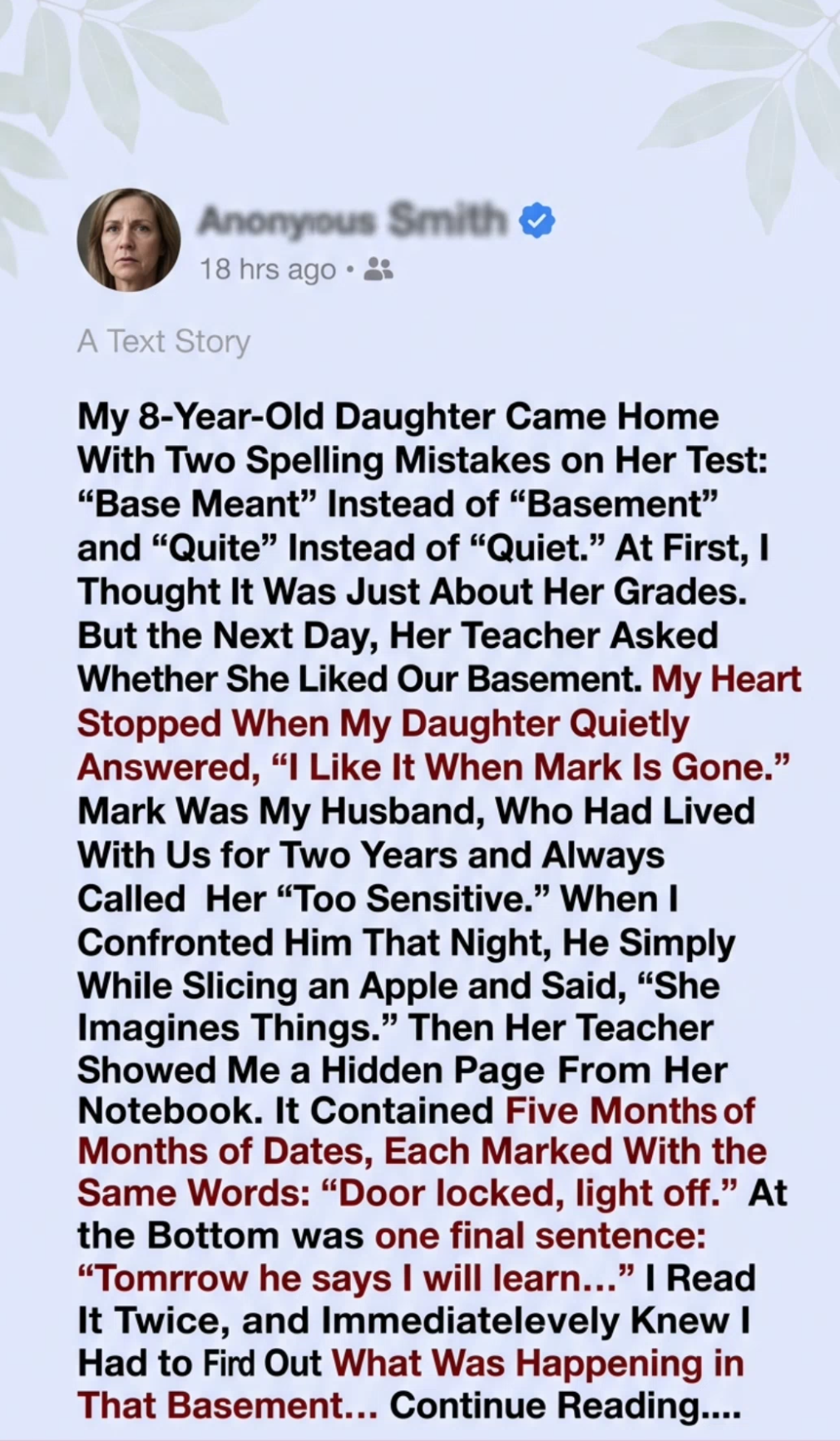
The first mistake was on the second page of my daughter’s spelling test.
The word was basement.
Emily had written base meant.
The second mistake was quiet.
She had written quite.
I almost smiled when I saw them.
My daughter was eight years old, in third grade, and usually took her spelling tests very seriously. She would sit at the kitchen table with her colored pencils, whispering each word to herself until she could spell it without looking.
I assumed she had simply rushed through the test.
I circled the two mistakes with a red pen and wrote, “Let’s practice these tonight.”
Emily watched me from the other side of the table.
“Am I in trouble?”
“Of course not, sweetheart. They’re just spelling mistakes.”
She nodded, but she didn’t look relieved.
Instead, she folded her hands in her lap and stared at the paper.
“Mom?”
“Yes?”
“Can I ask you something?”
“Anything.”
“Do spelling words have to mean what they sound like?”
I laughed gently.
“Not always. English can be strange.”
She looked at the test again.
“Sometimes words mean something different when people say them.”
I didn’t understand what she meant.
I was busy preparing dinner, answering a message from work, and reminding myself to pick up milk the next morning.
“That’s true,” I said. “We’ll talk about it later.”
I wish I had stopped what I was doing and asked her to explain.
But I didn’t.
The next morning, her teacher called me.
Her name was Mrs. Bennett. She had taught Emily since the beginning of the school year and had always been kind, patient, and attentive.
“Could you come in for a few minutes after school?” she asked.
“Is something wrong with Emily’s grades?”
There was a pause.
“I’d rather discuss it in person.”
That answer made me nervous.
I spent the rest of the day wondering whether Emily had been fighting with another student or struggling with something she hadn’t told me.
When I arrived at the school, Mrs. Bennett was waiting outside her classroom.
She closed the door behind us.
“Before we begin, I want you to know that Emily is a thoughtful little girl. She’s not in trouble.”
“Then what’s happening?”
Mrs. Bennett sat down.
“Yesterday, I was reviewing the spelling tests. I noticed the same two mistakes you probably noticed.”
I nodded.
“Basement and quiet?”
“Yes. I asked Emily whether she had been practicing those words at home.”
“What did she say?”
Mrs. Bennett looked uncomfortable.
“She told me she liked our basement.”
I blinked.
“Well, we have a finished basement. She has a little play area down there.”
“That’s what I thought. So I asked her whether she enjoyed spending time there.”
Mrs. Bennett took a breath.
“She said, ‘I like it when Mark is gone.'”
My heart seemed to stop.
Mark was my husband.
He wasn’t Emily’s biological father, but he had been part of our lives for two years. We had married when Emily was six.
Mark had always described himself as a strict but caring stepfather.
He often complained that Emily was too sensitive.
If she cried after being corrected, he said she needed thicker skin.
If she wanted me to sit with her while she did homework, he said she was becoming dependent.
I had occasionally disagreed with him, but I had never imagined that there was something seriously wrong.
“What exactly did she mean?” I asked.
Mrs. Bennett shook her head.
“I didn’t want to put words in her mouth. I asked whether she wanted to tell me anything about the basement.”
“And?”
“She became very quiet. Then she said she didn’t like the door being locked.”
I felt my fingers go cold.
“What door?”
“She didn’t explain. I asked whether she felt safe at home, and she said she was safe when you were there.”
I stared at Mrs. Bennett.
She opened a folder.
“There’s something else.”
Inside was a photocopy of a page from Emily’s notebook.
At the top, in her uneven handwriting, were the words:
Things I Remember.
Below them were dates.
October 4 — Door locked, light off.
October 11 — Door locked, light off.
October 18 — Door locked, light off.
October 25 — Door locked, light off.
November 2 — Door locked, light off.
There were more.
The dates continued for five months.
Some entries included little drawings of a door.
Others had a small square beside the words, as if Emily had been marking off days.
At the bottom of the page, she had written:
Tomorrow he says I will learn.
I read that sentence twice.
Then I looked up.
“Did she write this at school?”
“She brought the notebook from home. I found the page when she accidentally left it in her reading folder.”
“Did she tell you what tomorrow means?”
“Not yet. She became distressed when I asked. I stopped questioning her.”
Mrs. Bennett leaned forward.
“Please don’t confront anyone in a way that could put Emily at greater risk. I think we should involve the appropriate child-protection professionals and make sure she’s safe.”
I nodded.
I could barely speak.
My mind was racing through memories.
Mark insisting that Emily spend time downstairs because she needed to learn independence.
Mark saying he was teaching her discipline.
Mark telling me that I was making her anxious by comforting her too much.
And every time I asked Emily why she seemed frightened, she would say she was tired.
I had believed him when he said she was imagining things.
I had believed him because I wanted our marriage to work.
That was the part I would regret for a long time.
I thanked Mrs. Bennett and asked her to help me contact the appropriate school safeguarding staff.
We arranged for Emily to speak with a trained child-protection professional, rather than having her repeatedly questioned by adults who might unintentionally influence her answers.
I also called my sister, Laura.
She lived fifteen minutes away.
“Can Emily stay with you tonight?” I asked.
“Of course. What’s wrong?”
“I’ll explain when I see you. Please don’t ask her questions.”
Laura’s voice changed immediately.
“Is she in danger?”
“I don’t know yet.”
“Bring her here.”
When I collected Emily from school, she was waiting with Mrs. Bennett.
She ran toward me, but stopped just before reaching my arms.
That small hesitation hurt more than anything.
I knelt.
“Hi, sweetheart.”
“Are you mad?”
“No. Why would I be mad?”
She looked at Mrs. Bennett, then back at me.
“Because I wrote things.”
I gently opened my arms.
“You’re not in trouble for writing anything. You can always tell me when something worries you.”
She stepped forward and hugged me.
I held her for a long time.
Then we drove to Laura’s house.
I told Emily that she would be having a sleepover with her aunt.
She seemed relieved.
Before leaving, she whispered something.
“Mom?”
“Yes, baby?”
“Can I sleep upstairs?”
I swallowed.
“Of course.”
She looked at me carefully.
“With the light on?”
“Absolutely.”
I stayed with her until she fell asleep.
Then I called Rebecca Morgan, a family attorney I had consulted years earlier during my divorce from Emily’s biological father.
I told her what the teacher had discovered.
Rebecca didn’t interrupt.
When I finished, she said, “Do not return Emily to an environment where you believe she may be unsafe. We need to work with the proper authorities, document what has happened, and avoid anything that could compromise an investigation.”
“What about Mark?”
“Don’t confront him tonight. Don’t threaten him. Don’t try to search for evidence in a way that could create danger or interfere with the investigation. Let the professionals handle the child’s interview.”
I agreed.
But before I hung up, I asked one question.
“Rebecca, what if I’ve missed something?”
Her answer was quiet.
“Then the most important thing is what you do now.”
I didn’t sleep that night.
At 7:12 the following morning, Mark called.
“Where are you?”
“I’m at Laura’s.”
“Why?”
“Emily wanted to sleep over.”
He sighed.
“Again? You’re encouraging this behavior.”
I stared at the wall.
“What behavior?”
“Her refusing to be independent. She’s eight, not a baby.”
I said nothing.
“Are you coming home tonight?”
“I’ll let you know.”
His voice became sharper.
“What’s that supposed to mean?”
“I need some time.”
He laughed.
“Don’t tell me this is about those spelling mistakes.”
My stomach tightened.
“Why would you say that?”
“Because you made such a big deal about her test yesterday.”
I hadn’t told him about the teacher’s conversation.
I hadn’t mentioned the notebook.
I hadn’t even told him that Mrs. Bennett had called me.
Yet he already knew about the spelling mistakes.
That wasn’t necessarily proof of anything. He could have seen the paper on the kitchen table.
But something about the way he said it made my skin crawl.
He continued.
“Emily is dramatic. You know that. She makes everything sound worse than it is.”
I ended the call.
At 9:30, I received a call from a child-protection caseworker.
Her name was Ms. Alvarez.
She explained that the school had followed its safeguarding procedures and that the information had been referred for assessment.
She asked whether Emily was somewhere safe.
I told her she was with her aunt.
“That’s good,” she said. “Please keep her there for now while we arrange the next steps.”
She also explained that a trained interviewer would speak with Emily using an appropriate, non-leading process.
I asked whether I could be present.
She explained that it was important for the interview to be conducted by someone trained to avoid influencing a child’s account. I understood, even though every part of me wanted to hold Emily’s hand through every second.
Then she asked whether I had noticed anything unusual.
I thought about it.
There had been small things.
Emily had stopped going downstairs to get her toys.
She had started asking whether I would be home before dinner.
She had become frightened when Mark called her name from another room.
And two months earlier, she had asked me whether a locked door could open from the inside.
I had answered casually.
“Of course, honey. Most doors can.”
She had looked at me as if I had given the wrong answer.
I told Ms. Alvarez everything I remembered.
She thanked me and said the investigation would continue.
That afternoon, Mark sent a message.
We need to stop letting Emily control this household. She needs consistency. Bring her home tonight.
I didn’t respond.
Then another message arrived.
I checked the basement. Nothing is wrong down there.
I stared at the words.
I had not mentioned the basement to him.
My hands began to shake.
I showed the message to Rebecca.
She told me to preserve it and forward it through the appropriate channel.
I did.
Later that evening, Ms. Alvarez called again.
She said Emily had spoken with the trained interviewer.
She couldn’t share every detail immediately, but she confirmed that the information raised concerns requiring further investigation.
I asked whether Emily had said anything about the locked door.
“She described being sent into the basement as punishment,” Ms. Alvarez said. “She said the door was sometimes locked from the outside, and the light was switched off.”
I closed my eyes.
“How long was she kept down there?”
“She gave different estimates. We are still establishing the details.”
I gripped the phone.
“Was she hurt?”
“We’re arranging the appropriate assessment. I don’t want to speculate before that is completed.”
I understood.
But I wanted to scream.
Instead, I asked, “What happens now?”
“First, we make sure she remains safe. Then we investigate the circumstances and determine what protective steps are necessary.”
That night, I told Laura what I knew.
She sat beside me on the sofa.
“I always thought Mark was too hard on her,” she said.
“Why didn’t you tell me?”
“I did, once. You said he was trying to be a father.”
I looked down.
She was right.
I remembered that conversation.
Laura had noticed that Emily seemed uncomfortable around Mark. She had suggested that I pay attention.
I had defended him.
I had told my sister that she didn’t understand how difficult it was to blend a family.
Now I wished I could go back and listen.
The next morning, Ms. Alvarez asked me to come to a meeting with her and a police investigator.
I went with Rebecca.
The investigator explained that the basement itself would be examined, and that any relevant evidence would be collected through the proper process.
They asked me to provide information about the house, the locks, and the layout.
I explained that the basement had a recreation room, a storage area, and a small utility room.
The recreation room had a door at the top of the stairs.
There was also a separate light switch outside the room.
The investigator asked whether the door could be locked from the outside.
I hesitated.
“Yes. There’s an old privacy lock. Mark replaced the handle last year.”
“Did you know it could be secured from outside?”
“No.”
I felt sick.
I had never checked.
The investigator asked whether Mark had a key.
“I don’t know.”
We agreed that the authorities would coordinate access to the property.
I was not going to walk into the basement alone.
I was not going to confront Mark.
I was not going to put my daughter in danger because I wanted answers immediately.
That afternoon, Mark called again.
This time, he sounded almost cheerful.
“Can we talk like adults?”
“What do you want?”
“I want my family back.”
“Emily is my family.”
A pause.
“She’s my daughter too, in every way that matters.”
I said nothing.
He continued.
“Look, I know you spoke to the teacher. I know she showed you that ridiculous notebook.”
My heart pounded.
“How do you know about the notebook?”
“Emily left it downstairs. I found it.”
“Where is it now?”
“Why does that matter?”
“Where is it, Mark?”
He laughed softly.
“You’re making this into something it isn’t.”
I heard a faint metallic sound.
Then he said, “Children need boundaries. If she doesn’t learn to follow rules now, she’ll never learn.”
“What did you do to her?”
His voice hardened.
“I disciplined her.”
“By locking her in the basement?”
Silence.
Then he said something I will never forget.
“She was never alone. I was always in the house.”
I felt the room tilt.
“That doesn’t make it okay.”
“She was safe.”
“She was frightened.”
“She’s a child. Children get frightened.”
I ended the call.
Rebecca immediately advised me to preserve the recording if it had been lawfully made under the applicable rules and to provide it to the investigator for review. I followed her instructions.
That evening, the authorities arranged to examine the property.
I stayed at Laura’s house with Emily.
I did not go inside.
I waited for updates.
Hours passed.
Finally, Ms. Alvarez called.
The investigator had located the basement notebook.
It contained additional entries, including dates that matched the teacher’s photocopy.
They had also examined the door.
The lock could be secured from the hallway.
There was a light switch outside the room.
The investigators documented the condition of the room and collected relevant evidence.
But there was another discovery.
Inside a storage cabinet, they found a small digital timer and a handwritten list.
The list contained dates and times.
Some entries were marked with phrases such as:
Practice staying quiet.
No crying this time.
She must learn to obey.
The investigators did not immediately tell me what every entry meant.
They were still examining the material.
But the existence of the list was enough to make the situation much more serious.
Mark was asked to attend an interview.
He denied that he had harmed Emily.
He described the basement as a place where she went to calm down when she became upset.
He said he had never intended to frighten her.
But when investigators asked why the door had been locked, he said it was to stop her from running upstairs during punishment.
That answer contradicted his earlier claim that she had never been locked in.
He also acknowledged that he had sometimes switched off the light.
He described it as a way to teach her to manage her fear.
I couldn’t understand how someone could say those words and still believe he had done nothing wrong.
The investigation continued.
A few days later, Rebecca called.
“Mark has been formally instructed not to contact Emily. The authorities are pursuing the matter, and we need to discuss protective orders.”
I sat down.
“What happens to our marriage?”
Rebecca paused.
“That is something you can decide later. Right now, the priority is your daughter.”
I knew she was right.
But there was one more thing I needed to understand.
The sentence in Emily’s notebook.
Tomorrow he says I will learn.
I asked Ms. Alvarez whether Emily had explained what she meant.
She told me that during the interview, Emily had described Mark telling her that the following day she would be taught a new lesson.
She had become afraid that the punishment would become worse.
That was why she had written the sentence.
She hadn’t been trying to get better spelling marks.
She had been trying to tell someone what was happening.
The two spelling mistakes were not a secret code.
They were simply the words that had caught her teacher’s attention.
And that small mistake had opened a door that adults had failed to notice for months.
I cried after that call.
Not loudly.
I sat on Laura’s sofa and cried into my hands.
I thought about every time Emily had asked to sleep with me.
Every time she had avoided the basement.
Every time Mark had called her too sensitive.
And every time I had told her to be patient.
I had believed that a good marriage meant giving someone the benefit of the doubt.
I finally understood that protecting a child sometimes means refusing to give an adult another excuse.
A week later, I sat with Emily in Laura’s guest room.
The sunlight came through the curtains.
She was coloring a picture of a house.
I watched her draw a yellow sun above the roof.
“Mom?”
“Yes, sweetheart?”
“Are we going home?”
I put down my book.
“Not to the old house right now.”
“Why?”
“Because I want to make sure it’s safe for you.”
She colored another yellow line.
“Is Mark mad?”
“I don’t know, sweetheart. But you don’t have to worry about his feelings.”
She looked at me.
“Am I bad?”
The question broke something inside me.
I moved closer.
“No. You are not bad. You didn’t do anything wrong.”
“But he said I was naughty.”
I took her little hands.
“Being scared is not naughty. Crying is not naughty. Asking for help is not naughty. And nobody has the right to lock you somewhere to make you afraid.”
Her eyes filled with tears.
“Are you going to believe me?”
I pulled her into my arms.
“Yes. I believe that you were frightened, and I am going to listen. You never have to prove that you’re worth protecting.”
She began to cry.
I held her until she was ready to let go.
The legal process took several months.
The investigation established that Mark had repeatedly confined Emily in the basement as punishment, including occasions when the light was switched off and the door was secured from outside.
The authorities pursued the matter under the applicable child-protection and criminal procedures.
Mark was charged, and a court later imposed restrictions that prohibited him from contacting Emily while the proceedings and protective arrangements continued.
The family court also granted temporary protective orders.
I filed for divorce.
Mark’s attorney attempted to portray the incidents as ordinary discipline that had been misunderstood.
But the documented entries, the physical evidence, the messages, and Emily’s appropriately obtained account contradicted that explanation.
I did not attend every hearing.
Some proceedings were handled with measures designed to protect Emily from unnecessary exposure.
I learned that justice was not always dramatic.
Sometimes it was a stack of documents.
Sometimes it was a professional asking the right question.
Sometimes it was a judge carefully reviewing evidence and making sure a child did not have to face the person she feared.
The divorce was finalized the following year.
I retained primary custody, and Mark was prohibited from having unsupervised contact with Emily under the protective arrangements.
We sold the house.
I could not imagine raising my daughter in a place where a basement door had become a source of fear.
I didn’t want her childhood memories to be tied to that staircase.
We moved into a smaller home with a bright kitchen, a little garden, and no basement.
Emily chose the bedroom.
She picked pale blue curtains and a yellow reading lamp.
For the first few months, she wanted the hallway light on at night.
I left it on.
She wanted me to check the closet before bedtime.
I checked.
She wanted to sleep with the bedroom door open.
I left it open.
We also worked with a qualified child therapist who understood childhood trauma.
I learned not to demand that she tell me everything.
I learned not to turn every quiet moment into a question.
Most importantly, I learned that recovery was not a straight line.
Some days she laughed and played as if the world had become simple again.
Other days, a door closing too loudly made her freeze.
On those days, I reminded her that she was safe and that she could talk when she was ready.
Her teacher, Mrs. Bennett, remained an important part of her life.
At the end of the school year, she sent me a short note.
It read:
Emily has become more confident about asking for help. She is beginning to trust her own voice again. Thank you for taking her concerns seriously.
I kept that note.
I also kept the original spelling test.
Not because I wanted to remember the fear.
Because I never wanted to forget how easily a child’s distress could be mistaken for something ordinary.
Almost a year after the first phone call, Emily came home with another spelling test.
This time, she had received a perfect score.
She placed it on the kitchen table.
“Look, Mom!”
I smiled.
“Every word correct!”
She pointed to one of the words.
“Quiet.”
“That’s right.”
She thought for a moment.
“Quiet doesn’t always mean nobody talks, does it?”
I sat beside her.
“What do you mean?”
“Sometimes people are quiet because they’re scared. Sometimes they’re quiet because they’re happy. And sometimes they’re quiet because they’re thinking.”
I nodded.
“That’s a very good observation.”
She looked down at her paper.
“I used to think I wasn’t supposed to tell people things.”
I felt my throat tighten.
“You can tell me anything.”
“What if someone says I’m imagining it?”
I held her gaze.
“Then you can tell another safe adult. And another. You keep asking for help until someone listens.”
She leaned against me.
“Mrs. Bennett listened.”
“Yes, she did.”
“And you listened too.”
I kissed the top of her head.
“I should have listened sooner.”
She shook her head.
“But you listened when it mattered.”
I wanted to argue.
I wanted to tell her that I should have recognized the signs months earlier.
But she was eight years old.
She didn’t need to carry my guilt.
She needed to be a child.
So I hugged her and let the moment be what it was.
That night, I placed the perfect spelling test on the refrigerator.
Beside it, I put a small photograph of Emily standing in our new garden, smiling beneath the afternoon sun.
I thought about the first test, the two mistakes, and the notebook filled with dates.
I thought about how long she had tried to communicate something she didn’t yet have the words to explain.
And I thought about the teacher who noticed.
The truth was, my daughter had not needed a perfect spelling score.
She had needed one adult to understand that something was wrong.
For five months, she had written the same sentence:
Door locked, light off.
Now, in our new home, she could close her bedroom door because she wanted privacy.
She could turn off her light because she was ready to sleep.
And she could open both again whenever she wanted.
No one controlled those choices for her.
No one told her that fear was weakness.
No one called her too sensitive.
She was simply a little girl learning that her voice mattered.
And I was a mother learning that protecting a child sometimes begins with the smallest detail—a strange spelling mistake, a quiet answer, or a page of handwriting that someone else might have overlooked.
I used to think the basement was just another room in our house.
Now I understood that the most frightening thing had never been the darkness downstairs.
It was how long an eight-year-old child had believed she had to face it alone.
THE END.