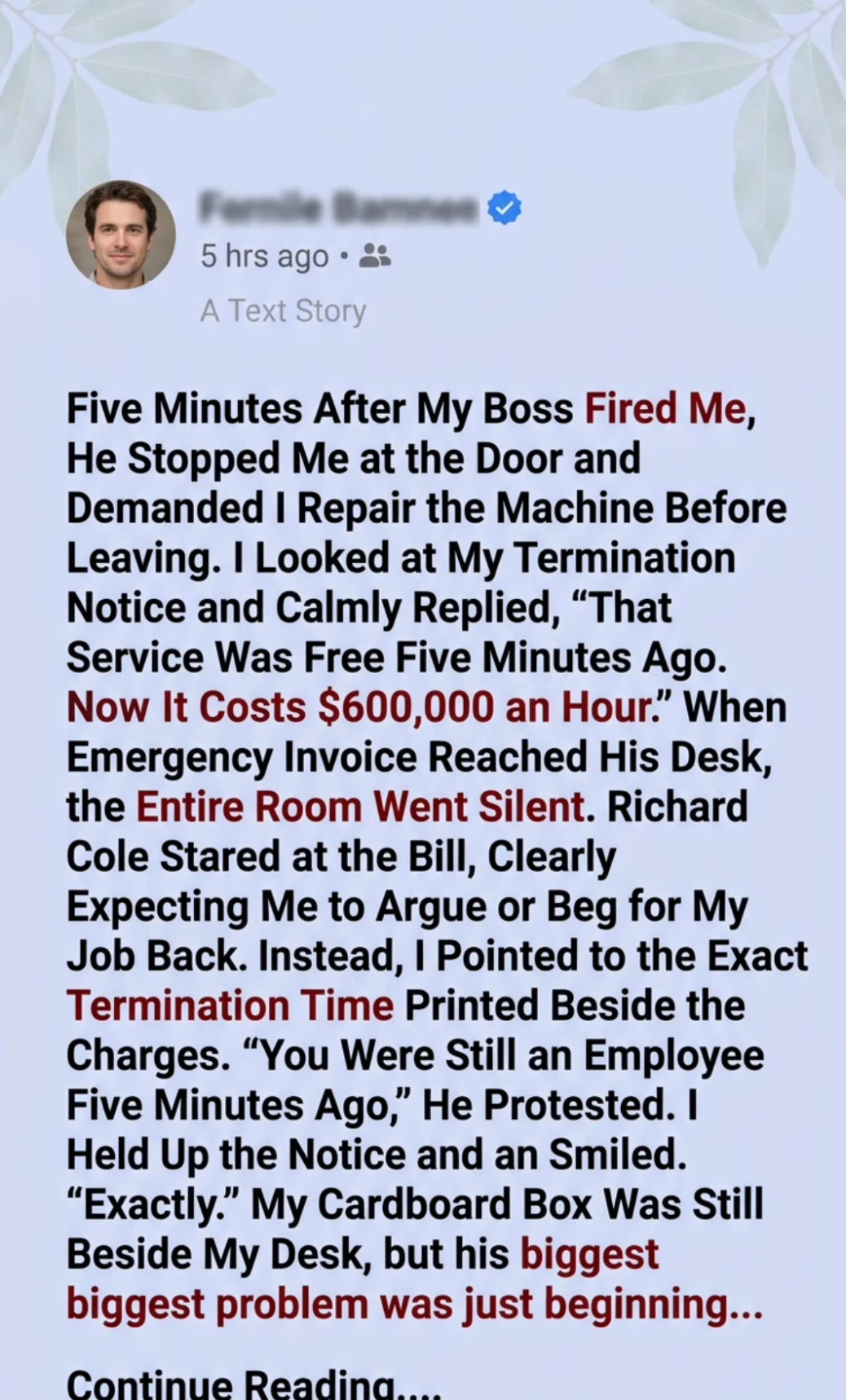
The termination notice was still warm from the printer when Richard Cole told me I was no longer needed.
Twenty-seven years.
That was how long I had worked at Hawthorne Precision Components, a manufacturing company that produced specialized turbine assemblies for power plants, aircraft suppliers, and industrial facilities.
I had started as a maintenance technician at twenty-four. I learned every machine on the production floor, worked overnight emergencies, trained new engineers, and eventually became the senior industrial systems specialist.
If a machine made an unusual sound, I knew what it meant.
If a production line lost pressure, I knew which valve to check.
And if the central automated press stopped responding, I was the person everyone called.
Especially Richard.
But apparently, twenty-seven years of experience meant very little to a new executive who had decided that older employees were too expensive.
Richard had become operations director eleven months earlier. He was forty-two, ambitious, polished, and obsessed with reducing costs.
He loved presentations about efficiency.
He loved graphs showing lower maintenance expenses.
He loved telling shareholders that the company was modernizing.
What he didn’t love was being told that his decisions could damage the equipment.
For months, I had warned him about the company’s central production press, a machine known internally as Line Seven.
It wasn’t an ordinary machine.
It was a customized hydraulic forming system responsible for producing the company’s highest-value turbine components. Without it, several major production contracts would fall behind schedule.
The press had an intermittent pressure-control fault.
It wasn’t failing every day. Sometimes it operated perfectly for weeks.
But the pressure readings occasionally fluctuated beyond the recommended operating range. The control system compensated by adjusting the hydraulic output, which placed additional stress on the main pump and accumulator assembly.
I submitted three maintenance reports.
I requested a planned shutdown.
I recommended replacing the pressure regulator before the fault became serious.
Each time, Richard rejected the proposal.
“The machine is still running,” he told me during one meeting.
“Running isn’t the same as operating safely within specification,” I replied.
He rolled his eyes.
“We cannot stop production every time an engineer gets nervous.”
“I’m not nervous. I’m looking at the readings.”
“And I’m looking at the budget.”
That was how every conversation ended.
Eventually, I stopped arguing and started documenting everything.
Every warning.
Every rejected maintenance request.
Every unusual reading.
Every email.
I kept copies in the company’s maintenance system and in my professional records, following the company’s retention policy.
I had learned a long time ago that a technician could be blamed for a machine failure even when management had refused to approve the repair.
I wasn’t going to let that happen.
The Morning Everything Changed
On a Tuesday morning, I arrived at the factory at 6:40.
The production floor was already busy.
Forklifts moved between storage areas. Workers checked incoming materials. The sound of machinery filled the building.
I walked toward Line Seven and noticed something immediately.
The hydraulic pump was producing a slightly different vibration.
I checked the pressure display.
The numbers were fluctuating again.
I connected my diagnostic equipment and reviewed the latest readings.
The pattern was worse than the previous week.
I called the control-room supervisor.
“Don’t increase the production cycle until I finish checking this.”
He nodded.
I sent Richard an urgent maintenance notification.
At 8:15, he replied.
Do not interrupt production. We have an executive demonstration tomorrow.
I read it twice.
Then I called him.
“Richard, this is the exact issue I warned you about. The pressure-control system is becoming unstable.”
“Can it finish today’s orders?”
“I can’t guarantee that.”
“Then make it finish today’s orders.”
“That’s not how equipment reliability works.”
His voice became cold.
“Are you refusing a direct instruction?”
“I’m telling you the machine needs an inspection before we continue.”
He hung up.
At 10:30, I received an invitation to his office.
I assumed he wanted to discuss the machine.
Instead, he was sitting behind his desk with the human resources manager beside him.
A termination notice was waiting on the table.
Richard didn’t ask me to sit.
“Your position has been eliminated,” he announced.
I looked at the paper.
“Eliminated?”
“We’re restructuring maintenance. Your compensation is no longer aligned with our operating model.”
I had heard that language before.
It meant they wanted someone cheaper.
The HR manager explained my final salary, unused leave, severance terms, and return-of-property requirements.
I listened without interrupting.
Then I looked at Richard.
“Who is taking over Line Seven?”
He gave a small smile.
“We have a new maintenance contractor.”
“Do they have the diagnostic history?”
“They’ll receive the necessary information.”
“Have they been informed about the pressure-control fault?”
Richard’s expression tightened.
“That’s no longer your responsibility.”
I looked at the termination notice again.
The effective time was printed clearly.
10:42 a.m.
I signed the acknowledgment confirming receipt.
I did not sign anything claiming that the equipment was safe or that I had completed a successful handover.
Those were separate matters, and I wasn’t going to certify something I had not verified.
I collected my personal belongings and placed them in a cardboard box.
A photograph of my wife and daughter.
Two coffee mugs.
A small desk calendar.
A framed certificate recognizing twenty years of service.
I was carrying the box toward the exit when I heard Richard calling.
“Daniel!”
I stopped.
He hurried out of his office.
“Where are you going?”
I looked at him.
“Home. My employment ended at 10:42.”
He pointed toward the production floor.
“Line Seven just stopped.”
For a moment, I thought he was joking.
“What happened?”
“The pressure system tripped. The operators can’t restart it.”
I set the box down.
“Did anyone isolate the hydraulic system?”
“That’s what we’re trying to figure out.”
“Then don’t let anyone attempt a restart.”
Richard looked irritated.
“Can you just come and repair it?”
I stared at him.
“Richard, you just terminated me.”
“This is an emergency.”
“Yes. It appears to be.”
He lowered his voice.
“Daniel, don’t make this difficult. You know the machine better than anyone.”
I looked at the termination notice in my hand.
Then I looked back at him.
“That service was part of my employment five minutes ago. Now it requires a separate emergency service agreement.”
He frowned.
“What are you talking about?”
“I’m no longer your employee. If you want my professional services, your company needs to engage me under a new contract.”
Richard laughed.
“You can’t seriously be asking for a contract while the factory is shut down.”
“I didn’t shut it down.”
He stepped closer.
“How much?”
I thought about the specialized equipment, the emergency mobilization, the diagnostic work, and the fact that the company needed an immediate technical assessment.
I also knew that the work could not begin without proper authorization, safety controls, and access to the equipment.
I gave him a number.
“Six hundred thousand dollars per hour for the emergency specialist response team, with a four-hour minimum. Parts, additional technicians, and any major repair work would be quoted separately.”
His face changed.
“That’s ridiculous.”
“Then use your new contractor.”
He stared at me.
For the first time that morning, he had no immediate answer.
The Emergency Invoice
I didn’t leave the factory immediately.
I sat in my car and called my attorney, then contacted my professional liability insurer to confirm the appropriate process for accepting emergency work independently.
I had operated a small industrial maintenance consultancy on the side for several years, with the company’s knowledge and in accordance with its outside-work policies.
I had never solicited Hawthorne’s business while employed there.
Now that my employment had ended, any engagement would need to be completely separate.
My attorney advised me to insist on a written agreement, a clearly defined scope, proper insurance coverage, and confirmation that the company’s safety officer had approved the work area.
No verbal promises.
No informal return to the production floor.
No pretending I was still an employee.
I sent Richard a formal emergency-service proposal.
The proposed rate was $600,000 per hour for a specialized emergency response team, subject to a four-hour minimum.
The price reflected the extraordinary emergency mobilization requested, the specialist resources required, and the commercial terms of the proposed engagement.
It was not a charge for something I had already done.
It was a proposal for work that had not yet begun.
The invoice template included the effective termination time and a clear statement:
No services were provided under this proposal before written authorization and acceptance of the engagement.
Richard received it at 11:06 a.m.
I know because he called less than a minute later.
“Daniel, what is this?”
“An emergency-service proposal.”
“You can’t charge us six hundred thousand dollars an hour.”
“You asked for emergency specialist support.”
“I asked you to fix a machine!”
“And I explained the terms under which I could accept that work.”
He was breathing heavily.
“You’re holding the entire company hostage.”
“No, Richard. Your production equipment is currently unavailable. I’m offering a properly documented way to obtain specialist assistance.”
He went quiet.
Then he said something I would remember for a long time.
“You were still an employee five minutes ago.”
I looked at the termination notice.
“Exactly.”
He ended the call.
I assumed that was the end of it.
It wasn’t.
The Meeting in the Conference Room
At 11:30, I received another call.
This time it was from the chief financial officer, Margaret Ellis.
“Daniel, I need to understand what happened.”
I explained the termination, the equipment failure, Richard’s request, and the emergency-service proposal.
Margaret listened carefully.
Then she asked, “Did you actually perform any repair work after your termination?”
“No.”
“Did you enter the production area?”
“No.”
“Did you authorize anyone to touch the machine?”
“No.”
“Good. Please don’t do anything until we review the situation.”
I agreed.
Twenty minutes later, I was invited to a conference call with Margaret, Richard, the plant manager, and the company’s legal counsel.
Richard was already angry.
He started speaking before everyone had joined.
“Daniel is demanding an absurd amount of money to do a job he was hired to do.”
Margaret interrupted.
“His employment ended at 10:42. We need to separate the employment issue from the emergency-service issue.”
Richard shook his head.
“He knows this machine. He knows we can’t operate without him.”
The plant manager spoke next.
“That’s true. The new contractor hasn’t completed the site orientation or received the full diagnostic history. They can’t take responsibility for the system today.”
Margaret looked at me through the screen.
“Daniel, why did you quote that amount?”
I explained that the proposed rate was for an emergency response team, not simply my personal hourly salary. It included rapid mobilization, specialist availability, technical assessment, and a minimum engagement period.
I also made clear that the proposal was negotiable.
But I would not work without a signed agreement.
Richard leaned forward.
“You’re acting like you’re the only person who understands this equipment.”
I replied calmly.
“I’ve never said that. I’ve said the people currently available haven’t completed the necessary assessment.”
The company’s legal counsel asked for the maintenance records.
I told them where the reports were stored in the company’s system.
Then I mentioned something else.
“Before I left, I submitted a final condition report. It includes the pressure fluctuations, my recommended isolation procedure, and the three previous maintenance requests that were declined.”
Richard’s expression changed.
“What final report?”
“The one submitted at 10:39.”
He turned toward the plant manager.
“Find it.”
The plant manager opened the maintenance system.
A few seconds passed.
Then he said, “I’ve got it.”
Silence filled the conference room.
The Report Richard Had Never Read
The report was six pages long.
It contained pressure readings, vibration measurements, photographs of the regulator assembly, and the history of the maintenance requests.
The final section contained a warning.
Continued operation under current conditions may result in an uncontrolled pressure event, component damage, or automatic protective shutdown. Immediate inspection and controlled isolation are recommended.
The plant manager scrolled down.
There were three separate rejection records.
Each one carried Richard’s electronic approval.
The first rejection was dated six months earlier.
The second was dated three months earlier.
The third was dated two weeks earlier.
Margaret looked at Richard.
“Did you review these?”
Richard shifted in his chair.
“I reviewed the budget implications.”
“That’s not what I asked.”
He didn’t answer.
The legal counsel requested the full maintenance history.
The plant manager provided it.
Then he opened the control-room incident log.
At 10:58, Line Seven had experienced a sudden pressure deviation.
The protective system had activated.
The machine had shut down automatically.
Fortunately, the safety system had worked.
No one had been injured.
But the main hydraulic assembly had sustained damage, and production could not resume until the system was inspected.
Margaret leaned back.
“How long will the repair take?”
The plant manager hesitated.
“We don’t know yet. We need a qualified assessment.”
Richard immediately looked at me.
“Daniel can do it.”
I shook my head.
“I can submit a proposal. The company needs to approve it first.”
Margaret turned toward legal counsel.
“Please review the proposal and tell us what authorization is required.”
For the next hour, the company negotiated the scope.
They eventually agreed to a smaller emergency engagement with a fixed assessment fee and a separately approved repair budget.
The final arrangement was not the original $600,000-per-hour proposal.
It was a written emergency contract worth $600,000 for the initial four-hour specialist response, with any additional work subject to separate authorization.
The agreement also required:
-
A qualified safety officer to supervise the work.
-
Proper isolation and verification before inspection.
-
A documented scope of work.
-
No guarantee of restoration until the equipment had been assessed.
-
Written approval for additional parts and labor.
I signed the agreement through my consultancy.
Only then did I return to the factory.
The Machine That Everyone Thought Was Broken
When I arrived, the plant manager met me at the entrance.
He looked exhausted.
“Thank you for coming.”
I nodded.
“Let’s see what we’re dealing with.”
I changed into the required protective equipment and attended the safety briefing.
The machine was already isolated.
The electrical supply had been locked out, and the hydraulic system had been depressurized according to the approved procedure.
I reviewed the isolation records before touching anything.
Then I started the inspection.
The problem was worse than the control-room log suggested.
The pressure regulator had developed internal damage. The unstable pressure had placed excessive strain on the pump assembly, and a secondary sensor had recorded readings outside its normal range.
The machine had not simply suffered a software glitch.
It had experienced a genuine mechanical failure.
I photographed the damaged components and recorded the readings.
Then I called the plant manager.
“The regulator needs replacement. The pump assembly also needs inspection before anyone attempts a restart.”
“Can we get it running today?”
“Not safely without confirming the condition of the pump.”
He nodded.
“Tell me what you need.”
I prepared a repair plan.
The company approved the required parts and specialist support.
A replacement regulator was located at a regional supplier. A qualified hydraulic technician joined the team, and we arranged delivery.
By late afternoon, the damaged regulator had been removed.
The pump assembly was inspected.
We discovered additional wear that would have caused another shutdown if the company had replaced only the regulator.
That discovery saved the company from restarting the machine with an unresolved problem.
The next morning, after the replacement parts were installed and the system passed the required checks, the machine completed a controlled test cycle.
The pressure readings stabilized.
The vibration returned to normal operating levels.
The safety systems were verified.
Line Seven was cleared for production under the plant’s approved operating procedure.
I submitted the technical report.
I did not tell anyone I had saved the company.
The equipment had been designed with protective systems for exactly this reason. The operators had followed their procedures, and the shutdown had prevented a potentially more serious incident.
My job had been to identify the fault, coordinate the repair, and document the result.
But the financial consequences were only beginning.
The Cost of One Rejected Maintenance Request
Two days later, Margaret called me.
“Daniel, the board wants an independent review of the Line Seven incident.”
“Why?”
“Because the maintenance records show that the failure was preceded by multiple warnings.”
I already knew what she was going to ask.
“Do they want me to participate?”
“Yes. As an external technical consultant.”
I agreed, provided the scope was documented and the review was independent.
The company hired an engineering assessment firm to examine the equipment and review the maintenance history.
Their report confirmed that the pressure-control fault had been identified well before the shutdown.
It also concluded that the company had repeatedly deferred recommended maintenance without completing an adequate technical risk assessment.
The report did not claim that the machine would certainly have failed on a particular day.
It did establish that the risk had been known and that the decision to continue operating had not been supported by sufficient engineering evidence.
The financial review was even more uncomfortable.
The company had lost production time.
Several shipments were delayed.
Customers demanded revised delivery schedules.
Emergency replacement parts and specialist labor cost substantially more than the original planned maintenance.
The company also had to pay for additional testing and independent verification before returning the line to normal production.
The board wanted to know why the maintenance recommendations had been rejected.
Richard’s explanation was that he had been under pressure to meet quarterly cost-reduction targets.
But the emails told a more complicated story.
In one message, he had written:
We cannot approve another expensive maintenance shutdown before the shareholder presentation. Keep the line running unless there is a confirmed failure.
In another, he had instructed the maintenance department to reduce its reported downtime figures.
The board began examining his other operational decisions.
They discovered that several maintenance requests across the factory had been delayed for similar reasons.
Some had been harmless.
Others required immediate review.
Richard was placed on administrative leave while the company investigated.
The Room Went Silent Again
Three weeks later, I returned to Hawthorne for a board review meeting.
This time, I wasn’t carrying a cardboard box.
I was carrying an engineering report.
The boardroom was full.
Margaret sat beside the company’s legal counsel. The plant manager was there. Two directors joined remotely.
Richard sat at the far end of the table.
He looked different.
His expensive suit was wrinkled, and he kept moving a pen between his fingers.
The chairman opened the meeting.
“Daniel, please explain what happened with Line Seven.”
I presented the timeline.
The original pressure-control fault.
The three maintenance requests.
The rejected approvals.
The automatic shutdown.
The inspection.
The replacement work.
The controlled restart.
I also explained the distinction between the machine’s protective shutdown and the damage to its hydraulic components.
Then I displayed the maintenance approval records.
Each rejection showed Richard’s name.
The chairman studied the screen.
“Richard, do you dispute these approvals?”
Richard cleared his throat.
“No. But I was working within the financial limits given to me.”
Margaret replied.
“The budget allowed for the maintenance. You rejected the requests.”
Richard turned toward her.
“We were trying to protect the company’s profitability.”
The chairman looked at him.
“How much did the planned maintenance cost?”
The plant manager answered.
“The original estimate was approximately $180,000, including the replacement components and scheduled downtime.”
“And the emergency repair and resulting disruption?”
The finance director opened a spreadsheet.
“The direct emergency costs, specialist services, production losses, expedited deliveries, and associated recovery expenses were substantially higher. The current verified total is approximately $2.7 million, excluding potential customer claims that are still being assessed.”
Nobody spoke.
Richard stared at the spreadsheet.
The chairman closed his folder.
“Your cost-saving decision was not a saving.”
Richard looked at me.
“Daniel, you knew the machine could fail. Why didn’t you do more?”
I took a breath.
“I submitted the reports. I requested the shutdown. I documented the readings. I escalated the risk. I followed the company’s reporting procedure.”
“You could have insisted.”
“I did insist. Three times. But I did not have authority to approve the budget or override the operations director.”
He looked away.
Then the chairman asked me a question I hadn’t expected.
“If you had still been employed here, what would you have done differently?”
I thought about it.
“Nothing about the technical recommendation. But I would have requested an independent safety review earlier and made sure every escalation was formally acknowledged by the appropriate department.”
The chairman nodded.
“That’s a fair answer.”
The Offer I Never Expected
The board completed its investigation the following week.
Richard was removed from his operations position.
The company also changed its maintenance approval process. Major equipment risks could no longer be rejected solely because of quarterly budget targets. High-risk maintenance recommendations required written review by an independent engineering authority.
The company offered me another position.
This time, it wasn’t as an employee returning to my old desk.
They proposed that I become an independent reliability consultant responsible for reviewing critical equipment risks across their facilities.
I would choose my own team, negotiate project fees, and work under separate contracts.
I appreciated the offer.
But I didn’t accept immediately.
For twenty-seven years, I had built my life around that factory.
I had missed birthdays, canceled holidays, and answered emergency calls at two in the morning.
I had believed that loyalty would be returned with loyalty.
When the company needed to reduce expenses, I discovered how quickly that belief could disappear.
I told Margaret I would consider a limited consulting arrangement but would not return to a permanent position.
She understood.
We negotiated a one-year agreement with clearly defined responsibilities, independent authority over technical recommendations, and appropriate professional protections.
The company also agreed that no safety-related recommendation could be suppressed simply because it was financially inconvenient.
I accepted.
Not because I needed Richard’s approval.
Not because I wanted revenge.
But because I believed the people working on those machines deserved better protection than the system had given them.
The Last Conversation
Several months later, I was leaving a meeting when I saw Richard standing near the reception area.
He looked smaller somehow.
He approached me.
“Daniel.”
I stopped.
“Richard.”
He glanced at the visitor badge on my jacket.
“I heard you’re consulting for the company again.”
“On certain projects.”
He nodded.
Then he looked down.
“I wanted to apologize.”
I didn’t respond immediately.
He continued.
“I thought cutting maintenance costs would make me look successful. I thought you were resisting change because you didn’t want to lose control of the equipment.”
I listened.
“I should have taken your reports seriously.”
“Yes,” I said.
He swallowed.
“I made a mistake.”
“You made several decisions without giving the technical risks the attention they required.”
He nodded.
“I know.”
I could see that he wanted me to make the conversation easier for him.
Perhaps he wanted to hear that everything was forgiven.
But I wasn’t going to pretend the situation had been harmless.
“Richard, I hope you’ve learned from it. But an apology doesn’t change what happened.”
“I understand.”
I picked up my briefcase.
Then I added something I had wanted to say for months.
“You don’t have to be an engineer to respect engineering advice. You just have to understand that a machine doesn’t care about someone’s job title.”
He looked at me.
For once, he didn’t argue.
I walked toward the exit.
What Happened After That
My consultancy grew steadily.
The Hawthorne contract became one of several projects I handled. I hired two experienced technicians and a younger engineer who had recently completed his professional qualifications.
I made one rule clear to every person on my team.
“We don’t promise that machines will never fail. We identify risks, document evidence, recommend appropriate action, and never pretend something is safe just because someone wants production to continue.”
The company also changed its internal reporting system.
Maintenance warnings were tracked independently. Critical recommendations had mandatory response deadlines. Rejected repairs required written technical justification, not simply a manager’s signature.
Line Seven continued operating for years afterward.
The machine was never perfect, but its maintenance history was finally managed properly.
As for the $600,000 emergency engagement, it became a lesson inside the company about the cost of losing specialist availability.
People sometimes asked whether I had really charged that much simply because Richard fired me.
The answer was more complicated.
I had proposed an extraordinary emergency rate because the company requested immediate specialist mobilization after ending my employment. The company negotiated the terms, approved a fixed emergency engagement, and paid for the services actually delivered.
The amount wasn’t a punishment.
It was a commercial agreement.
And the most important part of the story wasn’t the invoice.
It was the maintenance report Richard had ignored.
One evening, almost a year after the incident, I was cleaning out an old drawer at home.
I found the termination notice.
The paper had become slightly yellow around the edges.
I read the line again.
Employment effective: 10:42 a.m.
I remembered standing beside my desk with a cardboard box, wondering how a company could discard twenty-seven years of experience in a ten-minute meeting.
Then I remembered the machine stopping.
The phone calls.
The conference room.
The maintenance records.
The board’s silence.
I folded the notice and placed it in a folder.
My wife walked into the room.
“Why are you keeping that?”
I smiled.
“Because it reminds me of something.”
“What?”
I looked at the paper one last time.
“Never confuse being valuable with being valued.”
Then I put the folder away.
Richard had believed he was firing an expensive employee.
What he had actually done was end an employment relationship without understanding the value of the expertise he was losing.
And five minutes later, when he needed that expertise, he discovered that the person he had dismissed was no longer obligated to provide it for free.
THE END.