The first insult came before the appetizers had even reached the tables.
I was standing near the entrance to the private dining room, checking that the servers had everything they needed, when Vanessa Whitmore walked toward me in a silver evening dress.
She was my stepson’s biological mother.
She was also a woman who had spent most of the last twelve years reminding me that she belonged to a world I could never enter.
Vanessa was wealthy, polished, and accustomed to being the most important person in any room. Her family owned several commercial properties, and she had a reputation for supporting expensive charities and attending exclusive events.
I was Margaret Ellis, sixty-one years old, a widow, and a former professional cook who now managed the kitchen of a small neighborhood restaurant.
I had never been ashamed of my work.
But Vanessa had always considered it something embarrassing.
She looked at my black trousers, white blouse, and simple apron.
“Are you working tonight?” she asked.
“I helped coordinate some of the food,” I answered. “The chef and I prepared a few dishes together.”
Her eyes moved toward the appetizer trays.
“Oh. I see.”
There was a brief silence.
Then she smiled at two women standing behind her.
“Well, I suppose someone has to do the inexpensive work.”
The women gave uncomfortable little laughs.
I kept my expression neutral.
“Dinner should be ready shortly.”
Vanessa leaned closer.
“Just make sure you don’t confuse this with a professional kitchen, Margaret. We’re celebrating my son’s wedding, not running a little roadside café.”
I looked at her.
“I understand what tonight means.”
“Do you?”
She turned away before I could answer.
I watched her walk toward the main table, where my stepson, Ethan, was speaking with his fiancée, Olivia.
I could have told him what she had said.
But I didn’t want to turn his rehearsal dinner into an argument.
I had promised myself that I would do everything possible to make the evening special for him.
I had no idea that before the night ended, someone else would stand up and defend me in front of everyone.
The woman Vanessa never wanted in her son’s life
I met Ethan when he was eleven.
His father, Robert, had been widowed for three years when we started dating. Ethan’s biological mother, Vanessa, was very much alive, but she and Robert had separated when Ethan was four.
Their relationship had been complicated long before I entered the picture.
Vanessa had moved to another city after the separation, and Ethan spent most of his childhood living with his father. She visited when her schedule allowed, usually during holidays and occasional weekends.
When Robert and I married, I understood that I wasn’t replacing anyone.
Ethan already had a mother.
I was simply another adult who hoped to make his life a little easier.
At first, he barely spoke to me.
He was polite, but distant. He didn’t want me attending school events, and he sometimes called me Margaret instead of anything resembling a parental title.
I never corrected him.
I helped him with homework when he asked. I learned which foods he disliked. I drove him to football practice and attended his school performances when he invited me.
Slowly, we developed our own relationship.
When he was sixteen, he started spending more time in the kitchen with me.
He loved watching me cook.
One evening, he stood beside the stove while I prepared a simple mushroom risotto.
“How do you know when it’s finished?” he asked.
“You listen.”
He looked confused.
“Listen to what?”
“The rice. The pan. The sound changes when the liquid is almost absorbed. Cooking isn’t just following instructions. You have to pay attention.”
He laughed.
“You make it sound like music.”
“Sometimes it is.”
After that, he began asking me to teach him.
We made pasta from scratch, roasted vegetables, prepared soups, and experimented with different sauces.
He wasn’t particularly talented at first, but he was curious.
And curiosity is often more important than natural ability.
Vanessa rarely approved of our relationship.
Whenever she visited, she made comments about how Ethan was becoming too comfortable in our household.
Once, she told him that he should remember who his real mother was.
I never argued with her.
I believed Ethan was old enough to understand that loving one person didn’t require rejecting another.
Robert used to tell me that I had more patience than he did.
“Vanessa knows how to make every situation difficult,” he said one night.
“I don’t need to compete with her,” I replied.
He squeezed my hand.
“You shouldn’t have to.”
Robert died unexpectedly when Ethan was twenty-two.
A sudden heart condition took him within hours of being admitted to the hospital.
The loss changed everything.
Ethan was devastated. Vanessa became more involved in his life again, and I stepped back whenever he needed time with her.
But I never stopped being there.
I helped him organize his father’s belongings, attended counseling appointments when he asked, and stayed available whenever grief became overwhelming.
One evening, months after the funeral, Ethan came into my kitchen.
“Can I still call you when I need advice?” he asked.
I put down the knife I was using.
“Ethan, you never needed permission.”
He hugged me.
It was the first time he had ever called me Mom.
I didn’t correct him.
And I never forgot it.
The secret I had kept for thirty years
Vanessa had one particular belief about me.
She thought I had always been a small-town cook with no education, no professional experience, and no ambition.
She wasn’t entirely wrong about my present circumstances.
I did work in a small restaurant.
I did earn a modest salary.
And I did prefer practical clothes to expensive designer outfits.
But she knew almost nothing about my past.
When I was twenty-four, I had traveled to Paris on a culinary training program.
It was the most difficult and exciting period of my life.
I had grown up in a family where food was important. My mother cooked for everyone, and my grandmother taught me how to make bread, preserve vegetables, and turn inexpensive ingredients into beautiful meals.
I studied hospitality after school, then worked in several restaurants before earning a place in a competitive training program in France.
My instructor was Étienne Laurent.
At the time, he was a demanding young chef with an extraordinary reputation for precision and creativity.
Today, he was one of the most respected chefs in the world.
He had earned three Michelin stars at his flagship restaurant and had spent decades teaching young cooks, opening restaurants, and advising culinary institutions.
But thirty years ago, he was simply the man who made me redo a sauce six times because the texture wasn’t right.
I learned more from him than I could ever explain.
He taught me that good cooking wasn’t about expensive ingredients or impressive presentation.
It was about understanding ingredients, respecting the people who produced them, and knowing when not to interfere with something already beautiful.
I trained under him for nearly two years.
After completing my program, I was offered an opportunity to continue working in Europe.
I almost accepted.
But my mother became seriously ill.
I returned home to help care for her.
By the time she recovered, I had built a life in my own country. I worked in hotels, restaurants, and catering kitchens. I married, raised a family, and eventually became a kitchen supervisor.
I never regretted returning.
I did, however, stop talking about Paris.
Not because I was ashamed of my experience.
But because I had learned that a person’s value was not measured by the most impressive name on their résumé.
When Robert became ill, I left a demanding hotel position to spend more time with him.
After he died, I took a simpler job at a neighborhood restaurant.
It gave me stable hours and enough time to rebuild my life.
Vanessa saw only the job title.
She never asked what I had done before.
And I never felt the need to explain.
The rehearsal dinner
Ethan and Olivia chose a historic hotel for their rehearsal dinner.
The private dining room overlooked a garden, and the tables were decorated with white flowers and small candles.
There were fifty guests, including relatives, close friends, business associates, and several people who had traveled from different cities.
Olivia wanted the evening to feel elegant but personal.
She asked whether I would help the hotel’s executive chef prepare one of the appetizers.
I agreed because she had always been kind to me.
The dish was a delicate roasted mushroom tartlet with caramelized shallots, herbs, and a light sauce made from vegetable stock.
It was simple, but every element needed care.
The executive chef, Thomas, and I spent the afternoon preparing it.
I helped balance the seasoning, adjust the filling, and check the pastry.
When the first tray was ready, Thomas tasted one and nodded.
“That’s excellent, Margaret.”
I smiled.
“Thank you.”
He looked at the kitchen team.
“Let’s keep this exactly as it is. Don’t change the filling.”
For me, that was enough.
I wasn’t looking for applause.
I simply wanted the food to be good.
The guests began arriving at seven.
Ethan greeted everyone at the entrance, while Olivia moved between tables, thanking people for coming.
Vanessa arrived twenty minutes later.
She wore an expensive silver dress and carried herself as though the hotel belonged to her.
When she saw me near the service station, her expression tightened.
“Still helping in the kitchen?” she asked.
“Yes.”
She looked toward the appetizer tray.
“I hope the hotel chef knows what he’s doing.”
“He does,” I answered.
“Good. We wouldn’t want the guests remembering the food for the wrong reasons.”
Then she walked away.
I tried to forget the comment.
The appetizers were served shortly afterward.
Several guests complimented the tartlets.
One woman asked the server for the name of the person who had prepared them.
Thomas pointed toward me.
“Margaret helped develop that dish.”
The woman smiled.
“It’s wonderful. Please tell her.”
I thanked her.
But Vanessa had overheard.
She approached the table where I was standing.
“Please don’t encourage people to think you created the menu,” she said quietly.
“I haven’t.”
“You were helping with one appetizer. That’s not the same as being a chef.”
“I know the difference.”
“Then act like it.”
She picked up a tartlet, looked at it, and placed it back on the tray without tasting it.
“I’m not eating that.”
The nearby guests went silent.
Ethan had just returned from greeting another guest and heard the final sentence.
“Mom, what’s going on?”
Vanessa smiled.
“Nothing, darling. I was just explaining that we should leave the cooking to professionals.”
Ethan glanced at me.
“Margaret helped Chef Thomas prepare those.”
Vanessa shrugged.
“I’m sure she did her best.”
Then she turned toward the guests.
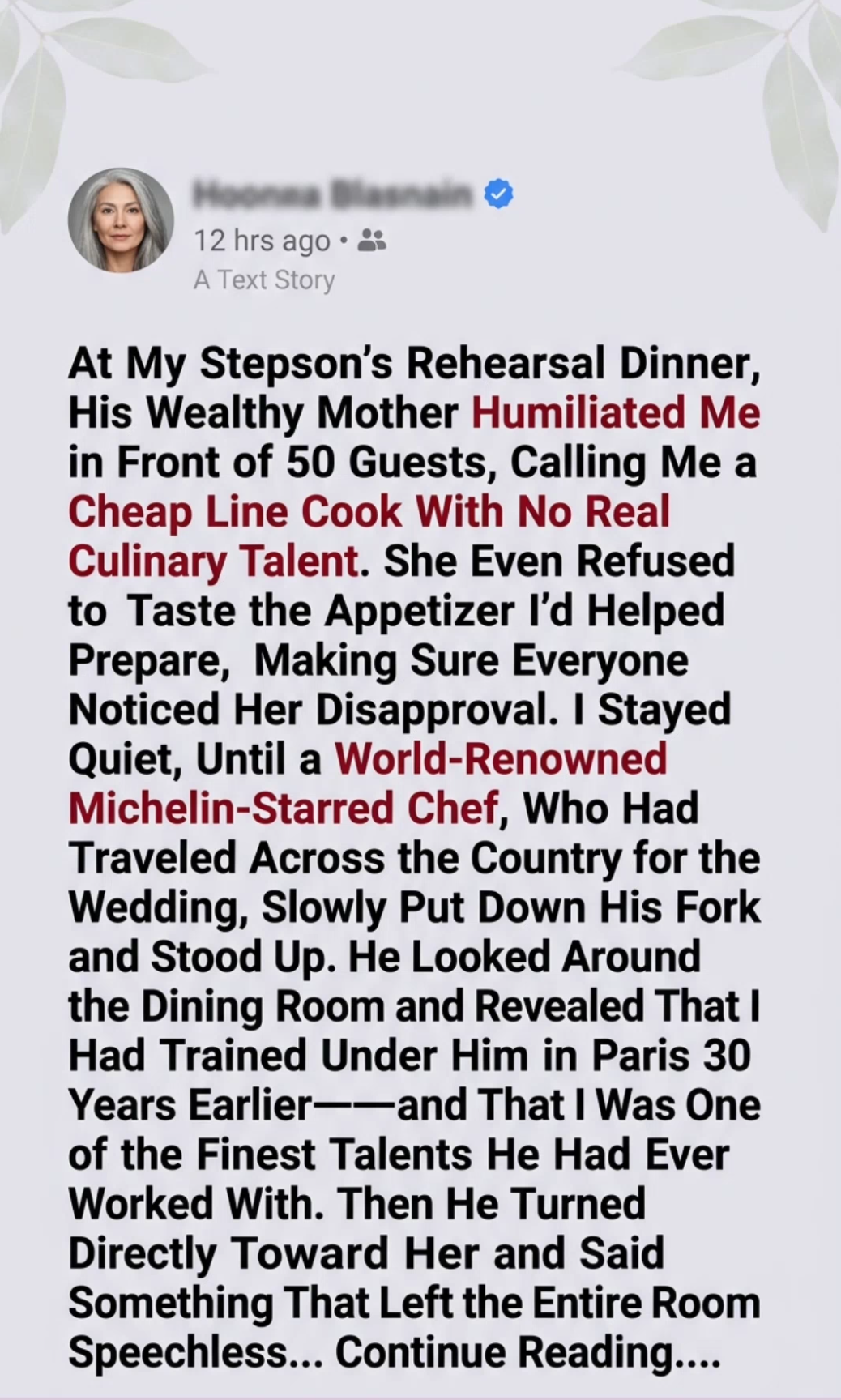
“It’s sweet when people have hobbies, isn’t it? But there’s a difference between being a professional and being a cheap line cook with no real culinary talent.”
The words landed harder than I expected.
I felt the room change.
A few people looked down at their plates.
Someone stopped speaking.
Ethan’s face turned red.
“Mom, that’s enough.”
Vanessa waved her hand.
“I’m only being honest.”
I wanted to disappear.
Not because I believed her.
But because the evening was supposed to celebrate Ethan and Olivia, and I could see how uncomfortable they had become.
I quietly stepped away from the table.
Then a man’s voice came from the far end of the room.
“I’m sorry. Could we pause for a moment?”
Everyone turned.
The chef who remembered Paris
Étienne Laurent was sitting near the center of the room.
He had arrived earlier that afternoon after traveling from New York, where he had attended a culinary conference.
He was a guest of Olivia’s uncle, who had worked with him on a charitable food program.
I had recognized him immediately when he entered the hotel.
But I hadn’t approached him.
I wasn’t sure whether he would remember me after thirty years, and I didn’t want to make the evening about my past.
He had been quietly enjoying the dinner.
Now he was placing his fork beside his plate.
He stood slowly.
“I’m sorry to interrupt,” he said. “But I believe I heard something that deserves an answer.”
Vanessa turned toward him.
“I’m sorry. Do we know each other?”
Étienne didn’t answer immediately.
He looked at the appetizer tray.
Then he looked at me.
“Margaret?”
I felt my stomach tighten.
“Yes?”
He studied my face for several seconds.
Then his expression changed.
“Margaret Ellis?”
I nodded.
He smiled.
“Good heavens. It really is you.”
The room became completely silent.
He walked toward me.
“I thought I recognized your hands when the first tartlets came out.”
I didn’t know what to say.
He extended his hand.
“It’s been thirty years.”
I shook it.
“Chef Laurent. It’s wonderful to see you.”
He laughed.
“Please. After all these years, you may call me Étienne.”
Vanessa looked between us.
“You know Margaret?”
Étienne turned toward her.
“Know her? I trained her.”
He looked around the dining room.
“Thirty years ago, Margaret studied under me in Paris. She was one of the most promising young cooks in our program.”
I felt my face grow warm.
He continued.
“She had an extraordinary understanding of ingredients. She could taste a sauce and identify what was missing without needing to see the recipe. She understood texture, balance, and restraint in a way that many experienced cooks never learn.”
I shook my head slightly.
“Étienne, you don’t have to—”
He raised one hand gently.
“Allow me.”
Then he turned toward the guests.
“I have trained hundreds of cooks over the years. Some became famous. Some opened successful restaurants. Others chose different lives. But I remember the ones who understood that cooking is an act of respect.”
He looked directly at Vanessa.
“And Margaret was one of the finest talents I ever worked with.”
Vanessa’s smile disappeared.
The words that silenced the room
Étienne glanced toward the untouched appetizer on Vanessa’s plate.
“May I ask you something?”
Vanessa straightened.
“Of course.”
“Did you taste the tartlet before deciding it was unworthy of you?”
Her cheeks reddened.
“I don’t have to taste everything.”
“Certainly not. But it is difficult to judge a dish you have not tasted.”
He picked up a fresh tartlet from the tray.
He examined it carefully, then took a bite.
For a moment, he said nothing.
He tasted the filling, then the pastry.
Finally, he looked toward Thomas, the executive chef.
“Who prepared the filling?”
Thomas gestured toward me.
“Margaret developed it with me.”
Étienne nodded.
“The shallots are cooked slowly enough to bring out their sweetness without making them heavy. The mushrooms are seasoned properly, and the sauce supports the filling instead of hiding it.”
He took another small bite.
“It’s excellent.”
He turned toward Vanessa.
“And I would like you to understand something.”
The room was so quiet that I could hear someone set down a glass.
“A person’s profession does not determine their worth. Nor does their salary, their clothing, or the size of the restaurant where they work.”
He paused.
“Calling someone a cheap line cook because they don’t live the way you do says nothing about their talent. It only reveals how little you understand the work you are criticizing.”
Vanessa opened her mouth.
He continued before she could speak.
“I have spent my entire life in professional kitchens. I have worked with wealthy restaurant owners, celebrated food critics, talented young cooks, and people who spent decades preparing meals in small family businesses. Some of the best food I have ever tasted came from kitchens without expensive equipment or famous names above the door.”
He looked at me again.
“Margaret never needed a title to prove that she was a good cook.”
Then he turned directly toward Vanessa and said the words that left the entire room speechless.
“If you cannot recognize excellence when it is served in front of you, perhaps the problem is not the cook. Perhaps it is the person doing the judging.”
Nobody moved.
Vanessa’s face had turned bright red.
For the first time since I had known her, she seemed unable to find an immediate response.
My stepson’s choice
Ethan stepped forward.
“Mom, I think you owe Margaret an apology.”
Vanessa looked at him.
“Ethan, this is between the adults.”
“No,” he said. “It isn’t. You insulted someone who has been part of my life for twenty years.”
“I was making a comment about the food.”
“You called her a cheap line cook.”
Vanessa’s expression hardened.
“Don’t take sides.”
Ethan shook his head.
“I’m not choosing between you and Margaret. I’m asking you to treat her with basic respect.”
Olivia came to stand beside him.
“Margaret has done so much for us,” she said. “She helped with the menu because I asked her to. She didn’t demand attention or recognition.”
Vanessa looked around the room.
Some guests were watching her.
Others were looking at me.
She seemed to realize that everyone had heard what happened.
Then she turned toward me.
“Margaret, I didn’t mean for it to come across that way.”
I could have accepted the words and moved on.
But I wanted her to understand what she had done.
“You didn’t accidentally insult me,” I said quietly. “You chose your words carefully. You wanted everyone to hear them.”
She looked away.
“I was trying to make a point.”
“You made one.”
I paused.
“But not the one you intended.”
Étienne stepped back, allowing us to speak.
I continued.
“I don’t expect you to admire my career. I don’t expect you to like my cooking. You don’t even have to eat the food I prepare. But you don’t get to humiliate me because my life looks different from yours.”
Vanessa swallowed.
“I understand.”
I wasn’t certain she did.
But I had said what I needed to say.
The conversation after dinner
The rest of the evening continued, although the atmosphere was different.
Étienne spent some time speaking with the hotel chef about the menu. He also asked me about my years after Paris.
I told him about returning home to care for my mother, working in hotels, marrying Robert, and eventually choosing a quieter life.
He listened carefully.
“You made the right decision for your life,” he said.
“I hope so.”
He smiled.
“Of course. A career is not the only way to measure a life.”
Then he surprised me.
He asked whether I would consider joining a small culinary education project he was helping organize.
The project provided practical training for young people who wanted to enter the hospitality industry but couldn’t afford expensive culinary schools.
They needed experienced cooks to teach basic techniques, kitchen organization, food safety, and professional discipline.
“We don’t need people who want to become famous,” he explained. “We need people who know how to work, teach, and respect ingredients.”
I laughed.
“You make it sound like you are offering me a job.”
“Not a job. An opportunity.”
I told him I would think about it.
Before he left, he gave me his contact information.
“Don’t disappear for another thirty years,” he said.
“I’ll try not to.”
An apology that finally meant something
Two weeks after the rehearsal dinner, Vanessa called me.
I almost let it go to voicemail.
But I answered.
“Hello?”
“Margaret. It’s Vanessa.”
“Hello.”
She took a breath.
“I’ve been thinking about what happened at the rehearsal dinner.”
I waited.
“I was embarrassed by the way things unfolded.”
“I imagine you were.”
She paused.
“I know that’s not an apology.”
“No, it isn’t.”
“I shouldn’t have called you a cheap line cook. I shouldn’t have spoken about your work that way, especially in front of Ethan’s guests.”
I remained quiet.
She continued.
“I think I have spent a long time comparing myself with people. Their money, their careers, their homes. I don’t know why I felt the need to make you look smaller.”
I looked at the photograph of Robert on the bookshelf.
“Maybe because you thought making me smaller would make you feel bigger.”
She didn’t argue.
“Maybe.”
Then she said something I hadn’t expected.
“I spoke to Ethan after the dinner. He told me how much you helped him after his father died. I knew you had been supportive, but I don’t think I understood how much you had done.”
“I didn’t do it to earn your approval.”
“I know.”
She hesitated.
“Would you be willing to meet for coffee?”
I considered the invitation.
I didn’t trust her completely.
One apology could not erase twelve years of remarks and quiet disrespect.
But I also didn’t want to carry resentment into the next chapter of Ethan’s life.
“Coffee is fine,” I said. “Let’s take things slowly.”
She agreed.
The wedding day
The wedding took place three weeks later.
It was a beautiful afternoon.
Ethan looked nervous in his suit, and Olivia was radiant.
Before the ceremony, he found me near the garden entrance.
“Can I talk to you for a minute?”
“Of course.”
He took my hands.
“I know I haven’t always made things easy.”
“You were a child when I met you. You don’t owe me an apology for growing up.”
He smiled.
“I just want you to know that you’re important to me.”
My eyes filled.
“You are important to me, too.”
He looked toward the ceremony area.
“Would you be comfortable walking with me during the family entrance?”
I understood what he was asking.
He wasn’t asking me to replace his mother.
He was asking me to share a moment that mattered to him.
I nodded.
“I would be honored.”
Vanessa walked in separately, and Ethan greeted her warmly.
There was no competition.
No argument.
No attempt to erase anyone.
There was simply room for more than one person to love him.
During the reception, Vanessa approached my table.
She looked at my dress, then at the place card.
“Margaret, would you mind joining us for a photograph?”
I smiled.
“Of course.”
She stood beside me.
For a moment, we both looked toward the camera.
Then she leaned closer and said quietly, “You look lovely.”
“Thank you.”
It was a small sentence.
But it was the first compliment she had ever given me without attaching a criticism to it.
A new chapter
A month after the wedding, I met Étienne in the city where he was holding the first training session for his culinary education project.
The classroom was modest, with stainless-steel tables, basic equipment, and a group of young people who were eager to learn.
He introduced me as a visiting instructor.
I felt embarrassed when the students applauded.
“I haven’t taught in years,” I whispered.
Étienne smiled.
“Then you can teach them what experience has taught you.”
I began with something simple.
“How to make a good vegetable stock.”
I explained how to prepare the ingredients, how to control the heat, and why rushing the process would ruin the result.
One young student raised his hand.
“Chef, is there a secret ingredient?”
I smiled.
“Patience.”
He laughed.
I continued teaching.
Over the following months, I returned several times. The work was rewarding, and I discovered that I enjoyed helping young cooks develop confidence.
I wasn’t trying to become famous.
I wasn’t interested in expensive restaurants or impressive titles.
I simply wanted to pass along what I had learned.
Vanessa and I also began having occasional coffee.
Our relationship was never perfect, but it became more respectful. She stopped making remarks about my job, and I stopped feeling that I needed to defend my choices.
One afternoon, she asked me about Paris.
I told her about the tiny apartment where I had lived, the early mornings in the training kitchen, and the first time Étienne praised a sauce I had prepared.
She listened.
Then she said, “I wish I had known that about you.”
I looked at her.
“You could have asked.”
She nodded.
“I suppose I could have.”
What I learned
I never told the story of the rehearsal dinner to make Vanessa look foolish.
I told it because it reminded me of something I had almost forgotten.
For years, I had allowed other people’s opinions to make me question the value of my own life.
I had worked in small kitchens, cooked ordinary meals, and chosen family over professional recognition.
None of those decisions made me less talented.
None made me less worthy of respect.
And the most important lesson I learned in Paris had nothing to do with knives, sauces, or presentation.
It was something Étienne had told me during my first year of training.
He had found me upset after a difficult service because another cook had criticized my work.
He placed a plate on the counter and said:
“Margaret, never confuse someone else’s inability to recognize your work with proof that your work has no value.”
Thirty years later, I finally understood how deeply those words mattered.
At the rehearsal dinner, Vanessa had tried to make me feel small in front of fifty people.
But I didn’t need to shout, list my achievements, or prove that I had once trained in one of the finest kitchens in Paris.
The truth was enough.
And when I eventually returned to teaching, I realized that the greatest recognition wasn’t the applause from a room full of wealthy guests.
It was watching a young cook prepare a dish with confidence, knowing that I had helped them believe they belonged in a professional kitchen.
I had spent years thinking my best chapter was behind me.
It wasn’t.
It was simply waiting for me to pick up my knife again.
THE END.