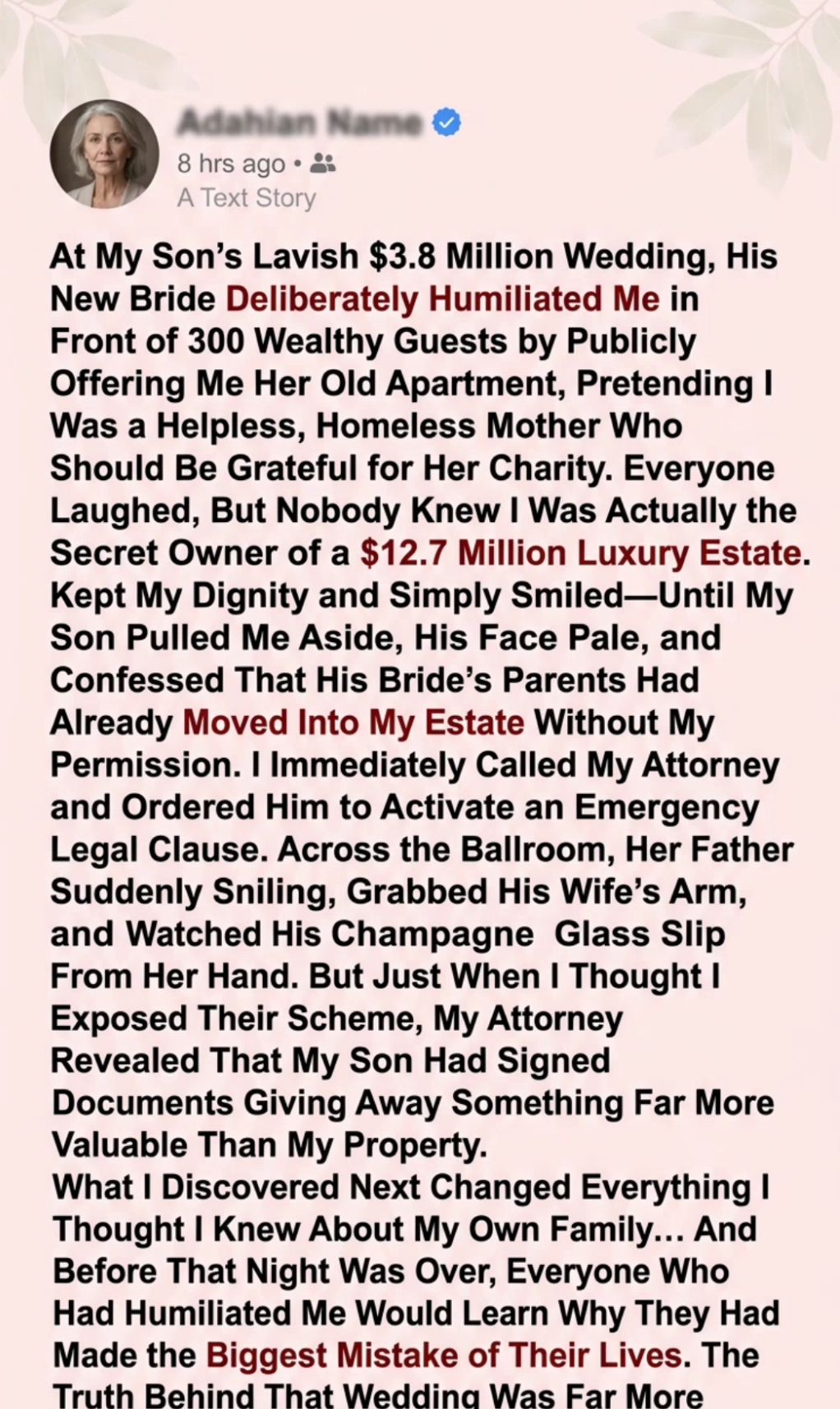
The champagne was still being poured when my daughter-in-law decided to make me the evening’s entertainment.
Three hundred guests had gathered inside the grand ballroom of the Bellamy Hotel for my son Jonathan’s wedding.
The wedding had reportedly cost $3.8 million.
There were crystal chandeliers, enormous floral arrangements, a twelve-piece orchestra, and a menu prepared by a celebrated catering company. Guests had flown in from New York, London, Los Angeles, and several European cities.
I wore a dark emerald dress, a simple diamond necklace, and the earrings my late husband had given me on our thirtieth anniversary.
I was sixty-seven years old.
My name was Eleanor Hayes.
And according to my new daughter-in-law, Vanessa, I was a lonely, financially struggling widow who needed someone to rescue me.
She had decided to make that announcement during the wedding reception.
She stood beside Jonathan, holding a microphone and smiling at the guests.
“I want to say something about my new husband’s mother,” she began.
I looked up from my table.
Vanessa continued.
“Eleanor has been through a difficult time. She’s older now, and I know living alone hasn’t been easy for her. So Jonathan and I discussed something special.”
She turned toward me.
“We have an apartment that we no longer use. It’s not enormous, but it’s comfortable. We thought Eleanor could move into it and finally have a place where someone can look after her.”
A few guests smiled.
Then Vanessa added, “We don’t want her worrying about rent or maintenance. She can have it. We just want her to be safe.”
The room erupted in scattered laughter and applause.
I sat perfectly still.
A woman at the next table leaned toward her husband and whispered something.
Vanessa raised her glass.
“Family should take care of family, don’t you think?”
More applause.
I looked at my son.
Jonathan was standing beside her, smiling uncertainly.
He did not look proud.
He looked uncomfortable.
I could have stood up and corrected her.
I could have told everyone that I owned a luxury estate worth $12.7 million, along with other investments and assets that my husband and I had built over decades.
I could have explained that I had never asked Vanessa for an apartment.
But I didn’t.
I simply lifted my glass, smiled politely, and said:
“That is very generous of you, Vanessa.”
Her smile widened.
She believed she had won.
She had no idea that the real trouble was already waiting for me outside the ballroom.
The woman they thought they knew
My husband, Richard Hayes, had been a property developer.
He started with a small construction business and gradually built a portfolio of commercial buildings, residential properties, and land investments.
We were never the sort of couple who needed to announce our wealth.
Richard believed that money was useful only when it gave you choices.
He disliked showing off, and I agreed with him.
We raised Jonathan in a comfortable home, but we did not give him everything he wanted.
He attended good schools, traveled with us occasionally, and had opportunities to study business. But we expected him to work, save, and learn how to manage his own finances.
When Richard died six years earlier, I inherited most of his estate.
Some assets were placed in trusts and holding companies. Others remained in my name. My financial affairs were managed by a small team of professionals who had worked with Richard for years.
The largest property was a luxury estate outside the city.
It was a beautiful place with a long private driveway, landscaped gardens, a guesthouse, a swimming pool, and a separate residence for staff.
Its current estimated value was $12.7 million.
Richard had purchased the land years before the surrounding area became fashionable. We built the main residence together, choosing every detail.
It was where we celebrated our anniversary.
It was where Jonathan learned to ride a bicycle.
And it was where Richard died peacefully in his bedroom after a long illness.
I rarely discussed its value.
I simply called it home.
After Richard’s death, I spent more time there, although I also maintained a smaller city residence.
Jonathan knew the estate belonged to me.
He had visited it many times.
What he did not know was how the property was structured, what protections Richard had established, or how much control he would never be allowed to exercise without my approval.
I had never considered that he might need those protections.
Until Vanessa entered our lives.
When Vanessa joined the family
Jonathan met Vanessa at a charity fundraising event.
She was attractive, confident, and socially skilled.
She came from a wealthy family. Her father, Charles Whitmore, owned a chain of commercial property management companies, while her mother, Patricia, was active in several charitable organizations.
At first, I was pleased.
Jonathan had spent several years concentrating on work after his father’s death. It was good to see him happy.
Vanessa was polite during our first meeting.
She complimented the house, asked about my garden, and showed interest in the history of Richard’s business.
But as the relationship developed, I began noticing small things.
She frequently asked Jonathan questions about his inheritance.
She wanted to know whether the estate was owned personally or through a company.
She asked whether I planned to sell any properties.
Once, while we were having lunch, she casually asked:
“Eleanor, have you thought about what will happen to the estate when you get older?”
I put down my fork.
“What do you mean?”
“Well, it’s a large property. It must be difficult to maintain.”
“I have people who help me.”
“Of course. But eventually, you might prefer something smaller.”
“Perhaps. I’ll decide when that time comes.”
She smiled.
“I’m only thinking about your comfort.”
I thanked her.
But I remembered the conversation.
A few months later, Jonathan told me they were engaged.
I congratulated him and asked when they wanted to celebrate.
He said Vanessa’s parents were already planning a large wedding.
The budget, he explained, was approximately $3.8 million.
I was surprised by the amount.
“That’s a lot of money for one day,” I said.
“Vanessa’s family is contributing a significant portion,” he replied.
I didn’t argue.
It was his wedding.
I only asked that he and Vanessa remember what marriage was supposed to mean.
“It’s not a performance for three hundred people,” I told him. “It’s a commitment between two people.”
He smiled.
“I know, Mom.”
I wanted to believe him.
The first sign that something was wrong
About six weeks before the wedding, I received a call from the property manager at the estate.
His name was Samuel.
He had worked for our family for nearly fifteen years.
“Mrs. Hayes, I need to ask you about something.”
“What is it, Samuel?”
“Mr. Whitmore contacted the maintenance office.”
I paused.
“Which Mr. Whitmore?”
“Charles. Vanessa’s father.”
“What did he want?”
“He asked whether we could arrange access to the guesthouse for a furniture delivery.”
I frowned.
“Why would he need access to my guesthouse?”
“He said you had approved a temporary stay.”
I sat down.
“I haven’t approved anything.”
Samuel was silent for a moment.
“That’s what I thought. I wanted to confirm before allowing anyone onto the property.”
“Did you give him access?”
“No, ma’am. I explained that I needed written authorization from you.”
“Good. Don’t allow anyone to enter the guesthouse without my approval.”
“Understood.”
I called Jonathan immediately.
He answered after several rings.
“Hi, Mom.”
“Did you tell Vanessa’s parents they could use the guesthouse?”
He hesitated.
“I thought we had discussed it.”
“No, we haven’t.”
“Mom, it’s just temporary.”
“Who is moving in?”
“Vanessa’s parents need somewhere to stay while their house is being renovated.”
I was confused.
“Why would they stay at my estate?”
“It’s convenient. The guesthouse is empty.”
“Jonathan, it is not an empty property that belongs to the family. It is my home.”
He sighed.
“Mom, they’re going to be my in-laws. We should be able to help each other.”
“I have no objection to helping them if I choose to. But I haven’t agreed to this.”
“Vanessa said she thought you would be fine with it.”
“Then Vanessa should have asked me.”
He promised to speak with her.
I believed the matter was settled.
I was wrong.
The wedding humiliation
The rehearsal dinner was pleasant enough.
The wedding morning was busy.
And by the time the reception began, I had already heard several strange comments from Vanessa’s relatives.
One woman asked whether I had found a suitable retirement apartment.
Another asked whether I would be moving closer to Jonathan after the wedding.
I answered politely.
Then came Vanessa’s public announcement.
Her offer of an old apartment was not kindness.
It was a carefully staged humiliation.
She wanted three hundred people to believe that I was dependent on her generosity.
I could see Charles Whitmore watching from his table.
He was smiling.
Patricia sat beside him, her expression equally pleased.
Then Jonathan approached me.
“Mom, can we talk?”
His face was pale.
I looked at him.
“What’s wrong?”
He glanced toward Vanessa.
“Not here.”
We walked into a quiet corridor outside the ballroom.
He looked as though he had been holding something inside for days.
“Mom, I need to tell you something.”
“Go ahead.”
“Vanessa’s parents moved into the estate.”
I stared at him.
“What?”
“They moved into the guesthouse last week.”
I felt my stomach tighten.
“Who gave them permission?”
He looked down.
“I did.”
“Did you have written authorization from me?”
“No.”
“Did you tell Samuel that I had approved it?”
Jonathan hesitated.
“I told him we had discussed it.”
I closed my eyes briefly.
“Jonathan, we did not agree to that.”
“I know. I thought you would eventually accept it.”
I looked at my son.
“Why would you think that?”
He rubbed his forehead.
“Because Vanessa said her parents were having problems with the renovation. They needed somewhere to stay, and the guesthouse was available.”
“That doesn’t make it yours to offer.”
“I know.”
“Do they have keys?”
He nodded.
“Who gave them the keys?”
“I did.”
I felt the anger rise, but I kept my voice controlled.
“Are they still there?”
“Yes.”
“Have they moved their belongings into the main house?”
He looked away.
“Some furniture was delivered.”
I took a breath.
“Jonathan, listen carefully. You do not own that property. You cannot offer it to anyone.”
“I know, Mom.”
“Then why did you do it?”
He looked frightened.
“Because Vanessa told me it was already arranged.”
I stared at him.
“What does that mean?”
He hesitated.
Then he said, “There are documents.”
The emergency call
I took out my phone and called my attorney.
His name was Michael Reeves.
He had represented Richard and me for more than twenty years.
He answered quickly.
“Eleanor?”
“Michael, I need you to activate the emergency property-protection provisions for the estate.”
There was a brief silence.
“Has something happened?”
“Yes. Unauthorized occupants have entered the guesthouse, and I have reason to believe documents may have been signed without my approval.”
His voice became serious.
“Are you at the estate?”
“No. I’m at Jonathan’s wedding.”
“Do not confront anyone. I will review the property records and contact the property manager. We need to establish exactly what documents were signed and whether anyone has attempted to represent that they have an interest in the property.”
“Please do that immediately.”
“I’ll begin now.”
I ended the call.
Jonathan was staring at me.
“What did you just do?”
“I contacted my attorney.”
“Mom, please don’t turn this into a legal fight.”
I looked at him.
“Your wife’s parents moved into my property without my permission. What would you like me to do?”
He swallowed.
“Maybe we can talk to them.”
“We will. But first, I need to know what you signed.”
He looked away.
And that was when I realized the guesthouse was not the only problem.
The document my son had signed
Michael called back less than fifteen minutes later.
I stepped farther down the corridor.
“Eleanor, I reviewed the documents Samuel sent me.”
“What did you find?”
“Your son signed an occupancy and property-management agreement with a company associated with Charles Whitmore.”
I felt cold.
“An agreement for the guesthouse?”
“That’s how it is described. But the language goes much further.”
“What does it say?”
“Jonathan appears to have represented that he was authorized to grant long-term access and management rights over certain areas of the estate.”
I stared at the ballroom doors.
“Could he do that?”
“Not on his own. He has no ownership interest and no authority to bind you or the property-holding company.”
“Then why does it matter?”
“Because the agreement also contains a provision concerning a proposed family asset-management arrangement.”
I was silent.
Michael continued.
“There’s a schedule attached. It identifies the estate, certain furnishings, and several other assets. The document appears to contemplate transferring management rights to a new entity controlled by the Whitmore family.”
I felt my hands tighten around the phone.
“Did I sign anything?”
“No. That’s the problem.”
“Then the agreement is not authorized.”
“Correct. But we need to determine whether they have submitted it to any third party or used it to obtain financing, services, or other benefits.”
I looked toward Jonathan.
He was standing near the corridor entrance, waiting.
“Michael, what is the emergency clause?”
“It allows us to suspend delegated access arrangements, notify relevant parties that no authority has been granted, and initiate immediate protective steps under the existing property structure. It also allows the trustee to review any attempted unauthorized disposition of protected assets.”
“Activate it.”
“I will. But Eleanor, there’s something else.”
“What?”
“The documents don’t just mention your estate.”
My stomach tightened.
“What else?”
“Your son signed a separate acknowledgment concerning his beneficial interest under the family trust.”
I looked at Jonathan.
“What does that mean?”
“I’m reviewing the exact language. It appears he agreed to assign certain future rights in exchange for financial support connected to the wedding and a proposed business venture.”
I felt the room tilt slightly.
“What future rights?”
“His potential distribution rights under the family trust.”
I closed my eyes.
Richard had established that trust years earlier.
It was designed to support Jonathan and future generations, but it had strict conditions.
Jonathan could receive distributions under the terms of the trust.
He could not simply sell or transfer the trust’s underlying assets.
But the document he had signed might still create legal and financial complications.
“Michael, I need the full document.”
“I’ll send it securely. Don’t sign anything or make promises to anyone.”
I ended the call.
When I turned around, Jonathan was crying.
The truth about the wedding money
“Mom,” he said, “I didn’t know it would become this.”
I looked at him.
“What did you sign?”
He rubbed his face.
“Vanessa’s father said it was just paperwork for the wedding.”
“What paperwork?”
“He said their family was contributing money to help with the wedding and a new business opportunity. They wanted some assurance that I would cooperate with their property-management company.”
“What did that have to do with my estate?”
“I don’t know.”
“Jonathan.”
He lowered his voice.
“They told me the estate would eventually become part of the family business.”
I stared at him.
“Who told you that?”
“Charles.”
“And you believed him?”
“He said you had discussed it with Vanessa.”
“I never discussed it with Vanessa.”
“I know that now.”
I felt a deep sadness.
“Did you read the documents?”
He didn’t answer.
That was answer enough.
“How much money did they give you?”
He looked toward the ballroom.
“About $1.2 million.”
“For what?”
“The wedding deposit, some business expenses, and a few investments.”
I felt my heart sink.
“Did you use the money?”
“Some of it.”
“Jonathan, you cannot sign away rights you do not own, and you cannot promise property that belongs to me.”
“I didn’t mean to hurt you.”
“I believe you may not have intended to. But you still signed documents without understanding what they meant.”
He began crying harder.
“Vanessa said it was normal. She said families combine resources when they get married.”
“Combining resources requires consent.”
He nodded.
“I’m sorry.”
I wanted to hug him.
But I needed answers first.
“Did Vanessa know you had signed the trust acknowledgment?”
“Yes.”
“Did her parents?”
“Yes.”
“And did they tell you that they were moving into the estate?”
He nodded again.
“Vanessa said it was already agreed.”
I looked at him.
“Then why did you wait until tonight to tell me?”
He wiped his face.
“Because I realized something wasn’t right. Her father asked me to sign another document yesterday. It said the property-management arrangement would become effective after the wedding.”
“What did you do?”
“I refused.”
That explained his pale expression.
He had finally realized the wedding wasn’t simply a celebration.
It was also being used as a deadline.
The father who stopped smiling
When I returned to the ballroom, Charles Whitmore was standing near the bar.
He was laughing with two business associates.
His champagne glass was in his right hand.
I approached him.
“Charles, we need to speak.”
He smiled.
“Eleanor. Wonderful evening, isn’t it?”
“Your family has occupied my estate without my permission.”
His smile weakened.
“I’m sure there’s been a misunderstanding.”
“There hasn’t.”
He glanced toward Jonathan.
“Perhaps we should discuss this privately.”
“We can discuss it here.”
His expression changed.
“Your son invited us.”
“Jonathan had no authority to grant you occupancy.”
“He told us the arrangement was approved.”
“It wasn’t.”
Charles lowered his voice.
“Eleanor, we’re family now. There is no reason to make a scene.”
I looked at him.
“You have already made a scene. My daughter-in-law publicly offered me an apartment as though I had nowhere to live, while your family was occupying my property without authorization.”
His jaw tightened.
Vanessa appeared beside him.
“What is going on?”
I looked at her.
“Your parents are living in my guesthouse without my permission.”
She laughed nervously.
“Eleanor, we discussed this.”
“No. We did not.”
Charles stepped closer.
“This is a family matter.”
“It became a property matter when you entered my estate.”
He looked toward Jonathan.
“Tell your mother we have an agreement.”
Jonathan looked down.
Then he raised his head.
“I signed the documents, but Mom never approved them.”
Charles’s face changed.
“Jonathan, don’t do this.”
“I should have read everything.”
Patricia approached, holding her champagne glass.
“What’s happening?”
Charles grabbed her arm.
“Nothing. We need to leave.”
His champagne glass slipped from her hand and shattered against the floor.
Several guests turned.
The music continued, but the conversation around us stopped.
Vanessa looked at her father.
“Dad?”
Charles didn’t answer.
He was staring at me.
For the first time that evening, he no longer looked confident.
The attorney arrives
Michael Reeves arrived at the hotel approximately twenty minutes later.
He had brought a property specialist from his firm and copies of the relevant documents.
We moved to a private meeting room.
Charles, Patricia, Vanessa, Jonathan, and I were present.
Michael placed a folder on the table.
“Before anyone says anything, I want to make one point clear. Mrs. Hayes has not authorized any transfer of ownership, occupancy, management rights, or control over the estate.”
Charles leaned back.
“We have a signed agreement.”
“You have a document signed by someone who does not own the property and has not been appointed as an authorized representative.”
“Jonathan is her son.”
“That does not make him the owner.”
Charles tapped the table.
“He has a beneficial interest in the family trust.”
Michael nodded.
“Potential future distributions under specific conditions. That is not the same as ownership of the trust assets.”
He opened the folder.
“The estate is held through a property company controlled under the existing trust structure. Mrs. Hayes remains the authorized decision-maker for the relevant property matters. Your occupancy arrangement was never approved.”
Patricia looked at Charles.
“You told us it was settled.”
Charles ignored her.
Michael continued.
“The emergency protective provisions have now been activated. Access authorization is suspended pending review. The property manager has been instructed not to accept further deliveries or recognize any new occupancy claims.”
Vanessa looked horrified.
“You can’t just throw my parents out.”
Michael answered calmly.
“Any change in occupancy will be handled according to the applicable property agreements and law. No one is being removed without proper process. But no one has permission to expand or alter their occupancy either.”
Charles stood.
“This is ridiculous.”
Michael placed another document on the table.
“There’s also the separate acknowledgment Jonathan signed.”
Jonathan stared at it.
“What is that?”
Michael explained.
“It appears to be an agreement assigning certain future trust-related benefits to an entity associated with the Whitmore family.”
Jonathan’s face went pale again.
“I thought it was an investment agreement.”
“Did you read the assignment section?”
“No.”
Michael looked at Charles.
“Who prepared this document?”
Charles didn’t answer.
What the Whitmores really wanted
The following morning, Michael arranged a full legal and financial review.
The documents revealed a more complicated arrangement than I had imagined.
Charles Whitmore’s property-management company had been experiencing serious financial pressure.
Several commercial tenants had left, and the company had outstanding obligations connected to a development project.
He needed new assets and credible financial backing.
The $12.7 million estate was attractive.
But he could not simply transfer ownership.
So the plan appeared to rely on a series of smaller steps.
First, obtain permission to occupy the guesthouse.
Second, present the occupancy arrangement as evidence of a family relationship with access to the property.
Third, obtain management rights through Jonathan’s signature.
Fourth, use the proposed arrangement to strengthen the Whitmore company’s financial position while seeking outside financing.
The documents did not prove that the estate had been transferred or that a lender had accepted it as collateral.
But they did show an attempt to create the appearance of authority that did not exist.
The trust assignment was another part of the arrangement.
Jonathan had agreed to assign certain future benefits in exchange for financial support.
The exact enforceability of that assignment required legal review, but the trust documents contained protections against unauthorized transfers and attempts to control the underlying assets.
The lawyers also discovered that Vanessa had been involved in the communications.
She had sent emails discussing the guesthouse, the property-management company, and the proposed family arrangement.
One message from Charles was especially revealing.
It said:
Once the wedding is complete, Jonathan will be more comfortable presenting this as a family decision. Eleanor will eventually understand that it is better for everyone.
I read the sentence twice.
They had assumed I would eventually accept something they had already arranged.
They had mistaken my quiet nature for weakness.
My son’s confession
Jonathan came to my house three days later.
He looked exhausted.
He sat across from me in the living room, holding a folder.
“Mom, I need to tell you everything.”
I nodded.
“I’m listening.”
He explained that Vanessa’s father had approached him months earlier with a business opportunity.
The plan involved a property-services company that would manage several high-value residential properties.
Charles told him that Jonathan could become a partner.
The initial contribution would come from the Whitmore family.
Jonathan was excited.
He had wanted to start his own business but didn’t have enough capital.
Charles promised that the family could help him build something substantial.
Then the wedding expenses increased.
The Whitmores offered to cover several additional costs.
Jonathan began signing documents.
At first, he believed they were ordinary agreements related to financing and business formation.
Later, the documents became more complicated.
He asked questions, but Charles reassured him.
Vanessa told him that her father had handled similar arrangements for years.
Eventually, Jonathan signed the trust-related acknowledgment.
“Why didn’t you show me?” I asked.
He looked down.
“I was embarrassed.”
“About what?”
“That I needed help. That I didn’t understand the documents. I thought you would tell me I wasn’t ready.”
I looked at my son.
“Jonathan, I might have told you to get independent legal advice. I would never have wanted you to sign something you didn’t understand.”
He began crying.
“I know.”
I let him finish.
Then I asked the question I had been avoiding.
“Did you know Vanessa’s parents were going to move into my estate?”
He nodded.
“I knew they wanted to stay there temporarily.”
“Did you know they planned to use the property in their business discussions?”
He hesitated.
“I knew they wanted to list it as a family-associated asset. I didn’t understand what that meant.”
“Did you think I would agree?”
“I thought you might eventually.”
I looked out the window.
“That is what hurts most.”
He lowered his head.
“I am sorry.”
I believed he was sorry.
But I also knew that an apology could not undo what had happened.
The estate is protected
Michael’s team moved quickly.
They sent formal notices to the Whitmore company, the property manager, and the relevant parties who had received the unauthorized documents.
The estate’s occupancy arrangements were reviewed.
The property manager documented the condition of the guesthouse and recorded which belongings had been brought onto the property.
The Whitmores were informed that their continued stay would not be treated as an ownership or management right.
They were given a reasonable period to arrange alternative accommodation, subject to the applicable agreements and legal process.
The proposed management arrangement was suspended.
The trust assignment was challenged under the trust’s governing terms.
No ownership of the estate changed hands.
No new management rights were granted.
And the company associated with Charles was prohibited from presenting the estate as an asset it controlled.
The financial review also identified that Jonathan had received approximately $1.2 million from the Whitmore family.
Some of the money had been spent on wedding expenses.
Some had been transferred into accounts connected to the proposed business.
Michael advised that we needed to distinguish between legitimate wedding contributions, personal loans, and payments tied to the disputed agreements.
We did not simply assume that every payment was illegal.
We reviewed each one.
The final accounting showed that Jonathan had to repay a portion of the money that had been advanced to him under the proposed business arrangement.
The wedding expenses that had been openly agreed upon were treated separately.
The lawyers also sent a notice requiring the Whitmore company to stop using the estate’s name and address in any financial or business presentation.
Charles was furious.
But he had no lawful basis to demand control of property he did not own.
The cost of believing the wrong people
The wedding was over.
The photographs were beautiful.
The flowers had been removed.
The ballroom had returned to its normal schedule.
But Jonathan’s marriage was already under severe strain.
He discovered that Vanessa had known more about her father’s financial situation than she had admitted.
She had also known that the guesthouse arrangement was not approved.
When he confronted her, she told him that she believed the estate would eventually belong to him.
Jonathan asked why she had allowed her parents to move in without asking me.
She replied:
“Because your mother was never going to agree if we asked her directly.”
That answer changed something in him.
He realized the arrangement had never been about convenience.
It had been about avoiding my consent.
Jonathan moved into a separate apartment while he considered what to do about the marriage.
I did not tell him to divorce Vanessa.
That was his decision.
I only told him that he needed independent legal advice and that he should not sign another document without understanding every line.
Vanessa contacted me several times.
At first, she accused me of destroying her marriage.
Then she accused me of being selfish.
Finally, she stopped calling.
Her parents moved out of the guesthouse after the occupancy issue was formally resolved.
The estate was inspected, and the property manager confirmed that no damage had been done beyond ordinary wear.
I changed the access arrangements.
The keys were replaced.
And the property records were updated to prevent anyone from repeating the same attempt.
The most painful discovery
A month later, Michael called me.
“Eleanor, we have finished the first stage of the trust review.”
“Is everything protected?”
“The underlying assets are secure. The estate remains protected. But there’s one issue involving Jonathan’s potential benefits.”
“What issue?”
“The assignment he signed cannot transfer ownership of the trust assets. However, it has created a dispute over the financial support he received and whether he made enforceable promises concerning future distributions.”
I sighed.
“Can the trust still protect him?”
“Yes, but it cannot protect him from every personal financial obligation he may have created.”
I understood.
Jonathan had not given away the estate.
He had not become the owner of it.
But he had allowed himself to become financially entangled with people who wanted access to assets they did not control.
“What happens next?” I asked.
“We’ll challenge the assignment and negotiate a resolution. If necessary, the trust’s independent trustee will make a formal determination under its terms.”
I thanked him.
After the call, I sat in Richard’s old study.
His photograph stood on the desk.
I remembered how carefully he had planned the trust.
He had always worried that money could become a source of conflict.
He had told me once:
“Eleanor, the purpose of protecting our family isn’t to make sure everyone gets whatever they want. It’s to make sure no one can take what doesn’t belong to them.”
I finally understood why he had insisted on independent trustees, separate property ownership, and clear restrictions.
He hadn’t been expecting our son to become dishonest.
He had simply understood that people sometimes make poor decisions when money, ambition, and family pressure collide.
The conversation that changed everything
Several weeks later, Jonathan asked to see me.
We met at the estate.
He walked through the garden where he had played as a child.
He stopped near the old stone bench.
“Dad used to sit here,” he said.
“Yes.”
“I remember him telling me this place would always be home.”
I nodded.
“He loved it here.”
Jonathan looked at me.
“I thought I was helping build a future for my marriage.”
“I know.”
“I didn’t think I was giving away something that wasn’t mine.”
“You were trying to secure a future using something you didn’t own.”
He lowered his head.
“I understand that now.”
I looked at him carefully.
“Jonathan, I need you to understand something else. I will always love you. But I will not allow you to make financial decisions on my behalf.”
“I know.”
“You cannot promise people my property. You cannot offer them access. And you cannot sign documents that suggest you have authority you don’t possess.”
He nodded.
“I won’t do it again.”
I believed he wanted to change.
But I told him that trust would need to be rebuilt through actions, not promises.
He accepted that.
Then he asked, “Do you think Dad would be disappointed in me?”
I thought about Richard.
“He would be disappointed in the decisions you made. But he would also want you to learn from them.”
Jonathan wiped his eyes.
“I miss him.”
“So do I.”
We sat together for a long time.
For the first time since the wedding, we spoke without lawyers, money, or arguments between us.
Just a mother and her son.
The final wedding photograph
Months later, I received a wedding photograph in the mail.
It showed Jonathan and Vanessa standing beneath the floral arch.
I was in the background, seated near the front.
Vanessa was smiling.
Jonathan looked happy.
I placed the photograph in a drawer rather than displaying it.
Not because I wanted to erase the day.
But because I no longer wanted to remember it as the day my family nearly lost something important.
The estate was still mine.
The trust remained intact.
The Whitmore company had no authority over my property.
Jonathan had entered a repayment arrangement for the money connected to the disputed business proposal, and the trust assignment was being resolved through the proper legal process.
His marriage did not survive the following year.
He and Vanessa eventually separated after their disagreements about money and family control became impossible to ignore.
I did not celebrate that outcome.
I knew he was hurting.
I also knew he needed to take responsibility for the choices he had made.
We rebuilt our relationship slowly.
He began visiting without asking about property values or investments.
We cooked together again.
Sometimes he would come to the estate on a Sunday afternoon and help me prepare dinner.
One day, he looked at the old kitchen and said:
“Mom, I wish I had listened when you told me to be careful.”
I smiled sadly.
“So do I.”
He looked down.
“I thought I was being a good husband by supporting Vanessa’s family.”
“Supporting your wife is not the same as surrendering your judgment.”
He nodded.
“I know that now.”
What I learned about family, wealth, and dignity
The wedding had cost $3.8 million.
The flowers were flown in.
The ballroom was decorated.
The champagne was expensive.
Three hundred guests watched Vanessa offer me an apartment as though I were a helpless widow who needed her charity.
But none of those things mattered as much as what happened afterward.
I learned that a person’s wealth does not make them generous.
A family name does not make someone trustworthy.
And a wedding celebration does not turn an unauthorized promise into a legal right.
I also learned that protecting your family sometimes means refusing to protect them from the consequences of their own decisions.
I did not need to humiliate Vanessa in return.
I did not need to expose her parents publicly.
I did not need to announce the value of my estate to prove that her comments were false.
I simply needed to protect what belonged to me.
The estate was never just a $12.7 million property.
It was the home Richard and I built.
It was where our son grew up.
It was where we celebrated birthdays, holidays, and ordinary Sunday afternoons.
It held memories that could never be measured by a property valuation.
And I was not going to let anyone turn those memories into a financial opportunity without my consent.
One evening, as the sun was setting over the gardens, Jonathan came to visit.
He brought groceries and asked whether we could make his father’s favorite dinner.
I agreed.
We prepared roasted chicken, vegetables, and the simple apple dessert Richard used to love.
Jonathan set the table.
For a moment, the house felt peaceful again.
Before he left, he hugged me.
“Thank you for not giving up on me.”
I held him for a few seconds.
“I’m your mother. I won’t stop loving you.”
Then I added:
“But I will always expect you to respect me.”
He nodded.
And this time, I believed he understood.
THE END.