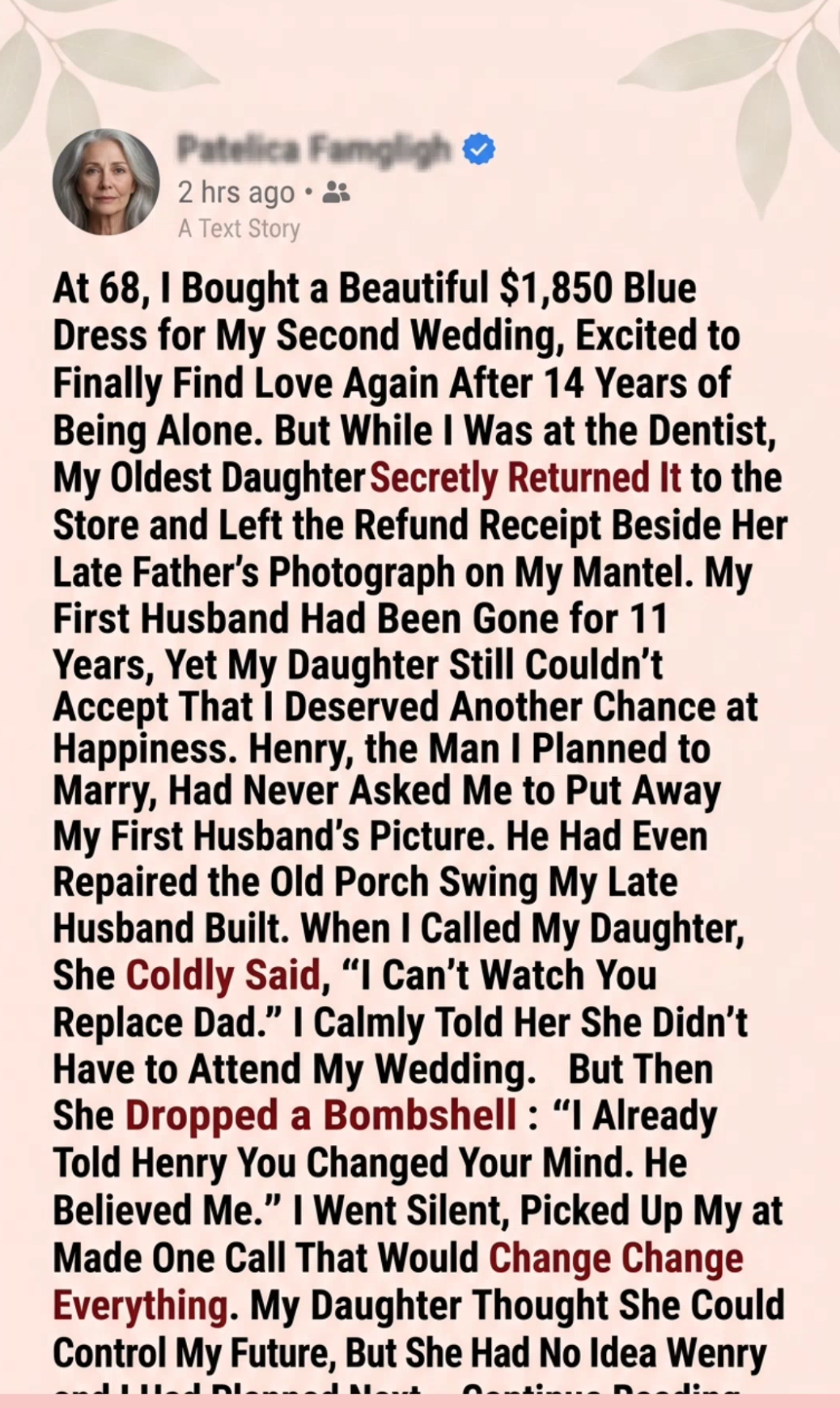
My name is Margaret Whitmore. I was sixty-eight years old when I bought the blue dress.
It was the kind of dress I had stopped allowing myself to imagine wearing.
Soft navy-blue silk, a simple neckline, delicate sleeves, and a fitted waist that made me stand a little straighter when I looked in the mirror. It cost $1,850, which was more than I normally spent on clothing in several months.
I knew it was expensive.
I also knew I wanted it.
For fourteen years, I had lived alone.
My first husband, Robert, died after a short illness when I was fifty-seven. We had been married for thirty-four years. We had raised two daughters, bought a modest house, survived financial difficulties, and built a life that was not always perfect but had been ours.
When Robert died, I thought the loneliness would eventually become easier.
It did, in some ways.
I learned to repair small things around the house. I learned to eat dinner without turning on the television. I learned to travel with friends and enjoy quiet mornings.
But I never stopped missing companionship.
I missed having someone ask how my day had gone.
I missed sharing small discoveries.
I missed sitting on the porch with another person while the evening settled around us.
My daughters, Laura and Emily, were grown. They had families and responsibilities of their own. I loved them, but I had never wanted to make them responsible for filling the empty space in my life.
Then I met Henry.
He was seventy-one, a retired civil engineer, and a widower. His wife had died six years earlier. He had one son who lived several hours away.
We met at a community garden.
I was struggling to carry a heavy bag of soil toward the raised beds when Henry offered to help.
“That bag looks heavier than it needs to be,” he said.
I laughed.
“Most things do these days.”
He carried it for me.
A week later, we met again.
Then we began having coffee after gardening.
Eventually, coffee became lunch, lunch became dinner, and dinner became the comfortable kind of companionship I had thought might never return.
Henry never tried to replace Robert.
He never asked me to remove Robert’s photographs.
He never complained when I mentioned something my first husband had said or done.
In fact, Henry had repaired the old porch swing Robert built many years earlier.
One afternoon, I found him working beneath it with a wrench.
“What are you doing?” I asked.
“Your swing is making a terrible noise.”
“Robert built that swing.”
Henry looked up.
“I know. I’m not replacing it. I’m making sure you can keep using it.”
I stood there for a moment.
That was when I realized I had fallen in love with him.
Not because he reminded me of Robert.
Because he respected the life I had lived before him.
After two years together, Henry proposed.
There was no expensive restaurant or elaborate surprise.
We were sitting on the porch swing when he took my hand.
“Margaret, I know we both have histories. I don’t want to erase mine or yours. I just want to spend whatever time we have left making new memories together. Would you marry me?”
I cried.
Then I said yes.
My daughters reacted differently.
Emily, my younger daughter, was delighted.
She hugged me and said she was happy I had found someone who made me smile again.
Laura, my oldest, was less enthusiastic.
At first, she said she was surprised.
Then she began asking questions.
“Are you sure you’re ready for this?”
“Yes.”
“Isn’t it too soon?”
“Henry and I have been together for two years.”
“You’re almost seventy, Mom. Why do you need to get married again?”
I tried not to take the question personally.
“Because I love him.”
Laura looked away.
She had been very close to Robert. She was twenty-seven when he died, and his illness had been especially difficult for her.
She had visited him almost every day during his final weeks.
I understood that she missed him.
I missed him, too.
But over the years, Laura had developed a habit of treating any change in my life as though it were an insult to his memory.
When I bought a new sofa, she asked why I had replaced the one Dad chose.
When I painted the bedroom, she asked whether I was trying to erase him.
When I began traveling with friends, she said I seemed to be enjoying myself too much.
I had tried to be patient.
Grief does not follow a timetable, and I knew that.
But I also knew Robert would never have wanted me to spend the rest of my life sitting alone because he was gone.
One evening, I mentioned the wedding date.
“We’re thinking about the second Saturday in October.”
Laura put down her fork.
“That’s very soon.”
“It’s four months away.”
“Have you thought about how Dad would feel?”
I stared at her.
“Your father loved me. He wanted me to be happy.”
“You don’t know that.”
I felt a small ache in my chest.
“Actually, Laura, I do.”
She pushed her chair back.
“I just don’t think this is right.”
She left before dinner was over.
I hoped she would eventually come around.
I did not demand that she attend.
I simply wanted her to understand that loving Henry did not mean I had stopped loving Robert.
The blue dress was my first wedding purchase.
I had spent weeks looking at dresses online and visiting shops.
Most were either too formal or too youthful for my taste. I wanted something elegant, comfortable, and appropriate for a small afternoon ceremony.
When I found the blue dress, I knew immediately.
The saleswoman helped me adjust the sleeves.
I looked in the mirror.
For the first time in fourteen years, I saw a woman who was excited about her future.
I bought it.
The dress was delivered to my home two days later.
I hung it in the spare bedroom and called Emily.
“You’re not going to believe what I found.”
“What?”
“My dress.”
She squealed.
“Send me a picture!”
I did.
She called back immediately.
“Mom, you look beautiful. That’s the one.”
I smiled.
“Do you really think so?”
“I know so.”
I had never felt so happy about a piece of clothing.
The wedding was going to be small.
We planned to have the ceremony in the garden of a local inn, followed by dinner with family and a few close friends.
Henry wanted a simple celebration.
I wanted the same.
We had agreed not to spend money unnecessarily.
The dress was my one indulgence.
Then, three days before my final fitting, I had a dentist appointment.
I left home at nine in the morning.
When I returned shortly after eleven, I noticed something strange on the mantel.
A white envelope sat beside Robert’s photograph.
At first, I assumed it was a bill.
Then I saw the store logo.
I opened it.
Inside was a refund receipt.
The amount was $1,850.
My dress had been returned.
I stood completely still.
I went into the spare bedroom.
The garment bag was gone.
The hanger was empty.
I checked the closet, then the hallway, then the laundry room.
Nothing.
My heart began beating faster.
I called the store.
A sales associate confirmed that the dress had been returned that morning.
“Do you have the name of the person who brought it back?” I asked.
There was a pause.
“Yes, ma’am. It was returned by a woman who said she was a family member.”
“Did she have the receipt?”
“She presented the original purchase information and said you had changed your mind.”
I gripped the telephone.
“Did she have my authorization?”
The associate sounded uncomfortable.
“She told us she had your permission. I can ask our manager to review the transaction.”
I thanked her and ended the call.
I knew exactly who had done it.
Laura.
I called her.
She answered after three rings.
“Hello, Mom.”
“Did you return my wedding dress?”
Silence.
Then she sighed.
“Yes.”
I closed my eyes.
“Why?”
“Because I couldn’t let you do this.”
“Do what?”
“Get married again. Pretend Dad never existed.”
I looked at Robert’s photograph.
“Your father has not been forgotten.”
“Then why are you replacing him?”
“I’m not replacing anyone.”
“You’re marrying another man and wearing a wedding dress. What am I supposed to think?”
I felt my hands trembling.
“Laura, I bought that dress with my own money. It was my decision.”
“You don’t need it.”
“That’s not for you to decide.”
She became louder.
“I can’t watch you replace Dad.”
I took a slow breath.
“Your father died eleven years ago. I loved him. I still love him. But I am allowed to have a future.”
She said nothing.
Then I told her something I had been avoiding.
“If you cannot accept my marriage, you don’t have to attend the wedding.”
There was a long silence.
Then Laura dropped the bombshell.
“I already told Henry you changed your mind. He believed me.”
For several seconds, I could not speak.
“What?”
“I called him yesterday. I told him you were having doubts and that you didn’t want to go through with the wedding.”
“Why would you do that?”
“Because someone needed to stop this.”
I felt something inside me settle.
Not anger.
Not panic.
Something colder and clearer.
“Laura, you had no right to do that.”
“He deserves to know.”
“He deserves to hear the truth from me.”
She laughed bitterly.
“He’s not your husband, Mom. Dad was.”
I ended the call.
I sat down on the sofa.
The refund receipt remained on the mantel beside Robert’s photograph.
For a few minutes, I did nothing.
Then I picked up my phone and called Henry.
He answered immediately.
“Margaret?”
“Henry, did Laura call you?”
He was quiet.
“Yes.”
“What did she tell you?”
“She said you were having second thoughts. She said you were feeling overwhelmed and had decided to postpone the wedding.”
I closed my eyes.
“Henry, I never said that.”
He exhaled.
“I wondered.”
“What do you mean?”
“Because it didn’t sound like you. But I didn’t want to pressure you.”
My eyes filled with tears.
“I’m sorry she put you in that position.”
“Don’t apologize for something you didn’t do.”
I looked at the empty hanger in the spare bedroom.
“Henry, I still want to marry you.”
He answered without hesitation.
“So do I.”
I wiped my eyes.
“Then I need to tell you what happened to the dress.”
I explained everything.
He listened.
When I finished, he was silent for a moment.
Then he said, “I think we need to speak with someone.”
I knew what he meant.
Not the police.
Not the store.
Our attorney.
Because there was another issue Laura had never understood.
The wedding was not simply an event.
Henry and I had been making plans for our future, and those plans involved more than a dress.
I called Michael Reeves, the attorney who had helped me settle Robert’s estate and update my financial documents.
“Michael, I need your advice. My daughter returned something I bought without my permission, and she has been telling my fiancé that I canceled our wedding.”
He listened carefully.
“Do you have the receipt and confirmation from the store?”
“Yes.”
“Keep them. Don’t confront her again until we’ve reviewed the situation.”
I explained what Laura had said.
Then I told him about the plans Henry and I had been discussing.
Michael asked me to come to his office the next morning.
Before we ended the call, he said something that made me pause.
“Margaret, are you and Henry planning to change your estate arrangements after marriage?”
“Yes. We’ve discussed it.”
“Have you signed anything?”
“No. We were going to meet with you after the wedding.”
“Good. I think we should meet before.”
I agreed.
When I hung up, Henry called again.
“Are you all right?”
“I think so.”
“Would you like me to come over?”
“Yes, please.”
He arrived twenty minutes later.
He found me sitting at the kitchen table with the refund receipt.
He placed his coat over the back of a chair and sat beside me.
For a moment, neither of us spoke.
Then he picked up the receipt.
“She really did this?”
“Yes.”
He looked toward the living room.
“Robert’s photograph?”
“She left it beside his photograph.”
Henry put the paper down.
“That must have hurt.”
I nodded.
He took my hand.
“Margaret, I want you to know something. I never wanted to replace Robert. I never expected you to forget him. I fell in love with the woman you already were, including the parts of your life that came before me.”
I began crying.
He held my hand.
After a while, I said, “I don’t want this wedding to become a battle with my daughter.”
“It doesn’t have to.”
“What if she keeps trying to stop us?”
Henry looked at me.
“Then we stop giving her the power to decide.”
The following morning, we met Michael at his office.
He had already reviewed the information I sent.
First, he addressed the dress.
He explained that the store had processed the return based on the information presented by Laura. We could ask the store to provide a written record of the transaction and determine whether its return policy had been followed.
He also suggested that I contact the store directly to resolve the refund and purchase another dress if the original could not be recovered.
There was no need to turn a retail dispute into a criminal accusation without more information.
I agreed.
Then we discussed Henry.
Henry and I had been planning to marry and combine certain household arrangements.
We wanted to protect our individual savings, make sure our medical and financial wishes were clear, and decide what would happen to our homes if one of us died.
We had also discussed a small joint account for shared expenses.
Michael recommended that we formalize those decisions before the wedding.
“Marriage should not automatically mean that every asset becomes a shared asset,” he explained. “You both have adult children and existing estates. You should make clear decisions about ownership, inheritance, and responsibilities.”
Henry nodded.
“I want Margaret to be secure. I don’t want either of us to have to guess what the other intended.”
Michael prepared a list of documents we would need.
We discussed separate property schedules, updated wills, healthcare directives, and a written agreement concerning the house Henry owned and the home I had inherited from Robert.
We also agreed that neither of us would make changes to our children’s inheritance arrangements under pressure.
Then Michael asked about Laura.
“Does she have access to your bank accounts or financial documents?”
“No.”
“Does she have authority under any power of attorney?”
“No.”
“Has she ever signed anything on your behalf?”
“Not that I know of.”
“Good. Keep your financial documents private. If you eventually appoint someone to assist you, choose that person carefully and make the authority specific.”
I nodded.
Before we left, Michael asked whether I wanted to send Laura a formal letter regarding the return of the dress.
I thought about it.
“Not yet. I want her to understand that she crossed a line, but I don’t want to escalate things unnecessarily.”
He respected that.
Henry and I left the office together.
Outside, he took my hand.
“How are you feeling?”
“Strangely calm.”
“Good.”
I looked at him.
“I still want that blue dress.”
He smiled.
“Then we’re going to get you another one.”
That afternoon, I called the store.
The manager reviewed the transaction.
Laura had brought the dress back and claimed I had changed my mind. She had presented the purchase information but had not provided written authorization from me.
The manager apologized.
Because the dress had already been processed for return and placed into the store’s inventory system, it could not be immediately restored to my original purchase.
However, the store agreed to check whether it was still available and offered to hold it while the matter was resolved.
I thanked the manager.
Then I drove to the store with Henry.
The dress was still there.
When I saw it hanging in the back of the fitting room, I felt an unexpected rush of emotion.
I touched the fabric.
Henry stood beside me.
“Still the one?” he asked.
“Absolutely.”
The manager offered to reverse the refund and restore the purchase.
I paid the necessary difference in the transaction and took the dress home.
This time, I placed it in a locked garment cabinet in the spare bedroom.
Not because I was afraid of Laura.
Because I was done allowing other people to make decisions about things that belonged to me.
Two days later, Laura arrived at my house.
She did not call first.
I opened the door.
“Mom, we need to talk.”
“All right.”
She walked inside and immediately noticed the garment bag hanging in the spare bedroom.
“You bought it again?”
“Yes.”
She shook her head.
“I can’t believe you’re doing this.”
“Laura, I am marrying Henry.”
She folded her arms.
“You’re choosing him over Dad.”
I looked at her.
“No. I’m choosing to live.”
She stared at me.
“You don’t understand what this is doing to me.”
I took a breath.
“I understand that you miss your father. I miss him, too.”
“Then why can’t you just leave things the way they are?”
“Because my life is not supposed to end when someone I love dies.”
Her eyes filled with tears.
“You’ve changed.”
“Yes. I have. I’ve learned to live without your father. I’ve learned to enjoy things again. And I’ve learned that being a widow does not mean I must remain alone forever.”
She looked toward the mantel.
Robert’s photograph was still there.
Beside it sat a smaller photograph of Henry and me at the community garden.
Laura noticed it.
“You put his picture next to Dad’s?”
“Yes.”
“That’s disrespectful.”
“No, Laura. It’s honest.”
She began crying.
“I just don’t want to lose him again.”
That was the first time I understood what was underneath her anger.
She was not simply objecting to the wedding.
She was afraid that accepting Henry meant accepting that Robert was truly gone.
She had kept her father alive in her mind by treating every change in my life as a betrayal of him.
I moved closer.
“Laura, you will never lose your father because I marry Henry.”
She shook her head.
“You don’t know that.”
“I do. Your father is part of my life. He is part of your life. Nothing Henry and I do can erase that.”
She wiped her face.
“Then why does it feel like you’re replacing him?”
“Because you’re hurting. And I am sorry for that. But I cannot spend the rest of my life proving that I still love someone who died eleven years ago.”
She looked at me.
For a moment, I thought she might understand.
Then she said, “I already told people you canceled the wedding.”
I felt my shoulders tighten.
“Who?”
“Some relatives. Aunt Denise. Cousin Rebecca. A few of Dad’s friends.”
I stared at her.
“You told them I canceled?”
“I thought you would eventually change your mind.”
“Laura, that was not your decision.”
She lowered her head.
“I was trying to protect you.”
“No. You were trying to control me.”
She flinched.
I continued.
“I love you. I want you at my wedding. But if you cannot attend without trying to stop it, you should stay home.”
She looked at me as if I had slapped her.
“You would really get married without your oldest daughter?”
“I would rather marry without you than spend my wedding day wondering whether you are going to sabotage it.”
She started crying again.
I opened the door.
“I need you to leave now.”
She stood in the hallway for a moment.
Then she walked out.
The next week, something unexpected happened.
I received a letter from Aunt Denise.
She had heard from Laura that I was canceling the wedding because I was confused about my feelings for Henry.
The letter was kind.
She said she hoped I was doing well and wanted me to know that she would support whatever decision made me happy.
I called her.
“Denise, I haven’t canceled anything.”
She sounded surprised.
“Laura told me you had changed your mind.”
“She was wrong.”
I explained what happened.
Aunt Denise became quiet.
Then she said, “Margaret, your mother remarried after your father died. Do you remember that?”
I did.
My mother had married a gentle man named George when she was sixty-five.
Laura had been very young at the time, and she barely remembered it.
“Your mother used to tell me that she wished she had stopped apologizing for being happy sooner,” Denise continued. “She didn’t want you to make the same mistake.”
I felt tears in my eyes.
“Thank you for telling me.”
“Your father would have wanted you to be happy. Robert would have, too.”
That evening, I told Henry about the conversation.
He smiled.
“Maybe we should invite Denise to the wedding.”
“We already have.”
“Good.”
He kissed my forehead.
Then he brought out a small folder.
Inside were the updated plans for our ceremony.
We had decided to keep the wedding small and simple.
No grand entrance.
No elaborate reception.
Just family, close friends, and a quiet ceremony in the garden.
Henry had also arranged something special.
He had contacted the carpenter who originally built Robert’s porch swing.
The carpenter had retired, but he agreed to make a small wooden plaque for the swing.
It read:
Built by Robert. Restored with care. A place for new memories.
I cried when I saw it.
Henry placed the plaque on the side of the swing.
He did not ask whether I wanted Robert’s name removed.
He made sure it remained.
That was the kind of man I was marrying.
Two weeks before the wedding, Laura called.
Her voice was quieter than usual.
“Mom?”
“Hello, sweetheart.”
“Can we meet?”
I agreed to meet her at a small café.
She arrived alone.
For a while, we talked about ordinary things.
Then she placed a photograph on the table.
It was a picture of Robert holding her when she was about five years old.
“Do you remember this day?” she asked.
I smiled.
“Yes. You had just fallen into the garden pond.”
She laughed softly.
“Dad was so angry with you because you laughed before you helped me.”
“He was trying not to laugh himself.”
For a moment, we were simply mother and daughter remembering someone we both loved.
Then Laura looked down.
“I’ve been thinking about what you said.”
I waited.
“I know you aren’t replacing Dad.”
I nodded.
“Good.”
She took a breath.
“I think I was afraid that if you got married again, everything we had with him would become less important.”
I reached across the table.
“It won’t.”
“I know that now.”
She looked at me.
“I shouldn’t have returned the dress.”
“No, you shouldn’t have.”
“And I shouldn’t have called Henry.”
“You’re right.”
She swallowed.
“I was wrong.”
I squeezed her hand.
“Thank you for saying that.”
She began crying.
“I don’t want to lose you, Mom.”
“You won’t lose me because I marry someone.”
She nodded.
“Can I still come to the wedding?”
I smiled.
“Of course. If you can come to celebrate with us.”
“I can.”
Then she added something that mattered more than any apology.
“I want to help you get ready.”
I thought about it.
“All right. You can help me with my hair.”
She smiled through her tears.
“Thank you.”
We finished our coffee.
Before leaving, she hugged me.
It was not a complete solution.
I knew that.
But it was a beginning.
The wedding day arrived on a clear October afternoon.
I wore the blue dress.
Henry wore a dark suit and a small white flower in his lapel.
The garden was decorated with white flowers and soft green ribbons.
There were twenty-eight guests.
Aunt Denise sat in the front row.
Emily stood beside me.
Laura helped with my hair that morning, carefully arranging it the way I liked.
Before the ceremony, she came into the small room where I was waiting.
“Mom?”
“Yes?”
She looked at the dress.
“You look beautiful.”
I smiled.
“Thank you.”
She glanced at Robert’s photograph, which I had brought with me in a small frame.
“Are you bringing Dad’s picture?”
“Yes. I thought I’d place it on the memory table.”
She nodded.
“That’s nice.”
Then she looked at me.
“I think he would be happy for you.”
My eyes filled.
“Thank you, sweetheart.”
She hugged me.
When I walked into the garden, Henry was waiting beneath a wooden arch.
He looked at me as though he had been waiting his whole life.
The ceremony was simple.
We promised to respect each other’s histories, protect each other’s independence, and make the most of the time we had together.
When the officiant pronounced us married, Henry kissed my cheek.
Everyone applauded.
I looked toward the front row.
Laura was crying.
But she was smiling, too.
For the first time, I felt that she was not watching her father disappear.
She was watching her mother begin again.
After the wedding, Henry and I did exactly what we had planned.
We kept our financial arrangements clear.
We maintained separate ownership of our individual properties.
We established a joint account for shared household expenses.
We updated our wills and healthcare documents with independent legal advice.
We also made sure that our children understood the arrangements.
It was not a secret.
It was not a trick.
It was simply two older adults making thoughtful decisions about their future.
Laura eventually asked me about the arrangements.
I explained them.
She listened.
Then she said, “I think it’s sensible.”
I smiled.
“Thank you.”
She never again tried to control my relationship with Henry.
There were occasional difficult moments.
Sometimes she became emotional when we visited Robert’s grave.
Sometimes she struggled when Henry joined family traditions that had once belonged only to her father.
But we learned to talk about those feelings without turning them into accusations.
Henry never demanded that Laura treat him like a replacement father.
He never tried to take Robert’s place in family photographs or old stories.
He simply showed up.
He attended birthdays.
He helped with garden projects.
He listened when Laura wanted to talk about her father.
Slowly, she began to appreciate him for who he was.
One afternoon, several months after the wedding, I found Laura sitting on the porch swing.
Henry had repaired it again after a loose bolt began making noise.
She was holding the old photograph of Robert that I kept near the back door.
“Mom,” she said, “I think Dad would have liked him.”
I sat beside her.
“I think so, too.”
She smiled.
“Henry never tries to compete with him.”
“No. He doesn’t.”
She looked at the swing.
“Maybe that’s why I was so afraid. I thought someone new would take Dad’s place.”
I put my arm around her.
“Nobody can.”
She leaned against my shoulder.
And for the first time in years, we were able to talk about Robert without feeling that we had to protect his memory from the present.
On my sixty-ninth birthday, Henry gave me a small gift.
It was a blue silk scarf that matched my wedding dress.
Inside the box was a note.
For the woman who taught me that love can begin again without erasing what came before.
I kept the note in the same drawer as my wedding photographs.
The refund receipt was there, too.
I had not kept it because I wanted to remember the hurt.
I kept it because it reminded me of the day I finally understood something important.
My daughter had believed that grief gave her the right to decide what happened to my future.
She had believed that because she missed her father, I had to remain alone.
She had believed that returning a dress could stop a wedding.
But she was wrong.
I could love Robert and marry Henry.
I could preserve the memories of my first marriage while creating new ones.
I could be a mother without surrendering my right to be a woman with dreams of her own.
And I could forgive my daughter without allowing her to control me again.
Sometimes, at sunset, Henry and I still sit on the old porch swing.
Robert built it.
Henry repaired it.
And now it belongs to a new chapter of my life.
I do not see that as replacing anything.
I see it as proof that love can leave something behind, and that something beautiful can grow around it.
At sixty-eight, I thought buying a $1,850 blue dress was an extravagant decision.
I now know it was something much more important.
It was the moment I chose not to apologize for being happy.
THE END.