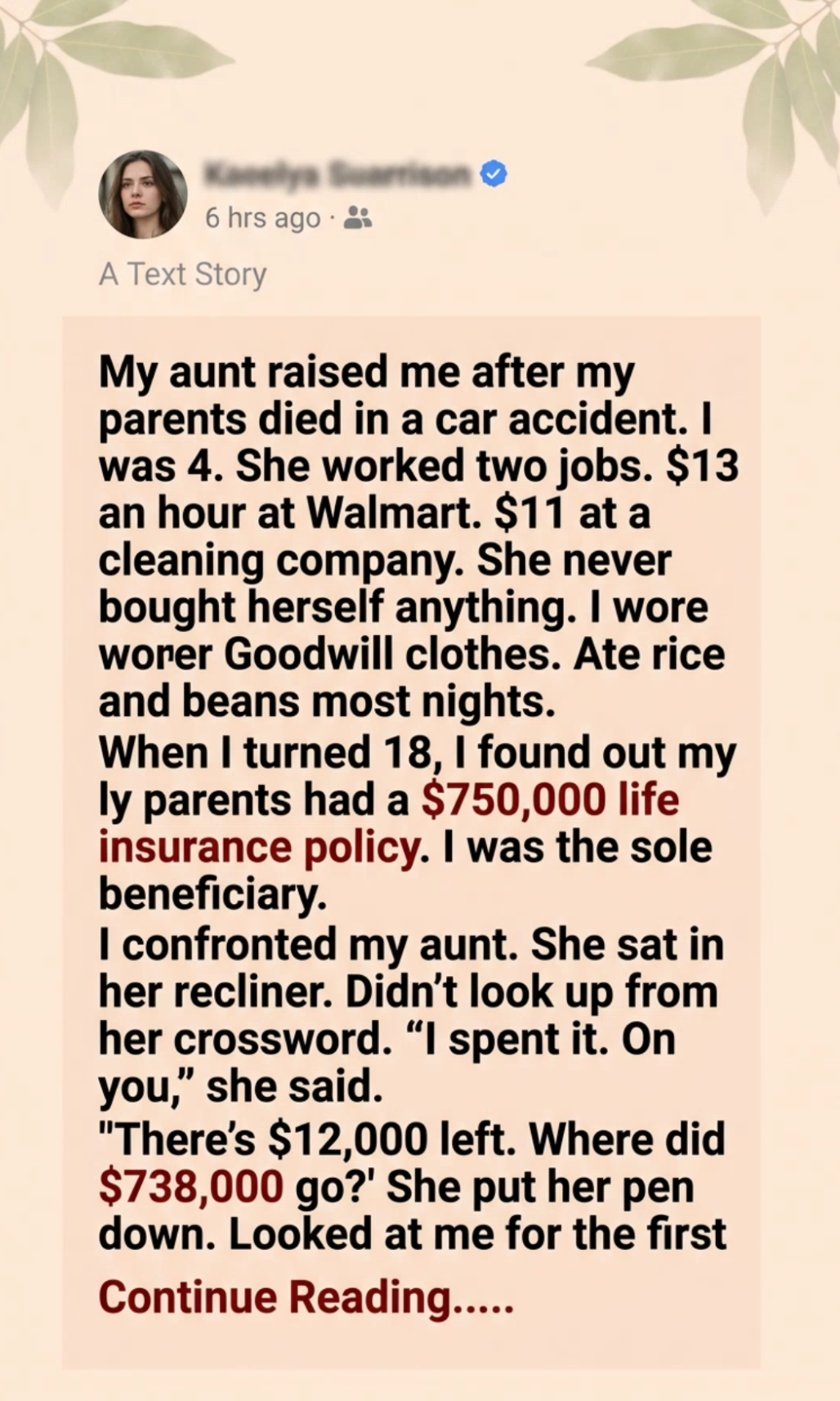
My parents died on a rainy Thursday afternoon when I was four years old.
I don’t remember the accident itself. I remember the weeks afterward in fragments: unfamiliar adults speaking in low voices, a black dress that smelled like perfume, flowers covering every flat surface in our house, and a little red toy car sitting on the coffee table that nobody had the heart to move.
I remember asking when my mother was coming home.
Nobody answered.
My aunt Margaret did.
She was my mother’s older sister. She was thirty-four at the time, unmarried, and working as a cashier at Walmart. She lived in a small two-bedroom apartment above a laundromat, drove a twelve-year-old Honda, and had never planned on raising a child.
But when the social worker asked where I would go, Margaret didn’t hesitate.
“She’s coming home with me,” she said.
That decision changed both our lives.
I grew up knowing my aunt worked hard. I just didn’t understand how hard until I was old enough to recognize what exhaustion looked like.
She worked from seven in the morning until three in the afternoon at Walmart, earning thirteen dollars an hour. After that, she drove across town to a cleaning company, where she worked from five until ten at night for eleven dollars an hour.
Sometimes she came home so tired that she fell asleep sitting at the kitchen table.
I would wake up in the morning and find her uniform folded over the back of a chair, her shoes beside the door, and a note telling me what to eat for breakfast.
“There’s cereal in the cupboard. Don’t forget your lunch. Love you, Auntie.”
She never signed her notes with her name.
She always wrote Auntie.
Our apartment was small, and most of my clothes came from Goodwill. My classmates wore new sneakers and carried expensive backpacks. I wore hand-me-down jackets and used the same backpack until the zipper broke.
Dinner was usually rice and beans, sometimes with an egg if Margaret had enough money that week.
I never thought we were poor because she never allowed me to feel ashamed of it.
When I complained about not having the latest shoes, she would smile and say, “Your feet don’t know what brand they’re wearing.”
When I asked why she never bought herself new clothes, she would say, “Because I already have clothes.”
When I asked why she didn’t go on vacations like the other parents, she would tell me, “My favorite place is wherever you are.”
As a child, I believed her.
As a teenager, I began to understand that she had given up almost everything for me.
She missed birthday parties because she was working. She missed school events when the cleaning company needed someone to cover a shift. She never took a weekend off unless I was sick.
When I got pneumonia at eleven, she slept in a chair beside my hospital bed for three nights. When the doctor asked whether she was my mother, she said, “Close enough.”
She attended every parent-teacher conference she could.
She helped me with homework even when she barely understood the assignments herself. When I struggled with algebra, she sat beside me with a notebook and tried to follow the teacher’s instructions.
“I’m not very good at this,” she admitted one night.
“Then why are you helping me?”
She tapped my forehead gently.
“Because you’re going to be better at it than I am.”
I loved her.
I really did.
But there was something about our financial situation that never quite made sense to me.
Margaret worked two jobs for fourteen years. She rarely took days off. She received tax refunds most years. She didn’t own a house, didn’t have a car payment after her Honda was paid off, and never seemed to spend money on herself.
Yet we always appeared to be one unexpected bill away from disaster.
If the refrigerator broke, we had to borrow one from a neighbor for two weeks.
If I needed a school trip payment, Margaret sometimes asked for an extra shift.
If I needed new glasses, she waited until payday.
I never questioned it.
I assumed that raising a child was simply expensive.
Then, shortly after my eighteenth birthday, everything changed.
It happened because I needed my birth certificate.
I had received a letter from a community college asking me to complete my financial aid paperwork. The application required information about my parents, including their dates of death.
I asked Margaret where she kept the important documents.
“Top drawer of the filing cabinet,” she answered while making coffee.
I found my birth certificate, my parents’ death certificates, and a folder containing several old insurance documents.
One page caught my attention.
It was a life insurance policy issued in my father’s name.
The death benefit was $500,000.
A second policy, issued in my mother’s name, listed a benefit of $250,000.
Both policies had been purchased several years before the accident.
I read the documents twice.
The beneficiary section contained my name.
Not Margaret’s.
Mine.
There was also a letter from the insurance company confirming that the claims had been approved following my parents’ deaths.
The combined amount was $750,000.
I sat on the floor with the papers in my hands.
I had grown up believing that my parents had left nothing behind.
But they had left me three-quarters of a million dollars.
I looked through the folder again.
There were copies of checks, account statements, and correspondence between the insurance company and an attorney.
The documents suggested that the money had been paid into a custodial arrangement when I was still a minor.
I couldn’t understand all the legal language, but one thing was clear.
The money had existed.
And I had never heard about it.
I carried the documents into the living room.
Margaret was sitting in her recliner, working on a crossword puzzle. She had reading glasses low on her nose and a cup of tea beside her.
“Aunt Margaret?”
“Hmm?”
“Can I ask you something?”
“Of course.”
I placed the insurance documents on the coffee table.
She glanced at them.
Then she returned to her crossword.
“Where did you find those?”
“In the filing cabinet.”
She nodded.
“Okay.”
I waited.
She didn’t say anything else.
I pulled a chair closer.
“Did you know my parents had life insurance?”
Her pen stopped moving.
“Yes.”
“Seven hundred and fifty thousand dollars?”
She finally looked up.
“Yes.”
I felt my stomach tighten.
“Was that money supposed to be mine?”
She looked at the papers again.
“Yes.”
I swallowed.
“Then where is it?”
Margaret leaned back in her recliner.
For a moment, she looked almost annoyed that I had interrupted her crossword.
Then she said something I had never expected to hear.
“I spent it. On you.”
I stared at her.
“What?”
She put the pen down.
“I spent it raising you.”
I felt my face getting hot.
“There’s twelve thousand dollars left. Where did the other seven hundred and thirty-eight thousand go?”
She looked at me for the first time without distraction.
Her expression wasn’t angry.
It was tired.
And then she said something that made the room feel smaller.
“Before you decide what you think happened, you should know that I kept every receipt.”
I didn’t know what to say.
She stood slowly, walked to the hallway closet, and pulled down a large plastic storage container.
It was old, beige, and covered in dust.
She carried it into the living room and placed it on the coffee table.
“Open it,” she said.
Inside were folders.
Dozens of them.
Each one had a year written on the tab.
2008\.
2009\.
2010\.
2011\.
And so on.
I opened the first folder.
Inside were receipts, bank statements, school invoices, medical bills, rent payments, insurance premiums, and handwritten notes.
There were records of almost everything.
I looked up.
“Why did you keep all this?”
“Because I knew one day you might ask.”
I began going through the papers.
The first few pages were confusing, but the numbers started to become clearer.
The insurance money had not been handed to Margaret as unrestricted personal money.
It had been placed in a custodial account for my benefit, with Margaret appointed to manage it while I was a minor. The account had been used for my support, education, medical care, and other expenses permitted under the arrangement.
She had not simply received a pile of cash and been free to spend it however she wanted.
The records showed a series of withdrawals over fourteen years.
Some were small.
Some were substantial.
And some were expenses I had never known about.
I found a payment of $18,600 for emergency surgery when I was seven.
I remembered that operation. I had been told it was covered by insurance.
Apparently, insurance had covered part of it, but not everything.
There were payments for dental treatment, asthma medication, school fees, tutoring, and summer programs.
There were years of rent payments.
There were utility bills.
There were groceries.
There were school clothes and shoes.
There were deposits for a used car after Margaret’s Honda finally became unsafe to drive.
I looked at her.
“You used my money for rent?”
She nodded.
“Your parents’ policy was meant to provide for you. You needed somewhere safe to live. I couldn’t raise you on the sidewalk.”
“But you were working.”
“I was.”
“Then why did you use the insurance money?”
“Because my paycheck couldn’t cover everything.”
I looked down again.
The documents showed that Margaret had continued working both jobs even while the account paid some of our expenses.
I found another statement.
She had paid herself no salary for managing the account.
There were no luxury purchases.
No expensive vacations.
No designer bags.
No jewelry.
No large transfers to friends or relatives.
But there were several withdrawals that weren’t immediately clear.
One was for $9,800.
Another was for $14,200.
A third was nearly $22,000.
I pointed to them.
“What are these?”
Margaret moved closer.
“Your schooling.”
I shook my head.
“My schooling didn’t cost that much.”
“Not just tuition. The first one was for the private school you attended after the public school couldn’t accommodate your learning difficulties. The second covered your specialist evaluations and treatment. The third was the college savings deposit I made before the market dropped.”
I stared at her.
“I never went to private school.”
She nodded.
“You went for two years. Then the school changed its program, and I moved you back.”
I remembered changing schools.
I had thought it was because we moved apartments.
I had never known there had been another reason.
I kept reading.
Then I found a folder marked 2015 — Housing and Family Support.
Inside were documents showing that Margaret had temporarily used part of the account to cover a housing deposit and essential expenses after she was injured at work.
She had fallen while cleaning an office building and damaged her shoulder.
She couldn’t lift properly for almost four months.
The cleaning company had not paid her during most of her recovery.
I remembered that year.
She had told me she was taking a few weeks off because she was tired.
I remembered cooking rice by myself and watching television while she slept.
I had never known she had been injured.
“Why didn’t you tell me?”
“Because you were eleven.”
“You could have told me.”
She looked at me quietly.
“I didn’t want you growing up thinking you were responsible for keeping me alive.”
That answer hurt more than I expected.
I returned to the statements.
The account had paid for my needs, but the records also showed that Margaret had repeatedly contributed her own wages whenever the balance was insufficient.
There were handwritten notes in the margins.
Used personal paycheck for winter coat.
Paid school balance from Walmart wages.
Replaced broken glasses.
No withdrawal this month. Covered groceries myself.
I read those notes slowly.
Then I noticed something else.
The remaining twelve thousand dollars wasn’t sitting in a regular savings account.
It was in a separate account with my name attached to it.
I looked up.
“Is this all that’s left?”
“Yes.”
“Why didn’t you tell me?”
“Because I wanted to explain it when you were old enough to understand what happened.”
I sat back.
I was angry.
I was confused.
And I was embarrassed by how quickly I had assumed the worst.
But I wasn’t ready to apologize.
“Seven hundred and fifty thousand dollars is a lot of money,” I said. “Even with everything you showed me, how did it disappear so quickly?”
Margaret folded her hands.
“Because fourteen years is a long time to raise a child. Especially one who needs more than food and a bed.”
I stared at her.
She continued.
“Your parents didn’t leave you a house. They didn’t leave you a college degree. They didn’t leave you someone to drive you to the doctor, help you with homework, or sit beside you when you had nightmares. They left money. I used that money to give you a life.”
“Then why did we live so cheaply?”
“Because I didn’t want the money to disappear before you became an adult.”
She pointed toward the folders.
“I paid for what you needed. I didn’t buy what you wanted every time you wanted it. I didn’t take you to expensive restaurants because I couldn’t afford to. I didn’t buy myself things because I was trying to make sure there would be something left when you turned eighteen.”
I looked at the final statement.
The balance was $12,146.83.
It was less than two percent of the original amount.
I felt a wave of disappointment.
I had imagined that the money might pay for college, help me buy a home, or give me the financial security I had never experienced.
Instead, most of it was gone.
But there was still one question I needed answered.
“Did you ever take money for yourself?”
Margaret didn’t become defensive.
She simply nodded.
“Yes.”
My stomach dropped.
“How much?”
“Not as much as you think.”
“How much?”
She walked to the container and found another folder.
She opened it and handed me a statement.
There were several payments marked as reimbursements for expenses she had personally covered.
Some were for groceries.
Some were for transportation.
Some were for medical expenses she had paid out of pocket.
There was also a modest monthly payment for a period when she had reduced her work hours to care for me after surgery.
The documents did not show a secret fortune or a series of personal luxury purchases.
But they did show that she had benefited from the account in some ways.
And I needed to understand those details.
“Did you have an accountant look at this?”
She nodded.
“Your parents’ attorney helped me establish the account. After that, I had an accountant review the records every year.”
“Can I see those reports?”
“Of course.”
“All of them?”
“Every single one.”
I spent the next several days reviewing everything.
I also contacted the attorney whose name appeared in the original paperwork. He was retired, but his former law partner agreed to meet with me.
I brought every folder.
I expected to discover something terrible.
Instead, I learned that the arrangement had been more complicated than I understood.
My parents had named me as the beneficiary, but the insurance proceeds had been administered through a custodial arrangement while I was a minor. Margaret had been authorized to use funds for my support and welfare, subject to the governing documents and applicable law.
The attorney explained that not every withdrawal automatically became improper simply because the money had originally been mine.
The important questions were whether the expenses were permitted, whether records existed, whether Margaret had fulfilled her duties, and whether any personal benefit had been improperly taken.
The accountant reviewed the statements.
He found several entries that needed better explanations, but he found no evidence of a secret investment account, unexplained luxury purchases, or money transferred to relatives.
Most of the withdrawals corresponded to documented expenses connected to my upbringing.
The attorney also explained that the remaining balance was legally mine when I reached the age specified in the account documents.
I was entitled to take control of it.
I could also request a more detailed accounting.
Margaret never argued.
She signed every authorization.
She handed over every document.
She even offered to pay for an independent review if I wanted one.
That was when my anger began to change.
Because someone who had deliberately stolen my inheritance would probably have tried to hide something.
Margaret had done the opposite.
She had saved everything.
Still, I needed time.
For two weeks, I barely spoke to her about the money.
I went to college orientation. I completed financial aid forms. I opened my own bank account.
I also started looking at Margaret differently.
I noticed the worn-out recliner.
The faded curtains.
The kitchen table with one uneven leg.
Her winter coat, which had been repaired twice.
I noticed that she still bought the cheapest coffee.
I noticed that she had never replaced the old television even though the picture had started flickering.
One evening, I found her in the kitchen preparing rice and beans.
I stood in the doorway.
“Can I ask you something?”
She looked over.
“Always.”
“Why didn’t you tell me about the money when I was younger?”
She turned down the stove.
“Because I didn’t want you to grow up counting your inheritance.”
“But I was entitled to know.”
“You’re right.”
I hadn’t expected her to agree so quickly.
She continued.
“I should have explained the arrangement when you were old enough to understand it. I should have shown you the statements earlier. I was afraid you’d think I had raised you because of the money, or that every decision I made had a price attached to it.”
I pulled out a chair.
“Did you ever resent me?”
She looked genuinely surprised.
“Resent you?”
“You were thirty-four. You could have had your own life. You could have traveled, gotten married, bought a house. Instead, you spent fourteen years working two jobs.”
She sat across from me.
“I had a life.”
“Margaret.”
“I did,” she insisted gently. “It wasn’t the life I imagined when I was twenty-five. But it was still mine.”
She reached across the table.
“Sometimes I was tired. Sometimes I was scared. Sometimes I cried in the bathroom because I didn’t know how I was going to pay the next bill. But I never regretted bringing you home.”
I looked away.
She squeezed my hand.
“You were four years old. You had lost your mother and father. You needed someone. I was there.”
For the first time since discovering the policy, I started crying.
Not because of the money.
Because I had spent days imagining that the woman who raised me had stolen from me.
And she had spent fourteen years making sure I never felt abandoned.
“I’m sorry,” I whispered.
She shook her head.
“You don’t have to apologize for asking questions.”
“But I thought you took it.”
“You had every right to understand what happened to it.”
“I should have asked you before accusing you.”
She smiled sadly.
“You’re eighteen. You’re allowed to make mistakes.”
We sat there for a long time.
Then I asked the question that had been sitting in my mind for days.
“What happens now?”
She looked at me.
“That’s up to you.”
I thought about the remaining money.
I thought about college.
I thought about how much Margaret had sacrificed.
And I thought about how unfair it would be to let her spend the rest of her life working two jobs because she had spent her younger years raising me.
I told her I wanted the remaining money placed in an account that I controlled.
She agreed.
I also told her I wanted to use part of it for college and keep the rest invested for my future.
She nodded.
“That’s what your parents would have wanted.”
Then I told her something else.
“I want you to stop working at the cleaning company.”
She laughed.
“Absolutely not.”
“I’m serious.”
“So am I.”
“You’ve worked two jobs since I was four.”
“Because you needed me to.”
“I don’t need you to do that anymore.”
She looked at me for a moment.
“I don’t want you making decisions about my life because you feel guilty.”
“I’m not.”
“Then don’t.”
I didn’t argue.
Instead, I spent the next few weeks making a plan.
I applied for scholarships. I compared college costs. I met with the financial aid office and asked about work-study programs.
I discovered that I could attend community college while working part-time.
I also arranged for the remaining insurance funds to be managed responsibly, with enough available for my education and emergency expenses.
But I didn’t use the money to buy a car or move into an expensive apartment.
I wanted to finish school without repeating the financial struggles Margaret had endured.
Then, after my first semester, I received an unexpected opportunity.
A local nonprofit offered a scholarship for students who had lost one or both parents and were being raised by relatives.
I applied.
I wrote about my parents, my aunt, and the life we had built together.
I didn’t mention the insurance money.
I wrote about the woman who worked two jobs and still showed up for every school event she could.
I wrote about the woman who taught me that a person could be poor without being powerless, tired without being unkind, and disappointed without giving up.
I received the scholarship.
It covered most of my tuition.
When I told Margaret, she cried.
Not loudly.
She simply covered her mouth and sat down.
“Your mother would be so proud of you,” she said.
I hugged her.
“I hope so.”
Over the next year, things changed.
Margaret reduced her hours at the cleaning company. She still worked at Walmart because she liked the routine and the people, but she no longer had to work every evening.
I helped her replace the broken refrigerator.
She refused to let me buy her a new car.
So I paid for a proper repair and new tires instead.
We also started doing something we had never done before.
Once a month, we went out for dinner.
Not somewhere expensive.
Just a little family restaurant near our apartment.
The first time we went, Margaret ordered the cheapest meal on the menu.
I told her to order whatever she wanted.
She looked at me.
“Old habits.”
I smiled.
“Then let’s practice new ones.”
She ordered the salmon.
I ordered a burger.
We talked for two hours.
And for the first time, I understood that taking care of someone didn’t always mean giving them money.
Sometimes it meant giving them permission to stop sacrificing everything.
On my twentieth birthday, Margaret gave me a small envelope.
Inside was a photograph of my parents.
It was taken shortly before the accident.
My mother was laughing, and my father had one arm around her shoulders. I had seen the picture before, but never with the writing on the back.
Margaret had written it herself.
They trusted me with the most important thing they ever had. I hope I did right by them.
I read it twice.
Then I looked at her.
“You did.”
She started crying.
I hugged her.
And I told her something I should have said years earlier.
“You didn’t spend my inheritance on me, Aunt Margaret. You spent your life raising me. The money just helped you do what you had already chosen to do.”
She held me tighter.
For a long time, I had thought my parents had left me $750,000.
But they had left me something else, too.
They had left me a sister who became a mother.
A woman who worked two jobs, wore old clothes, skipped vacations, and quietly carried responsibilities she had never asked for.
The money was gone.
The receipts remained.
But the greatest evidence wasn’t in those folders.
It was in the person I had become.
And in the woman who had made sure I got the chance to become her.
I still have the twelve thousand dollars that remained from the insurance policy.
I haven’t spent it carelessly.
I use it carefully for education and emergencies, just as my parents intended.
And Margaret?
She still calls me her little girl, even though I’m grown now.
Sometimes I still find her sitting in that old recliner, working on a crossword puzzle.
When I visit, she asks whether I’ve eaten.
I always tell her yes.
She never believes me.
So she gets up and makes rice and beans anyway.
And I never complain.
Because I finally understand what those meals really cost.
THE END.