The first thing my husband said when he entered my hospital room was not, “Are you all right?”
It wasn’t, “What happened?”
It wasn’t even, “I’m sorry.”
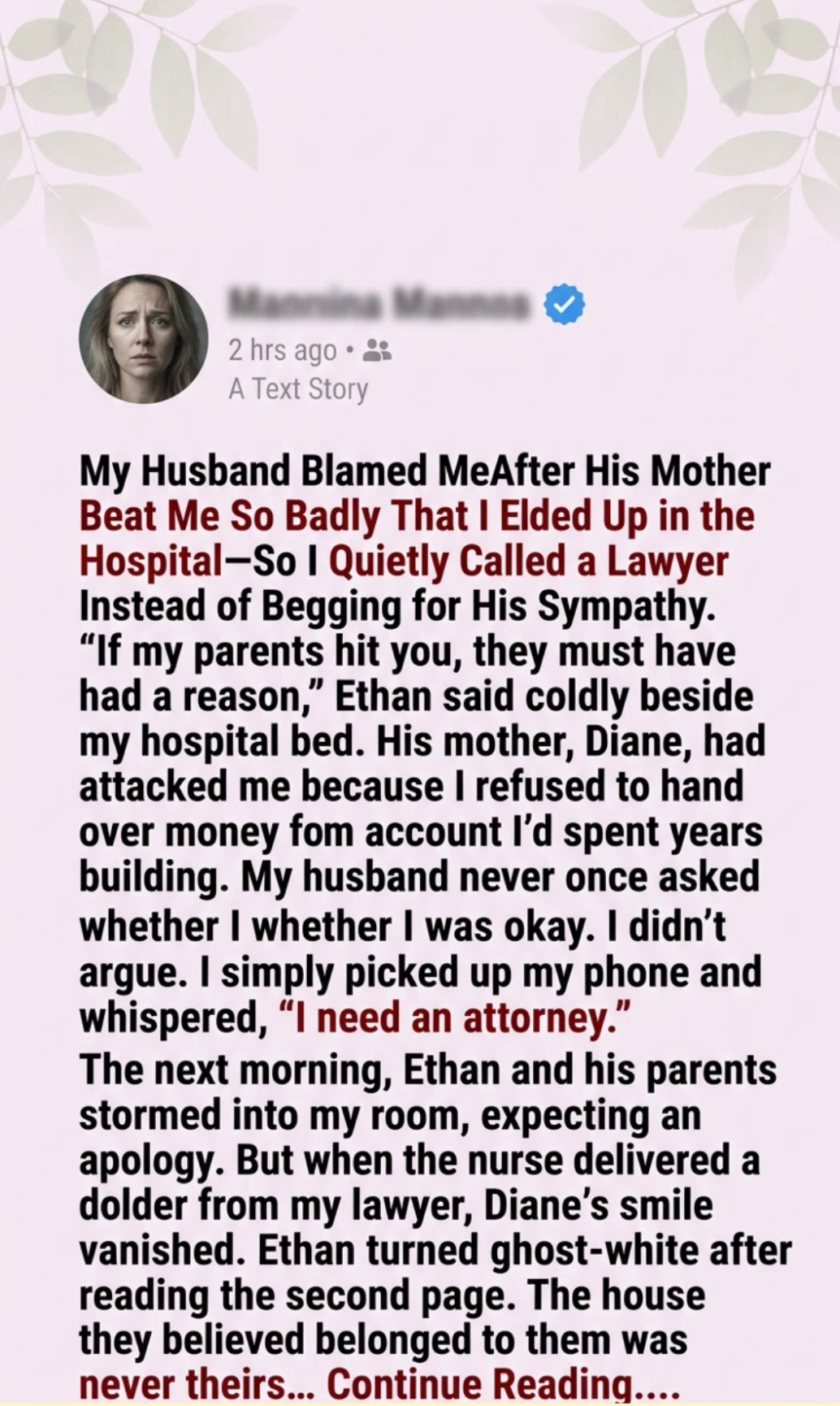
He stood beside my bed, glanced at the bandage around my forehead, and said, “If my parents hit you, they must have had a reason.”
For several seconds, I thought I had misunderstood him.
My name is Natalie Brooks. I was thirty-eight years old, and I had been married to Ethan Brooks for nine years.
My left wrist was wrapped in a medical brace. There were bruises along my arms, stitches above my eyebrow, and pain in my ribs every time I tried to move.
I had spent the previous night in the emergency department after my mother-in-law, Diane, attacked me during an argument about money.
And my husband was standing beside my hospital bed defending her.
I looked at him.
“Your mother attacked me.”
Ethan sighed.
“She wouldn’t have done that without a reason.”
I stared at him.
“She hit me because I refused to give her money.”
“Don’t make it sound worse than it was.”
I slowly turned my face toward the window.
Something inside me became very quiet.
For nine years, I had tried to keep peace in our marriage. I had made excuses for his mother’s behavior, swallowed insults, and convinced myself that Ethan’s occasional cruelty was simply stress.
But lying in that hospital bed, I finally understood something.
The man I had spent nine years protecting was not going to protect me.
So I reached for my phone.
Ethan frowned.
“Who are you calling?”
I looked at him.
“A lawyer.”
His expression changed.
“Don’t be ridiculous.”
I didn’t answer.
I had already made my decision.
The family I married into
I met Ethan when I was twenty-eight.
He was charming, confident, and seemed genuinely interested in building a stable future.
He worked in commercial property management, while I was an accountant for a regional construction company.
We met at a friend’s birthday dinner.
He made me laugh, remembered small details about our conversations, and called the next morning to ask whether I had arrived safely at work.
Six months later, we were engaged.
His parents, Richard and Diane Brooks, were polite during the engagement.
Diane was particularly interested in the wedding arrangements.
She had opinions about everything: the flowers, the reception, the guest list, and even the color of my dress.
I assumed she was simply excited.
I didn’t realize that she expected to remain the most important woman in her son’s life.
After the wedding, Ethan and I rented a small apartment while saving for a house.
I had been financially careful since my early twenties.
My parents had struggled with debt when I was growing up, and I had watched how quickly unexpected expenses could destroy a family’s stability.
I started saving early.
I worked overtime, avoided unnecessary purchases, and invested a portion of my income.
By the time I married Ethan, I had accumulated a substantial amount of personal savings.
My financial adviser had helped me organize those funds into separate accounts.
Some were invested.
Others were held in a savings account for future property purchases and emergencies.
Ethan knew I was financially responsible, but I never gave him unrestricted access to those accounts.
We maintained a joint household account for shared expenses, while keeping our individually owned assets separate.
That arrangement worked for years.
Until Diane began asking questions.
The first warning signs
Diane had a habit of treating her son’s marriage as an extension of her own household.
If she wanted something, she expected Ethan to provide it.
If she wanted to visit, she arrived without checking.
If she disliked a decision, she called him until he changed it.
At first, I tried to be accommodating.
When she complained that her kitchen needed renovation, I suggested a few affordable contractors.
When she wanted a new television, Ethan helped her compare prices.
When she said her car was becoming unreliable, I encouraged her to get it inspected before buying another.
But gradually, her requests became demands.
She began asking Ethan for money every month.
Sometimes she said it was for medical expenses.
Other times, it was for household repairs or unexpected bills.
I didn’t object to helping family when we could afford it.
What bothered me was that she never explained where the money went.
Ethan would transfer funds without discussing it with me.
When I asked how much he had given her, he became defensive.
“She’s my mother, Natalie.”
“I know. I’m not saying you can’t help her. I’m asking whether we can agree on a budget.”
“Why do you always make everything about money?”
I eventually stopped asking.
Then Diane learned about my personal savings.
I don’t know exactly how she found out.
Perhaps Ethan told her.
Perhaps she saw a bank statement on the kitchen counter.
Whatever happened, her attitude changed.
One afternoon, she called me.
“I heard you’ve been saving quite a bit of money.”
I was surprised.
“Who told you that?”
“Does it matter? Ethan and I were discussing the family.”
I paused.
“What do you need?”
She laughed.
“Nothing yet. I just think families should support one another.”
A week later, she asked for $25,000.
She said she wanted to invest in a small property renovation with a relative.
I asked for the business plan.
She became offended.
“Why would I need to show you paperwork? I’m not a stranger.”
“I would ask anyone for documentation before lending that amount.”
She accused me of being arrogant.
Ethan told me I should have handled the conversation more gently.
I refused to transfer the money.
That should have been the end of it.
It wasn’t.
The house they believed belonged to Ethan
Three years before the attack, I had purchased a house outside the city.
It was a modest but beautiful property with four bedrooms, a large kitchen, and a garden that received afternoon sunlight.
I bought it using funds from my personal savings and an inheritance left by my grandmother.
The purchase was completed through a legal structure reviewed by my attorney.
The property was registered in the name of my wholly owned property company, Natalie Brooks Property Holdings LLC.
The arrangement was lawful and documented.
I was the sole member of the company, and the company held title to the house.
Ethan and I lived there together.
He contributed to ordinary household expenses, and we shared certain maintenance costs.
But he had never been an owner.
He knew the house was held by my company.
He had even signed a document acknowledging that the property was not being transferred into joint ownership.
At the time, he didn’t care.
He liked the house.
He enjoyed the garden, the large kitchen, and the quiet neighborhood.
Diane loved it even more.
She began referring to it as “the family house.”
She told relatives that Ethan had finally bought a proper home.
I corrected her once.
“It’s held by my property company.”
She waved her hand.
“What’s yours is his. You’re married.”
I smiled politely.
“That’s not how property ownership works.”
She never forgave me for saying that.
Over time, she began acting as if she had a claim to the house.
She wanted to choose new furniture.
She wanted to replace the kitchen cabinets.
She wanted a bedroom reserved for her whenever she visited.
When I refused to give her a permanent room, she accused me of excluding her from the family.
Ethan told me I was being unreasonable.
I reminded him that we had agreed the house would remain our private home.
He said nothing.
The money demand that became an attack
The confrontation happened on a Saturday afternoon.
Diane arrived without calling.
Ethan was at work.
I was in the kitchen reviewing invoices for a small consulting project I had been handling.
She walked in carrying her handbag.
“We need to talk.”
I put down my pen.
“Hello, Diane. Is something wrong?”
She sat at the kitchen island.
“I’ve found a property I want to buy.”
I nodded.
“That’s good.”
“It’s a small commercial building. The seller needs a quick decision.”
I waited.
“I need you to transfer $90,000.”
I thought I had misheard her.
“Ninety thousand dollars?”
“Yes. You have the money.”
“That’s not a reason for me to give it to you.”
Her expression hardened.
“Don’t start with your attitude.”
I took a breath.
“What is the property? Who owns it? What are the projected costs?”
She pushed a folder toward me.
I opened it.
There were several printed photographs, a rough price estimate, and a handwritten page describing potential rental income.
There was no independent valuation.
No verified ownership information.
No proper financial projection.
No purchase agreement.
I closed the folder.
“This isn’t enough information for a $90,000 investment.”
Diane laughed sharply.
“You’re an accountant. You know how to move money.”
“That’s not how responsible financial decisions are made.”
She leaned forward.
“You’re married to my son. You have a duty to help this family.”
“I help Ethan with our household expenses. I’m not transferring my personal savings into an undocumented investment.”
Her face changed.
“You think you’re better than us.”
“No. I think ninety thousand dollars deserves proper paperwork.”
She stood.
“That money belongs to the family.”
“It belongs to my company and my personal savings. You don’t have permission to access it.”
She stepped closer.
“You’re turning my son against me.”
“I’m not discussing Ethan. I’m discussing your request.”
Then she reached across the island and grabbed my arm.
I pulled away.
“Don’t touch me.”
She pushed me.
I stumbled backward against the kitchen counter.
I tried to move toward the hallway, but she followed.
“You ungrateful woman! My son gave you everything!”
“Stop, Diane!”
She struck me.
I raised my arm to protect my face.
The next few moments became confused and frightening.
She grabbed my hair, shoved me against the side of the counter, and struck me again.
I tried to get away.
My foot slipped.
I fell against the edge of a chair before hitting the floor.
I remember the sound of something breaking.
I remember pain in my wrist.
And I remember Diane shouting that I would regret humiliating her.
The house became quiet after she left.
I tried to stand but couldn’t.
My phone was on the kitchen counter.
I managed to reach it and call emergency services.
When the paramedics arrived, I was sitting on the floor, holding a towel against the cut above my eyebrow.
They asked what happened.
I told them.
They examined me, stabilized my wrist, and took me to the hospital.
I had a concussion, a fractured wrist, several deep bruises, and injuries to my ribs.
The doctor told me I would need follow-up examinations.
I spent the night under observation.
And the following morning, Ethan arrived.
The hospital room
Ethan entered carrying a paper coffee cup.
He looked annoyed.
“What’s going on?”
I stared at him.
“Your mother attacked me.”
He sighed.
“She says you were screaming at her.”
“She hit me.”
“She said you pushed her first.”
I looked at my husband.
“Do you believe that?”
He avoided my eyes.
“I wasn’t there.”
“Then why are you defending her?”
“Because she’s my mother.”
I felt a strange emptiness.
“Did you even ask whether I’m okay?”
He looked at the bandage on my forehead.
“You’re obviously alive.”
I turned away.
Then he said the words I would never forget.
“If my parents hit you, they must have had a reason.”
I slowly looked back at him.
“Your mother attacked me because I wouldn’t give her ninety thousand dollars.”
He shook his head.
“You always make things difficult.”
I reached for my phone.
He watched me.
“Who are you calling?”
“My lawyer.”
His expression changed.
“Don’t be ridiculous.”
I dialed the number.
My attorney, Helen Carter, answered after two rings.
“Natalie?”
“I need your help.”
Her voice became serious.
“Are you safe?”
“I’m in the hospital. Diane attacked me. Ethan is here, and he’s defending her.”
There was a brief silence.
“Do you need immediate protection?”
“Yes. And I need you to secure the property records and review our financial arrangements.”
“Don’t discuss anything with them. I’ll arrange to speak with you as soon as possible.”
I ended the call.
Ethan stared at me.
“You’re actually getting a lawyer involved?”
I looked at him.
“Yes.”
He shook his head.
“You’re going to destroy this family over an argument.”
I didn’t answer.
The family had already been destroyed.
I was simply the last person to admit it.
The folder that changed everything
The following morning, Ethan returned with his parents.
Diane entered first.
She was wearing a cream-colored coat and carrying a designer handbag.
She looked perfectly composed.
Richard followed behind her.
Ethan closed the door.
Diane glanced at my wrist.
“Well, I hope you’ve calmed down.”
I said nothing.
She placed her handbag on the visitor’s chair.
“We need to settle this like adults.”
Richard cleared his throat.
“Natalie, your mother-in-law is upset. Everyone said things they shouldn’t have.”
I looked at him.
“She attacked me.”
Diane rolled her eyes.
“Oh, please. You make it sound like I tried to kill you.”
Ethan stepped forward.
“Let’s not exaggerate.”
I stared at him.
He had not even asked whether I could move my injured wrist.
He had not asked whether I had slept.
He had not asked what the doctors had said.
He had come to pressure me into forgiving his mother.
Diane leaned closer.
“You need to apologize for humiliating me.”
I looked at her.
“No.”
Her smile disappeared.
“What did you say?”
“I said no.”
Ethan raised his voice.
“Natalie, stop being difficult.”
Before I could answer, the nurse entered.
She carried a document folder.
“Ms. Brooks? Your attorney’s office asked us to deliver these documents to you.”
Diane frowned.
“Her attorney?”
The nurse placed the folder on my bedside table.
“There’s also a message requesting that any visitors leave if you feel uncomfortable.”
I opened the folder.
The first document was a formal notice concerning the ownership and management of the house.
The second was a letter from my attorney explaining that the property was held by Natalie Brooks Property Holdings LLC, of which I was the sole member.
It also stated that Ethan had no ownership interest in the property.
The third document concerned the company’s authority to manage access to the house and begin the appropriate legal process regarding occupancy, subject to applicable residential and marital-property laws.
The fourth was a notice requesting preservation of financial records related to the proposed $90,000 transfer.
I turned to the second page.
Ethan leaned over my shoulder.
His face changed.
“What is this?”
I looked at him.
“The ownership record.”
He grabbed the page.
“That’s not possible. We live there.”
“Yes. We live there. That doesn’t make you the owner.”
Diane snatched the document from him.
“You can’t throw my son out of his own house!”
I looked at her.
“It’s not his house.”
She turned toward Ethan.
“Tell her!”
He was staring at the document.
“Mom, it’s in her company’s name.”
Diane’s face lost color.
“What?”
“She owns the company,” he said quietly.
Richard stepped forward.
“Surely the house is marital property.”
I looked at him.
“The ownership and any marital rights are matters for the lawyers and the court. But the deed is not in Ethan’s name.”
Diane turned toward me.
“You planned this!”
I shook my head.
“No. I planned for my property to be legally documented. I didn’t plan for you to attack me.”
Ethan placed the papers on the bed.
“You’re trying to make me homeless.”
I looked at him.
“You were standing beside my hospital bed yesterday defending the woman who injured me. You were more concerned about her feelings than my safety.”
He opened his mouth.
I continued.
“And now you’re worried about where you will live.”
Nobody answered.
I pressed the nurse call button.
“I’d like these visitors to leave.”
Diane began shouting.
“You can’t do this to us!”
The nurse calmly asked them to step outside.
Richard tried to speak, but I raised my hand.
“Please leave. My lawyer will contact you.”
For the first time since I had married Ethan, his family was no longer controlling the conversation.
What my lawyer uncovered
Helen arrived later that afternoon.
She was a practical woman in her early fifties who had represented me in several business and property matters.
She sat beside my bed.
“How are you feeling?”
“Painful. But I’m all right.”
She reviewed the hospital documentation, photographs of my injuries, and the information I had provided.
Then she explained what we needed to do.
First, we would ensure the assault was properly documented and reported.
Second, we would preserve evidence, including emergency service records, medical reports, photographs, and any available security footage.
Third, we would address immediate safety concerns through the appropriate legal process.
Fourth, we would review the financial situation and property records.
She made it clear that the company ownership of the house did not automatically resolve every possible marital or occupancy issue.
The legal consequences would depend on the applicable state law, the history of the property, and the financial contributions made during the marriage.
I appreciated her honesty.
I didn’t want false promises.
I wanted a lawful plan.
Over the next several days, Helen reviewed the records.
The property had been purchased before the most recent dispute using my separate funds and inheritance.
The title was held by my wholly owned company.
The company records clearly identified me as the sole member.
Ethan had signed an acknowledgment confirming that he understood the ownership arrangement.
There was also a written agreement concerning household expenses.
It did not give him ownership of the property.
The lawyer also reviewed our joint accounts.
She found that Ethan had made several transfers to Diane over the previous year.
The amounts were not enormous individually, but together they were significant.
More concerning was a recent draft transfer instruction involving my personal account.
It had been prepared using information Ethan had access to through our household paperwork.
It had never been completed.
Helen advised that we immediately notify the bank, revoke any unnecessary shared access, and strengthen account security.
I agreed.
I also requested a complete financial review.
There was no reason to assume that the ninety-thousand-dollar request was the first time Diane had tried to obtain money from me.
The police investigation
The hospital had already documented my injuries.
I provided a statement to the police.
I described the argument, the demand for money, and the physical assault.
The investigation included interviews and the available medical evidence.
Diane initially claimed that I had fallen during an argument.
But the medical documentation and the photographs showed injuries consistent with the account I had provided.
A neighbor had also heard shouting and later told investigators that she had seen Diane leaving the property in a visibly agitated state.
The case proceeded through the appropriate legal channels.
I did not contact Diane.
I did not threaten her.
I did not try to negotiate directly.
My lawyer handled communication.
A protective order was later issued under the applicable court process, establishing clear restrictions on contact while the matter proceeded.
Diane was furious.
She told relatives that I was destroying the family.
Some people believed her.
Others asked questions.
I stopped trying to persuade everyone.
The evidence could speak for itself.
The husband who suddenly wanted to negotiate
Ethan’s attitude changed when he realized I was serious.
At first, he sent angry messages.
He accused me of being vindictive.
He said I was overreacting.
He told me that a marriage required forgiveness.
Then his messages became softer.
He wrote that he missed me.
He said his mother had been under stress.
He promised that things would never happen again.
Finally, he sent a message that made me understand what he really wanted.
Can we please settle this before you ruin our financial future?
I read it several times.
He hadn’t written that he was sorry.
He hadn’t asked whether my wrist was healing.
He hadn’t acknowledged what his mother had done.
He was worried about money.
I forwarded the message to Helen.
She advised me not to respond emotionally.
A week later, Ethan requested a meeting.
Helen agreed to arrange one through the attorneys.
During the meeting, Ethan sat across from me.
He looked tired.
“Natalie, I want to fix this.”
I looked at him.
“How?”
“I’ll talk to my mother.”
“She attacked me.”
“I know.”
“Do you?”
He lowered his eyes.
“I shouldn’t have said what I said at the hospital.”
“No. You shouldn’t have.”
He reached for a glass of water.
“She was angry about the money.”
“That doesn’t excuse violence.”
“I know.”
I waited.
Then he said, “But you have to understand, she’s my mother.”
I stared at him.
“And I’m your wife. Or I was supposed to be.”
He looked down.
“I don’t want a divorce.”
I felt no anger.
Only sadness.
“Ethan, you had a chance to stand beside me when I was injured. Instead, you stood beside the person who hurt me.”
“I was confused.”
“You were clear enough to blame me.”
He didn’t answer.
I told him I was proceeding with the separation and divorce process.
He looked stunned.
“After nine years?”
“After nine years, I finally understand what I cannot accept.”
The house they could no longer control
The next few months were complicated.
Ethan initially refused to leave the property.
He argued that it was his marital home and that he had lived there for years.
Helen reminded me that ownership and occupancy were separate legal questions.
We followed the proper court process rather than attempting to remove him ourselves.
The company filed the necessary notices and pursued the appropriate legal remedies.
The divorce proceedings also addressed the property, the household contributions, and the division of marital assets.
The final outcome did not simply depend on whose name appeared on the deed.
The court considered the relevant financial history and applicable law.
But the records established something important.
Ethan had never purchased the house.
He had never paid the purchase price.
He had not been granted an ownership interest.
The property had been acquired through my separate funds and held through my company.
The court ultimately recognized the company’s ownership and addressed Ethan’s occupancy rights through the legal process.
He was given a reasonable period to arrange alternative accommodation.
Diane was not permitted to enter the property.
The day Ethan moved out, I stayed with my sister.
I didn’t want another confrontation.
When I returned, the house was quiet.
The living room was empty.
The bedroom closet had a space where his clothes had been.
For a while, I stood in the doorway.
I remembered the day we moved in.
I remembered choosing the kitchen cabinets, planting the garden, and celebrating our first Christmas there.
I had believed I was building a home with someone who loved me.
Now I understood that I had been building a life with someone who had never learned to respect my boundaries.
I cried that evening.
Not because I wanted him back.
Because I was grieving the years I had spent trying to make the marriage work.
Diane’s final attempt
Several months later, Diane tried to contact me through a relative.
She wanted to discuss “putting the family back together.”
I declined.
She then sent a letter.
It was several pages long.
She wrote that she had been emotional, that she had felt disrespected, and that she regretted how the argument had escalated.
But she also claimed I had provoked her by refusing to help.
She said that if I had simply transferred the money, none of this would have happened.
I read the letter once.
Then I gave it to Helen.
There was no apology in it.
It was an attempt to make me responsible for her actions.
The criminal case continued through the legal system.
Diane eventually entered a negotiated resolution that included a formal acknowledgment of responsibility and court-imposed conditions.
I did not attend every hearing.
My lawyer kept me informed.
I focused on healing.
My wrist improved.
The headaches gradually disappeared.
The bruising faded.
The emotional damage took longer.
Starting over
A year after the attack, I was living in the house again.
I had repainted the kitchen, replaced the broken chair, and planted new flowers in the garden.
I also changed the locks and improved the security system.
The divorce had been finalized.
Our financial arrangements had been separated.
The court had addressed the property and the remaining marital issues.
I had not received everything I wanted.
Legal proceedings are rarely as simple as people imagine.
There were expenses, delays, and difficult compromises.
But I had regained control of my life.
One Saturday morning, I was sitting on the back patio when my phone rang.
It was my sister, Emily.
“How are you doing?”
I looked at the garden.
“Better.”
“Do you ever regret what happened?”
I thought about it.
I regretted the assault.
I regretted the betrayal.
I regretted that I had spent years making excuses for people who treated my kindness as weakness.
But I didn’t regret calling the lawyer.
“No,” I said. “I regret not recognizing the warning signs sooner.”
Emily was quiet.
Then she said, “You did what you had to do.”
I smiled.
“Yes. I did.”
A few weeks later, I received a message from Ethan.
It was short.
I hope you’re doing well. I know I failed you. I should have protected you, and I should never have blamed you for what happened.
I read it twice.
For the first time, he had acknowledged his responsibility without mentioning his mother.
I didn’t reply immediately.
Eventually, I wrote:
I hope you learn from what happened. But I am not returning to the marriage. I need a life where safety, respect, and honesty are not negotiable.
Then I put my phone down.
I wasn’t waiting for another apology.
I wasn’t hoping he would change.
I had already made my decision.
That evening, I prepared dinner in the kitchen Diane had once tried to claim as her own.
I opened the windows.
The garden smelled of fresh rain.
For the first time in a long while, I felt comfortable inside my own home.
I thought about the hospital room, the moment Ethan blamed me, and the nurse placing the legal folder beside my bed.
Diane had believed that because she was older, wealthier, and connected to my husband, she could demand whatever she wanted.
Ethan had believed that marriage meant I should accept his family’s behavior without question.
Both of them had mistaken my patience for permission.
But I had learned that protecting yourself is not the same as destroying a family.
Sometimes, protecting yourself is the first honest thing you have done in years.
I didn’t call a lawyer because I wanted revenge.
I called because I needed safety, accountability, and the truth recorded properly.
And when the people who had hurt me finally understood that I would no longer protect them from the consequences of their actions, the house became quiet again.
This time, the silence felt like peace.
THE END.