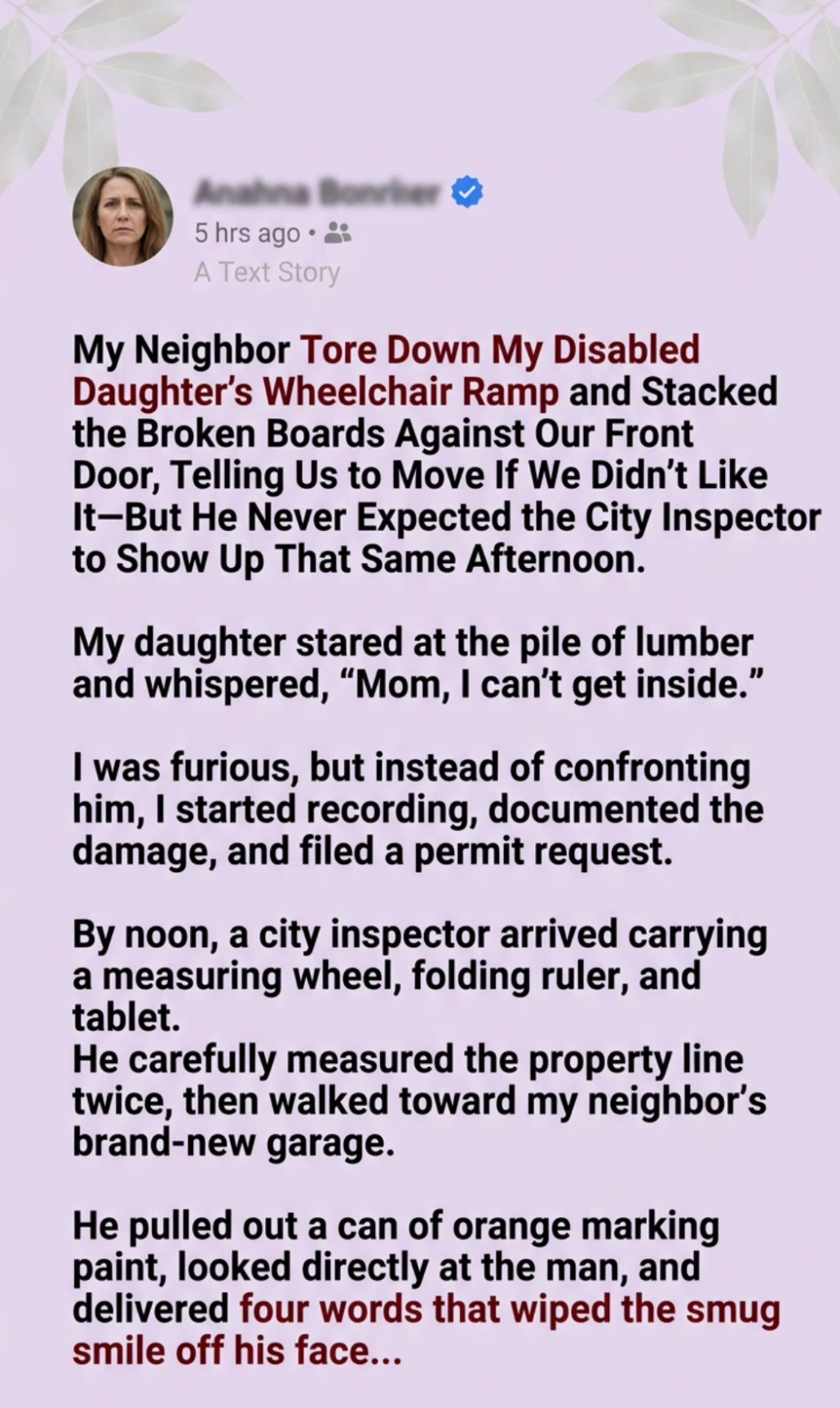
The first thing I noticed was the silence.
Usually, when my daughter Lily came home from school, I could hear the soft mechanical sound of her wheelchair moving along the wooden ramp before I even reached the front door.
That afternoon, there was nothing.
I was in the kitchen preparing lunch when I heard a strange scraping noise outside. It sounded like someone dragging heavy furniture across the driveway.
Then Lily called out.
“Mom?”
Something about her voice made me drop the knife I was holding.
I rushed toward the front window.
Lily was sitting in her wheelchair at the bottom of our porch steps. Her schoolbag rested across her lap, and her hands were gripping the wheels.
In front of her was a pile of broken lumber.
Our wheelchair ramp had been torn apart.
The boards were stacked against the front door, blocking the entrance. Several screws and metal brackets were scattered across the concrete. One of the handrails had been bent almost in half.
I ran outside.
“Lily! Are you hurt?”
She shook her head.
“No, Mom.”
Her eyes were fixed on the wooden pieces.
“I can’t get inside.”
I looked at the destroyed ramp, then toward the neighboring property.
My neighbor, Gordon Price, stood beside his newly built garage, holding a cordless drill.
He was smiling.
“What happened here?” I demanded.
Gordon shrugged.
“Cleaned up the mess.”
“That was my daughter’s wheelchair ramp!”
“It was sitting too close to my property.”
“You didn’t even speak to me.”
“I shouldn’t have to ask permission to protect my own land.”
I stared at him.
“You destroyed an accessibility ramp without warning. My daughter cannot get into her own house.”
Gordon looked at Lily.
Then he looked back at me.
“Maybe you should have thought about that before building something that close to the boundary.”
I felt my face grow hot.
“Help me understand something. You deliberately blocked our front door?”
He folded his arms.
“I put the boards where they belong. If you don’t like it, move.”
Lily lowered her head.
That was when I realized Gordon wasn’t simply being unreasonable.
He wanted us to feel powerless.
And he had chosen the one thing he knew we depended on.
Our ramp.
I wanted to scream at him.
I wanted to throw every broken board back into his yard.
But Lily was watching me.
So I took a breath, pulled out my phone, and started recording.
“Gordon, I’m documenting the damage to our property and the obstruction of our entrance. Please don’t touch anything else.”
He laughed.
“Go ahead. Call whoever you want.”
I did.
But not before making sure my daughter was safe.
The ramp that gave my daughter independence
My name is Laura Bennett.
I was forty-three years old, and my daughter Lily was fourteen.
When Lily was six, a serious spinal condition left her with limited mobility. After years of treatment and rehabilitation, she learned to use a wheelchair independently.
She was determined, funny, stubborn, and far more courageous than most adults I knew.
She hated being treated as though she couldn’t make her own decisions.
The ramp outside our home had been one of the most important improvements we had ever made.
Before it was installed, Lily needed someone to help her navigate the front steps. Even entering our house required planning.
The ramp changed that.
It gave her the freedom to come home from school, visit the garden, and leave whenever she wanted without waiting for someone to carry her or arrange special assistance.
We had hired a licensed contractor to design and install it.
The work had been completed after the required local approvals and inspections.
The ramp included a proper slope, handrails, a level landing, and a nonslip surface.
It wasn’t something I had thrown together with leftover wood.
It was a professionally built accessibility feature.
Gordon had known this from the beginning.
When he first moved into the house next door, he had even complimented the ramp.
“Smart design,” he had said once.
But things changed when he decided to build a large detached garage behind his house.
His new structure was almost twice the size of the old one.
It had a workshop, storage space, and a concrete driveway.
During construction, I noticed that his contractors were working very close to our boundary.
I didn’t interfere.
I assumed the necessary approvals had been obtained.
Then, three weeks before the ramp was destroyed, Gordon came to my door.
“I need you to move that ramp.”
I looked at him.
“Why?”
“It’s interfering with my plans.”
“The ramp was approved.”
“I don’t care. It’s too close.”
I told him I would review the property documents, but I wasn’t going to remove an accessibility feature without a legitimate reason.
He became irritated.
“You people always think the rules don’t apply to you.”
I asked what he meant.
He walked away without answering.
I should have recognized that something worse might happen.
But I never imagined he would take a power tool to the ramp while my daughter was at school.
The first report
After helping Lily enter the house through the side entrance with assistance from a neighbor, I called the police non-emergency line.
I explained that someone had dismantled an accessibility ramp attached to my property and left the materials blocking our front entrance.
The dispatcher asked whether there had been threats or injuries.
I said there had been no physical injury, but the damage had left my daughter unable to use the normal entrance to her home.
An officer was sent to document the incident.
While waiting, I photographed everything.
I took pictures of the broken handrails, the exposed screws, the damaged landing, and the pile of lumber against our door.
I also recorded a short video showing the original location of the ramp and Gordon standing beside the garage.
When the officer arrived, he spoke to both of us.
Gordon claimed the ramp had crossed the property line.
I explained that it had been installed by a licensed contractor and that I had the original plans and approval records.
The officer examined the damage.
“Do you have documentation showing where the property boundary is?”
“Yes.”
“Keep those records. Don’t argue with him. We’ll document what happened, and you should contact the city building and property departments.”
Gordon laughed from his driveway.
“She’s making a big deal out of nothing.”
The officer looked at him.
“Destroying someone else’s property is not nothing, sir.”
Gordon stopped smiling.
The officer gave me an incident reference number and advised me to preserve all photographs, videos, contractor records, and receipts.
After he left, I called the company that had installed the ramp.
The owner, a contractor named David Reynolds, answered.
When I explained what happened, he was silent for several seconds.
“Laura, that ramp was installed according to the approved plans. I still have the inspection photographs.”
“Can you send them to me?”
“Immediately.”
He also offered to come over and assess the damage.
I thanked him.
Then I contacted the city’s building department and accessibility office.
I submitted a complaint with photographs and copies of the original ramp approval.
I also requested an urgent inspection because the destruction had left Lily without a safe accessible entrance.
The person who received my complaint asked whether the neighboring property was undergoing construction.
“Yes. A large detached garage.”
“Do you know whether that garage has been inspected?”
“I don’t know.”
She paused.
“Please include photographs showing the location of the garage and any work close to the property boundary. An inspector may need to review both structures.”
That caught my attention.
I had been so focused on the destroyed ramp that I hadn’t considered whether Gordon’s garage itself complied with the approved plans.
I sent everything.
Then I waited.
The orange paint
At 11:48 that morning, a city vehicle pulled into our driveway.
A man stepped out carrying a tablet, a measuring wheel, and a folding ruler.
He introduced himself as Martin Hayes, a building and property compliance inspector.
“Mrs. Bennett?”
“Yes.”
“I received your complaint. I’d like to see the ramp location and the neighboring structure.”
I showed him the photographs first.
He examined the original plans, then walked around the front of the house.
He studied the remaining attachment points.
He measured the distance between the house and the boundary markers.
Then he examined the broken boards.
“Who removed this?”
“My neighbor. He said it was too close to his property.”
Martin nodded.
“Did he provide a survey?”
“Not to me.”
“Did he give you any written notice?”
“No.”
He took several photographs.
Then he asked to see the garage.
Gordon appeared almost immediately.
“What’s going on?”
Martin introduced himself and explained that he needed to inspect the garage’s exterior placement.
Gordon’s expression changed.
“Why?”
“We received a complaint involving the boundary and a damaged accessibility structure.”
Gordon looked at me.
“You called the city?”
“Yes.”
He laughed.
“She’s trying to get me in trouble because I cleaned up her illegal ramp.”
Martin didn’t respond to the insult.
He opened his tablet and reviewed the approved site plan.
Then he walked toward the side of Gordon’s garage.
He rolled the measuring wheel along the concrete.
He checked the distance from the exterior wall to the boundary marker.
Then he measured again.
This time, he used the folding ruler to check the position of a corner footing.
He looked at the tablet.
He looked at the garage.
Then he pulled a can of orange marking paint from his inspection bag.
Gordon frowned.
“What are you doing?”
Martin marked a small point on the concrete near the garage’s corner.
Then he looked directly at Gordon.
“Your garage crosses the boundary.”
Gordon’s smile disappeared.
“What?”
Martin checked his tablet once more.
“Your approved site plan does not match the structure currently standing here. The measured position indicates that part of this garage extends onto the neighboring parcel.”
Gordon stepped closer.
“That is impossible.”
Martin pointed to the orange mark.
“That’s the boundary reference. We need a licensed surveyor to establish the exact line, but the measurements indicate a serious encroachment.”
Gordon turned toward me.
“This is ridiculous.”
Martin remained calm.
“Sir, I am not making a final ownership determination. I’m documenting a potential violation. You will receive a written notice requiring the matter to be reviewed.”
Gordon’s face had turned red.
“You can’t tell me to tear down my garage.”
“I haven’t told you that.”
“You just marked it!”
“I marked the location for further verification.”
Then Martin added something that made Gordon go completely quiet.
“The structure may also have been built outside the approved setback.”
I looked at the garage.
For the first time, I noticed that its rear corner seemed much closer to our property than the plans showed.
Gordon had spent weeks insisting that our ramp was too close to his land.
Now the city was investigating whether his own garage had crossed into ours.
But Martin wasn’t finished.
He asked Gordon to provide the building permit, approved site plan, and inspection records.
Gordon went inside to find them.
When he returned, he handed over a folder.
Martin studied the documents.
Then he looked up.
“Sir, this permit authorizes a smaller structure in a different position.”
Gordon snatched the papers back.
“That plan was changed.”
“Do you have the approved revision?”
Gordon said nothing.
Martin entered something into his tablet.
“I’ll need to review the full permit history.”
What the survey revealed
Two days later, a licensed surveyor arrived.
His name was Patrick Lewis.
He had been appointed to establish the boundary using the recorded property documents and existing survey references.
I watched from my porch as he placed equipment around the two properties.
He worked carefully, checking multiple reference points.
Gordon stood near his garage, pacing.
At one point, he approached Patrick.
“You’re wasting everyone’s time. The old fence is the boundary.”
Patrick continued working.
“The fence is not necessarily the legal boundary. I’m using the recorded survey information.”
Gordon crossed his arms.
“Well, I’ve lived here long enough to know where my property ends.”
Patrick didn’t argue.
He simply continued measuring.
By the afternoon, he had completed the fieldwork.
The preliminary result confirmed that the garage extended approximately twenty-two inches over the recorded boundary at its closest point.
The encroachment affected a section of the concrete footing and part of the garage wall.
The survey also showed that the wheelchair ramp, as originally installed, remained entirely within my property.
I felt a strange mixture of relief and anger.
Gordon had destroyed something that was legally on my land because he believed it was too close to his.
Meanwhile, part of his new garage was standing on mine.
I asked Patrick whether the survey meant Gordon had to remove the structure.
He shook his head.
“That’s a legal and permitting question. My job is to establish the boundary. The city and the property attorneys will determine the next steps.”
I understood.
I didn’t want to make assumptions.
I wanted the facts documented properly.
The surveyor provided a signed report and a drawing showing the measured boundary.
I sent copies to the city and to my attorney.
Gordon received his own copy.
That evening, he came to my front door.
I opened it but kept the screen door closed.
He looked different.
The confidence was gone.
“Laura, we need to talk.”
“About what?”
“The survey.”
“What about it?”
He rubbed his forehead.
“I think there’s been a misunderstanding.”
I stared at him.
“You told me my ramp was on your land.”
“I thought it was.”
“You destroyed it without checking.”
“I was trying to protect my property.”
“You didn’t have the right to do that.”
He glanced toward the side entrance.
“Look, I have a lot of money tied up in that garage. If the city makes me change it, it’ll cost a fortune.”
I said nothing.
He continued.
“Maybe we can work something out.”
I shook my head.
“What exactly are you asking me to work out?”
“Perhaps we can agree on a boundary adjustment.”
I almost laughed.
“You want me to give you part of my property after you destroyed my daughter’s ramp?”
“I didn’t know it was going to become this complicated.”
“It was never complicated. You should have spoken to me before touching anything.”
Gordon looked down.
“I can pay for a replacement ramp.”
“That doesn’t settle the property issue.”
“Then what do you want?”
I looked directly at him.
“I want my daughter’s access restored. I want the damage paid for. And I want the property boundaries respected.”
He nodded slowly.
“Fine.”
I closed the door.
For the first time since the incident, I felt that he understood I wasn’t going to be bullied into silence.
The second inspection
The city returned the following week.
Martin Hayes brought another inspector, this time from the planning and zoning department.
They reviewed the garage permit and the survey report.
The problem was more serious than the initial measurements had suggested.
Gordon’s contractor had constructed the garage using an outdated drawing.
A revised plan had been submitted during the approval process, but the contractor had apparently continued working from an earlier version.
The revised plan required the garage to be moved farther from the boundary.
That hadn’t happened.
The inspectors also discovered that the garage’s roof overhang and a drainage channel had been built in a way that directed rainwater toward my property.
There were no immediate findings of structural danger, but the city issued a formal notice requiring Gordon to address the permit discrepancies and correct the drainage problem.
He was instructed not to perform further exterior construction until the review was complete.
The notice did not automatically require demolition.
It gave him a period to submit a correction plan and obtain the necessary approvals.
Gordon was furious.
He blamed the contractor.
The contractor blamed the outdated drawings.
The city refused to accept either explanation as a reason to ignore the violation.
Meanwhile, my attorney sent Gordon a formal demand for compensation for the damaged ramp.
We included:
-
The original installation contract.
-
The accessibility approval documents.
-
Photographs taken before and after the destruction.
-
The contractor’s assessment of the damage.
-
The police incident reference.
-
The survey report.
The replacement estimate was $8,750.
That included rebuilding the ramp, replacing the damaged handrails, restoring the landing, and installing stronger protective hardware.
Gordon initially refused to pay.
He claimed the ramp had been an obstruction.
But the survey had established that it was on my property, and the original approval documents supported its lawful installation.
After his attorney reviewed the evidence, Gordon’s position changed.
He agreed to pay the replacement cost and cover the additional inspection expenses through a written settlement.
The city continued its separate review of his garage.
I didn’t ask for more than I was entitled to.
I simply wanted my home restored and my daughter protected.
My daughter asks the question
While the legal and inspection matters were being handled, Lily stayed with my sister for several days.
She didn’t like being away from home.
She missed her bedroom, her books, and the little garden she had planted beside the porch.
I visited her every afternoon.
One evening, she asked me something that broke my heart.
“Mom, did Mr. Price destroy the ramp because he doesn’t like me?”
I sat beside her.
“Why would you think that?”
She shrugged.
“He always looks annoyed when I come outside.”
I took her hand.
“Listen to me. What happened wasn’t your fault.”
“But he said we should move.”
“He had no right to say that.”
Lily looked down at her wheelchair.
“I don’t want people to think I’m a problem.”
I felt tears gathering in my eyes.
“You are not a problem. The ramp is not a problem. Your wheelchair is not a problem. You deserve to enter your home safely, just like anyone else.”
She was quiet for a moment.
“Are we going to get another ramp?”
“Yes.”
“Will it be strong?”
I smiled.
“Stronger than the old one.”
She finally smiled back.
“Can we paint the handrails blue?”
I laughed.
“We can discuss colors with the contractor.”
That was the moment I knew we were going to be okay.
Gordon could damage wood.
He could create paperwork problems.
He could make our lives difficult for a while.
But he wasn’t going to make my daughter ashamed of needing an accessible home.
The day the new ramp arrived
Three weeks later, David Reynolds and his crew arrived to rebuild the ramp.
This time, we reviewed every measurement before construction began.
The city inspector checked the plans and confirmed that the replacement would remain within the recorded property boundary.
We selected weather-resistant materials and reinforced the handrails.
The landing was widened slightly to make turning easier for Lily.
And yes, we painted the handrails blue.
On the final afternoon, David stepped back and inspected the finished structure.
“Ready for its first customer,” he said.
Lily rolled toward the entrance.
She stopped at the bottom of the ramp.
Then she looked at me.
“Are you coming?”
“I’m right behind you.”
She moved up slowly.
The wheels made a familiar sound against the wooden surface.
At the top, she turned around and smiled.
“I can get inside.”
I laughed.
“You certainly can.”
She rolled through the doorway and into the living room.
Then she called out:
“Mom! It works!”
I stood on the porch, looking at the ramp.
For several seconds, I couldn’t speak.
It was only a wooden structure.
But to Lily, it meant freedom.
It meant independence.
It meant coming home without asking permission from anyone.
Gordon’s final mistake
I thought the matter was over.
The ramp had been replaced.
The compensation had been paid.
The city had issued its notices.
But Gordon wasn’t finished.
A few days after the new ramp was completed, I received a letter from his attorney.
It proposed that I grant Gordon a permanent easement over the section of land occupied by his garage.
In exchange, he offered to cover some landscaping expenses.
I read the letter twice.
He wanted me to legally allow part of his garage to remain on my property.
I took it to my attorney.
She explained that I was under no obligation to agree.
She also warned me that granting an easement could affect the future use and value of my property.
I declined the offer.
Gordon then approached me in the driveway.
“You’re making this harder than it needs to be.”
I looked at him.
“You destroyed my daughter’s ramp. You built a garage across the boundary. The city has issued a notice. And now you want me to sign away part of my land?”
“I’m trying to find a reasonable solution.”
“Then correct the problem according to the city’s requirements.”
He shook his head.
“You don’t understand how expensive this is.”
“I understand that you should have checked before building.”
He stepped closer.
“You could make this disappear.”
I kept my voice calm.
“No. I could make it convenient for you. That’s not the same thing.”
He walked away.
I didn’t hear from him again until the city issued its final determination.
The garage had to move
After reviewing the revised plans, survey findings, and construction records, the city determined that Gordon’s garage could not remain in its existing position under the permit as approved.
He was given two options.
He could submit a compliant redesign that corrected the encroachment and setback issues, subject to approval.
Or he could remove the affected portions of the structure and rebuild according to the approved site plan.
The city did not order him to demolish the entire garage immediately.
However, he was prohibited from treating the existing encroachment as an approved permanent structure.
Gordon hired another contractor.
The corrected plan required removing part of the exterior wall, rebuilding the affected footing, relocating a section of the structure, and correcting the drainage.
The work cost him far more than it would have cost to follow the approved plans in the first place.
I didn’t celebrate.
I didn’t stand outside and laugh.
I simply watched from my kitchen window as the contractors began correcting the problem.
One afternoon, Gordon approached my porch.
He stood at the bottom of the ramp.
For a moment, I thought he might complain again.
Instead, he looked toward the blue handrails.
“Your daughter likes the new one?”
“Yes.”
He nodded.
Then he said something I hadn’t expected.
“I shouldn’t have taken the old one apart.”
I looked at him.
“No, you shouldn’t have.”
He shifted his weight.
“I was angry about the garage, and I thought you were making things difficult.”
“That didn’t give you the right to destroy something my daughter needed.”
He looked down.
“I understand that now.”
I didn’t rush to forgive him.
An apology didn’t erase what Lily had experienced.
But I accepted that he had finally acknowledged what he did.
“Please don’t touch anything on our property again,” I said.
“I won’t.”
He turned and walked back toward his house.
That was the end of our conversation.
What really mattered
Several months passed.
The garage was corrected and inspected.
The drainage was redirected.
The city closed its enforcement file after the required work was completed.
The replacement ramp remained in place.
Lily returned to her normal routine.
She started spending more time in the garden and even invited two friends over for a movie night.
One Saturday morning, I watched her roll down the ramp carrying a small watering can.
She stopped beside the flowerbeds.
“Mom, do you think these flowers will grow?”
“If you water them.”
She smiled.
“I know how to do that.”
I stood beside her.
For a while, we watched the sunlight move across the garden.
Then she said something I will never forget.
“I’m glad we didn’t move.”
I looked at her.
“Me too.”
She smiled.
“This is my home.”
I bent down and kissed the top of her head.
“Yes, sweetheart. It is.”
That evening, I sat on the porch while Lily watched a movie inside.
I thought about the day Gordon destroyed the ramp.
I remembered her sitting outside, looking at the pile of broken boards.
I remembered her whispering that she couldn’t get inside.
And I remembered the orange mark Martin Hayes had painted beside the garage.
People often assume that the most powerful moment in a dispute is when the person who acted unfairly finally faces consequences.
For me, it wasn’t.
It was the moment Lily rolled up the new blue ramp without anyone needing to carry her.
It was the moment she entered her own house independently.
It was the moment she stopped worrying that she was somehow responsible for someone else’s anger.
Gordon had thought the ramp was just a collection of boards.
He had never understood what it represented.
It was my daughter’s independence.
It was her right to come home.
And no matter how angry a neighbor became, no one had the right to take that away from her.
I had started that day with broken wood piled against my front door.
I ended it with a stronger ramp, a documented property boundary, and a daughter who knew she never had to apologize for needing access to her own home.
THE END.