It was a bright Tuesday morning at Maplewood Elementary School.
The students in Mrs. Anderson’s fourth-grade classroom were unusually energetic. Some were whispering to their friends, others were drawing in the corners of their notebooks, and a few were still trying to finish their spelling homework before the lesson began.
Mrs. Anderson stood beside the whiteboard, holding a marker.
She was a patient teacher who had learned that children often remembered lessons better when they were having fun.
“Good morning, everyone!”
“Good morning, Mrs. Anderson!” the class answered.
“Today, we’re going to play a little vocabulary game. I want you to think carefully before you answer.”
She wrote a word on the board:
PREDATOR
Then she turned around.
“Can anyone tell me what a predator is?”
Several hands went up.
“Yes, Marcus?”
“A predator is an animal that hunts other animals.”
“Excellent,” Mrs. Anderson replied. “A lion, for example, is a predator because it hunts other animals for food.”
She nodded toward the board.
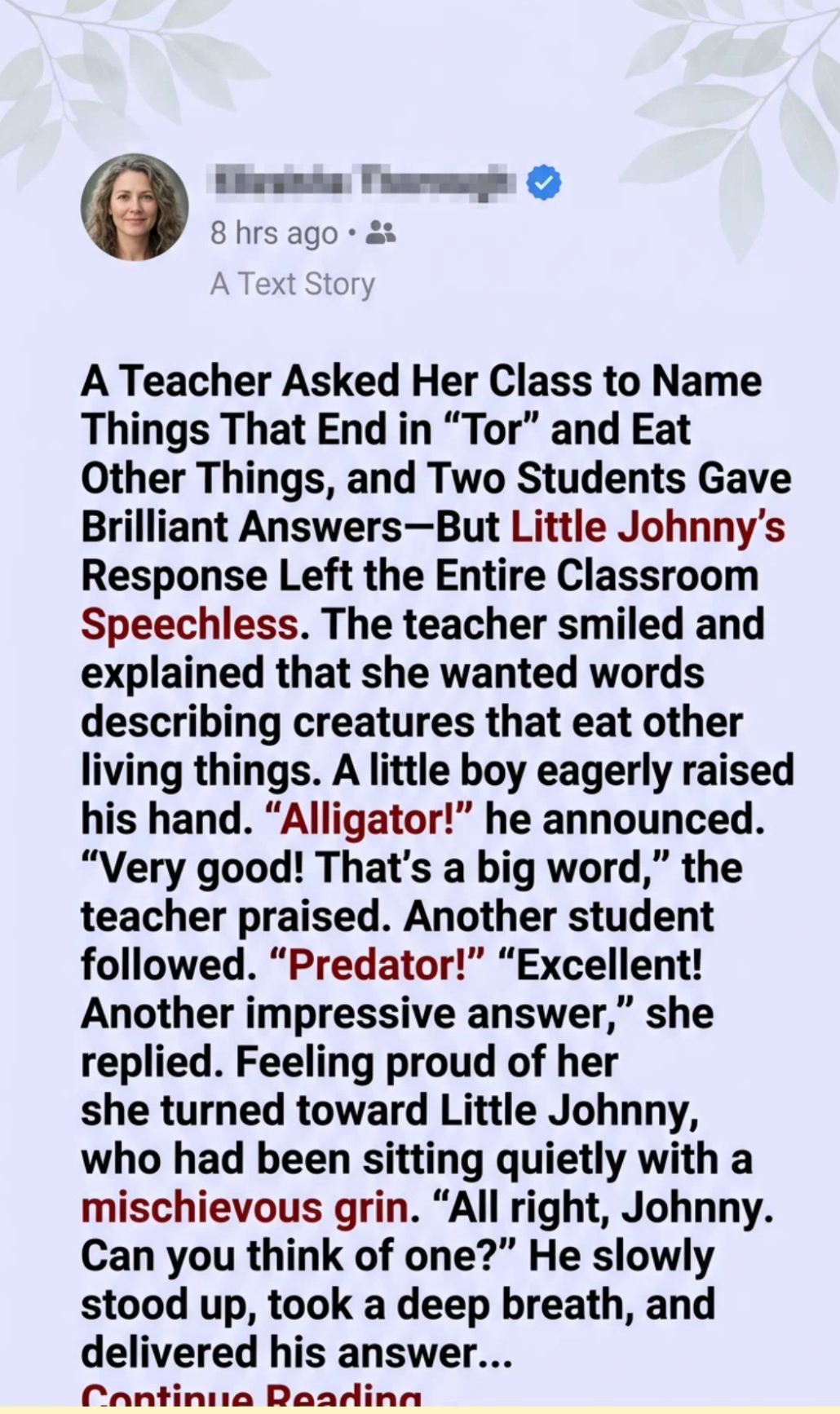
“Now, here’s the challenge. I want you to name creatures or living things that eat other living things, and their names must end with the sound ‘tor.’ Let’s see how many we can find.”
The students looked at one another.
A few began whispering possible answers.
Mrs. Anderson smiled.
“Who wants to start?”
A boy named Kevin raised his hand so quickly that his pencil fell onto the floor.
“Yes, Kevin?”
“Alligator!”
Mrs. Anderson clapped.
“Very good! An alligator is a carnivorous animal that eats fish, birds, and other animals. Excellent answer!”
Kevin sat down proudly.
Another hand immediately shot up.
“Yes, Olivia?”
“Predator!”
“Wonderful! That’s another correct word describing an animal that hunts and eats other animals.”
The class seemed impressed.
Mrs. Anderson looked around the room.
“Anyone else?”
Little Johnny was sitting near the back window.
He wasn’t writing anything.
He wasn’t looking at the board.
He was wearing a mischievous little smile that Mrs. Anderson recognized immediately.
Johnny was a bright student, but he had a habit of finding unusual answers to ordinary questions.
Sometimes his answers were surprisingly clever.
Sometimes they were completely ridiculous.
Mrs. Anderson pointed toward him.
“Johnny, you’ve been very quiet. Can you think of another word?”
Johnny slowly stood up.
He looked at the board.
Then he looked at his classmates.
He took a deep breath.
“Yes, Mrs. Anderson. I know one.”
“Wonderful! What is it?”
Johnny smiled.
“Terminator!”
The classroom went silent.
Mrs. Anderson blinked.
“Terminator?”
“Yes!”
She placed the marker on the desk.
“Johnny, can you explain how the Terminator eats other living things?”
Johnny nodded confidently.
“Easy! My dad says whenever the Terminator sees someone, he always says, ‘I’ll be back.’ And then he comes back to finish them off!”
For one second, nobody moved.
Then the entire classroom exploded with laughter.
Kevin nearly fell out of his chair.
Olivia covered her mouth.
A boy in the front row laughed so hard that he dropped his notebook.
Even Mrs. Anderson had to turn toward the whiteboard to hide her smile.
“Johnny!” she exclaimed, trying to regain control. “The Terminator is a fictional character, not an actual creature that eats other living things!”
Johnny shrugged.
“But he definitely eats up all the bad guys!”
That made the class laugh even harder.
Mrs. Anderson raised both hands.
“All right, all right! Settle down!”
The laughter slowly faded.
She turned back to Johnny.
“That’s a very creative answer, but for today’s science vocabulary, we need real animals. Can you think of another one?”
Johnny pretended to think.
He tapped his chin.
Then he raised one finger.
“Does a refrigerator count?”
Mrs. Anderson frowned.
“A refrigerator?”
“Yes. My mother says it eats everything in the kitchen. Every time we put food inside, it’s gone a few days later!”
The students started laughing again.
Mrs. Anderson pressed her lips together, trying not to smile.
“Johnny, I think your mother might be talking about your family eating the food, not the refrigerator.”
Johnny looked disappointed.
“Oh. That explains why my father keeps checking it at midnight.”
The class burst into another round of laughter.
Mrs. Anderson finally gave up trying to look serious.
She laughed along with them.
When the noise settled, she picked up the marker again.
“Johnny, I appreciate your imagination. But let’s return to the lesson. The correct scientific examples include animals such as an alligator, a predator, and a carnivore. We need to understand what the words mean, not just how they sound.”
Johnny nodded.
“Yes, Mrs. Anderson.”
“Good. Now, can someone tell me what a carnivore is?”
A girl near the front raised her hand.
“An animal that eats meat.”
“Exactly!”
Mrs. Anderson wrote CARNIVORE on the board.
Then she added another word:
HERBIVORE
“And what does an herbivore eat?”
“Plants!” the class answered together.
“Excellent.”
Johnny raised his hand again.
Mrs. Anderson looked suspicious.
“Yes, Johnny?”
“Does that mean my father is a carnivore?”
“Why would you say that?”
“Because he eats meat.”
“And what about your mother?”
“She eats vegetables.”
Mrs. Anderson nodded.
“So your father is a carnivore and your mother is a herbivore?”
Johnny shook his head.
“No, Mrs. Anderson. They’re both omnivores.”
“Very good! And why is that?”
“Because my mother eats vegetables, my father eats meat, and together they eat everything in the refrigerator!”
The classroom erupted again.
Mrs. Anderson laughed so hard that she had to put the marker down.
“Johnny, I think we have learned something important today.”
Johnny looked proud.
“What is it?”
She smiled.
“Animals eat to survive, but apparently your family eats to empty the refrigerator.”
Everyone laughed.
Johnny sat down, pleased with himself.
And Mrs. Anderson continued the lesson, knowing that her students would probably remember the difference between carnivores, herbivores, and omnivores for a very long time.
Especially the part about the refrigerator.
THE END.