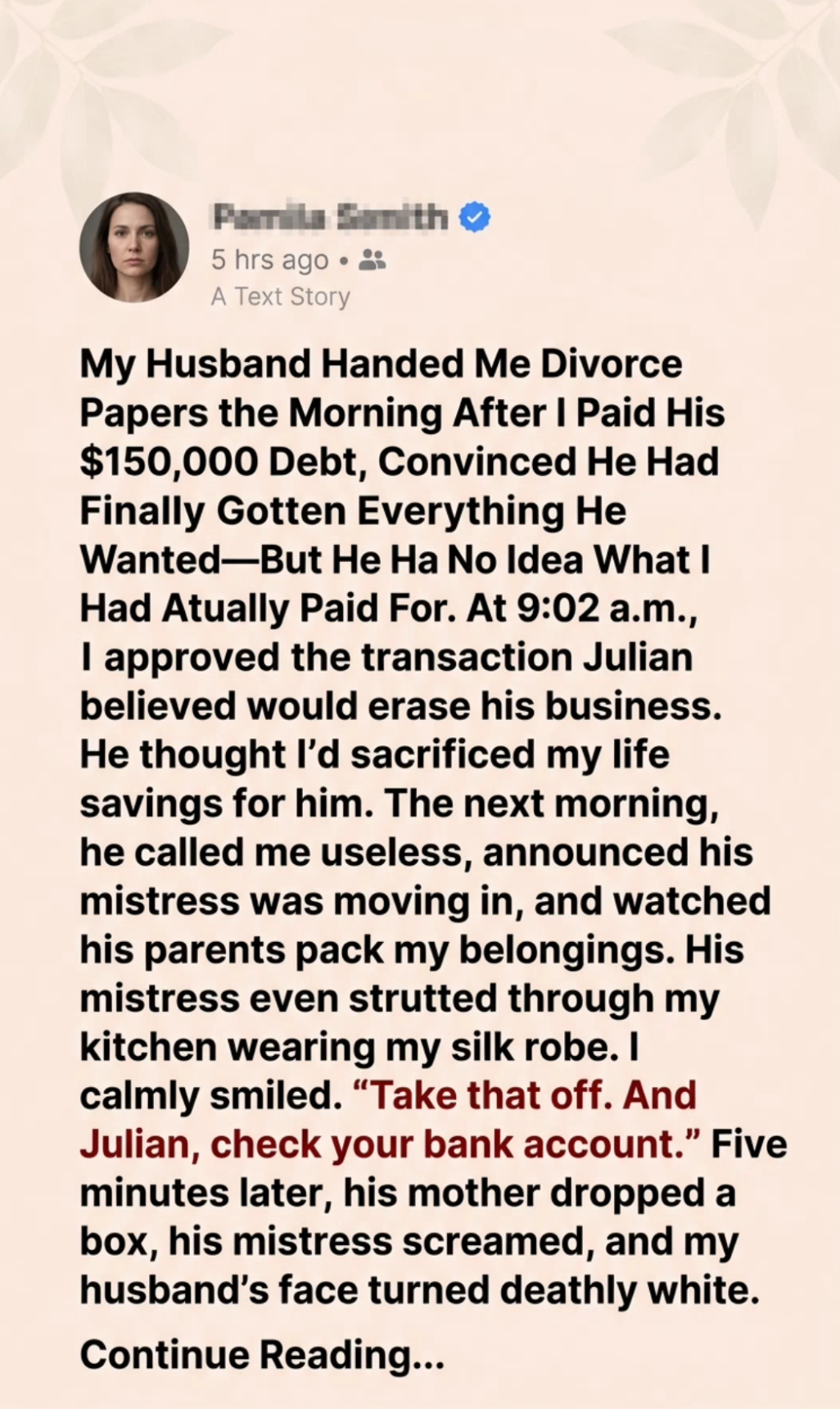
At exactly 9:02 on Tuesday morning, I approved a financial transaction worth $150,000.
My husband, Julian Hart, believed I had just emptied my life savings to rescue his failing company.
He stood behind my chair, watching the confirmation screen with a satisfied smile.
“Finally,” he said. “We can breathe again.”
I looked at him.
“Yes, Julian. Finally.”
He kissed the top of my head, something he hadn’t done in months.
“You’ve saved me, Evelyn.”
I almost laughed.
Not because the situation was funny, but because my husband had absolutely no idea what he had just agreed to.
For three years, Julian had been telling me that his business was struggling. He blamed rising costs, unreliable customers, delayed payments, and an increasingly difficult market.
I had supported him.
I had reviewed his accounts, helped negotiate with creditors, and encouraged him when he felt defeated.
When he told me his company owed $150,000 and that the debt had to be settled immediately, I agreed to help.
He thought I was using my personal savings.
He thought I was making a desperate sacrifice because I loved him.
He thought the money would erase his financial problems.
But the transaction wasn’t what he believed it was.
And the money wasn’t mine.
The next morning, at 8:15, Julian walked into our bedroom carrying a brown envelope.
He dropped it onto the bed.
“Sign these.”
I looked at the envelope.
“What is it?”
“Divorce papers.”
For several seconds, I didn’t move.
Julian loosened his tie and glanced at his watch.
“I’ve been thinking about this for a long time. We aren’t happy. There’s no point pretending anymore.”
I stared at him.
“You gave me divorce papers less than twenty-four hours after I paid your debt?”
He shrugged.
“That’s business. Don’t make everything emotional.”
Then he added the words that finally made me understand how little he respected me.
“You’ve been useless for years, Evelyn. I need someone who understands ambition. Someone who can actually help me build something.”
I heard footsteps behind him.
A woman entered our bedroom.
Her name was Vanessa.
She was thirty-two, worked as a marketing consultant, and had been Julian’s mistress for at least eight months.
She wore my silk robe.
My favorite one.
The pale champagne-colored robe I had received from my mother on my fortieth birthday.
Vanessa looked around the bedroom.
“So this is where you’ve been living?”
Julian smiled.
“This is our home now.”
I looked at the robe.
Then at him.
He continued speaking as if I were a stranger who had arrived to collect a delivery.
“My parents are coming to help you pack. Vanessa will be moving in today.”
I slowly stood.
“Your parents are coming to pack my belongings?”
“Yes. There’s no reason to drag this out.”
Vanessa walked toward the dresser and picked up one of my perfume bottles.
“Julian told me you wouldn’t make trouble.”
I smiled.
Not because I was happy.
Because I finally understood that the people standing in front of me had made a terrible mistake.
I looked at Vanessa.
“Take that off.”
She frowned.
“What?”
“The robe. Take it off.”
She laughed.
“Excuse me?”
I turned toward Julian.
“And Julian, check your bank account.”
He rolled his eyes.
“Evelyn, don’t start.”
“Check it.”
He pulled out his phone.
Five minutes later, his mother dropped the box she was carrying.
Vanessa screamed.
And Julian’s face turned deathly white.
Because the $150,000 transaction had not rescued his business in the way he imagined.
It had exposed the truth about what he owed, who controlled the debt, and what he had actually signed.
And for the first time in our marriage, Julian was the one begging me to listen.
The woman Julian thought he had married
My name is Evelyn Hart.
I was forty-two years old when my marriage ended.
I had been married to Julian for eleven years.
We met at a charity event in Chicago, where I was volunteering with a small business mentorship organization.
Julian was charming, energetic, and full of ideas.
He had recently started a commercial equipment distribution company called Hartwell Supply.
He talked about building something lasting.
He wanted to create jobs, support local manufacturers, and eventually expand into other states.
I admired his ambition.
At the time, I worked as a financial operations consultant.
My job involved helping companies organize their finances, improve cash flow, and identify risks before they became serious problems.
I wasn’t wealthy when Julian and I married, but I was financially independent.
My parents had taught me to save, avoid unnecessary debt, and understand every document before signing it.
I owned a small apartment before our wedding.
I also had investments and a consulting business that I had built over several years.
Julian knew all of this.
He never seemed bothered by it.
In fact, he often said he admired my independence.
For the first few years, our marriage was good.
We bought a house together.
We traveled.
We hosted dinners with friends.
I helped Julian improve his business operations, but I kept my own professional life.
Then his company began expanding.
He hired more employees, leased a larger warehouse, and signed several distribution agreements.
His income increased.
So did his confidence.
Eventually, he stopped asking for my advice.
He began telling me what I should do.
He suggested I reduce my consulting work because he wanted us to have a more traditional home life.
I compromised.
I took fewer clients and spent more time managing our household.
Then he started criticizing me for not contributing enough.
“You don’t understand how much pressure I’m under,” he would say whenever I asked about his finances.
I tried to be patient.
I believed marriage meant supporting each other through difficult seasons.
I didn’t realize that Julian had begun confusing my support with an obligation to obey him.
The first warning I ignored
About eighteen months before the divorce, Julian began coming home later.
He claimed he was meeting suppliers.
Sometimes he said he was working with investors.
His phone became permanently attached to his hand.
He changed his password.
He began taking calls outside.
When I asked whether something was wrong, he became defensive.
“Why are you always questioning me?”
“I’m not questioning you. I’m asking how your day went.”
“You don’t understand business.”
That sentence became his favorite response.
One evening, I noticed a restaurant charge on our joint credit card.
It was for two people at a restaurant Julian had never mentioned.
When I asked about it, he said he had taken a potential client to dinner.
I accepted the explanation.
A few weeks later, I found a hotel receipt in his car.
He said the company had paid for a room after a late meeting.
Again, I accepted it.
Then I discovered a message from Vanessa.
It appeared briefly on his tablet while I was using it to check a delivery confirmation.
I miss waking up beside you. When are you finally going to leave her?
I didn’t confront him immediately.
I wanted to know whether it was a misunderstanding.
But over the following weeks, I saw more messages.
There were photographs.
There were hotel reservations.
There were conversations about an apartment Vanessa wanted Julian to rent for them.
And there was one message that made my stomach turn.
Once her money fixes the company, we can start fresh.
I read it several times.
Her money.
I was still trying to understand what she meant when Julian came home.
I put the tablet back where I found it.
I said nothing.
Not because I was afraid of him.
Because I had learned something important.
When people believe you don’t know the truth, they often reveal much more than they intended.
The $150,000 debt
Three months later, Julian told me his company was in serious trouble.
He sat across from me at the kitchen table with several financial statements.
“The bank is threatening legal action,” he said.
“How much do you owe?”
“One hundred and fifty thousand dollars.”
I studied the documents.
The debt appeared to involve a business credit facility and several overdue obligations.
Julian said a major customer had delayed payment.
He claimed that if the debt wasn’t settled, the bank might freeze the company’s operating accounts.
He looked exhausted.
“I don’t know what else to do.”
I asked whether he had spoken to the bank.
“They won’t give me more time.”
“What about your business partners?”
“They’re not willing to put in more money.”
I examined the statements.
Something bothered me.
The figures didn’t match the records I had seen previously.
There were payments to a company called V.R. Advisory.
There were also several transfers labeled consulting expenses.
The total was significant.
“Who is V.R. Advisory?” I asked.
Julian looked up sharply.
“An external consultant.”
“For what?”
“Business development.”
“Can I see the invoices?”
He closed the folder.
“Evelyn, I don’t have time for an audit.”
“I didn’t say audit. I asked to see the invoices.”
He stood.
“Forget it. I shouldn’t have asked you.”
He walked away.
That night, I called my attorney, Rebecca Collins.
Rebecca had helped me structure my consulting company years earlier.
I explained the situation without mentioning the messages I had found.
She advised me not to transfer money or sign any documents until we understood the legal structure of the debt.
“Is this a personal guarantee?” she asked.
“I don’t know.”
“Then find out. And don’t assume that paying the creditor means your husband has become financially responsible.”
I promised I would be careful.
The next morning, I contacted an independent financial reviewer.
I also requested copies of the relevant company records through the documents Julian had already shared with me.
What I discovered was more complicated than a simple business debt.
Hartwell Supply owed money to a private commercial lender.
The lender had acquired the outstanding debt after Julian’s original bank facility had been transferred.
The current creditor was a company called Northbridge Recovery Partners.
I recognized the name.
Northbridge was one of several investment and restructuring firms managed by a financial group I had worked with for years.
And that was when I realized Julian had not told me the full story.
The company behind the debt
My consulting business had grown considerably during the years of my marriage.
I had gradually expanded into financial restructuring and private investment analysis.
Three years earlier, I had partnered with two former colleagues to establish Hartwell Capital Advisory, a separate investment and financial management company.
Despite the similar name, it had no connection to Julian’s Hartwell Supply.
We had deliberately chosen different legal structures and separate branding.
Hartwell Capital Advisory invested in distressed commercial assets, helped businesses restructure debt, and provided financial oversight to selected companies.
I held a controlling interest.
My partners handled daily operations.
I focused on major transactions and risk assessments.
Northbridge Recovery Partners was one of the firms through which our investment group managed certain commercial debt portfolios.
I was not personally responsible for every loan or collection decision.
But I did have access to the investment committee’s reports.
When I reviewed the Hartwell Supply file, I discovered that the $150,000 obligation had been purchased at a discount after the original lender decided it no longer wanted to manage the account.
The outstanding balance was approximately $150,000, including contractual interest and permitted fees.
The debt was secured by business assets and a personal guarantee Julian had signed.
It was not an imaginary debt.
But it was also not the whole story.
The financial review revealed that Julian had used company funds to make payments to V.R. Advisory.
That company was registered to an address associated with Vanessa.
The payments were described as marketing and consulting expenses.
Some had no supporting invoices.
Others appeared to relate to personal travel and accommodation.
There were also transfers to an account that had no obvious business purpose.
The financial reviewer did not conclude that every payment was improper.
But the documentation was inadequate, and several transactions required explanation.
I had a choice.
I could tell Julian what I had discovered.
Or I could let the independent review continue and protect myself from being drawn into whatever he had done.
I chose the second option.
I didn’t want revenge.
I wanted the facts.
What I actually paid for
The next day, Julian came to me again.
He looked desperate.
“Evelyn, I need your help.”
I closed my laptop.
“What happened?”
“The lender is giving me one final opportunity. If I settle the debt tomorrow, they’ll close the account.”
“How much?”
“One hundred and fifty thousand.”
I looked at him.
“Have you read the settlement terms?”
“Yes.”
“Have you reviewed the release conditions?”
“Yes.”
“Is the personal guarantee included?”
He hesitated.
“They said the debt will be settled.”
“That wasn’t my question.”
He rubbed his forehead.
“Can you please just help me?”
I agreed to arrange a payment, but only after Rebecca reviewed the documents.
She discovered that the lender was willing to accept a negotiated settlement, provided the funds cleared and the agreement was executed correctly.
I instructed my financial team to prepare the transaction.
The payment would not come from my personal savings.
It would come through a properly documented settlement arrangement involving the debt portfolio.
The investment committee approved the transaction based on its commercial merits.
The payment would close the outstanding obligation and release the relevant security interests once the settlement conditions were fulfilled.
But there was another detail.
Julian had signed a separate acknowledgment confirming the accuracy of his company’s financial disclosures and agreeing to cooperate with the review of certain transactions.
That agreement did not make him guilty of anything.
It simply required him to provide the records and explanations that had been requested.
He signed it without carefully reading the attached schedule.
At 9:02 a.m., the payment was approved.
Julian believed I had sacrificed my savings.
He believed he had escaped his debt.
What he didn’t understand was that the settlement was part of a larger financial review.
The debt was being resolved.
The questions about the missing records were not.
The morning he brought the divorce papers
The next morning, Julian entered our bedroom with the envelope.
He looked unusually confident.
“Sign these.”
I read the first page.
He was requesting a divorce and proposing that we divide our marital assets according to his lawyer’s draft.
The document also claimed that he had independently managed his company and that I had no interest in its business operations.
I looked up.
“Who prepared this?”
“My attorney.”
“Does your attorney know about yesterday’s settlement?”
“Of course.”
“Does he know about the outstanding financial review?”
Julian frowned.
“What review?”
I closed the envelope.
“You should ask him.”
He became impatient.
“Evelyn, I don’t want another discussion about the company. We’re finished.”
Vanessa entered wearing my robe.
Then Julian told me she would be moving into the house.
His parents arrived less than ten minutes later.
His mother, Patricia, carried two empty cardboard boxes.
His father, Robert, followed with a suitcase.
Patricia had always been polite to me when Julian was present.
Without him, she could be cruel.
She looked at the bedroom.
“Oh, this is going to take longer than I thought.”
I watched her pick up a framed photograph of my parents.
“Please put that down,” I said.
She ignored me.
Vanessa opened my wardrobe.
“Julian said I could have the larger closet.”
I turned toward her.
“That’s my closet.”
She smirked.
“Not for long.”
I walked over and took the photograph from Patricia.
Then I looked at Julian.
“Before anyone packs anything else, I want you to check your bank account.”
He laughed.
“Why?”
“Because you should know what happened after yesterday’s payment.”
He pulled out his phone.
At first, he looked confused.
Then he refreshed the screen.
His expression changed.
“What is this?”
“Read it.”
He stared at the notification.
The $150,000 debt settlement had cleared.
But the company had also received a formal notice confirming the release of the security interests only after the required conditions had been met.
Another notification appeared.
It was from his company’s accountant.
The independent reviewer had requested supporting documents for the V.R. Advisory payments and several other transactions.
Then his phone rang.
He answered.
“What?”
I couldn’t hear the caller clearly.
But I heard Julian say:
“No, that can’t be right.”
He turned away.
“Who authorized this?”
A pause.
“I’m the owner of the company!”
He listened again.
Then his voice dropped.
“Send me the report.”
He ended the call.
Vanessa stepped closer.
“What happened?”
Julian didn’t answer.
I held out my hand.
“Give me the robe.”
Vanessa stared at me.
“Are you serious?”
“Yes.”
She looked at Julian.
He was still staring at his phone.
For the first time, she seemed uncertain.
She untied the belt and removed the robe.
Patricia was holding a box near the bedroom door.
Her hands began to shake.
“What is going on?” she asked.
I looked at Julian.
“Tell them.”
He swallowed.
“Northbridge has completed the debt settlement. But they’re asking for the records behind the consulting payments.”
Vanessa’s face changed.
“What consulting payments?”
Julian looked at her.
“V.R. Advisory.”
She went pale.
Patricia dropped the box.
It hit the floor, spilling my mother’s photographs and several folded sweaters across the hallway.
Vanessa screamed.
“You said everything was taken care of!”
Julian turned toward her.
“Be quiet.”
But I wasn’t finished.
The name on the financial report
I walked to the dresser and picked up a thin folder.
I had prepared it the previous evening.
Inside were copies of the settlement documents, the independent review request, and the relevant corporate ownership records.
I placed it on the bed.
“Julian, you need to understand something. I did not pay your debt with my personal savings.”
He looked at me.
“Then whose money was it?”
“Funds managed through a financial restructuring group in which I hold a controlling interest.”
He stared.
“You own that company?”
“I am its controlling shareholder.”
He shook his head.
“That’s impossible.”
“Why?”
“Because you told me you were consulting.”
“I was consulting. I was also building a separate investment business.”
“You never told me.”
“I did tell you that I was expanding my financial work. You never asked what it involved.”
He looked at the documents.
Then he found the ownership schedule.
His face changed again.
“Evelyn Hart,” he read. “Managing partner.”
“Yes.”
He flipped through the pages.
“Northbridge Recovery Partners…”
“Is one of the firms involved in managing the debt portfolio.”
He looked up.
“So you own the company that owned my debt?”
“Not exactly. I have an interest in the investment group that controls the portfolio manager. The creditor and the advisory group are separate legal entities.”
He looked as if he didn’t understand.
I explained carefully.
“The debt was acquired by an investment vehicle. My group participates in its management and investment decisions. The settlement was approved by the committee. It was not a personal favor, and it wasn’t a gift.”
Julian’s voice cracked.
“Why would you do that?”
“Because the settlement made commercial sense, and because I wanted the debt resolved without destroying the business.”
He stared at me.
“And the review?”
“That is a separate matter. The creditor and the company are entitled to ask for documentation supporting transactions made with company funds.”
Vanessa stepped backward.
“Why is my company name in those documents?”
I turned toward her.
“Because V.R. Advisory received payments from Hartwell Supply.”
She shook her head.
“Those were consulting fees.”
“Then the invoices should explain the services.”
Julian looked at her.
“Vanessa, you told me you had submitted everything.”
“I did.”
“Where are the reports?”
She said nothing.
The room became very quiet.
I didn’t accuse her of stealing money.
I didn’t claim the transfers were criminal.
I simply pointed to the records.
“The reviewer has requested the contracts, invoices, work products, and supporting documentation. If the services were legitimate, the documents should establish that.”
Julian looked at the floor.
For the first time, he seemed to realize that I had not rescued him from consequences.
I had helped resolve a debt while leaving the facts available for independent examination.
And now those facts were catching up with him.
His parents learned the truth
Patricia slowly picked up the box she had dropped.
“Evelyn,” she said, “I think there has been a misunderstanding.”
I looked at her.
“What misunderstanding?”
She glanced toward Julian.
“We didn’t know you were involved in all this.”
“You didn’t ask.”
“We thought Julian had paid his debt with your money.”
“He didn’t.”
She lowered her voice.
“Then perhaps we should all calm down.”
I almost smiled.
The previous evening, she had called me an obstacle to her son’s happiness.
Now she wanted calm.
Robert walked into the bedroom.
“Julian, what’s happening with the business?”
Julian handed him the phone.
His father read the message.
Then he looked at Vanessa.
“Why are your consulting payments in this report?”
Vanessa crossed her arms.
“I don’t have to explain my business to you.”
Robert frowned.
“You’re receiving money from my son’s company. You should be able to explain it.”
Julian sat on the edge of the bed.
“Dad, please.”
Robert looked at me.
“Can you give us a few minutes?”
“No.”
He appeared surprised.
“This is a family matter.”
“It became a financial matter when you arrived to remove my belongings.”
Patricia looked embarrassed.
I continued.
“You can take Julian’s belongings if he asks you to help. But nobody is taking my property, and nobody is entering my personal office or touching my financial records.”
Robert nodded slowly.
“That’s fair.”
Vanessa picked up her handbag.
“I’m leaving.”
Julian looked at her.
“Where are you going?”
She didn’t answer.
She walked out of the bedroom, still wearing her own clothes.
For the first time, the woman who had imagined herself moving into my home looked as though she wasn’t sure she wanted to be there.
The investigation Julian never expected
Over the next several weeks, the financial review continued.
Julian hired a new attorney.
Vanessa hired one too.
The independent reviewer examined the payments to V.R. Advisory and found that some expenses had adequate documentation while others did not.
There were invoices for marketing consultations.
There were travel charges.
There were payments that appeared to have no clear connection to the company’s operations.
The reviewer asked for further explanations.
Vanessa eventually provided additional documents.
Some were accepted.
Others remained disputed.
The review did not establish that she had committed a crime.
But it did reveal serious weaknesses in Julian’s financial controls.
He had approved payments without requiring adequate supporting records.
He had allowed personal and business expenses to become mixed.
He had also signed several financial statements without carefully reviewing the underlying figures.
The company needed restructuring.
Julian had to replace his bookkeeper, hire an independent controller, and negotiate revised payment terms with several suppliers.
The debt settlement remained valid.
The $150,000 obligation had been resolved according to the agreement.
But his business was no longer the effortless success he had described to his friends.
Meanwhile, our divorce proceedings moved forward.
Rebecca represented me.
She reviewed the proposed division of marital property and challenged several assumptions in Julian’s draft.
The house had been purchased during our marriage, but part of the down payment came from funds I had owned before the wedding.
Our financial records were clear.
My investment company was also a separate business, established and funded independently.
It was not automatically marital property simply because I was married to Julian.
The lawyers worked through the details.
We agreed on a fair division of the assets that legally belonged to both of us.
I refused to use the financial review as leverage in the divorce.
I wanted the proceedings handled properly.
Julian had made his choices.
I would make mine without becoming the person he had accused me of being.
The day Julian came back
Three months after he handed me the divorce papers, Julian asked to meet.
We chose a quiet café near the courthouse.
He arrived early.
He looked thinner.
His suit was wrinkled, and he had dark circles beneath his eyes.
“Thank you for coming,” he said.
I placed my handbag beside the chair.
“What do you want to discuss?”
He looked at me for several seconds.
“I made a mistake.”
I waited.
“I thought you were going to destroy me.”
“I didn’t.”
“I know.”
He lowered his head.
“Vanessa left.”
I said nothing.
“She moved out after the review started. She said she didn’t want to be involved in my business problems.”
“I’m sorry you’re going through that.”
He gave a bitter laugh.
“Don’t pretend you care.”
“I can care that you’re struggling without wanting to be married to you.”
He looked at me.
“I thought you would fight for me.”
“I did fight for you, Julian. For years.”
He rubbed his forehead.
“I know.”
“No. You know I helped you pay a debt. You don’t understand what it cost me to keep believing in someone who was lying to me.”
He stared at the table.
“I was going to tell you about Vanessa.”
“When?”
He didn’t answer.
“Before or after she moved into our house?”
He closed his eyes.
“I was selfish.”
“Yes.”
“I thought the money would solve everything.”
“It solved one debt. It couldn’t solve your decisions.”
He looked up.
“Can we start over?”
I took a breath.
“Why?”
“Because I still love you.”
I looked at him for a long moment.
“Do you love me, or do you miss the person who kept your life together?”
He didn’t respond.
I continued.
“You wanted me to be your wife when you needed support. You wanted me to be invisible when you wanted a different woman. And when you thought I had nothing left to offer, you handed me divorce papers.”
He lowered his eyes.
“I know.”
“I won’t go back to that marriage.”
He nodded slowly.
For the first time, he didn’t argue.
The woman who started again
The divorce was finalized several months later.
I kept my consulting business and my ownership interests in the investment group.
The house was sold, and the proceeds were divided according to the settlement.
I moved into a smaller property near a park.
It had large windows, a quiet kitchen, and a spare room I turned into an office.
I returned to consulting full-time.
I also began mentoring women who wanted to establish independent financial lives.
I didn’t tell them to distrust their husbands.
I told them to understand their finances.
Know what you own.
Know what you owe.
Read the documents.
Keep records.
And never confuse love with surrendering your ability to make decisions.
A year after the divorce, I received a letter from Julian.
He had sold part of Hartwell Supply and brought in a new operating partner.
The company was smaller, but it was stable.
He wrote that he had begun working with a business adviser and was learning to separate personal emotions from financial decisions.
He also apologized for the way he had treated me.
I read the letter twice.
Then I placed it in a drawer.
I didn’t need to answer.
Not every ending requires a final conversation.
The truth about the $150,000
On the anniversary of the settlement, I sat in my office reviewing an investment report.
The $150,000 transaction appeared in the historical records.
It reminded me of the morning Julian had watched the confirmation screen and called me his savior.
He had believed I was giving away everything I had.
He had believed that paying his debt meant I would remain tied to him forever.
But the truth was much simpler.
I had approved a commercial settlement because it was financially reasonable.
I had protected my interests through proper documentation.
And I had refused to let his betrayal turn me into someone careless or vindictive.
The transaction had not bought his love.
It had not purchased his loyalty.
It had not saved our marriage.
It had simply closed one debt and revealed several truths that had been hidden behind it.
I closed the report.
Outside, the afternoon sun was shining through the office windows.
My phone rang.
It was Rebecca.
“Evelyn, how are you?”
“I’m good.”
“Are you sure?”
I smiled.
“Yes. Better than I’ve been in years.”
She laughed.
“Then I suppose we did our job.”
After we hung up, I walked to the window.
For years, I had thought strength meant holding everything together.
I thought being a good wife meant absorbing disappointment, protecting a struggling husband, and giving someone another chance whenever they promised to change.
Now I understood something different.
Sometimes strength means allowing a person to face the consequences of their own decisions.
And sometimes the greatest financial decision you can make is refusing to invest another day in a relationship that has already spent everything you gave it.
Julian had believed that the morning he handed me divorce papers was the morning he finally became free.
He was right about one thing.
That morning, someone did become free.
It was me.
THE END.