At forty years old, I married a man I barely knew how to love.
Not because I was secretly romantic.
Not because I believed in fairy tales.
And certainly not because I had finally found the man I had spent my entire life dreaming about.
I married Daniel Hayes because I was tired.
Tired of attending weddings alone. Tired of pretending I didn’t notice the sympathetic expressions people gave me when they asked whether I was seeing anyone. Tired of watching my mother grow older while worrying that I would spend the rest of my life by myself.
Most of all, I was tired of hearing the same sentence every time I visited her.
“Margaret, I won’t be here forever. I just want to know you’ll have someone.”
My name is Margaret Ellis. I was forty years old, worked as an administrator at a small accounting firm, and lived in a quiet apartment outside the city.
I had never been married.
I had dated two men seriously, but neither relationship had lasted. One moved overseas. The other told me he wasn’t ready to build a future with anyone.
After that, I stopped trying so hard.
I built a comfortable life. I had friends, a steady job, a small garden on my balcony, and a mother who loved me more than anyone in the world.
But my mother, Eleanor, had a different definition of a comfortable life.
She believed a woman needed a husband.
She never said it cruelly. She simply worried.
Whenever I visited, she would ask whether I had met anyone.
Whenever I attended a family gathering, she would quietly introduce me to someone’s divorced cousin or unmarried neighbor.
I used to laugh.
Eventually, I stopped laughing.
Then, one Sunday afternoon, I met Daniel.
It happened at a community fundraising event organized by the church near my mother’s house.
I was helping arrange donated books when I noticed a man struggling to carry a box of folding chairs.
He was tall, perhaps forty-three, with dark hair beginning to turn gray around his temples. He wore a simple blue shirt and walked with a noticeable limp.
One leg seemed stiffer than the other.
I hurried over.
“Would you like some help?”
He smiled.
“I’d appreciate it. These chairs are heavier than they look.”
We carried the box together.
His name was Daniel Hayes.
He worked as a building inspector for the local council and volunteered at the church whenever he could.
He wasn’t particularly talkative, but he had a calm manner that made conversation easy.
When I asked about his leg, he explained that he had suffered a serious injury in a construction accident several years earlier.
“The doctors repaired what they could,” he said. “I can walk, work, and live independently. I just don’t move as quickly as I used to.”
I nodded.
He didn’t sound bitter.
He didn’t ask for sympathy.
That was the first thing I noticed about him.
The second was that he listened.
When I spoke, he didn’t interrupt to tell me something about himself. He looked at me, considered what I said, and responded thoughtfully.
Before leaving, he asked whether I would like to have coffee sometime.
I agreed.
I didn’t feel butterflies.
I didn’t imagine a future.
But I enjoyed his company.
And that was enough to begin with.
Over the next three months, Daniel and I met regularly.
We had coffee at a small café near the river. We went to weekend markets. Sometimes we walked through the botanical gardens, although Daniel preferred taking the flatter paths.
He told me about his childhood, his work, and his father, who had died when Daniel was twenty-six.
He had never married.
When I asked why, he simply said that life had taken a different direction.
I didn’t push him.
He was careful with me.
If we walked somewhere crowded, he stayed close enough that I wouldn’t lose him in the crowd. If I mentioned being tired, he suggested sitting down. If it rained, he carried an umbrella without making a fuss.
He never held my hand unexpectedly.
He never kissed me without asking.
And he never told me he loved me.
Not once.
At first, I assumed he was simply reserved.
Then my mother began asking questions.
“Is he serious about you?”
“I think so.”
“Has he talked about marriage?”
“Not really.”
“Margaret, you’re forty. You shouldn’t spend another year wondering whether a man wants a future with you.”
I knew she was worried.
But I also knew Daniel wasn’t the sort of man who made promises simply to keep someone happy.
One evening, after dinner, I asked him directly.
“Daniel, what are you looking for?”
He placed his fork down.
“I’d like a wife. Someone to share ordinary life with. Someone I can care for and who can care for me.”
“Do you think I could be that person?”
He looked at me for a moment.
“I think you could.”
“Are you in love with me?”
He didn’t look away.
“I care about you deeply. But I don’t want to tell you something just because you expect to hear it.”
His honesty hurt more than I wanted to admit.
I looked down at my plate.
“Then perhaps we should stop seeing each other.”
He nodded slowly.
“If that’s what you want, I won’t pressure you.”
There was no argument.
No dramatic speech.
He simply paid for dinner and drove me home.
I watched him walk away with his familiar limp and wondered why a man who seemed so considerate could make me feel so uncertain.
Two weeks later, my mother collapsed in her kitchen.
It wasn’t a major medical emergency, but she had become dizzy while standing and fallen against a cabinet.
I received a call from the neighbor who found her.
I drove to the hospital immediately.
The doctors kept her overnight for observation and explained that she needed to slow down, take her medication regularly, and avoid doing too much by herself.
When I entered her room, she looked smaller than I remembered.
She held my hand.
“Don’t be frightened, sweetheart. I’m all right.”
I tried to smile.
“You scared me.”
She looked toward the window.
“I’ve been thinking about you.”
“Mom, please don’t start.”
She squeezed my fingers.
“I know you don’t need a husband to be happy. I know that. But I worry about what happens when I’m not here.”
I felt tears forming.
“You’re not going anywhere.”
“Nobody knows that.”
She paused.
“Daniel seems like a good man.”
I looked at her.
“Mom, we stopped seeing each other.”
“Why?”
“Because I don’t think he loves me.”
My mother was quiet for a while.
Then she said something I remembered for a long time.
“Maybe you have spent so many years waiting for someone to make you feel chosen that you haven’t noticed when someone is already choosing you through his actions.”
I didn’t answer.
She continued.
“I am not telling you to marry him. I just want you to stop believing that love always arrives with grand words and excitement.”
I kissed her forehead.
But her words stayed with me.
A week later, I called Daniel.
He answered on the second ring.
“Margaret?”
“Hello. I hope I’m not disturbing you.”
“You’re not.”
I told him about my mother’s fall.
He listened carefully.
Then he asked whether she was recovering.
“She’s home now.”
“Good. I’m glad.”
There was a pause.
“Would you like me to bring some groceries over?” he asked.
I almost said no.
Then I thought about how tired I had been.
“That would be kind.”
He arrived that afternoon carrying two grocery bags and a small container of homemade vegetable soup.
I opened the door.
“You didn’t have to do all this.”
“I know.”
He placed the bags on the kitchen counter.
“How is your mother?”
“Better. Still stubborn.”
He smiled.
“That sounds familiar.”
I laughed.
For the next hour, we talked.
Before leaving, Daniel stood near the doorway.
“I’ve been thinking about what you said at dinner.”
I looked at him.
“About love?”
“Yes.”
He took a breath.
“I don’t know whether I can give you the kind of romance you imagined when you were younger. I won’t pretend to be someone I’m not.”
I remained silent.
“But I can offer honesty, loyalty, patience, and a home where you don’t have to be afraid of being yourself.”
He paused.
“If that’s not enough, I understand.”
I looked at him.
“What if I don’t know what I want anymore?”
“Then we don’t have to decide today.”
It was such a simple answer.
But it made me feel less pressured than I had felt in years.
We began seeing each other again.
This time, I stopped trying to measure every moment against an imaginary standard.
I paid attention to how he treated me.
And slowly, I realized that I looked forward to seeing him.
Four months later, Daniel asked me to marry him.
There was no elaborate restaurant reservation or expensive ring.
He took me to the botanical gardens, to a quiet bench overlooking the lake.
We had been talking about his childhood when he suddenly became quiet.
“Margaret, can I ask you something?”
“Of course.”
“Would you consider building a life with me?”
I looked at him.
He reached into his coat pocket and removed a small ring box.
“I don’t want to promise you that every day will be exciting. Some days will be ordinary. Some will be difficult. I might need help when my leg hurts, and you might need me when you’re exhausted.”
He looked directly into my eyes.
“But I want to be the person who comes home to you.”
I stared at the ring.
“Daniel, are you asking me to marry you?”
“Yes.”
I thought about my mother’s worries.
I thought about my own loneliness.
I thought about the man sitting beside me, who had never told me he loved me but had consistently shown that he cared.
I said yes.
Not because I was certain I was in love.
But because I believed we could build something honest.
My mother cried when I told her.
She hugged me and whispered:
“I hope he treats you gently.”
I smiled.
“I think he will.”
Our wedding was small.
We invited close friends, a few relatives, and several people from the church where we had first met.
Daniel wore a charcoal suit.
I wore a simple ivory dress with lace sleeves.
When he stood beside me, I noticed his limp was more pronounced than usual.
“Are you hurting?” I whispered.
“A little.”
“Do you want to sit?”
He smiled.
“Not during this.”
The ceremony was beautiful.
When the officiant asked Daniel whether he would take me as his wife, he answered clearly.
“I do.”
When it was my turn, I said the same.
He slipped the ring onto my finger.
He didn’t make a dramatic declaration of love.
He simply held my hand.
After the ceremony, people congratulated us.
My mother hugged me for a long time.
“You’re going to be all right,” she whispered.
I wanted to believe her.
That evening, Daniel and I drove to the small house he owned on the edge of town.
It was a modest two-bedroom home with a garden, a wooden dining table, and a fireplace that needed repainting.
He had decorated the bedroom with fresh flowers.
There were two glasses of sparkling water on the bedside table and a folded nightgown laid neatly on the bed.
I stood in the doorway feeling nervous.
This was my first night as someone’s wife.
I had imagined the moment many times, but never quite like this.
Daniel came into the room a few minutes later.
He noticed my expression.
“Are you all right?”
I nodded.
“Just nervous.”
He smiled gently.
“That’s understandable.”
He handed me a soft blanket.
“Here. I thought you might get cold.”
I took it.
He turned off the main light, leaving the small bedside lamp on.
Then he walked toward the bed.
I closed my eyes, waiting nervously.
But he didn’t climb into bed.
Instead, he took another blanket from the wardrobe, placed it on the floor beside the bed, and began arranging it into a makeshift sleeping space.
I sat up.
“Daniel, what are you doing?”
He looked over his shoulder.
“Making myself comfortable.”
“Why are you sleeping on the floor?”
He adjusted the pillow.
Then he turned toward me.
“Because I don’t want you to feel pressured tonight.”
I stared at him.
He continued quietly.
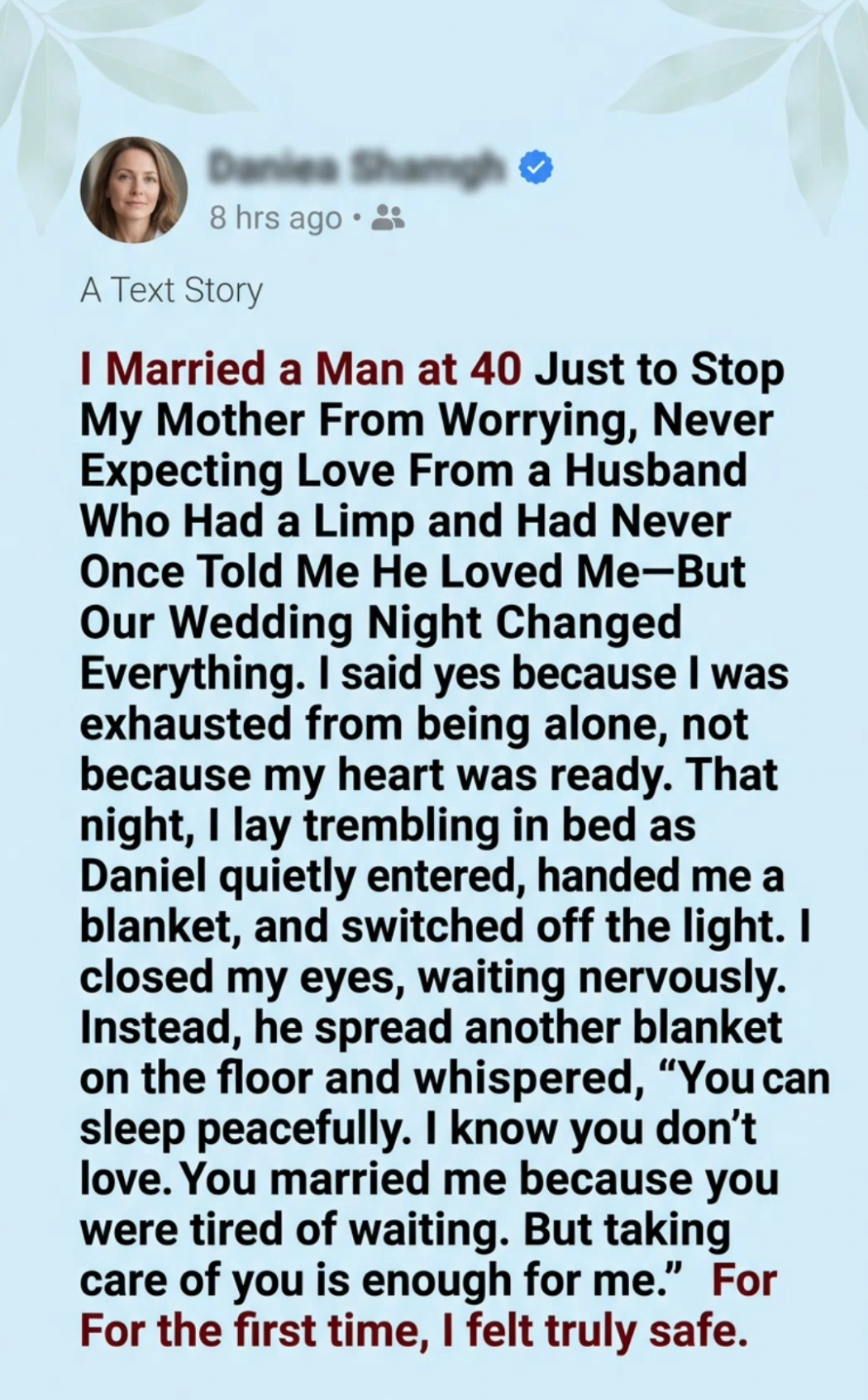
“You can sleep peacefully. I know you don’t love me. You married me because you were tired of waiting. But taking care of you is enough for me.”
I couldn’t speak.
He sat on the edge of the floor blanket.
“I don’t expect you to pretend. I don’t expect affection because we signed a marriage certificate. We can take our time.”
I felt tears gathering in my eyes.
“Daniel…”
He looked at me.
“I want you to feel safe in this house. That’s all.”
For several seconds, I simply stared at him.
I had spent so many years worrying that I would never be loved.
I had prepared myself to accept less than I wanted.
But this man, who had never once told me he loved me, was giving me something I had never experienced in any relationship.
He was giving me freedom.
Freedom to say no.
Freedom to be uncertain.
Freedom to become comfortable without owing him anything.
I climbed out of bed and walked toward him.
He looked concerned.
“Is something wrong?”
I shook my head.
Then I sat beside him on the floor.
“You’re not sleeping down here alone.”
He smiled.
“Margaret, you don’t have to—”
“I know.”
I placed my hand over his.
“That’s why I’m here.”
He didn’t move closer.
He waited.
I leaned my head against his shoulder.
For the first time that night, I felt truly safe.
The first few weeks of marriage were quieter than I expected.
Daniel woke early, made coffee, and read the newspaper at the kitchen table.
I usually slept another twenty minutes before joining him.
He never complained about my habits.
When I forgot to buy milk, he stopped at the store.
When his leg became painful after a long day, I helped him bring his work bag inside.
We learned each other’s routines.
I discovered that he liked old detective novels, hated loud television, and always checked the front door twice before going to bed.
He discovered that I talked to myself while cooking, left books open on the sofa, and became unusually quiet when something bothered me.
We were not passionate strangers who suddenly became inseparable.
We were two adults learning how to share a home.
And slowly, I began to feel something changing.
One evening, I was making dinner when I accidentally dropped a glass.
It shattered across the kitchen floor.
I froze.
My first instinct was to apologize repeatedly.
My previous relationship had involved a man who became angry over small mistakes.
Daniel heard the noise and hurried in.
“Are you hurt?”
“No. I’m sorry. I’ll clean it up.”
He immediately reached for the broom.
“Don’t move. There may be pieces near your feet.”
He carefully swept the broken glass.
Then he checked my hands.
“Are you sure you’re all right?”
I nodded.
He looked at me.
“Margaret, it’s only a glass.”
I laughed nervously.
“I know.”
“We can buy another one.”
Something about the way he said it made me cry.
He looked confused.
“What happened?”
I wiped my eyes.
“Nothing. I’m just not used to someone being so calm.”
He put the broom aside.
“You don’t have to be afraid of making mistakes with me.”
I looked at him.
He didn’t say he loved me.
But that night, I felt closer to him than I had ever felt to anyone.
About three months after our wedding, Daniel’s limp became worse.
He tried to hide it, but I noticed him pausing on the stairs and rubbing his knee when he thought I wasn’t looking.
One morning, he struggled to get out of bed.
“Daniel?”
“I’m fine.”
“You don’t look fine.”
He sat on the edge of the mattress.
“It’s just an old injury.”
I brought him a glass of water.
“Have you seen your specialist recently?”
He hesitated.
“Not in a while.”
“Why?”
He looked away.
“Appointments are expensive.”
I stared at him.
“Daniel, you have health insurance.”
“There’s still a deductible.”
I sat beside him.
“We’re married. We can plan for it together.”
He looked at me as though he wasn’t used to hearing those words.
Then he nodded.
We arranged an appointment.
The specialist explained that the original injury had caused long-term damage to the joint and surrounding tissue. Daniel needed physical therapy, better pain management, and possibly another procedure if the condition continued to deteriorate.
He wasn’t in immediate danger, but he needed to stop ignoring the problem.
When we returned home, he seemed unusually quiet.
I made tea and sat beside him.
“Are you worried?”
He nodded.
“I don’t want to become a burden.”
I took his hand.
“You’re not a burden.”
“You married a man who walks slowly. I know that.”
I looked at him.
“I married a man who treats me with respect. The limp came with the rest of you.”
He laughed softly.
I continued.
“If you need help, I’ll help. If I need help, you’ll help me. That’s what marriage is supposed to be.”
He lowered his eyes.
Then he squeezed my hand.
A month later, I discovered why Daniel had been so reluctant to talk about his accident.
I was looking for a folder containing our insurance documents when I found an old envelope in his desk.
It contained several photographs.
One showed Daniel in a hospital bed with his leg supported by a metal frame.
Another showed a younger woman standing beside him.
She had dark hair and a warm smile.
On the back of the photograph were the words:
Laura and Daniel, the day before the accident.
I put the photographs back.
I didn’t want to invade his privacy.
But that evening, I asked him about the woman.
He looked at the photograph I had found.
“Her name was Laura.”
“Your girlfriend?”
“My fiancée.”
I felt a small tightening in my chest.
Daniel sat down.
“We were engaged. The accident happened about six years ago.”
I waited.
He continued.
“I was working at a renovation site when a temporary platform failed. I fell several feet and suffered serious injuries to my leg and hip.”
He paused.
“Laura stayed with me through the hospital and rehabilitation. But after nearly a year, she told me she couldn’t live the life she had imagined with me.”
“She left?”
He nodded.
“She said she still cared about me, but she didn’t want to spend the rest of her life planning everything around an injury.”
I felt sorry for him.
“That must have hurt.”
“It did.”
He looked at the photograph.
“But I understood that she had the right to choose her future.”
“Did you love her?”
“Yes.”
I looked down.
He noticed my expression.
“Margaret, I don’t want you to think you’re competing with someone from my past.”
“I’m not.”
“I’ve never compared you to her.”
He placed the photograph back in the envelope.
“After Laura left, I decided I would never make someone feel obligated to stay with me. I thought that if I ever married again, I would need to be certain the woman wanted the life we could actually have.”
I understood then why he had been so careful.
His kindness wasn’t simply his personality.
It was something he had chosen after being hurt.
I moved closer.
“Daniel, I didn’t marry you because I felt sorry for you.”
He smiled.
“I know.”
“And I don’t want to spend our marriage pretending that we don’t need each other.”
He looked at me.
“All right.”
I took his hand.
“Maybe we should start saying what we actually feel.”
He raised an eyebrow.
“That sounds dangerous.”
I laughed.
“It might be.”
For a moment, we simply looked at each other.
Then he said, very quietly:
“I’m glad you’re here.”
I squeezed his hand.
“Me too.”
The following winter, my mother visited us for dinner.
She had been recovering well and was happy that I was married.
But she still didn’t quite understand Daniel.
She noticed his limp, his quiet nature, and the way he avoided talking about his work.
After dinner, while Daniel was washing dishes, she pulled me aside.
“Are you happy?”
I smiled.
“Yes.”
“Truly?”
“Truly.”
She hesitated.
“He doesn’t seem very affectionate.”
I looked toward the kitchen.
Daniel was carefully drying a plate before putting it away.
“He is affectionate. Just not in the way you expected.”
My mother sighed.
“Has he ever told you he loves you?”
I looked at her.
“Not yet.”
Her face changed.
“Margaret…”
I held her hand.
“Mom, he makes sure I get home safely. He remembers what I like. He takes care of me when I’m sick. He never makes me feel guilty for needing time or help. He treats my feelings as though they matter.”
I paused.
“I used to think love had to be announced. Now I’m learning that sometimes it’s practiced.”
My mother looked toward the kitchen.
Then she nodded slowly.
“Perhaps I was wrong about what you needed.”
I smiled.
“I think you were worried about me being alone. But I wasn’t looking for just any husband.”
She squeezed my hand.
“I wanted you to be happy.”
“I know.”
That evening, Daniel drove her home.
When he returned, he found me sitting in the living room.
“Did your mother enjoy dinner?”
“Yes.”
He hung up his coat.
“Good.”
I looked at him.
“She asked whether you love me.”
He froze for a moment.
Then he walked over and sat beside me.
“What did you say?”
“I told her you show it in your actions.”
He was quiet.
I leaned closer.
“But I’d still like to hear it someday.”
He looked at me.
“I know.”
He gently took my hand.
“Someday, Margaret.”
I rested my head against his shoulder.
For once, I wasn’t impatient.
Our first anniversary arrived on a Saturday.
I woke up to the smell of coffee and toast.
Daniel had placed a small bouquet of white flowers on the kitchen table.
Beside them was a handwritten card.
I opened it.
One year ago, I promised to build a life with you. Thank you for making that promise feel like home.
I read it twice.
When Daniel entered the kitchen, I held up the card.
“You wrote this?”
He nodded.
“It’s not very poetic.”
“It’s perfect.”
We spent the afternoon at the botanical gardens where he had proposed.
The weather was cool, and the trees were beginning to turn golden.
We sat on the same bench beside the lake.
Daniel was quieter than usual.
“Are you tired?” I asked.
“No.”
He reached into his coat pocket.
I smiled.
“Are you proposing again?”
He laughed.
“No. I have something for you.”
He handed me a small envelope.
Inside was a photograph.
It showed us on our wedding day.
I was looking down at my bouquet, and Daniel was looking at me.
On the back, he had written:
I didn’t know what our marriage would become. I only knew I wanted to be there for it.
I looked at him.
“Daniel…”
He took a breath.
“Margaret, I know I haven’t said this enough.”
My heart began beating faster.
He looked directly into my eyes.
“I love you.”
I couldn’t move.
He continued.
“I didn’t want to say it because I thought it would be unfair to ask you to believe words before I had given you a reason to trust them.”
My eyes filled.
“But somewhere along the way, you became the person I look for when I wake up. The person I want to tell when something good happens. The person whose happiness matters to me more than I know how to explain.”
He squeezed my hand.
“I love you, Margaret. Not because you married me. Not because you take care of my leg. I love you because you’re the woman I want beside me.”
I began crying.
He looked worried.
“Was that too much?”
I laughed through my tears.
“No.”
I leaned forward and kissed him.
Then I whispered the words I had never expected to say with such certainty.
“I love you too.”
He rested his forehead against mine.
For a long time, we said nothing.
We didn’t need to.
Two years after our wedding, Daniel underwent a procedure to improve the movement in his injured leg.
The recovery was difficult.
There were days when he needed a walking stick again. There were nights when the pain kept him awake.
I helped him with his exercises, drove him to appointments, and prepared meals when he couldn’t stand for long.
But there were also days when I became sick, exhausted, or overwhelmed.
Daniel took care of me too.
He never treated our marriage as a list of favors.
He simply believed that we were on the same side.
One evening, several months after his recovery began, we sat together on the back porch.
Daniel had managed to walk across the garden without his walking stick.
He was proud, although he tried to hide it.
I handed him a cup of tea.
“Look at you.”
He smiled.
“Slow progress.”
“Still progress.”
He looked at the garden.
“Do you ever regret marrying me?”
I turned toward him.
“Why would you ask that?”
“Because you were forty. You had other possibilities. You could have married someone who could run up the stairs without thinking about it.”
I put my cup down.
“Daniel, when I was younger, I thought the perfect husband would be someone who made me feel excited every morning.”
He listened.
“Then I got older, and I thought perhaps I had missed my chance. I thought I would have to choose between being alone and accepting a marriage that didn’t feel like love.”
I took his hand.
“But on our wedding night, you gave me something I had never received before. You let me be uncertain without making me feel guilty. You made me feel safe when I was most afraid.”
He looked at me.
“And now?”
I smiled.
“Now I know I married the right man.”
His eyes softened.
He leaned forward and kissed my forehead.
Then he said something that made me laugh.
“Good. Because I wasn’t planning to let you return me.”
I laughed so hard that I nearly spilled my tea.
He laughed too.
And for a moment, we were simply two people enjoying an ordinary evening.
I sometimes think about that wedding night.
I remember sitting on the edge of the bed, trembling because I didn’t know what my new husband expected from me.
I remember watching him spread a blanket on the floor.
I remember the quiet words that changed everything.
You can sleep peacefully. I know you don’t love me. You married me because you were tired of waiting. But taking care of you is enough for me.
At the time, I thought I was marrying a man who might never love me.
I didn’t understand that he was offering me the very thing I had spent years searching for.
Not a perfect body.
Not a grand romantic performance.
Not promises made in front of other people.
Just patience.
Respect.
Honesty.
And a place where I could finally put down the fear that I was too old, too late, or too difficult to love.
My mother had worried that I would grow old alone.
She never imagined that the man who walked with a limp would become the person who made me feel most secure.
Daniel still walks slowly.
Some mornings, his leg hurts.
We still have disagreements about household expenses, what to watch on television, and whether the garden needs more flowers.
Our life is not a fairy tale.
It is better than that.
It is real.
And whenever someone asks me whether I married Daniel because I was afraid of being alone, I tell them the truth.
“At first, perhaps I did.”
Then I smile.
“But I stayed because I discovered what it feels like to be loved without having to beg for it.”
THE END.