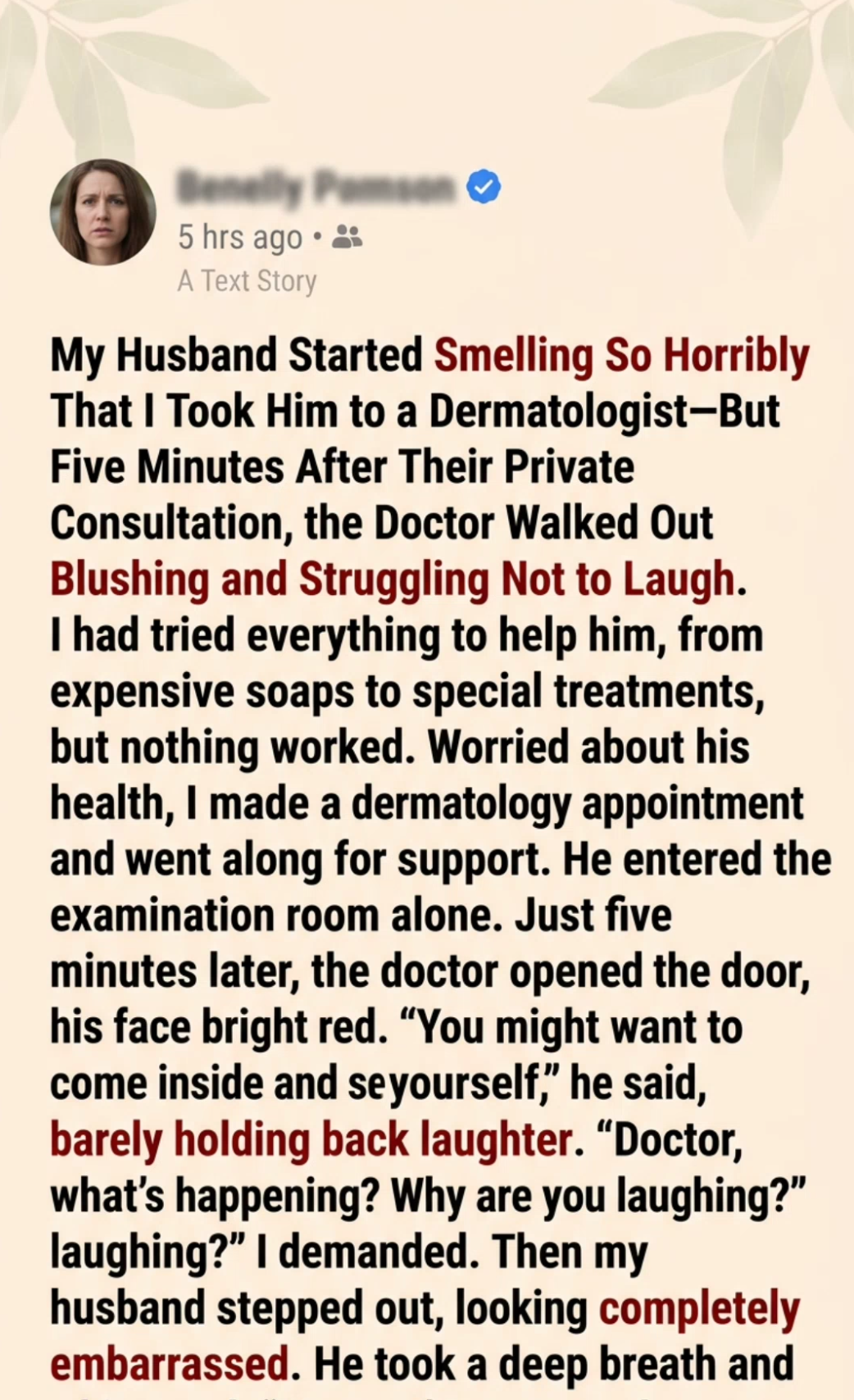
For almost six months, I believed my husband was suffering from a medical condition that nobody could diagnose.
His smell was unlike anything I had encountered before.
It wasn’t ordinary body odor. It wasn’t the smell of sweat after a long day at work. It was a strange, sour, almost rotten smell that seemed to follow him wherever he went.
At first, I thought it was his clothes.
I washed everything separately, changed detergents, bought expensive fabric softeners, and even replaced several of his shirts.
Nothing helped.
Then I blamed his deodorant.
I purchased antibacterial soaps, medical-strength antiperspirants, special body washes, and expensive skincare products recommended by pharmacists.
Still, the smell remained.
It became so strong that I could sometimes smell it before he entered a room.
My husband, Martin, was fifty-two years old. He had always been clean, well-dressed, and particular about his appearance. He showered every morning, shaved regularly, and never left the house without checking his clothes.
That was why the situation confused me so much.
He wasn’t neglecting his hygiene.
Something seemed terribly wrong.
Our friends began noticing it too.
During one dinner, my friend Rachel quietly moved her chair farther away from him. Another time, my brother opened a window and joked that the room needed fresh air.
Martin pretended not to notice.
But I saw his expression.
He was embarrassed.
One evening, after we returned from visiting friends, he stood in the bathroom staring at himself in the mirror.
“Do you think something is wrong with me?” he asked.
I walked behind him and placed my hands on his shoulders.
“I think we should see a doctor.”
He shook his head.
“It’s probably just my skin.”
“Then we’ll see a skin specialist.”
He finally agreed.
I booked an appointment with a respected dermatologist named Dr. Samuel Reed.
I expected a consultation, some tests, perhaps a prescription.
I never expected what happened next.
The appointment was on a Thursday morning.
Martin wore a clean blue shirt, dark trousers, and a fresh jacket. Before leaving, he showered twice and used a fragrance-free body wash.
I even checked his collar.
Everything smelled normal.
For the first ten minutes after we arrived, I felt hopeful.
The clinic was clean and quiet. The receptionist was polite, and Dr. Reed had excellent reviews.
When the doctor called Martin’s name, we both entered his office.
Dr. Reed was a man in his late forties with glasses and a calm manner.
He listened carefully as I explained the problem.
“How long has this been happening?” he asked.
“About six months,” I answered.
“Does it happen every day?”
“Almost every day.”
Martin sat with his arms folded.
The doctor asked about medication, diet, sweating, skin irritation, and changes in personal hygiene.
Martin answered most of the questions.
Then Dr. Reed asked whether he had noticed any particular area where the smell was strongest.
Martin hesitated.
“I’m not really sure.”
The doctor asked him to describe his daily routine.
Martin mentioned showering, shaving, changing clothes, and using deodorant.
Then he added something that caught my attention.
“I’ve also been using a special treatment my wife doesn’t know about.”
I turned toward him.
“What treatment?”
Martin looked uncomfortable.
Dr. Reed glanced at me.
“Would you mind giving us a few minutes to discuss something privately?”
I was surprised.
“Is something serious?”
“Not necessarily,” he replied. “I’d just like to ask him a few questions on his own.”
I agreed and stepped into the waiting area.
I sat down and began scrolling through my phone.
Five minutes passed.
Then I heard a strange sound from inside the examination room.
It sounded like someone trying very hard not to laugh.
I looked up.
The door opened.
Dr. Reed stepped out.
His face was bright red.
He pressed his lips together, cleared his throat, and looked at me.
“Mrs. Martin, you might want to come inside and see for yourself.”
I stood immediately.
“Doctor, what’s happening? Why are you laughing?”
He raised one hand.
“I’m sorry. I don’t mean to be disrespectful. I just think you need to understand what your husband has been doing.”
I entered the room.
Martin was sitting on the examination chair with his head lowered.
His face was completely red.
I looked from him to the doctor.
“What happened?”
Martin took a deep breath.
Then he whispered:
“Honey, I’m not sure how to explain this, but I think I’ve been making the problem worse.”
I stared at him.
“What do you mean?”
He reached into his jacket pocket and removed a small plastic container.
It was filled with a thick, yellowish cream.
I looked at the label.
It was a homemade skin treatment.
“Where did you get that?”
Martin rubbed the back of his neck.
“From a man at work.”
Dr. Reed finally managed to speak.
“Your husband has been applying this mixture to his skin every night.”
I frowned.
“What is it?”
The doctor explained that the mixture contained several ingredients that were not intended for prolonged use on human skin. Some had been combined without proper measurements, and the product had been stored in an unsuitable container.
But that wasn’t the only problem.
Martin had been applying it to a specific area of his body that he had never mentioned to me.
And he had been covering the area with plastic wrap before going to sleep.
I looked at my husband.
“Why?”
Martin closed his eyes.
“Because I thought it would help.”
“Help with what?”
He swallowed.
Then he finally told me.
Three months earlier, Martin had noticed a small patch of dry skin beneath his arms.
It wasn’t painful, but it occasionally became itchy.
He mentioned it to a colleague named Peter, who claimed to know a natural remedy that worked better than expensive medical products.
Peter gave him a homemade cream.
He told Martin it was an old family formula made from natural oils, herbs, and other ingredients.
Martin applied a small amount.
At first, nothing happened.
Then the itching seemed to improve.
Encouraged, he began using it every night.
He applied more cream, covered the area with plastic wrap, and left it overnight.
After several weeks, the skin became irritated.
Instead of stopping, he assumed the irritation was part of the treatment.
Peter told him that unpleasant smells sometimes meant the body was getting rid of impurities.
Martin believed him.
He increased the amount.
That was when the smell became noticeable.
The cream had begun breaking down, mixing with sweat, and irritating the skin. The plastic covering trapped moisture and encouraged further skin problems.
The mixture itself had a strong, unpleasant odor.
And because Martin had been applying it every night, washing it away had become increasingly difficult.
I stared at him.
“You’ve been doing this for three months?”
He nodded.
“Why didn’t you tell me?”
“I was embarrassed.”
“Embarrassed about a rash?”
He looked at the floor.
“I didn’t want you to think I couldn’t take care of myself.”
I couldn’t believe it.
For six months, I had been buying products, washing clothes, changing detergents, and worrying that he had some serious disease.
Meanwhile, he had been applying a mysterious homemade cream to his skin every night.
Dr. Reed was still trying not to smile.
I looked at him.
“Is this dangerous?”
His expression became serious.
“At this point, we need to treat the irritation properly and make sure there isn’t a secondary infection. I don’t want either of you assuming it’s harmless simply because the ingredients are described as natural.”
He examined Martin’s skin and explained that the odor could be coming from the mixture, trapped moisture, and inflamed skin.
He advised Martin to stop using the cream immediately.
He also recommended gentle cleansing, avoiding occlusive coverings, and following a treatment plan appropriate for the skin irritation.
A sample of the mixture was documented, and the doctor arranged a follow-up examination to check whether the skin was healing normally.
Before we left, Dr. Reed looked at Martin.
“One more thing. If someone gives you a homemade treatment, that doesn’t automatically make it safe. Especially when you don’t know exactly what’s inside it.”
Martin nodded.
Then the doctor looked at me.
“I apologize for laughing. I was surprised by the explanation, not by your husband’s medical problem.”
I managed a small smile.
“At this point, Doctor, I think I’ve earned the right to laugh too.”
Martin covered his face.
On the drive home, neither of us spoke for several minutes.
Finally, I turned toward him.
“Peter gave you that cream?”
“Yes.”
“And you believed him?”
“He said his father used it.”
“Did you ever check what was inside?”
“No.”
I shook my head.
“Martin, you could have seriously hurt yourself.”
“I know.”
“Why didn’t you just tell me about the rash?”
He stared out the window.
“I thought you’d make a big deal out of it.”
I almost laughed.
“Instead, you let me believe something was terribly wrong with your entire body.”
He gave a weak smile.
“When you say it like that, it sounds ridiculous.”
“It was ridiculous.”
For the first time in months, we both laughed.
But the story wasn’t over.
Martin followed the dermatologist’s instructions.
He stopped using the homemade mixture, treated the irritated skin, and avoided the plastic covering.
Within a week, the smell had become noticeably weaker.
After two weeks, it was almost gone.
At the follow-up appointment, Dr. Reed confirmed that the irritation was improving. He reminded Martin to return if the symptoms came back or if he developed signs of infection.
The relief was enormous.
But the most important change happened at home.
Martin finally stopped pretending that he had to solve every problem alone.
He admitted that he had been afraid of appearing weak.
He had hidden a small medical problem because he didn’t want to feel embarrassed in front of his wife.
Unfortunately, hiding it had turned a manageable problem into six months of confusion.
A few weeks later, Peter called him.
He wanted to know whether the cream had worked.
Martin told him exactly what the dermatologist had said.
Peter laughed.
“Doctors always say things like that. They don’t understand natural treatments.”
Martin replied calmly.
“Maybe. But my doctor examined my skin, explained the irritation, and helped me get better. I’m not using your mixture again.”
Peter became defensive.
But Martin ended the conversation.
He never used the cream again.
Three months after our first appointment, we invited Rachel and her husband over for dinner.
Martin was in the kitchen preparing food when Rachel arrived.
She stopped near the doorway and looked at him.
Then she smiled.
“Well, Martin, you smell wonderful.”
He laughed.
“Thank you. I had professional help.”
I nearly dropped the serving spoon.
Rachel looked confused.
I started laughing.
Martin shook his head.
“Don’t ask. It’s a long story.”
Later that evening, after our friends had gone home, I found the small plastic container in a drawer.
Martin had kept it as a reminder.
I held it up.
“Are you planning to frame this?”
He laughed.
“Maybe I should. It cost me six months of embarrassment.”
I threw it away.
Then I sat beside him.
“Promise me something.”
“What?”
“Next time something is wrong, tell me. Even if it’s embarrassing. Especially if it’s embarrassing.”
He took my hand.
“I promise.”
I kissed his cheek.
And for the first time in six months, I didn’t smell anything strange.
Looking back, I realize how easily embarrassment can make people hide problems that could be solved with a simple conversation.
Martin wasn’t careless because he didn’t care about his health.
He was embarrassed, misinformed, and too proud to admit that he needed help.
The dermatologist had found the explanation in five minutes because Martin finally told the truth.
And although the doctor struggled not to laugh at the strange homemade remedy, he never made my husband feel foolish for asking for help.
That mattered more than anything.
We still joke about the appointment occasionally.
Whenever Martin buys a new skincare product, I ask whether it has been approved by a dermatologist.
He rolls his eyes.
But he checks the label.
And if something unusual happens, he tells me.
Because we learned something that morning:
Sometimes the most embarrassing problem isn’t the one happening to your body. It’s the secret you keep because you’re afraid to admit you need help.
THE END.