The first time my daughter told me she had no friends, I thought she was having a difficult day.
She was twelve. Middle school was complicated. Friendships changed overnight, small disagreements felt enormous, and a forgotten invitation could seem like the end of the world.
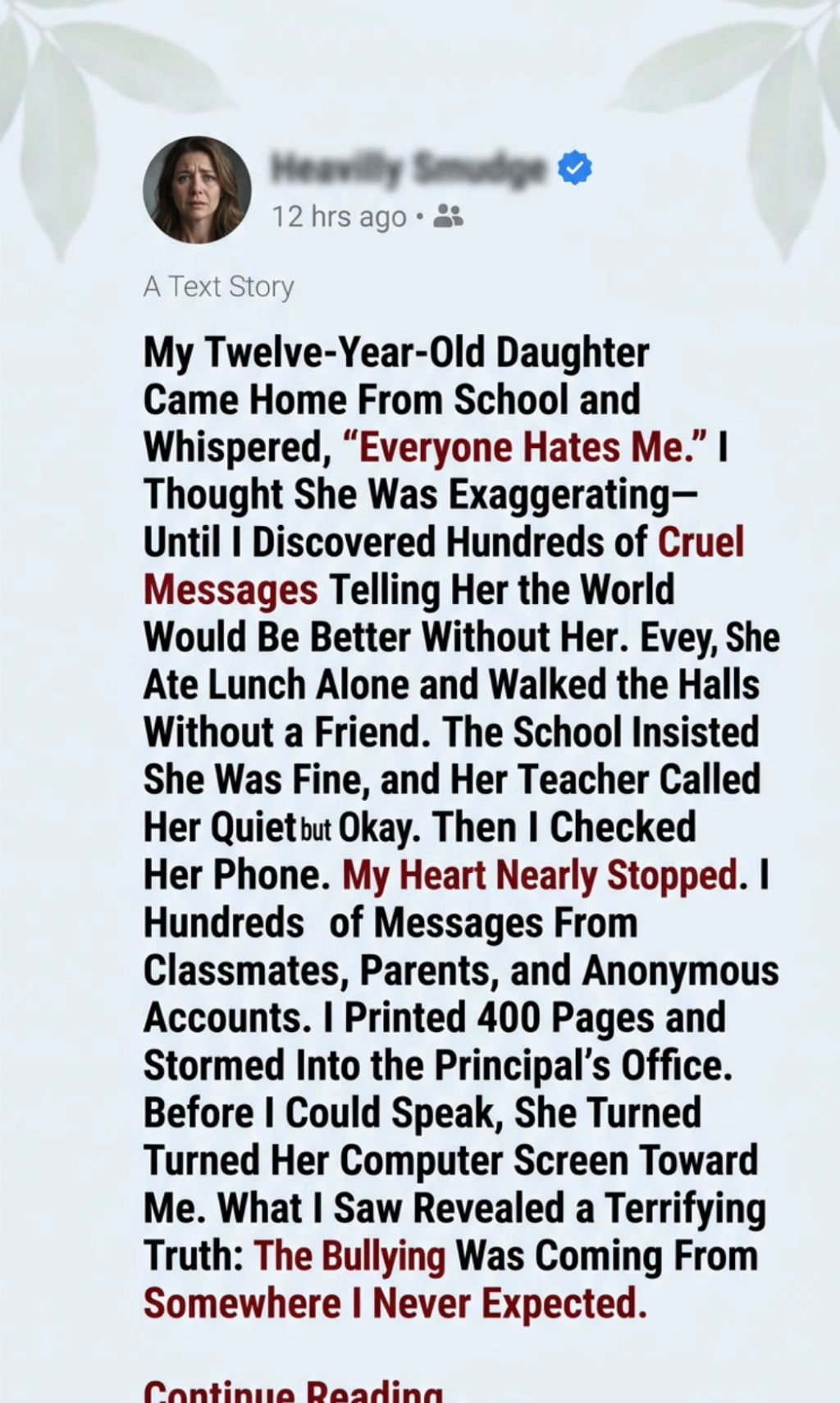
So when Lily came home one Tuesday afternoon, dropped her backpack beside the kitchen table, and whispered, “Everyone hates me,” I put down the vegetables I was cutting.
“What happened, sweetheart?”
“Nothing.”
“Did someone say something to you?”
She shrugged.
“It’s fine, Mom.”
Then she went upstairs.
I should have followed her.
Instead, I told myself she needed space.
That decision would haunt me for months.
My name is Rachel Morgan. I was thirty-nine, raising Lily on my own after her father and I separated three years earlier. We lived in a modest two-bedroom house, and most evenings were quiet. Lily loved drawing, reading fantasy novels, and making tiny paper animals that she lined up along her bedroom windowsill.
She had always been a thoughtful child. Not shy exactly, but careful. She preferred one close friend to a room full of acquaintances.
When she started seventh grade at Westbrook Middle School, I expected some adjustment. Her elementary-school friends had been assigned to different classes, and she was nervous about making new ones.
At first, she seemed okay.
She told me about science projects, complained about homework, and occasionally mentioned a girl named Sophie who sat beside her in English.
Then the little changes began.
Lily stopped talking about lunch.
She started asking me to drop her off farther from the school entrance.
She no longer wanted to attend birthday parties.
Her favorite blue hoodie became her everyday uniform, even when the weather was warm.
And every afternoon, she came home hungry.
One evening, I asked why she wasn’t eating lunch at school.
“I eat,” she said.
“What do you eat?”
“Stuff.”
“Lily.”
She stared at her plate.
“Sometimes I just don’t feel hungry.”
I believed her.
A week later, I received a message from her homeroom teacher, Mrs. Carter.
It said Lily was doing well academically but could benefit from participating more in class.
I replied that I would encourage her.
I even thanked the teacher for looking out for her.
I had no idea that the woman sending me those reassuring messages was connected to what was happening to my daughter.
The first serious warning came on a Thursday.
Lily returned home with red eyes. She walked straight past me, went into the bathroom, and locked the door.
I heard the faucet running.
When she finally came out, I noticed her hands were shaking.
“Did somebody hurt you?”
“No.”
“Did somebody threaten you?”
She looked at me.
For a moment, I thought she was going to tell me everything.
Instead, she whispered, “Please don’t make me go tomorrow.”
I sat beside her on the bed.
“Tell me why.”
She shook her head.
“I can’t.”
I promised I wouldn’t get angry.
I promised I would listen.
But she only pulled her knees against her chest and cried.
That night, I barely slept.
The next morning, I called the school.
Mrs. Carter answered.
I explained that Lily had become withdrawn and was frightened to attend class.
There was a pause.
Then she said, “Rachel, Lily is a very sensitive child. Sometimes she interprets ordinary social interactions more negatively than other students.”
I asked whether anyone had reported bullying.
“Not that I’m aware of.”
“Could you please check?”
“Of course. But I really wouldn’t worry too much. She’s quiet, but she’s doing okay.”
Quiet, but okay.
Those words became something I would remember for the rest of my life.
Because my daughter was not okay.
I just hadn’t seen how bad things had become.
Two days later, Lily left her phone on the kitchen counter while she went upstairs to change.
A notification appeared.
I wasn’t looking for trouble. I wasn’t planning to read her private conversations.
But the message was visible on the screen.
You should just disappear. Nobody would miss you.
My stomach tightened.
Another notification appeared.
Tomorrow will be worse.
I picked up the phone.
There were dozens of unread messages.
Some came from people whose names I recognized from Lily’s class. Others came from unfamiliar accounts.
I opened the first conversation.
Then the second.
Then the third.
Within minutes, my hands were trembling.
There were photographs of Lily taken in the cafeteria without her knowledge. Someone had edited one to make her look ridiculous. Others had circulated screenshots of her private messages, adding cruel captions.
A group chat contained jokes about her clothes, her appearance, and the way she walked.
Someone had created an account using her name and posted embarrassing comments that she had never written.
There were messages telling her nobody wanted her around.
Others told her she was a burden.
One message said the world would be better without her.
I kept scrolling.
There were hundreds.
Some were sent during school hours. Others arrived late at night.
I found messages from anonymous accounts that appeared to know her daily routine. They knew which hallway she used, where she sat during lunch, and which bus she took home.
Then I found something that made my blood run cold.
A message had been sent to a group chat from an account called WestbrookTruth.
It contained a photograph of Lily sitting alone beside the school gym.
The caption read:
Another day of nobody wanting her.
Below it, someone had written:
At least everyone knows what she is now.
I didn’t understand what that meant.
I kept looking.
Then I found a folder of screenshots.
There were more than four hundred pages of conversations, photographs, insults, impersonation attempts, and threats.
I sat at the kitchen table until the house grew dark.
When Lily came downstairs, she saw her phone beside me.
Her face went pale.
“Mom…”
I stood up.
“Why didn’t you tell me?”
She looked at the floor.
“I thought you’d make it worse.”
That sentence hurt more than anything on the phone.
I knelt in front of her.
“Listen to me. You are not in trouble. I am not angry with you. I am angry that people have made you feel like you have to suffer alone.”
She started crying.
Then she told me everything.
She had been eating lunch in the library because the cafeteria group had stopped allowing her to sit with them.
Someone had started a rumor that she had reported another student for cheating.
She had never reported anyone.
A photograph of her crying in the bathroom had been circulated.
Her classmates had begun treating her like she was contagious.
When she tried to defend herself online, the screenshots were shared without context, making her appear aggressive.
And every time she asked someone to stop, the messages became worse.
“Why didn’t you tell your teacher?” I asked.
“I did.”
“When?”
“Three weeks ago.”
“What did she say?”
Lily wiped her face.
“She said I should stop paying attention to people who wanted a reaction.”
I felt something inside me go very still.
I called the school principal’s office the next morning.
I requested an urgent meeting.
I also printed every relevant message, screenshot, and conversation I could preserve. I organized the pages by date, sender, and incident.
The printer ran for hours.
When I finished, there were nearly four hundred pages.
I placed them into two thick binders.
I didn’t want a shouting match.
I wanted answers.
But when I entered Principal Elaine Foster’s office on Monday morning, I was not prepared for what happened next.
Mrs. Carter was already there.
So was the school’s technology coordinator.
I placed the binders on the principal’s desk.
“My daughter has been targeted for months,” I said. “These are the messages. I want to know why nobody intervened.”
Principal Foster looked at the binders.
Her expression changed.
She opened the first one, turned several pages, and then looked toward Mrs. Carter.
“Did you know about this?”
Mrs. Carter folded her hands.
“I knew there had been some social difficulties.”
“Social difficulties?” I repeated. “There are messages telling my daughter she should disappear.”
Principal Foster didn’t answer immediately.
Instead, she looked at the technology coordinator.
“Show her the report.”
The coordinator turned his laptop toward me.
On the screen was a spreadsheet.
It contained account names, timestamps, access records, and a list of reports submitted through the school’s online bullying system.
I leaned closer.
There were dozens of reports.
Some had been submitted by students.
Others had been submitted anonymously.
And nearly every report had been marked:
RESOLVED — NO ACTION REQUIRED.
I stared at the screen.
“Who marked these resolved?”
The coordinator looked uncomfortable.
“Most of them were routed through the same staff account.”
“Whose account?”
He hesitated.
Then Principal Foster answered.
“Mrs. Carter’s.”
I turned toward the teacher.
She looked down.
For several seconds, nobody spoke.
Then Principal Foster opened another file.
It contained an internal communication thread between staff members.
One message, sent six weeks earlier, had caught the principal’s attention during a separate technology audit.
It had been written from Mrs. Carter’s school account to a small group of parents.
The subject line was:
Handling the Lily Situation.
I felt my heart pounding.
The principal read the first paragraph aloud.
It said that Lily was creating unnecessary conflict by making complaints about classmates. It suggested that parents should discourage their children from engaging with her until she learned to behave more appropriately.
I couldn’t believe what I was hearing.
“You sent this to parents?”
Mrs. Carter’s voice was small.
“I was trying to prevent further disruption.”
“By telling parents to isolate a twelve-year-old girl?”
“She was becoming difficult to manage.”
I looked at the principal.
“What does that mean?”
Principal Foster opened another document.
It was a record of an incident from the previous semester.
Lily had witnessed two students using a shared classroom tablet to access another student’s private account. She had reported what she saw to Mrs. Carter.
The teacher had initially dismissed the complaint.
Later, the school discovered that the students had indeed accessed another student’s account without permission.
But one of the students involved was the daughter of a parent who held a powerful position in the school’s parent association.
That parent had complained that Mrs. Carter’s classroom was being unfairly scrutinized.
According to the internal records, Mrs. Carter became concerned that Lily’s continued complaints would create problems with several influential families.
Instead of investigating each incident impartially, she had begun treating Lily as the source of disruption.
The coordinator explained that the anonymous bullying reports had been repeatedly closed without being escalated.
Some messages had been forwarded to parents.
Others had been discussed in a private parent group.
And several adults had contributed to the hostility by repeating the false claim that Lily was dishonest and difficult.
I looked at the teacher.
“Did you tell these parents to target my daughter?”
She shook her head quickly.
“No. I never told anyone to threaten her.”
“Then why did you tell them to keep their children away from her?”
“I thought it would calm things down.”
“Did you ever ask Lily whether she was safe?”
She said nothing.
Principal Foster closed the laptop.
“I want you to understand something,” she said. “The school has failed to respond appropriately. We are opening a formal investigation today. Mrs. Carter will not have contact with Lily while that investigation is underway.”
I looked at the four hundred pages on her desk.
“This isn’t just about a teacher making a bad decision. My daughter has been living with this every day.”
“I know,” the principal said quietly.
“No. You know now. She knew for months.”
That afternoon, the school district was notified.
An independent safeguarding officer was assigned to investigate. The district preserved the relevant records, reviewed the school’s reporting system, and contacted the families whose children appeared in the evidence.
The school also arranged for Lily to receive support from a counselor who had no connection to her previous classroom.
But the most important conversation happened at home.
When I told Lily that the school had discovered who had mishandled her reports, she didn’t look relieved.
She looked frightened.
“Are they going to hate me more?”
I sat beside her.
“I don’t know what every person will do. But I know this: you are not responsible for what they chose to do to you.”
She stared at the carpet.
“Mrs. Carter said I made everything difficult.”
“You were asking adults to protect you. That was never wrong.”
For the first time in months, Lily leaned against my shoulder.
The investigation lasted seven weeks.
It found that Mrs. Carter had repeatedly failed to escalate reports of harassment, had discouraged parents from allowing their children to associate with Lily, and had improperly shared information about a student’s complaints.
It did not establish that she had personally written every anonymous message. The investigators also found that several students had created or shared the accounts, while some adults had amplified the false rumors.
The district removed Mrs. Carter from her teaching position pending a formal employment review. She was later dismissed for serious breaches of professional responsibility and student safeguarding procedures.
The school introduced independent reporting channels, mandatory escalation rules, and training for teachers and administrators.
Several students received disciplinary consequences appropriate to their involvement. Their parents were required to participate in meetings, and the school arranged restorative sessions only where Lily felt comfortable and safe.
I refused to let anyone pressure her into forgiving people simply because they had apologized.
An apology was not a magic eraser.
Lily needed time.
At first, she barely spoke about school.
We arranged for her to attend a different class while the investigation continued. Eventually, she transferred to another middle school in the district.
The first morning at her new school, she stood beside the front door holding her backpack.
“Do I have to go in alone?” she asked.
I smiled.
“No. I’ll walk you to the office.”
She nodded.
That afternoon, she came home and placed her lunchbox on the counter.
“Mom?”
“Yes?”
“I ate with someone today.”
I turned around.
“Really?”
“Her name is Maya. She likes drawing too.”
I tried not to cry.
“That sounds wonderful.”
Over the next few months, Lily slowly returned to herself.
She started drawing again.
She joined the school’s art club.
She began talking about classmates without immediately looking worried that I might ask too many questions.
One evening, I found her sitting at the kitchen table, sketching a little girl standing beneath a large umbrella.
The girl was surrounded by dark clouds, but beyond the umbrella, a small patch of sunlight was appearing.
“What are you drawing?” I asked.
Lily looked at the paper.
“Someone who thought she was alone.”
I pulled out a chair.
“Is she?”
Lily shook her head.
“Not anymore.”
I sat beside her and watched her finish the picture.
A few weeks later, the school invited us to a district meeting about improving its anti-bullying procedures.
I didn’t want Lily to attend. She had already given enough of herself to a situation created by adults who should have protected her.
But she asked to come.
She stood beside me in the meeting room, holding a small notebook.
When the district officer asked whether she wanted to say anything, Lily looked at the adults around the table.
Her voice trembled, but she spoke clearly.
“When I told people I was being bullied, I thought they would help me. But some people decided I was the problem because I was the one complaining.”
The room was silent.
She continued.
“I don’t think every teacher is bad. I don’t think every student who was mean to me is going to be mean forever. But I want adults to understand that when a child says they’re being hurt, you shouldn’t decide they’re exaggerating just because they’re quiet.”
She paused.
Then she said something I will never forget.
“Sometimes the child who needs the most help is the one who stops asking for it.”
Nobody interrupted her.
After the meeting, a woman from the district approached us.
She told Lily that her words had helped the committee understand why reporting systems needed independent oversight.
Lily thanked her politely.
On the drive home, she looked out the window.
“Mom?”
“Yeah?”
“Do you think I’m weird?”
I glanced at her.
“No. Why would you ask that?”
“Because they made me feel like there was something wrong with me.”
I pulled into a parking space and turned toward her.
“Lily, listen carefully. Being quiet isn’t a flaw. Being sensitive isn’t a weakness. Having a different personality doesn’t make you less deserving of kindness.”
She looked at me for a long moment.
Then she smiled.
It wasn’t a huge smile.
It wasn’t the kind that erased everything that had happened.
But it was real.
That night, I put the two binders containing the four hundred pages into a locked cabinet.
I didn’t keep them because I wanted to remember every cruel word.
I kept them because evidence matters when people with responsibility choose not to listen.
And because I never wanted Lily to grow up believing that what happened to her was something she had imagined.
Months later, she brought home a new drawing from art club.
It showed two girls sitting together beneath a tree, sharing a sketchbook.
At the bottom, she had written:
You don’t have to be friends with everyone. You just have to remember that everyone deserves to be treated like a person.
I framed it and hung it in the hallway.
Sometimes I still think about the day she stood in our kitchen and whispered that everyone hated her.
I wish I had understood sooner.
I wish I had asked more questions when she stopped talking about lunch.
I wish I hadn’t accepted the words quiet but okay as proof that everything was fine.
But I also learned something I hope every parent remembers.
Children don’t always have the words to explain what is happening to them. Sometimes they show you through an untouched lunchbox, a locked bedroom door, a sudden fear of school, or a sentence spoken so softly you almost miss it.
When they finally find the courage to tell you, believe them enough to investigate.
And never confuse a child who has stopped complaining with a child who has stopped hurting.
Lily still has difficult days. She still remembers the messages sometimes. Healing hasn’t meant forgetting.
It has meant learning that the cruelest voices in one chapter of her life do not get to write the rest of her story.
And every morning, when she walks out of our front door with her backpack and her sketchbook, I remind her of one thing:
She never needed to become someone else to deserve a place in this world.
THE END.