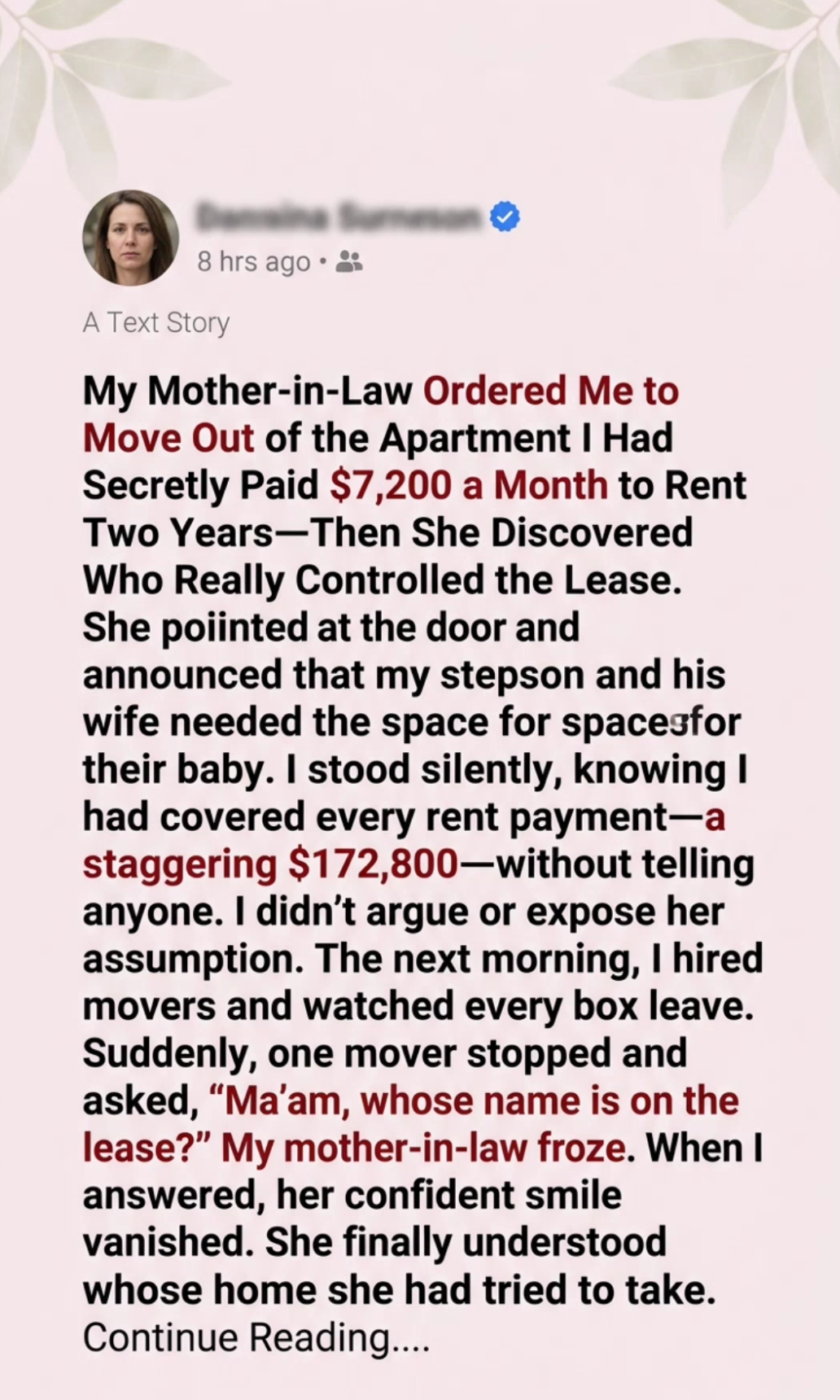
The day my mother-in-law told me to leave my own home, she didn’t even bother to lower her voice.
She stood in the middle of my living room, pointing toward the front door as though she were dismissing an unwanted guest.
“My son and his wife need this apartment now. They’re expecting a baby, and they need somewhere comfortable to raise their family. You can find somewhere smaller.”
I stared at her.
Her name was Patricia. She had always believed that because she was the mother of my late husband’s son, she had the right to make decisions for everyone in the family.
What she didn’t know was that I had paid every dollar of rent on that apartment for two years.
Seven thousand two hundred dollars every month.
Twenty-four consecutive payments.
A total of $172,800.
And I had never told anyone.
I didn’t shout.
I didn’t remind her that I had kept the apartment running while everyone else enjoyed the benefits. I didn’t explain that the furniture, utilities, maintenance, and household expenses had also come from my account.
I simply looked at her and asked, “When do you think they want to move in?”
“Within the next two weeks,” she replied confidently. “There is no reason for you to make this difficult.”
I nodded.
“Very well.”
She seemed surprised by how easily I agreed.
What Patricia didn’t realize was that I had already decided to leave.
But I wasn’t going to leave the way she expected.
To understand why, I need to explain how I ended up paying for that apartment in the first place.
My name is Claire Bennett. I was forty-six when this happened.
I had married Richard, Patricia’s eldest son, seven years earlier. Richard had one son from his previous marriage, Daniel, who was twenty-seven at the time.
I never tried to replace Daniel’s mother. I treated him respectfully, helped when he needed advice, and welcomed his wife, Melissa, into the family.
Richard and I lived comfortably. I had inherited a small investment portfolio from my father and worked as a financial consultant. Richard managed a regional distribution company.
When Richard died unexpectedly from a heart condition, my world changed.
I was devastated, but I also knew I had to keep moving.
During the months following his funeral, Patricia became increasingly involved in my affairs. She often called to ask whether I was eating properly, whether I needed help, or whether I had considered moving closer to the family.
At first, I appreciated her concern.
Then she began making decisions for me.
She suggested which furniture I should sell. She questioned why I was still working. She even told me which relatives should receive some of Richard’s belongings.
I tried to be patient.
After all, she had lost a son, too.
Several months later, Daniel and Melissa began experiencing problems with their rental property. Their landlord was selling the building, and they needed somewhere else to live.
Patricia asked whether they could stay with me temporarily.
I agreed to help them find an apartment.
The apartment we eventually found was beautiful: three bedrooms, a large kitchen, a balcony, and a secure underground parking space.
The rent was $7,200 per month.
Daniel and Melissa loved it, but they couldn’t afford the deposit and monthly payments on their own.
Patricia asked whether I could help.
I had the means, and I wanted to make sure my stepson and his wife had a stable place to live while they reorganized their finances.
So I agreed to rent the apartment.
However, I made one condition.
The lease would be in my name, and I would remain responsible for the rental agreement. Daniel and Melissa could live there, but they would need to contribute toward household expenses when they were financially able.
They agreed.
Patricia was delighted.
She called me generous and told everyone I was a blessing to the family.
I didn’t correct her when she described the arrangement as temporary family support.
I didn’t need praise.
I simply wanted to help.
The first few months went smoothly.
Daniel found a better-paying position, and Melissa started working part-time. They furnished the apartment and began settling in.
I paid the rent automatically from my bank account.
I also covered the building fees and several maintenance expenses because I wanted the apartment to remain in good condition.
Then Patricia started visiting more often.
At first, she brought groceries.
Later, she began criticizing how the apartment was arranged.
She said the curtains were too dark, the kitchen table was too small, and the guest bedroom should be converted into a nursery someday.
I ignored most of it.
Then she began referring to the apartment as Daniel’s home.
I found it strange, but I didn’t argue.
After all, he was living there.
What I didn’t expect was that Patricia would eventually decide that I no longer belonged there.
The announcement came on a Tuesday afternoon.
I had just returned from a meeting when I found Patricia sitting on the sofa with Daniel and Melissa.
There were several baby magazines on the coffee table.
Melissa was pregnant.
I congratulated them immediately.
Patricia smiled.
“Now that we’re going to have a baby in the family, we need to make some changes.”
I assumed she meant rearranging the apartment.
Then she pointed toward me.
“Claire, I think it’s time you moved out.”
I thought I had misunderstood.
“Moved out?”
“Yes. Daniel and Melissa need more space. With the baby coming, they need the whole apartment.”
I looked at Daniel.
He seemed uncomfortable.
“Did you know she was going to say this?”
He looked down.
Melissa remained silent.
Patricia continued.
“You have your own income. You can afford somewhere else. They are starting a family, and this is the best solution.”
I glanced around the room.
The sofa I had purchased.
The dining table I had selected.
The kitchen equipment I had paid for.
The apartment I had been financing for two years.
And there she was, telling me to leave.
I could have explained everything immediately.
I could have opened my banking application and shown her twenty-four rent payments.
I could have placed the lease on the table.
But something stopped me.
I wanted to see how far she would go without knowing the truth.
So I asked, “When would you like me to leave?”
Patricia looked pleased.
“Within two weeks would be ideal.”
I nodded.
“Then I’ll make arrangements.”
She smiled as though she had just won an argument.
That evening, I went into my bedroom and opened the folder containing the apartment documents.
The lease was there.
So were the payment records, utility accounts, building correspondence, and the original inventory.
I reviewed everything carefully.
The lease was still active, and I was the named tenant. Daniel and Melissa were occupants under the arrangement I had made with the landlord.
Patricia had no authority to remove me or transfer the tenancy.
More importantly, I had never agreed to surrender the apartment to anyone.
I called the property manager, a woman named Helen, the following morning.
I explained that I wanted to end the rental arrangement according to the lease terms and asked what notice and inspection procedures applied.
Helen checked the agreement.
“Claire, you’re the tenant on record. We can process your notice in accordance with the contract. Is there any dispute over possession?”
“Not yet,” I replied. “But I want everything handled properly.”
She explained the notice period, inspection requirements, and the procedure for returning the keys.
I thanked her.
Then I contacted a moving company.
I scheduled the move for the following week.
I also sent Daniel and Melissa a written message explaining that I would be ending the rental arrangement and that they needed to make alternative housing plans.
I did not insult them.
I did not mention Patricia.
I simply informed them that the apartment would no longer be available under my lease after the agreed notice period.
Daniel called immediately.
“Claire, what’s going on?”
“I’m ending the lease.”
“But Mom said you agreed to move out.”
“I did agree to move out. I never agreed to give you the apartment.”
He went quiet.
“Where are we supposed to go?”
“You have the same options any other renters have. You can look for another apartment, speak with your landlord about a new arrangement, or discuss a different financial plan.”
“Melissa is pregnant.”
“I know, Daniel. I congratulated you.”
He sighed.
“Can we talk about this?”
“Of course. But the decision about my lease has been made.”
He asked whether Patricia knew.
I told him she would find out soon enough.
The next morning, the movers arrived.
They began carefully wrapping the furniture and carrying boxes down to the truck.
Patricia arrived shortly afterward.
She walked into the apartment and immediately began shouting.
“What is happening?”
I was standing beside the dining table, checking the inventory.
“I’m moving.”
She stared at the boxes.
“Why are you taking everything?”
“Because these are my belongings.”
She pointed toward the movers.
“Those things belong to the apartment!”
One of the movers stopped.
He was an older man named Robert, and he had been working in residential removals for decades.
He looked from Patricia to me.
“Ma’am, whose name is on the lease?”
Patricia answered before I could.
“My son and his wife live here.”
Robert shook his head politely.
“I’m not asking who lives here. I’m asking who is named on the lease.”
I handed him a copy of the rental agreement.
He glanced at the first page.
Then he looked at Patricia.
“It’s her name.”
Patricia’s expression changed.
“What?”
I held the document toward her.
“My name is on the lease. I’ve paid the rent for the last two years.”
She took the pages.
Her eyes moved across the first page, then the payment records attached behind it.
I watched her calculate the figures.
Twenty-four payments.
Seven thousand two hundred dollars each.
One hundred seventy-two thousand eight hundred dollars.
Her confident smile vanished.
“You paid all this?” she whispered.
“Yes.”
“Why didn’t you tell us?”
I looked at her.
“Would it have changed anything?”
She opened her mouth but said nothing.
Daniel arrived just then.
He saw the movers, his mother holding the lease, and the boxes stacked beside the door.
“What happened?”
Patricia turned toward him.
“She says the apartment is hers!”
Daniel looked at the document.
Then he looked at me.
“Claire, is this true?”
“Yes.”
He stared at the payment records.
“You paid the rent every month?”
“Yes, Daniel. For two years.”
He looked genuinely shocked.
“But Mom said the apartment was arranged through the family.”
“It was arranged through me. I paid for it because I wanted to help you.”
Patricia interrupted.
“That doesn’t mean you can just throw them out when they’re expecting a child!”
I took a breath.
“I haven’t thrown anyone out. I have followed the proper notice process and informed them that I will no longer finance this apartment.”
Patricia shook her head.
“You could have told us.”
“I didn’t hide the lease. I signed it. You simply never asked whose name was on it.”
She looked toward Daniel.
“Say something!”
Daniel didn’t answer immediately.
Then he said, “Mom, Claire paid for this place. We knew she was helping us.”
Patricia turned sharply.
“You knew?”
Daniel nodded.
“We knew she was paying the rent.”
I looked at him.
That was the first time I realized he had allowed his mother to believe something different.
“Then why didn’t you correct her when she told me to leave?”
Daniel lowered his head.
“I thought it would be easier if everyone just agreed.”
I felt a deep disappointment.
“Easier for whom?”
He had no answer.
Melissa finally spoke.
“Claire, I didn’t know how much you were paying. I thought Daniel was contributing more than he was.”
Daniel looked at his wife.
I realized that the confusion had spread much further than I had imagined.
Patricia had been telling relatives that the apartment was effectively a family property.
Daniel had allowed her to make that claim.
And Melissa had believed that the household finances were being handled differently.
I decided not to argue in front of the movers.
I continued checking the inventory.
The movers packed my furniture, personal belongings, kitchen equipment, and the items I had purchased specifically for the apartment.
I left the appliances that belonged to the landlord.
I also left a written inventory of the property that would remain.
Before the final boxes were loaded, Patricia approached me.
“Claire, we should discuss this privately.”
I looked at her.
“We can talk after the move.”
She lowered her voice.
“You’re making this family look bad.”
I almost laughed.
“You asked me to leave an apartment I was paying for, Patricia. I am simply leaving.”
She looked away.
For the first time since I had known her, she seemed unable to find a response.
The movers finished that afternoon.
I completed the handover arrangements with Helen, returned the keys according to the agreed procedure, and documented the condition of the apartment.
The deposit was handled under the lease terms.
There were no dramatic confrontations with the landlord, no police officers, and no surprise legal tricks.
Just a contract, payment records, and a decision to stop funding an arrangement that was no longer being treated with respect.
I moved into a smaller apartment closer to my office.
It was quiet, comfortable, and entirely mine.
For the first few weeks, Patricia barely contacted me.
Then she began sending messages.
She said she had been stressed about the baby and hadn’t meant to hurt me.
She said she had assumed I would want to help because we were family.
She also suggested that I should consider paying the rent for Daniel and Melissa’s next apartment.
I read the message twice.
Then I replied:
I helped because I wanted to. I will not continue paying for housing while being treated as though I have no right to make decisions about it.
Daniel visited me a few days later.
He apologized for not correcting his mother.
He admitted that he had known the apartment was in my name but had avoided confronting Patricia because he didn’t want a family argument.
I told him that avoiding conflict had allowed someone else to disrespect me.
He agreed.
We discussed the future.
I told him I would still welcome a relationship with him and the baby, but I would no longer provide financial support without clear expectations and mutual respect.
He understood.
Melissa later called to apologize as well. She admitted that she had believed Patricia’s version of events and had not asked enough questions.
I accepted her apology.
The baby was born three months later, a healthy little girl named Sophie.
I visited them at the hospital with a small gift.
I held my granddaughter carefully and felt genuine happiness.
Nothing about the dispute was her fault.
Patricia was there, too.
She approached me while I was sitting beside the baby.
“Claire,” she said quietly, “I hope we can put everything behind us.”
I looked at her.
“We can move forward, Patricia. But moving forward doesn’t mean pretending it never happened.”
She nodded.
For once, she didn’t argue.
I never received the $172,800 back, because it had been rent paid under an arrangement I had voluntarily entered into. I hadn’t treated it as a loan, and I didn’t pretend otherwise.
But I learned something worth far more than the money.
Helping someone does not mean giving them control over your life.
Being generous does not make you powerless.
And being part of a family does not require you to accept disrespect.
I had spent two years paying for a home that other people began treating as though it belonged to them.
The day my mother-in-law ordered me out, she believed she was exercising authority.
The next morning, she discovered that the person she had tried to remove was the very person who had made the arrangement possible.
I didn’t need to humiliate her.
I didn’t need to shout.
I simply stopped paying for a life in which my kindness was mistaken for an obligation.
And that was the day I finally came home to myself.
THE END.