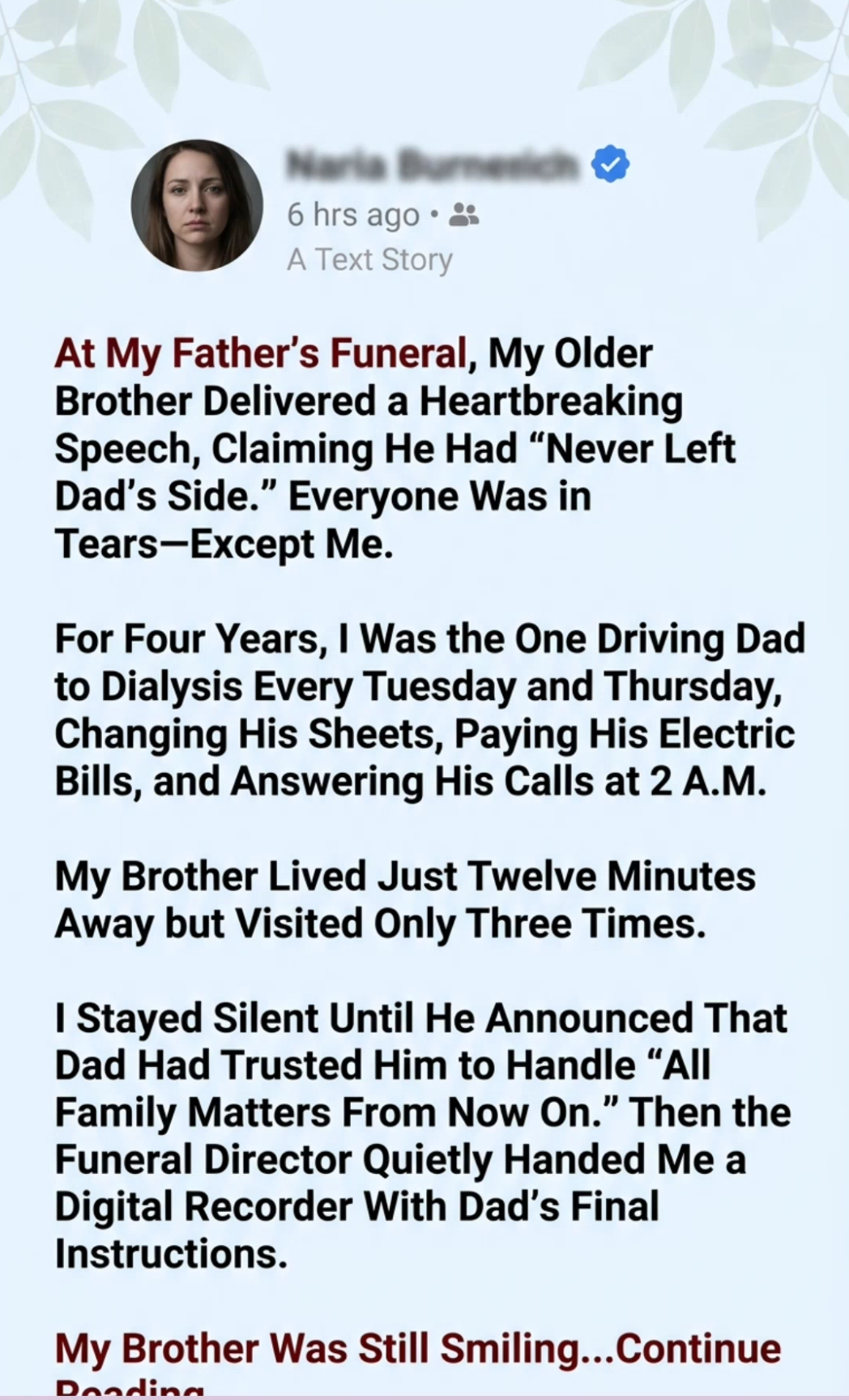
The first lie my brother told at our father’s funeral was that he had never left his side.
The second was that Dad had trusted him to take charge of everything after his death.
And the third was that he knew exactly what our father wanted.
I stood near the front of the chapel, holding a folded tissue in one hand, while my older brother, Marcus, stood beside the coffin delivering a speech that made half the room cry.
“My father was my best friend,” he said, his voice trembling at precisely the right moments. “I was with him through every difficult day. I made sure he never felt alone. Even when things became hard, I promised him I would always be there.”
My aunt covered her mouth.
One of Dad’s old neighbors wiped his eyes.
My mother, who had been separated from Dad for many years but had remained close to him, stared at Marcus with admiration.
I didn’t cry.
Not because I wasn’t grieving.
I had cried every night for the last four years.
I had cried in hospital corridors, in the driver’s seat outside dialysis clinics, and beside Dad’s bed when he couldn’t sleep because his legs hurt.
I had cried while changing his sheets after he was too weak to stand.
I had cried at two in the morning when his phone call woke me and he whispered that he couldn’t breathe properly.
And I had cried in my car after leaving his house because I didn’t want him to see how frightened I was.
Marcus lived twelve minutes away.
He visited three times in four years.
Yet there he was, standing beside our father’s coffin, telling everyone he had never left his side.
I kept my mouth shut.
Until he finished his speech.
Then he turned toward the guests and announced:
“Before we leave today, I want everyone to understand something. Dad trusted me to handle all family matters from now on. He made that very clear. I’ll be coordinating the arrangements, dealing with his personal affairs, and making sure his wishes are respected.”
He looked directly at me.
It was the look he had used since childhood whenever he wanted me to understand that he considered himself the person in charge.
I didn’t respond.
But just then, the funeral director approached me.
He held a small black digital recorder in his hand.
“Miss Emily,” he whispered, “your father asked me to give you this personally. He said you would know when to listen.”
Marcus was still smiling.
He hadn’t noticed.
But I had a feeling that smile wasn’t going to last.
My name is Emily Bennett.
I am thirty-four years old, and until my father died, I spent most of my adult life making sure he could continue living in the home where he had raised us.
Dad’s name was Robert Bennett.
He had worked as a maintenance supervisor at a municipal water treatment facility for nearly thirty years. He was practical, stubborn, and quietly generous.
He wasn’t a wealthy man.
He owned a modest three-bedroom house, an aging pickup truck, and a collection of tools he had accumulated over decades.
He also had a habit of fixing things for other people without charging them.
When a neighbor’s washing machine stopped working, Dad would show up with his toolbox.
When an elderly woman down the street couldn’t afford to replace a broken heater, he would find a secondhand one and install it himself.
He believed people should help one another.
But he hated asking for help.
That changed when his kidneys began failing.
At first, the doctors told us his condition could be managed with medication and regular monitoring.
Then his kidney function deteriorated.
Dialysis became necessary.
Twice a week, every Tuesday and Thursday, I drove him to the clinic.
The first few months were manageable.
I rearranged my work schedule, brought him breakfast, waited during treatment, and drove him home.
But as his health declined, ordinary tasks became difficult.
He couldn’t climb the stairs without stopping.
He struggled to shower.
Sometimes he became confused after treatment.
Eventually, I started staying overnight several times a week.
I bought a shower chair, installed grab bars, and moved his bedroom downstairs.
I organized his medication in labeled containers.
I changed his bedding.
I washed his clothes.
I cooked meals he could tolerate.
And whenever the electricity bill arrived, I paid it because Dad refused to admit that his pension was no longer enough to cover every expense.
I never thought of those things as sacrifices.
He was my father.
I loved him.
But I would be lying if I said it was easy.
Marcus was six years older than me.
He had always been the confident one.
At family gatherings, he spoke loudly, made jokes, and told stories about his business.
He owned a small property maintenance company and lived with his wife, Laura, in a comfortable house on the other side of town.
He had two children, a mortgage, and a busy schedule.
Whenever I asked whether he could help with Dad, he had a reason.
“Tuesday is impossible. I’ve got a client meeting.”
“Thursday? Laura has an appointment.”
“This weekend, maybe. The kids have activities.”
I tried to be understanding.
At first.
When Dad was admitted to the hospital with an infection, I called Marcus at 11:40 p.m.
“Can you come?” I asked. “They want to keep him overnight.”
He sighed.
“Emily, I’m exhausted. Can’t you stay?”
“I’m already here.”
“Then what’s the problem?”
“The problem is that I haven’t slept properly in three days.”
He paused.
“I’ll see what I can do.”
He never came.
Another time, Dad slipped while getting out of the shower.
I found him sitting on the bathroom floor, frightened and embarrassed.
I called an ambulance and then called Marcus.
He answered on the fifth ring.
“What happened?”
“Dad fell.”
“Is he okay?”
“I don’t know. The ambulance is coming.”
“Keep me updated.”
That was all.
He didn’t visit the hospital.
He didn’t call the next morning.
Three days later, he sent Dad a message asking whether he was feeling better.
I stopped asking for help after that.
Not because I didn’t need it.
Because I couldn’t keep making myself disappointed.
The last year of Dad’s life was the hardest.
He needed more assistance, and his dialysis sessions left him exhausted.
Some mornings, he could barely finish breakfast.
Other days, he insisted on sitting in the garden because he didn’t want to feel like a patient.
I remember one Thursday in October.
It was raining heavily.
Dad was sitting in the passenger seat of my car, wrapped in a gray blanket.
“You’re getting soaked,” he said, looking at my sleeve.
“I’m fine.”
“You should have brought an umbrella.”
“You should have brought a better attitude.”
He laughed.
It was a small laugh, but it was genuine.
At the clinic, he held my hand before getting out of the car.
“Emily?”
“Yes?”
“I know you have your own life.”
I looked at him.
“What’s that supposed to mean?”
“You spend too much time worrying about me.”
“That’s what daughters are for.”
He shook his head.
“Not if it costs them everything.”
I smiled.
“You haven’t cost me anything.”
He didn’t believe me.
I could see it in his eyes.
A few weeks later, he asked whether I was still saving money for a holiday.
I told him I was.
That was partly true.
I had a savings account, but most of what I earned had gone toward transportation, household expenses, groceries, and the additional things his care required.
Dad knew more than I wanted him to know.
He noticed every time I used an older phone.
He noticed that I stopped buying new clothes.
He noticed that I sometimes brought my own lunch because I couldn’t justify spending money at the clinic cafeteria.
One evening, he said something I never forgot.
“Your brother talks about helping me.”
I continued folding his laundry.
“That’s nice.”
“But you actually do it.”
I looked at him.
“Dad, don’t compare us.”
He was quiet for a moment.
Then he said:
“Sometimes the person who makes the most noise isn’t the person carrying the heaviest load.”
I didn’t answer.
I thought he was simply tired.
I didn’t realize he was paying attention to everything.
Dad died on a Monday morning.
He had been admitted to the hospital after developing complications from an infection.
For several days, the doctors tried to stabilize him.
I stayed beside his bed.
Marcus arrived on the second afternoon.
He brought a bouquet of flowers and stood near the window.
“How is he?” he asked.
“Not good.”
“Did the doctors say anything?”
“They’re concerned.”
He nodded.
Then he checked his phone.
“I’ll come back tomorrow.”
Dad died before he returned.
I was holding his hand when his breathing stopped.
There were no dramatic final words.
No sudden confession.
Just a quiet room, a monitor, and a nurse who gently placed her hand on my shoulder.
I called Marcus.
He answered immediately.
“Is Dad okay?”
I couldn’t speak.
He understood.
“Oh, God.”
Then he began crying.
I sat beside the bed, still holding Dad’s hand.
For the first time in four years, I didn’t have to check the time for dialysis.
And I hated that thought.
The funeral was held four days later.
Marcus insisted on organizing the public arrangements.
He contacted the funeral home, selected the flowers, and chose the music.
I didn’t object.
I had spent the previous week dealing with the hospital, collecting Dad’s belongings, and informing his friends.
I was exhausted.
I let Marcus take the tasks he wanted.
But when he delivered his speech, I realized he had taken something else too.
He had taken my place in the story.
He spoke about how he had supported Dad through every appointment.
He described sleepless nights, difficult conversations, and the emotional burden of watching a parent grow weaker.
He even mentioned the Tuesday and Thursday dialysis sessions.
“I never missed the important moments,” he said.
That sentence nearly made me stand up.
Because I remembered every single Tuesday and Thursday.
I remembered the clinic’s parking garage.
I remembered the smell of disinfectant.
I remembered the plastic chairs and the vending machine that swallowed my coins.
I remembered the nurse who knew Dad’s favorite tea.
I remembered driving home with him asleep beside me.
And I remembered Marcus calling those same days to ask whether Dad was available to discuss a business matter.
But I remained silent.
When the speech ended, everyone applauded.
My mother hugged Marcus.
My aunt told him he was a wonderful son.
Then he made his announcement about handling all family matters.
I thought that was when the funeral director approached me.
His name was Thomas Reed.
He had been working at the funeral home for more than twenty years.
Dad had known him through a local community group.
Thomas waited until Marcus moved away.
Then he placed the recorder in my hand.
“Your father left this with me three weeks ago,” he whispered.
“Why?”
“He said it was important that you receive it after the funeral. He also gave me a sealed envelope with instructions.”
I looked at the recorder.
“Did he tell you what was on it?”
Thomas shook his head.
“No. But he was very specific. He said I should not give it to anyone else, regardless of what they asked.”
I looked toward Marcus.
He was standing near the front of the chapel, surrounded by relatives.
“Does my brother know about this?”
“No.”
Thomas handed me a small envelope.
“Your father also asked me to give you this.”
My name was written on the front in Dad’s handwriting.
Emily.
I held it tightly.
“Thank you.”
Thomas nodded.
“Your father wanted you to hear his voice.”
I looked down at the recorder.
And suddenly, I felt like I was standing beside Dad’s hospital bed again.
After the funeral, I returned to Dad’s house alone.
The living room still smelled faintly of his aftershave.
His walking stick stood beside the armchair.
A folded blanket rested on the sofa.
On the kitchen counter was the medication schedule I had prepared the previous week.
I sat at the dining table.
Then I opened the envelope.
Inside was a single handwritten note.
Emily,
If you’re reading this, I am no longer there to explain myself.
I know what your brother has said about being responsible for me. I know what he has told people. I also know you will probably stay quiet because you don’t want to cause trouble.
Please listen to the recorder before you agree to anything.
You have done more for me than I ever knew how to thank you for.
Love, Dad.
My hands began shaking.
I turned on the recorder.
There was a click.
Then a brief sound of breathing.
And then Dad’s voice.
“Hello, Emily.”
I closed my eyes.
For several seconds, I couldn’t move.
He sounded tired, but unmistakably like himself.
“If Thomas has given you this, then I suppose I’ve run out of time.”
He paused.
“I don’t want you to be frightened by anything I say. And I don’t want you to feel that you have to fight your brother.”
I wiped my eyes.
Then Dad continued.
“Marcus has been telling people that he has been looking after me. I know he has said he handled my appointments, my bills, and my personal affairs.”
A pause.
“That isn’t true.”
I covered my mouth.
Dad continued.
“Emily, you were the one who took me to dialysis. You were the one who made sure I ate. You were the one who came when I called in the middle of the night. You paid bills when I couldn’t manage them. You changed my sheets. You helped me wash. You made sure I could stay in my own home.”
His voice became softer.
“I don’t want you to think I didn’t notice.”
I began crying.
Then came the sentence that changed everything.
“There’s something else you need to know. Marcus has been telling people that I gave him authority over my affairs. I never did.”
I stopped crying.
Dad continued.
“I did speak to him about helping with my paperwork. He said he was too busy. I asked him again later. He told me to leave everything until after I was gone.”
I stared at the recorder.
“That is why I made different arrangements.”
There was a pause.
“Emily, I have appointed a professional executor to handle my estate. Her name is Margaret Collins. She has the original documents. Neither you nor Marcus should be making decisions about the estate without speaking to her.”
I leaned closer.
Dad continued.
“There’s a folder in the bottom drawer of my desk. It contains a list of my accounts, insurance information, household bills, and the names of people who should be contacted.”
Then his voice changed.
“I also want you to understand that my house is not a prize. It is not a reward for whichever child can tell the best story at my funeral.”
I began crying harder.
“I have made arrangements for you to remain in the house for as long as you need to settle your life. You should not be pressured to leave because someone believes they deserve more.”
He took a breath.
“Marcus will probably be angry. Let him be angry. Don’t argue with him. Let Margaret explain everything.”
Then came the final part.
“Emily, I am proud of you. Not because you looked after me. Not because you spent money on me. Not because you gave up your time.”
His voice trembled.
“I’m proud of you because you did those things without expecting applause.”
The recording ended with a faint click.
I sat at the table for a long time.
I had heard Dad’s voice.
And for the first time since his death, I felt that he had left something behind that I could hold on to.
Not money.
Not a house.
The truth.
The next morning, Marcus arrived at Dad’s house.
He didn’t knock.
He used the spare key.
“Emily?”
I was in the kitchen making coffee.
“Morning.”
He placed a folder on the counter.
“We need to sort everything out.”
“What everything?”
“The house, the accounts, the bills, Dad’s belongings. All of it.”
I looked at him.
“Margaret Collins is handling the estate.”
He frowned.
“Who?”
“The professional executor Dad appointed.”
Marcus laughed.
“That’s ridiculous. Dad never mentioned that.”
“He did.”
“When?”
I didn’t answer.
He opened the folder.
“I’ve made a list of the things that need to be done. I’ll handle the bank, the utilities, and the property. You can help with sorting his personal belongings.”
I stared at the folder.
“Why would you handle the bank?”
“Because Dad trusted me.”
I took a breath.
“Did he?”
Marcus looked irritated.
“Don’t start.”
“I’m not starting anything.”
He leaned against the counter.
“Listen, Emily. You’re emotional. I understand that. But someone has to make decisions.”
“That’s why Dad appointed an executor.”
He stared at me.
“You’re taking this very seriously.”
“I am.”
He lowered his voice.
“Did Thomas give you something yesterday?”
I didn’t respond.
His expression changed.
“What did he give you?”
I looked at him.
“A recorder.”
His face went still.
“What recorder?”
“Dad’s final instructions.”
For the first time since the funeral, Marcus looked genuinely uncertain.
“What did he say?”
“That Margaret Collins is responsible for the estate.”
He reached for the counter.
“That’s impossible.”
“He also said he never gave you authority over his affairs.”
Marcus stared at me.
Then he laughed again, but the sound was forced.
“He was confused near the end. You know that.”
“He was clear enough to appoint an executor.”
“Emily, don’t be stupid. I was his son too.”
“I know.”
“Then why are you acting like I’m trying to steal something?”
I looked at him.
“I haven’t accused you of anything.”
He picked up his folder.
“Fine. We’ll discuss it with the lawyer.”
Then he left.
Margaret Collins contacted us two days later.
She was a solicitor who specialized in estate administration.
She invited Marcus and me to her office.
When we arrived, she greeted us politely and asked us to sit.
Marcus immediately began explaining how he had been responsible for Dad’s care.
Margaret listened without interrupting.
He described the hospital visits, the household arrangements, and his role in making sure Dad’s affairs were organized.
I remained silent.
When he finished, Margaret opened a file.
“Thank you, Mr. Bennett. I have reviewed the documents your father left with me.”
Marcus leaned forward.
“Good. So we can get started?”
“Yes. But I need to clarify something first.”
She placed a document on the table.
“Your father appointed me as executor of his estate approximately eight months before his death.”
Marcus looked at the document.
“What does that mean?”
“It means I am responsible for administering the estate according to his will and the applicable law. Neither of you has authority to distribute estate assets independently.”
Marcus frowned.
“But I’m his oldest son.”
“That does not automatically make you the executor.”
He turned toward me.
“Did you know about this?”
“I found out yesterday.”
Margaret continued.
“Your father also left a letter explaining his wishes regarding the house.”
She opened another folder.
“He wanted Emily to have the right to remain in the property for up to eighteen months after his death, without paying rent, so she could make arrangements for her own housing and employment.”
Marcus looked stunned.
“Eighteen months?”
“Yes.”
“Why her?”
Margaret glanced at him.
“Your father explained that Emily had been providing regular care and assistance for several years. He wanted her to have time to recover from that responsibility.”
Marcus leaned back.
“That’s unbelievable.”
Margaret continued.
“The will also provides for the house to be sold after the eighteen-month period, unless Emily chooses to purchase it at an independently assessed value. The remaining estate will then be divided according to the will.”
Marcus looked at me.
“So you’re getting the house?”
“No,” I said. “I’m being given time to decide what to do.”
He turned back to Margaret.
“What about the rest of the estate?”
Margaret explained that Dad had left a modest amount in savings, a life insurance benefit, and his personal belongings.
The estate was not enormous.
There was no hidden fortune.
No secret investment account.
No unexpected inheritance that would change anyone’s life.
Dad had simply made arrangements to protect the person who had spent years helping him.
Marcus looked increasingly frustrated.
“Why didn’t he tell me?”
Margaret answered calmly.
“He was entitled to make his own decisions.”
Marcus pushed his chair back.
“This is because she spent more time with him. He was influenced.”
Margaret’s expression remained professional.
“Your father made these arrangements while fully capable of understanding their consequences. The relevant medical and legal records were reviewed at the time.”
Marcus said nothing.
Then Margaret placed one final document on the table.
It was a list of emergency contacts and care arrangements Dad had prepared.
At the top were my name and phone number.
Below that were the names of his dialysis clinic, his primary doctor, and two neighbors.
Marcus’s name appeared near the bottom.
Beside it was a handwritten note:
Son. Lives nearby. Contact if available.
I stared at the page.
I hadn’t known Dad had written that.
Marcus saw it too.
His face reddened.
Margaret closed the folder.
“I suggest both of you take some time before making any further decisions.”
Outside the office, Marcus followed me to the parking area.
“Are you happy now?”
I turned.
“What?”
“You got what you wanted.”
I looked at him in disbelief.
“What exactly do you think I wanted?”
“The house. The sympathy. Everyone thinking you’re the good daughter.”
I stared at him.
“Marcus, I didn’t write Dad’s will.”
“But you were always there. You made sure he depended on you.”
I felt something inside me break.
“Do you hear yourself?”
He looked away.
“I had responsibilities.”
“So did I.”
“I had a business.”
“And I had a job.”
“I had children.”
“And Dad had a failing body.”
He looked at me.
For once, I didn’t lower my voice.
“You lived twelve minutes away. You knew he needed help. You knew I was exhausted. You knew he was going to dialysis twice a week. You could have come for one evening. You could have taken him to one appointment. You could have called him just to ask how he was feeling.”
Marcus’s jaw tightened.
“I called him.”
“Three times in four years.”
He looked down.
I continued.
“You don’t have to pretend you were there. Nobody expects you to be perfect. But you stood at his funeral and told everyone you never left his side.”
He didn’t answer.
“I was the one who was there, Marcus. And I never once needed to tell anyone.”
He opened his mouth.
Then closed it.
I got into my car and drove away.
The following weeks were difficult.
Marcus stopped speaking to me.
Some relatives contacted me, asking what had happened.
I didn’t tell them everything.
I simply said Dad had appointed an executor and that the estate was being handled according to his wishes.
My aunt eventually called.
“Your brother says there was some disagreement about the house.”
“There was a misunderstanding.”
“He says your father promised him everything.”
I sighed.
“Aunt Susan, Dad’s will is clear.”
She was quiet.
Then she asked something I didn’t expect.
“Emily, were you really the one taking him to dialysis all those years?”
I looked down.
“Yes.”
“Every week?”
“Tuesday and Thursday.”
She was silent for several seconds.
“I didn’t know.”
I felt my throat tighten.
“Most people didn’t.”
She apologized.
I accepted it.
But I also realized something.
I had spent years doing difficult things quietly.
That didn’t make them less important.
It simply meant fewer people had seen them.
Three months after Dad’s death, Margaret contacted us again.
She had completed the initial estate administration and arranged for the house to be professionally valued.
The property was worth less than Marcus expected.
It needed roof repairs, electrical updates, and some plumbing work.
There was no enormous profit waiting to be divided.
Margaret explained the available options.
I could remain in the house for the agreed period and decide whether to purchase it.
Or I could move out earlier, allowing the property to be prepared for sale.
Marcus was entitled to his share of the remaining estate according to the will.
He didn’t like the arrangement.
But he couldn’t change it simply because he disliked the outcome.
One afternoon, he called me.
“Emily, can we talk?”
“About what?”
“The house.”
I waited.
“I don’t want this to turn into a legal fight.”
“Neither do I.”
“Could you move out sooner? The house is just sitting there.”
I considered it.
“I haven’t decided.”
He sighed.
“You’re making this difficult.”
“No, Marcus. I’m taking the time Dad gave me.”
He became quiet.
Then he said:
“I know I wasn’t there as much as I should have been.”
I didn’t respond.
“I was dealing with work. Things were complicated.”
“I understand that.”
“I didn’t know it was so bad.”
I closed my eyes.
“You could have asked.”
“I know.”
For a moment, I thought he might apologize.
Instead, he said:
“Maybe we can split the house differently.”
I sighed.
“Margaret has already explained the arrangements.”
“You’re always hiding behind that solicitor.”
“Because she is the executor.”
He exhaled.
“Fine.”
We ended the call.
It wasn’t reconciliation.
But it was the first time he had admitted anything.
A year after Dad’s funeral, I moved out of his house.
I had found a smaller apartment closer to my workplace.
Before leaving, I spent an entire weekend going through his belongings.
I kept his old toolbox, his favorite armchair, a photograph of him standing beside the water treatment facility, and the gray blanket he used during dialysis.
I donated the clothes he no longer needed.
I gave his gardening tools to a neighbor who had often helped him.
And I kept the digital recorder.
I listened to it one final time before packing it away.
Dad’s voice filled the empty living room.
“Emily, I am proud of you.”
I sat on the floor and cried.
Not because of the house.
Not because of the will.
Because I missed him.
When Margaret completed the estate administration, the house was sold.
The proceeds were distributed according to Dad’s instructions.
Marcus received his share.
I received mine.
There was no dramatic confrontation in court.
No enormous financial revelation.
No family fortune.
Just a father who had quietly made sure his children were treated according to the decisions he had made while he was alive.
Several months later, Marcus invited me for coffee.
I almost declined.
But something told me to hear him out.
We met at a small café near his office.
He looked tired.
“I’ve been thinking about Dad,” he said.
“So have I.”
He stirred his coffee.
“I used to tell myself I was helping because I was paying attention to the big picture.”
I listened.
“But I wasn’t doing the actual work. I knew you were taking him to appointments. I knew you were handling the house. I just kept assuming you could manage.”
He looked at me.
“And when he died, I wanted people to think I had been there. I didn’t want to look like a bad son.”
I held his gaze.
“Then why didn’t you simply tell the truth?”
He looked down.
“Because I was ashamed.”
For the first time, I believed he understood what he had done.
He continued.
“I shouldn’t have said those things at the funeral.”
“No, you shouldn’t have.”
“I’m sorry.”
I nodded.
“Thank you.”
He waited.
“Can we start again?”
I considered the question.
“Maybe. But not by pretending nothing happened.”
He nodded.
“Fair.”
We finished our coffee.
There was no dramatic hug.
No instant forgiveness.
But we left without arguing.
Sometimes that is how a family begins repairing something.
Not with a grand speech.
With a small, honest conversation.
Two years later, I still think about Dad every Tuesday and Thursday.
Those were the days I used to drive him to dialysis.
Sometimes, when I pass the clinic, I remember how he would complain about the parking fee and insist that the nurses were giving him too much food.
I remember his jokes.
His stubbornness.
His hands.
And the way he always thanked me, even when I told him there was nothing to thank me for.
I never needed a recorder to prove that I loved my father.
I never needed a will to establish how much time I had spent with him.
And I never needed my brother to admit that I had been the one who stayed.
But I am grateful Dad left his final instructions.
Not because they gave me a place to live.
Not because they settled an argument.
Because they reminded me that he had seen everything.
He had noticed the quiet drives, the late-night calls, the changed sheets, the unpaid hours, and the small sacrifices nobody applauded.
At his funeral, my brother stood before everyone and told a story about being a devoted son.
For a few minutes, people believed him.
But my father had left something more powerful than a speech.
He had left the truth in his own voice.
And when I finally heard it, I understood that the most important people in our lives are not always the ones who stand closest to the coffin.
They are the ones who stood beside us when nobody was watching.
THE END.