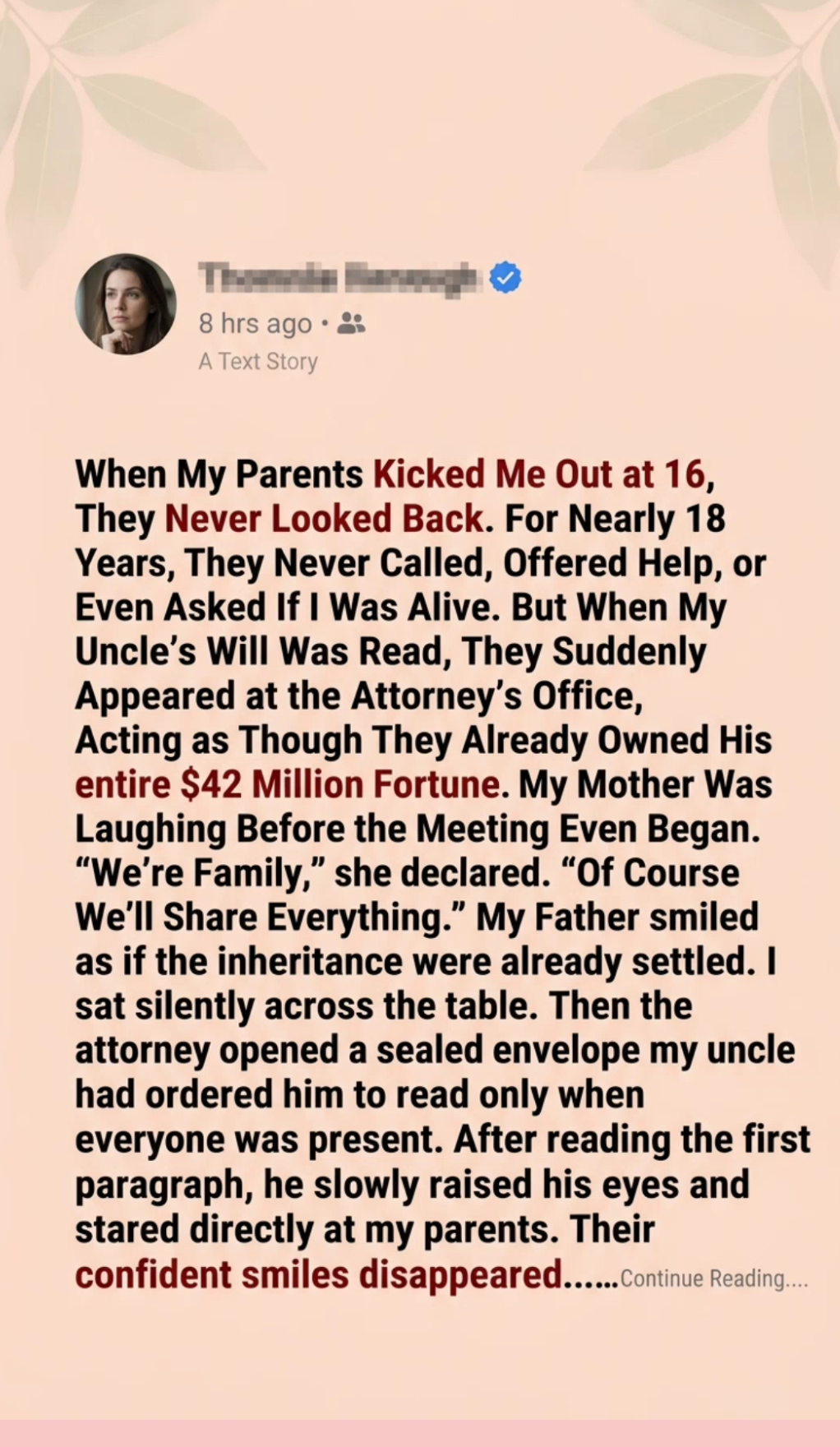
My mother was laughing when she walked into the attorney’s office.
Not a nervous laugh.
Not the kind people use when they’re uncomfortable.
She was genuinely amused, as if the entire meeting were a formality before someone handed her a fortune.
“Forty-two million dollars,” she whispered to my father. “Can you imagine? Your brother certainly knew how to make money.”
My father adjusted his expensive watch.
“Well, he was always good with investments. But he never had children of his own. Naturally, the family will inherit everything.”
I sat across the table from them.
I was thirty-four years old.
My mother hadn’t seen me since I was sixteen.
My father hadn’t called me in almost eighteen years.
Neither had sent a birthday card, asked whether I was alive, or offered help when I was sleeping in a room above a laundromat and working two jobs to survive.
Yet there they were, smiling at me as though we had enjoyed a perfectly normal family relationship.
My mother finally turned toward me.
“Isn’t this wonderful, sweetheart?”
I looked at her.
She hadn’t called me sweetheart since the day she told me to pack my belongings and leave.
“Yes,” I replied quietly. “It’s certainly something.”
She smiled again.
“Your uncle always loved family. He would have wanted us to share everything.”
My father nodded.
“Exactly. There’s no reason for arguments. We’ll handle the estate together.”
I said nothing.
Then the attorney, a gray-haired man named Jonathan Pierce, placed a thick folder on the table.
“Before we discuss the distribution of the estate,” he said, “there is a personal letter your uncle instructed me to read aloud.”
My mother waved her hand.
“Oh, how lovely. He probably wrote something sentimental.”
Jonathan opened a sealed envelope.
He removed a sheet of paper, adjusted his glasses, and began reading.
He had barely finished the first paragraph when he stopped.
His eyes moved from the letter to my parents.
Then he looked directly at my mother.
“Mr. and Mrs. Bennett,” he said slowly, “I believe you should understand that your brother made very specific arrangements concerning the circumstances under which you would receive anything from his estate.”
My mother’s smile disappeared.
My father leaned forward.
“What arrangements?”
Jonathan placed the letter on the table.
“Perhaps I should start from the beginning.”
And that was when my parents learned that the man they had ignored for nearly eighteen years had never forgotten what they did to me.
My name is Daniel Bennett.
I was sixteen when my parents threw me out.
My uncle, Arthur Bennett, was my father’s older brother.
He was a quiet man who owned a small engineering business that eventually grew into a major industrial technology company.
He wasn’t particularly affectionate, but he was dependable.
When I was younger, he sometimes took me to his workshop.
He taught me how to repair a bicycle chain, replace a broken switch, and use basic tools safely.
He never treated me like a child who couldn’t understand anything.
He explained things.
He listened.
And he never made me feel stupid for asking questions.
My father, Richard, was different.
He believed respect meant obedience.
He expected everyone in the house to follow his rules without question.
My mother, Margaret, usually supported him.
They had a comfortable home, two cars, and enough money to avoid most ordinary problems.
From the outside, we looked like a successful family.
Inside, things were less simple.
My father had always resented his older brother.
Arthur had built his business independently. He had never inherited money from their parents, and he had never asked Richard to work for him.
That didn’t stop Richard from constantly comparing himself to Arthur.
Whenever my uncle bought a new property or expanded his company, my father found a reason to criticize him.
“He thinks money makes him important,” Dad would say.
My mother would agree.
“He was always selfish.”
I didn’t understand why they disliked him so much.
Arthur had never been unkind to them.
He simply refused to let my father control his decisions.
The argument that ended my childhood began over a school scholarship.
I had been accepted into a technical program at a respected college.
The scholarship covered most of the tuition and included a small allowance for books and transportation.
I was excited.
I had always been interested in engineering, and the program offered an opportunity I couldn’t afford on my own.
When I told my parents, my father barely looked up from his newspaper.
“You’ll be working in my business after graduation.”
I frowned.
“I thought I could study engineering first.”
“We’ve already discussed this.”
“No, Dad. You told me I would eventually help with the business. You never said I couldn’t study.”
He folded the newspaper.
“You’re sixteen. You don’t get to decide everything.”
My mother placed a plate on the table.
“Your father knows what’s best.”
I tried explaining that the scholarship would make college affordable.
My father became angry.
He accused me of thinking I was better than the family.
Then he said something that changed the direction of my life.
“If you want to make your own decisions, you can do it somewhere else.”
I thought he was threatening me.
I didn’t believe he meant it.
But the argument continued.
I told him I wanted to accept the scholarship.
He stood up.
“Then pack your things.”
My mother didn’t stop him.
She didn’t ask him to calm down.
She didn’t tell me to stay.
Instead, she went upstairs and brought down a cardboard box.
“Don’t make this more difficult than it needs to be,” she said.
I looked at her.
“You’re actually kicking me out?”
She avoided my eyes.
“Maybe some time away will teach you to appreciate what we do for you.”
I packed my clothes, schoolbooks, a few photographs, and the small toolbox Uncle Arthur had given me.
I waited for someone to change their mind.
No one did.
My father opened the front door.
“Go, then.”
I stepped outside.
It was raining.
I was sixteen years old, carrying a cardboard box, with no place to sleep.
My mother closed the door behind me.
That was the last time I saw either parent for nearly eighteen years.
The first night, I slept in a twenty-four-hour bus station.
I had less than a hundred dollars in my pocket.
My scholarship documents were inside my backpack, and I had a phone with a cracked screen.
I called my parents once.
My mother answered.
“Please come home,” I said. “We can talk about the college later.”
She was silent.
Then she said:
“Your father doesn’t want you here.”
I asked if she could at least help me find somewhere to stay.
“We can’t keep rewarding this behavior, Daniel.”
She hung up.
I called my father.
He didn’t answer.
I never called again.
The next morning, I went to the college administration office.
A counselor named Mrs. Helen Foster listened while I explained what had happened.
She didn’t ask me why I had upset my parents.
She didn’t tell me to apologize.
She found me a temporary place in a student accommodation program and helped me apply for emergency assistance.
I still remember her words.
“You’re allowed to have a future, Daniel. Don’t let one difficult night decide the rest of your life.”
I accepted the scholarship.
I worked evenings at a grocery store, weekends in a repair shop, and sometimes overnight cleaning offices.
My life became a schedule of lectures, shifts, cheap meals, and exhaustion.
There were nights I wanted to quit.
There were mornings I couldn’t afford the bus and walked several miles to class.
But I kept going.
I completed the technical program, then earned a degree in mechanical engineering through a combination of scholarships, part-time work, and student assistance.
I never became rich overnight.
I simply kept working.
Uncle Arthur found me when I was nineteen.
I hadn’t contacted him because I assumed my parents had told him I was a troublemaker.
I also didn’t want to ask him for money.
One afternoon, I received a call from an unfamiliar number.
“Daniel?”
“Yes.”
“It’s Arthur.”
I sat down.
“Uncle?”
“How are you, boy?”
I didn’t know what to say.
“I’m okay.”
He was quiet.
Then he asked:
“Are you living with your parents?”
I stared at the wall.
“No.”
“Where are you staying?”
I hesitated.
“Student accommodation.”
He didn’t ask why.
He didn’t lecture me.
He simply said:
“I’d like to have lunch with you.”
We met at a small restaurant near his office.
Arthur looked older than I remembered, but his eyes were the same.
He ordered soup and sandwiches.
Then he asked about college.
I told him everything.
About the scholarship.
The jobs.
The bus station.
The accommodation program.
The day my mother had hung up.
He listened without interrupting.
When I finished, he put down his spoon.
“Your father told me you chose to leave.”
I laughed bitterly.
“Of course he did.”
Arthur looked at me.
“Did you?”
I shook my head.
“No.”
He nodded slowly.
“I thought so.”
He didn’t offer me a large amount of money.
He didn’t promise to fix my life.
Instead, he gave me something I needed more.
A place to ask questions.
He invited me to visit his workshop on Saturdays.
He introduced me to two engineers who became mentors.
He helped me find an internship through a professional contact.
And when I eventually graduated, he attended the ceremony.
My parents did not.
Arthur never tried to replace my father.
He never asked me to call him Dad.
He simply became someone I could trust.
Over the years, our relationship grew.
I started working as an engineer for a manufacturing company.
Later, I moved into operations management.
Arthur occasionally asked me to review technical proposals for his business, but he always insisted on paying me for my time.
When I questioned him, he said:
“Professional work deserves professional compensation. Family doesn’t mean free labor.”
I remembered that sentence.
It was the opposite of what I had grown up hearing.
My uncle eventually sold part of his original business and invested the proceeds in manufacturing facilities, commercial property, and technology companies.
He made several excellent decisions.
By the time he retired from day-to-day operations, his net worth had grown substantially.
But he never became obsessed with expensive things.
He lived in the same house for decades.
He drove a practical car.
He wore old sweaters and repaired his own garden equipment.
The only luxury he seemed to enjoy was buying books.
Sometimes I wondered why a man with so much money lived so simply.
He once told me:
“Money is useful when it gives you choices. It’s dangerous when it becomes the only reason people visit you.”
I understood that sentence more clearly after his death.
My parents reappeared when I was twenty-seven.
Not because they missed me.
Because they needed something.
My father called one afternoon.
I hadn’t heard his voice in eleven years.
“Daniel.”
I recognized him immediately.
“Yes?”
“Your mother and I would like to meet.”
I didn’t answer.
He continued.
“Your uncle has been spending a lot of time with you.”
I almost laughed.
“How would you know?”
“People talk.”
Then he mentioned that my uncle had been considering expanding one of his businesses.
My father wanted to discuss a potential opportunity.
I refused.
“I’m not arranging business meetings for you.”
“Don’t be difficult. We’re family.”
I looked out of my apartment window.
“That word didn’t seem very important when I was sixteen.”
He became irritated.
“Your mother was upset. We all said things we didn’t mean.”
I remembered the rain.
The bus station.
The phone call.
The cardboard box.
“Goodbye, Dad.”
I ended the call.
He never called again.
My mother sent one message two days later.
Your father is only trying to reconnect. Don’t be so unforgiving.
I deleted it.
When Arthur became seriously ill, I visited him regularly.
He had developed a heart condition and was struggling with mobility.
I helped organize his medical appointments, arranged for a home-care service, and visited every weekend.
He disliked being dependent on others.
“Don’t spend your entire life looking after an old man,” he complained.
“I’m not spending my life doing anything. I’m visiting my uncle.”
He smiled.
“That’s a clever answer.”
During one visit, he asked me about my parents.
“Have you spoken to them?”
“No.”
“Do you want to?”
I considered the question.
“I don’t know.”
Arthur nodded.
“That’s fair.”
He looked toward the window.
“People sometimes confuse being related with being trustworthy.”
I didn’t answer.
He continued.
“I don’t want you to spend your life angry. But I also don’t want you to confuse forgiveness with giving people access to you.”
I remembered those words.
He then asked me to bring his old business records from the study.
I assumed he wanted to review them.
Instead, he spent several hours organizing papers and making notes.
I didn’t ask too many questions.
I knew he was preparing for the possibility that he wouldn’t recover.
Arthur died at seventy-two.
His death was peaceful.
I was with him during his final afternoon.
He was tired, but he recognized me.
“Daniel?”
“I’m here.”
He reached for my hand.
“Did you bring the book?”
I showed him the paperback I had brought.
He smiled.
“Good. You always bring the wrong kind.”
I laughed.
Then he became quiet.
“Remember what I told you.”
“About what?”
“Don’t let money decide who you are.”
I nodded.
He closed his eyes.
A few hours later, he was gone.
I felt as if I had lost the only person who had never made me prove I deserved a place in his life.
The funeral was attended by former employees, business partners, neighbors, and several people whose lives Arthur had quietly helped.
My parents arrived separately.
I hadn’t invited them.
They had apparently heard about the funeral through a business associate.
My mother approached me after the service.
She wore a black dress and an expensive necklace.
“Daniel.”
I looked at her.
“Hello.”
She kissed the air beside my cheek.
“It’s been such a long time.”
“Yes.”
She glanced toward the other guests.
“Your uncle was a wonderful man.”
“He was.”
She sighed.
“He always had a soft spot for you.”
I said nothing.
My father joined us.
“We should arrange a meeting about the estate.”
I looked at him.
“The attorney will contact everyone who needs to be involved.”
He frowned.
“Of course. But we’re his closest family.”
I almost asked where they had been during the eighteen years when I needed family.
But I didn’t.
I was tired.
I wanted to grieve.
The estate meeting was scheduled three weeks later.
Jonathan Pierce, Arthur’s attorney, had handled his legal affairs for more than fifteen years.
He was careful, formal, and not easily impressed.
When my parents entered his office, they behaved as though they had already won.
My mother examined the furniture.
“Your uncle always had excellent taste.”
My father looked at the shelves.
“Did he leave any business interests outside the country?”
Jonathan ignored the question.
He asked everyone to sit.
Then he confirmed that Arthur’s estate included:
-
Shares in several privately held businesses.
-
Commercial and industrial properties.
-
Investment portfolios.
-
Cash and other financial assets.
-
Intellectual property and licensing interests.
The combined estimated value was approximately $42 million.
My mother actually laughed.
“Well, Arthur certainly did better than we thought.”
My father nodded.
“His success was always impressive.”
Then my mother said the sentence I would remember for years.
“We’re family. Of course we’ll share everything.”
She looked at me.
“Daniel, we’ll need to be sensible. Your father and I can manage the bigger decisions. You don’t need to worry about all that.”
I stared at her.
I was no longer sixteen.
I wasn’t the boy standing in the rain.
I didn’t need her permission to make decisions about my life.
But I said nothing.
Jonathan opened a folder.
“Before discussing the will, I have been instructed to read a personal letter written by Mr. Arthur Bennett.”
My mother smiled.
“How sweet.”
Jonathan removed the sealed envelope.
He checked the signature.
Then he began reading.
The letter started simply.
To my brother Richard, his wife Margaret, and my nephew Daniel.
I have spent a great deal of time thinking about this meeting.
I know some of you believe that family automatically creates an entitlement to everything I own.
It does not.
My mother stopped smiling.
Jonathan continued.
Richard and Margaret, you made a decision eighteen years ago when you removed your sixteen-year-old son from your home.
I did not learn the full circumstances immediately. When I did, I contacted you both.
Richard told me Daniel had chosen to leave because he was disrespectful and unwilling to follow instructions.
Margaret told me the same thing.
I later learned that Daniel had been sleeping in a bus station before a school counselor helped him find temporary accommodation.
My father’s face changed.
Jonathan paused, then continued.
I asked you why you had not contacted him. You told me he needed to learn responsibility.
I asked whether you had checked that he was safe.
You did not answer.
My mother looked down.
Jonathan turned the page.
Over the following years, I watched Daniel build a life without your help. I watched him work, study, and become a responsible man. I also watched him continue to treat people with kindness, even after experiencing something that would have made many people bitter.
He never demanded money from me.
He never asked me to punish you.
He never asked for revenge.
I am proud of him.
I felt my throat tighten.
Then Jonathan reached the paragraph that had changed his expression.
I have made arrangements for my estate that I want to be absolutely clear.
My father leaned forward.
Jonathan read slowly.
Daniel is the principal beneficiary of my estate, subject to the specific charitable gifts and business arrangements contained in my will.
My mother’s mouth opened.
My father stared at the attorney.
Jonathan continued.
Richard and Margaret are not entitled to control the estate, administer the companies, or make decisions about its distribution.
I have appointed an independent professional executor and trustee.
I have also created a separate provision for my brother and his wife, but it is conditional.
My mother looked up.
“What does that mean?”
Jonathan continued reading.
I have directed the trustee to offer Richard and Margaret a fixed settlement of $250,000, provided they sign a full release of any claims against the estate and comply with the confidentiality and non-interference provisions of the settlement.
My father looked confused.
“Two hundred and fifty thousand?”
“Yes,” Jonathan replied.
“That’s all?”
Jonathan didn’t answer immediately.
Then he read the final paragraph.
If they refuse the settlement or attempt to challenge the will without legitimate grounds, the offer will lapse. Their decision will not affect Daniel’s inheritance.
My mother stared at the table.
Then my father spoke.
“That’s impossible. Arthur would never do this.”
Jonathan placed the letter down.
“Mr. Bennett, your brother signed the will and supporting documents in accordance with the applicable legal requirements. The arrangements were reviewed by independent professionals.”
My father shook his head.
“He was manipulated.”
Jonathan looked directly at him.
“By whom?”
My father didn’t answer.
Then my mother turned toward me.
“Daniel, what have you told him?”
I looked at her.
“The truth.”
The next part of the meeting was even more difficult for my parents.
Jonathan explained that the $42 million figure represented the estimated value of Arthur’s entire estate, not an amount sitting in one bank account.
Some assets were held in companies.
Some were commercial properties.
Others were long-term investments.
The estate had to be administered carefully, and several business interests would remain under professional management.
My parents had no automatic authority over any of it.
My uncle had appointed an independent executor, an external accounting firm, and a corporate trustee.
I was the principal beneficiary, but I would not personally take control of every company.
The arrangement had been designed to protect the assets and prevent impulsive decisions.
My father looked angry.
“So Daniel gets everything?”
Jonathan corrected him.
“Not everything. There are charitable gifts, employee-related provisions, and specific distributions to several individuals. But he is the principal beneficiary.”
My mother turned toward me.
“You’re really going to accept this?”
I looked at her.
“Why wouldn’t I?”
“Because we’re your parents.”
I stared at her for a moment.
Then I asked:
“Do you remember the last time you saw me before today?”
She looked away.
“That was a long time ago.”
“I was sixteen.”
“Daniel—”
“I was sixteen, carrying a cardboard box in the rain.”
My father interrupted.
“We’ve already discussed that.”
“No, Dad. You haven’t discussed it. You have avoided it for eighteen years.”
My mother began crying.
I couldn’t tell whether she was genuinely upset or simply frightened by the situation.
She reached for my hand.
“Sweetheart, we made mistakes.”
I moved my hand away.
“Those weren’t mistakes that happened in one afternoon. You had eighteen years to call me.”
My father stood.
“This is ridiculous. We are not going to be humiliated by a dead man’s letter.”
Jonathan remained calm.
“Mr. Bennett, I suggest you sit down. We have not finished reviewing the documents.”
The attorney then explained why Arthur had chosen the $250,000 settlement.
It wasn’t intended as a reward.
It was an opportunity for my parents to leave the matter peacefully.
They could accept the payment, sign the required release, and have no further involvement in the estate.
They could also refuse.
But they could not simply demand control because they were the deceased’s brother and sister-in-law.
My father wanted to challenge the will.
He claimed Arthur had been influenced by me.
Jonathan produced a series of supporting documents.
Arthur had completed independent capacity assessments.
His instructions had been recorded in solicitor notes.
The will had been reviewed over several months.
The witnesses had no financial interest in the estate.
The professional executor had been involved before Arthur’s final hospitalization.
There was no credible evidence of coercion.
My father looked at the documents.
Then he asked:
“Did Arthur leave Daniel anything else?”
Jonathan turned another page.
“Yes.”
He explained that Arthur had created a separate education and training fund for young people who had experienced family displacement or homelessness.
The fund would provide scholarships, accommodation assistance, and vocational training.
Its initial endowment was $3 million.
I stared at him.
I hadn’t known.
Jonathan continued.
“Mr. Bennett also requested that you serve as an adviser to the foundation, subject to your agreement. The foundation will be managed by independent trustees.”
My eyes filled.
My uncle hadn’t just remembered what happened to me.
He had decided that someone else should have the opportunity I nearly lost.
My parents asked for time to consider the settlement.
They left the office without speaking to me.
Three days later, my father called.
I almost didn’t answer.
“Daniel, we need to discuss this.”
“About the settlement?”
“About everything.”
I waited.
He sounded less confident than before.
“Your mother is very upset.”
“I’m sorry she’s upset.”
“You know she loves you.”
I looked at the phone.
“She hasn’t spoken to me in eighteen years.”
“She didn’t know what to say.”
“She could have started with hello.”
He sighed.
“Your uncle has created a difficult situation.”
I almost laughed.
“Uncle Arthur didn’t create the situation. He documented it.”
My father became defensive.
“You’re going to let a letter destroy your family?”
I answered quietly.
“Dad, the family was already destroyed when you opened the front door and told me to leave.”
He went silent.
Then he asked:
“Would you consider giving us a larger amount?”
There it was.
Not an apology.
Not an explanation.
A negotiation.
I closed my eyes.
“No.”
“Daniel, forty-two million dollars is more money than you need.”
“That isn’t the point.”
“We’re your parents.”
“You’ve said that several times. It still doesn’t explain where you were.”
He ended the call.
My mother tried a different approach.
She sent a long message describing how difficult those years had been for her.
She said my father had been under pressure.
She said I had been stubborn.
She said they believed I would eventually return.
She also said they had been too embarrassed to contact me after so much time had passed.
I read the message twice.
Then I replied with one sentence.
I hope you both find peace, but I will not pretend those eighteen years never happened.
She didn’t respond.
The estate administration took almost a year.
Several business valuations had to be completed.
Property interests were reviewed.
Tax obligations were calculated.
The trustee established a management structure for the companies.
The final distribution was not a single enormous bank transfer.
It was a carefully managed portfolio of assets, investments, and ownership interests.
I accepted the principal beneficiary role with professional advice.
I also agreed to become an adviser to the foundation.
My first decision was to ensure that the foundation’s scholarship program included emergency accommodation.
I remembered what it felt like to be sixteen, holding a cardboard box and not knowing where I would sleep.
I wanted the fund to help young people before they reached that point.
The program began with twenty scholarships.
Each student received tuition support, transport assistance, and access to a qualified adviser who could help with housing and employment.
I attended the first scholarship event.
One young man approached me afterward.
He was seventeen.
He had been staying with friends after being forced to leave home.
He told me he wanted to study electrical engineering.
I asked him why.
He smiled.
“Because I like understanding how things work.”
I smiled back.
“Then you’re in the right place.”
For a moment, I thought about Uncle Arthur.
He would have liked that answer.
My parents eventually accepted the $250,000 settlement.
They signed the required documents and released any claims against the estate.
They didn’t receive a share of the companies.
They didn’t become trustees.
They didn’t gain authority over the foundation.
And they didn’t receive the control they had expected when they walked into the attorney’s office laughing.
After the settlement was completed, my mother sent another message.
I hope one day you can forgive us.
I stared at the words for a long time.
I had spent years imagining what I would say if they ever apologized.
But now I understood something.
Forgiveness wasn’t a switch.
It wasn’t a prize they could demand because they had finally said the right words.
I replied:
I don’t want to spend my life carrying anger. But rebuilding a relationship would require honesty, accountability, and time. I cannot promise anything beyond that.
She responded with a simple:
I understand.
I didn’t know whether she truly did.
But I no longer felt responsible for making her understand.
Two years later, I visited Uncle Arthur’s grave.
The foundation had already helped dozens of students.
The businesses were operating under professional management.
I had moved into a comfortable home, but I hadn’t bought anything extravagant.
I still drove a practical car.
I still worked.
I still enjoyed repairing small things myself.
I carried the same old toolbox Arthur had given me when I was a child.
I placed a small bouquet beside his grave.
“Your foundation is doing well,” I said quietly.
The wind moved through the trees.
I told him about the scholarships, the students, and the young man who wanted to become an electrical engineer.
Then I sat on the bench nearby.
I thought about the attorney’s office.
My mother’s laughter.
My father’s confident smile.
The sealed envelope.
And the moment Jonathan raised his eyes from the letter.
My parents had walked into that meeting believing they were entitled to a fortune because of a family connection.
They had forgotten that relationships are not established by blood alone.
They are built through choices.
My uncle had made his choices.
So had my parents.
And I had finally made mine.
I didn’t use the inheritance to punish them.
I didn’t use it to humiliate them publicly.
I didn’t need to.
I used it to build something meaningful from the life I had nearly lost when I was sixteen.
That evening, before leaving the cemetery, I placed my hand on the cold stone.
“Thank you, Uncle Arthur.”
Then I walked back to my car.
For eighteen years, my parents never asked whether I was alive.
But one man had remembered.
One man had listened.
One man had made sure that the boy they abandoned would never again have to wonder whether he deserved a future.
And that was worth more than the $42 million.
THE END.