At thirty-four, I thought I was finally closing one of the longest chapters of my life.
I had spent twelve years paying off my student loans.
I worked full-time, took extra shifts whenever I could, avoided expensive holidays, and postponed buying a house because I wanted to get rid of my debt first.
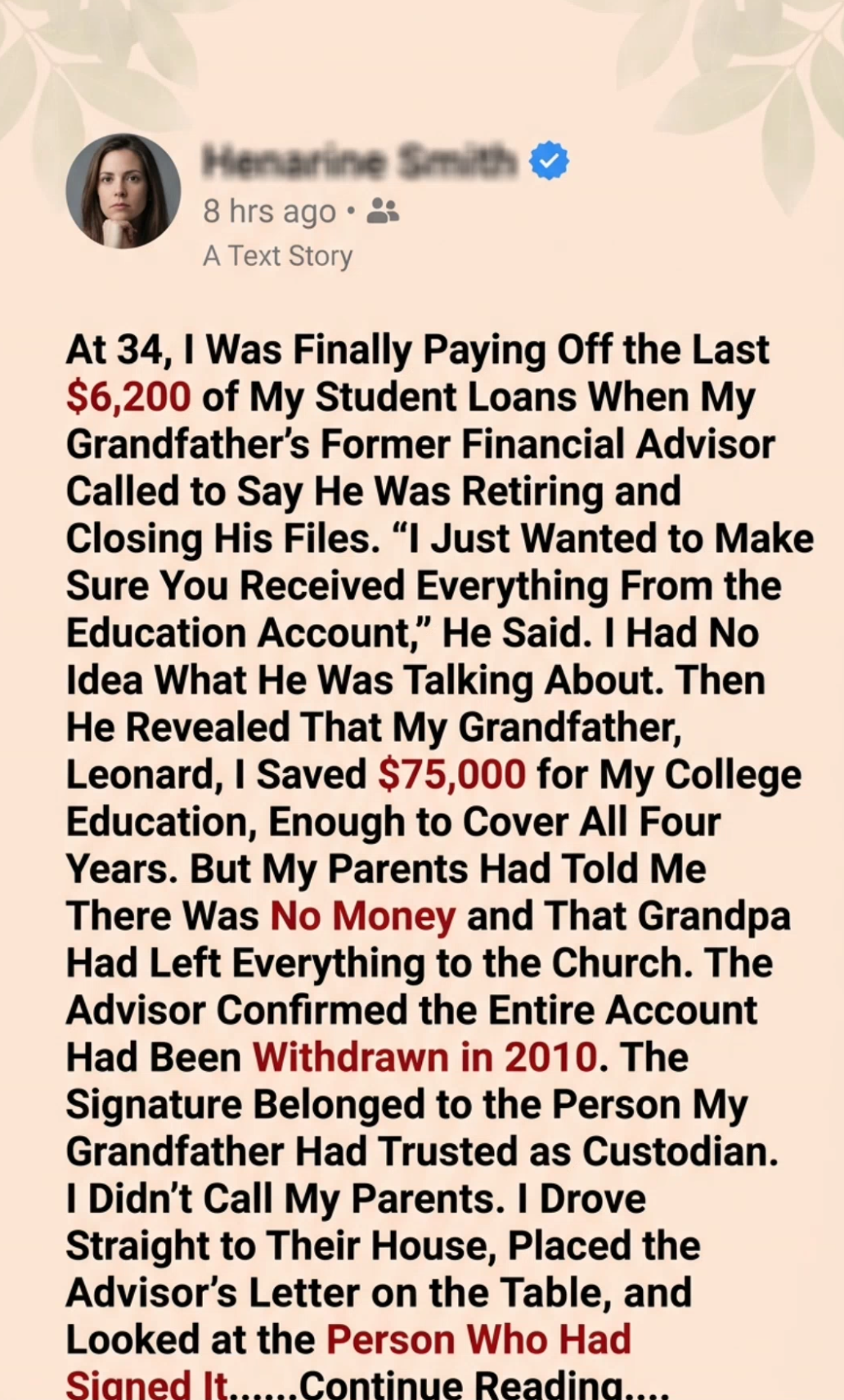
My remaining balance was $6,200.
I had already scheduled the final payments.
I remember sitting at my kitchen table that Tuesday morning, looking at the loan statement and feeling proud.
It wasn’t a fortune.
But it was mine to finish.
Then my phone rang.
The caller introduced himself as Thomas Reed, a financial advisor who had worked with my grandfather, Leonard Hayes, for many years.
I hadn’t spoken to him before.
“Am I speaking with Daniel Hayes?” he asked.
“Yes.”
“My name is Thomas Reed. I was your grandfather’s financial advisor. I’m retiring at the end of the month and closing several old client files. I wanted to make sure you received everything from the education account your grandfather established for you.”
I frowned.
“Education account?”
There was a brief silence.
“Yes. The account Leonard established for your college education.”
I sat up straighter.
“I’m afraid there’s been a misunderstanding. My grandfather didn’t leave me an education account.”
Thomas sounded surprised.
“Are you certain?”
“My parents told me there was no money for college. Grandpa left his estate to the church.”
He paused.
“Daniel, your grandfather established an account worth approximately seventy-five thousand dollars specifically for your education. It was intended to cover your tuition and related expenses.”
I couldn’t speak.
Seventy-five thousand dollars.
That was more than enough to cover the tuition at the university I had attended.
I remembered working weekends during college.
I remembered taking out loans.
I remembered my father telling me that everyone had to make sacrifices and that I should be grateful I was able to attend university at all.
I remembered my mother saying Grandpa had given everything away.
“Mr. Reed,” I finally said, “what happened to the money?”
His voice became more serious.
“That’s why I’m calling. The account was fully withdrawn in 2010.”
“Withdrawn?”
“Yes. The transaction was authorized by the individual listed as custodian.”
I felt a cold sensation move through my chest.
“Who was the custodian?”
Thomas took a breath.
“Your father, Michael Hayes.”
For several seconds, I couldn’t process the answer.
My father.
The man who had told me there was no money.
The man who had watched me sign student loan documents.
The man who had repeatedly reminded me that education was expensive and that I needed to take responsibility for my future.
He had been the person authorized to manage the account.
“Are you saying my father took the money?”
“I’m saying the account was liquidated under his authorization. I cannot tell you the purpose of the withdrawal without reviewing the complete records. But I have a copy of the transaction documentation and the account history.”
“Can you send those to me?”
“Of course. I also have a letter from your grandfather explaining his intentions.”
I thanked him and ended the call.
Then I sat motionless at my kitchen table.
My grandfather, Leonard, had been the person who encouraged me to study.
He used to tell me that education was something nobody could take away from me.
When I was sixteen, he gave me a small notebook and told me to write down the things I wanted to accomplish.
On the first page, he wrote:
Never let someone convince you that your future is worth less than their convenience.
He died when I was nineteen.
I remembered standing beside his grave while my parents told me he had left everything to the church.
I had accepted that explanation because I had no reason to doubt them.
Now, fourteen years later, I was learning that he had saved enough money to pay for my entire education.
And the money had disappeared.
I didn’t call my parents.
I didn’t send an angry message.
I waited for Thomas’s email.
It arrived an hour later.
There were several attachments.
The first was an account summary.
The second was a withdrawal authorization dated June 2010.
The third was a letter from my grandfather.
I opened the account summary first.
EDUCATION ACCOUNT SUMMARY
-
Original contribution: $75,000
-
Beneficiary: Daniel Hayes
-
Purpose: University education
-
Custodian: Michael Hayes
-
Final balance after withdrawal: $0
The withdrawal had occurred shortly before my second year of university.
I opened the authorization form.
The signature at the bottom belonged to my father.
There was no ambiguity.
I then opened my grandfather’s letter.
It was dated three months before his death.
Thomas,
I want Daniel to have the opportunity to attend university without beginning his adult life under a mountain of debt.
His father, Michael, has agreed to act as custodian until Daniel is old enough to manage the funds himself.
The money is for Daniel’s education. It should not be used for household expenses, business investments, personal purchases, or any other purpose.
Please make sure the account is handled according to those instructions.
Leonard.
I read it twice.
Then I closed the laptop.
I knew where my parents lived.
I drove there that afternoon.
My mother answered the door.
She looked surprised.
“Daniel? Is everything all right?”
“Is Dad home?”
“He’s in the living room.”
I walked past her.
My father was sitting in his favorite chair, watching the news.
He looked up.
“Well, this is unexpected.”
I placed the advisor’s letter and the withdrawal document on the coffee table.
“Do you remember Grandpa’s education account?”
My father glanced at the papers.
His expression changed.
Not dramatically.
Just enough.
“Where did you get those?”
“From his financial advisor.”
My mother stood behind the sofa.
“What is this about?”
I looked directly at my father.
“Grandpa left seventy-five thousand dollars for my college education. You withdrew every dollar in 2010.”
My father put down the remote.
“That was a long time ago.”
I stared at him.
“That’s your response?”
He sighed.
“Daniel, you don’t understand what was happening at the time.”
“Then explain it.”
My mother stepped forward.
“Your father was under a lot of pressure back then.”
I turned toward her.
“Did you know?”
She didn’t answer.
That was when I understood that this wasn’t something my father had done without anyone knowing.
Both of them had been aware of it.
I looked at the withdrawal form.
“Why did you sign this?”
My father leaned back.
“Because we needed the money.”
“For what?”
“Family expenses.”
“What family expenses?”
He rubbed his forehead.
“Things were difficult. The business wasn’t doing well. We had debts, bills, and other obligations.”
I felt my jaw tighten.
“So you used my college fund to pay for your problems?”
“It was money sitting in an account. We were going to replace it.”
“When?”
“When things improved.”
“Did they?”
He looked away.
I continued.
“Why did you tell me there was no money?”
My mother began crying.
“We didn’t want you to feel responsible.”
I looked at her.
“Responsible for what? My own education?”
My father interrupted.
“We were trying to keep the family together. You were young. You wouldn’t have understood the financial pressure.”
I stared at him.
“I understood student loans. I understood working weekends. I understood skipping meals when money was tight. I understood every payment I made over the last twelve years.”
My voice began to shake.
“You let me believe Grandpa hadn’t left me anything.”
My father stood up.
“Don’t speak to me like I’m some criminal. I raised you.”
I looked at him.
“And Grandpa trusted you.”
That silenced him.
For the first time, he seemed to realize that the conversation wasn’t about whether he had been a good father in other ways.
It was about a specific promise he had made to his own father.
I asked whether he had ever intended to repay the money.
He said he had planned to.
I asked whether he had told Grandpa that he had withdrawn it.
He didn’t answer.
Then my mother said something I will never forget.
“Your grandfather wouldn’t have wanted us to lose our home over this.”
I turned toward her.
“Did Grandpa know you used the money?”
She looked down.
My father finally spoke.
“He knew the family was struggling.”
“That’s not what I asked.”
He said nothing.
I picked up the papers.
“I’m going to need a complete explanation of where the money went.”
My father became defensive.
“You’re not going to drag us through court over something that happened fourteen years ago.”
“I’m not making threats. I’m asking for the truth.”
“You’ve got a good job. You paid your loans. Why are you reopening this?”
I looked at him.
“Because you made me pay for something Grandpa had already paid for.”
My mother covered her mouth.
I left without saying anything else.
That night, I barely slept.
I kept remembering the years I had spent trying to make my parents proud.
When I received my university acceptance letter, my father had told me that I needed to become financially independent.
When I complained about the cost of textbooks, my mother suggested I find a second job.
When I graduated, they congratulated me and told everyone how hard I had worked.
They knew the entire time.
The next morning, I called Thomas.
I asked whether he could help me obtain the full account records and any correspondence related to the withdrawal.
He agreed.
He also suggested that I speak with an attorney before contacting my parents again.
I followed his advice.
The attorney, Ms. Bennett, reviewed the documents.
She explained that the legal consequences would depend on the account structure, the applicable state law, the exact dates, and the evidence of how the money was used.
She warned me not to assume that a fourteen-year-old transaction automatically meant I had an enforceable claim.
But she also told me that the records deserved a careful review.
We requested additional documentation.
Several weeks later, Thomas located an old correspondence file.
It included a letter from my father sent shortly after the withdrawal.
The letter explained that he had used the money to stabilize the family business and intended to restore the education account once the company recovered.
The company never recovered.
It eventually closed.
My father had not replaced a single dollar.
There was also a handwritten note from my grandfather, dated several months later.
It read:
Michael says the business is experiencing difficulties. I have asked him whether Daniel’s education account remains untouched. He assured me that Daniel’s money is safe.
I read that sentence repeatedly.
My grandfather had asked.
My father had reassured him.
And Grandpa had died believing the money was still there.
That hurt more than the financial loss.
I had always thought my grandfather’s final years were peaceful because he believed he had arranged my future.
Instead, he had been given a promise that was never honored.
I showed the note to my attorney.
She advised me to preserve every document and avoid making accusations beyond what the records established.
Meanwhile, my parents began calling.
My father wanted to meet.
My mother sent messages saying the family was falling apart.
I agreed to one meeting, but I requested that my attorney be present.
My father was furious when he learned that.
“You’re bringing a lawyer to speak to your own parents?”
“I’m bringing someone who understands the documents.”
He eventually agreed.
We met in a small conference room.
My father arrived with a folder of his own.
He looked older than I remembered.
He began by saying that he had made a mistake.
He explained that the business had been struggling, that he feared losing everything, and that he had convinced himself the money would be returned quickly.
He said he never intended to deprive me of an education.
I listened.
Then I asked him:
“Why didn’t you tell me when I started taking out loans?”
He looked down.
“Because I was ashamed.”
“Why didn’t you tell me when I graduated?”
“I thought it was too late.”
“Why didn’t you tell me when I started paying them back?”
He didn’t answer.
Finally, I asked the question that had been troubling me most.
“Why did you tell me Grandpa left everything to the church?”
My mother began crying.
My father stared at the table.
“Because we didn’t want you asking questions about the account.”
I leaned back.
There it was.
The truth.
Not a misunderstanding.
Not an innocent mistake.
A decision made repeatedly over fourteen years.
I asked my father whether he understood how much interest I had paid on the loans.
He nodded.
I showed him the total.
Then I showed him the remaining balance I had been planning to pay off that week.
He looked at the figures.
“I can help you pay the remaining amount.”
I shook my head.
“That’s not what this is about anymore.”
He frowned.
“Then what do you want?”
“I want you to acknowledge what happened. I want you to stop pretending this was something Grandpa would have approved of. And I want a proper accounting of the money.”
My attorney explained that we would need to review the documents before discussing any potential recovery.
My father agreed to provide the remaining records.
The following months were difficult.
Our family became divided.
Some relatives said I should forgive my father because he had been under financial pressure.
Others said he had taken advantage of the trust placed in him.
I didn’t discuss the matter with everyone.
I wasn’t interested in turning the family into opposing teams.
I wanted the truth established.
Eventually, my father provided the business records he still had.
They showed that the education account withdrawal had been used to pay several outstanding business obligations, including supplier invoices and overdue commercial rent.
There was no evidence that he had spent the money on luxury purchases.
That didn’t erase what he had done.
But it helped me understand the circumstances.
My attorney continued reviewing the possible legal options.
In the end, my father agreed to a repayment arrangement after independent financial advice.
He could not repay the original amount immediately.
We negotiated a structured payment plan based on what he could realistically afford.
I also made it clear that the arrangement was not a condition for immediate forgiveness.
My mother asked whether I would ever visit them normally again.
I told her I didn’t know.
Trust is not something that returns simply because someone finally admits the truth.
A few weeks later, I received a handwritten letter from my mother.
She apologized for knowing about the account and remaining silent.
She admitted that she had convinced herself that keeping the family together was more important than telling me what happened.
She wrote that she had watched me struggle through university and had never found the courage to explain the truth.
I read the letter several times.
I didn’t immediately respond.
But I kept it.
As for my student loans, I paid the final $6,200 from my savings.
I had already planned to do it, and I wanted that chapter closed regardless of what happened with the repayment arrangement.
When the confirmation arrived, I printed it.
I placed it beside my grandfather’s letter.
Two pieces of paper.
One showed a debt finally paid.
The other showed a promise that had been broken.
I visited Grandpa’s grave the following weekend.
I brought a small bunch of white flowers.
I stood there for a while before speaking.
“I found the account, Grandpa.”
The wind moved gently through the trees.
“I wish you had known what happened.”
I placed the flowers beside his headstone.
“I finished university. I paid my loans. I did what you wanted me to do.”
Then I took a breath.
“And I won’t let what happened make me forget what you gave me.”
I stayed there until the cemetery became quiet.
I don’t know whether my relationship with my father will ever return to what it was.
We speak occasionally now.
He has made several payments under the agreement, and I intend to keep the arrangement formal until it is completed.
My mother and I are slowly rebuilding communication, although there are still difficult conversations ahead.
I no longer expect apologies to fix everything.
But I have stopped carrying the guilt that belonged to someone else.
For twelve years, I believed I had started adult life with a disadvantage because my family couldn’t afford to help me.
Now I understand that my grandfather had tried to give me a different beginning.
He had saved seventy-five thousand dollars because he wanted me to have choices.
Someone he trusted took that opportunity away.
But he couldn’t take away the education I earned, the work I did, or the person I became.
And when I finally paid that last $6,200, I realized something.
The money had been gone for fourteen years.
But the truth had finally caught up with it.
THE END.