For six years, I believed I was doing something good for my parents.
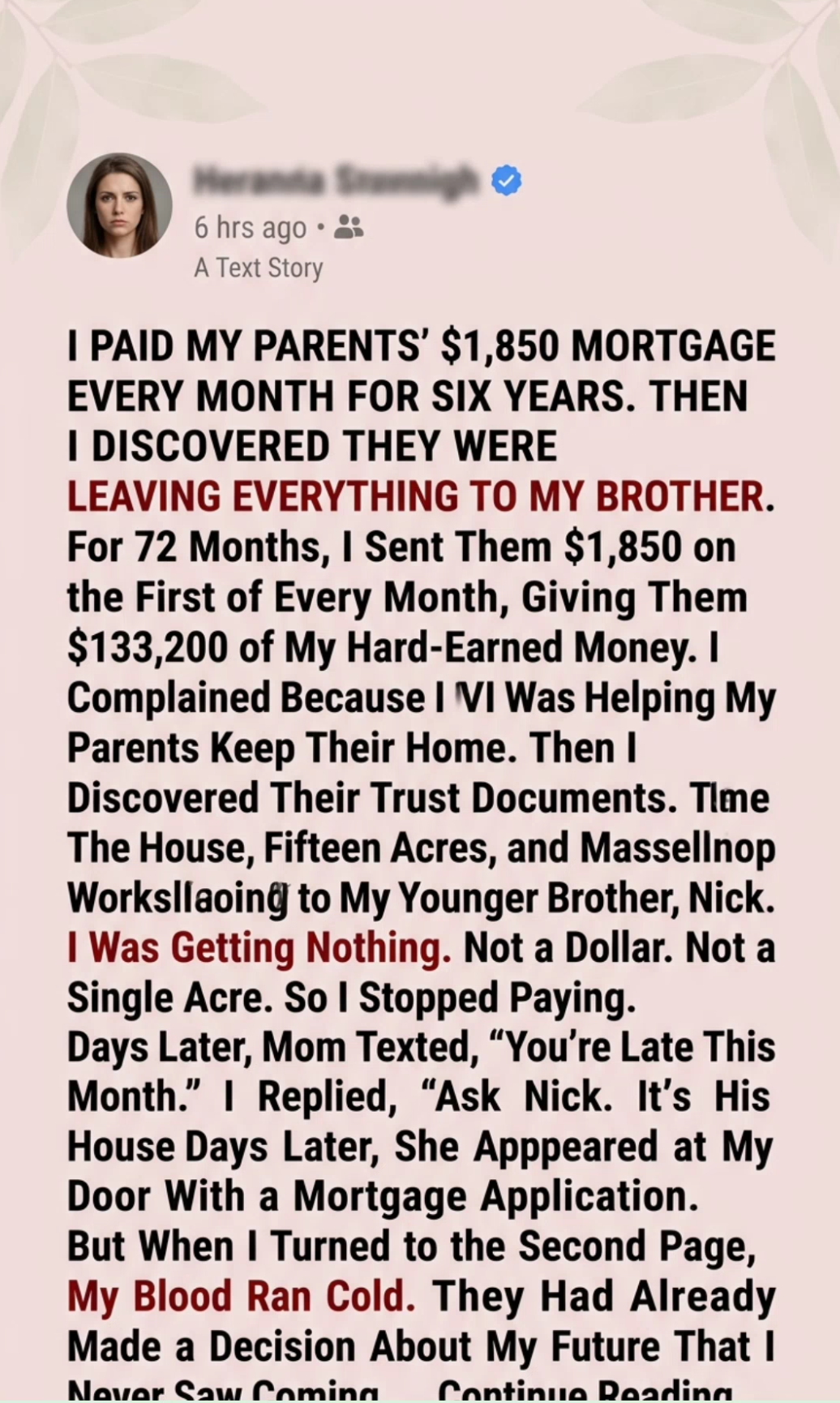
Every month, on the first day, I transferred $1,850 into their bank account.
I never missed a payment.
Not when I had unexpected car repairs.
Not when my business had a difficult month.
Not even when I wanted to take a vacation but decided the money would be better used helping them.
My parents, Richard and Susan, lived in a large farmhouse surrounded by fifteen acres of land. The property included an enormous workshop where my father had spent most of his adult life repairing machinery and building furniture.
It wasn’t a luxurious estate, but it was the place where my brother and I had grown up.
My younger brother, Nick, was thirty-one. I was thirty-seven.
Nick had always been the favorite.
He was charming, sociable, and good at making promises. Unfortunately, he wasn’t particularly good at keeping them.
He had tried several jobs, started two small businesses, and borrowed money from relatives more times than I could count.
I had taken a different path.
I worked hard, built a successful home-renovation business, and bought a modest house of my own.
When my father called me six years ago, he sounded worried.
“The mortgage payment has become difficult,” he explained. “Your mother’s medical expenses have increased, and the property taxes aren’t getting any cheaper.”
I asked how much they needed.
“$1,850 a month would keep everything current.”
I thought about it.
Then I agreed.
“Don’t worry, Dad. I’ll help.”
My mother cried when I told her.
“You’re such a good son. Your father and I don’t know what we’d do without you.”
Those words meant a lot to me.
I wasn’t expecting an inheritance.
I wasn’t expecting to own the property.
I simply wanted my parents to remain in the home where they had spent their lives.
For six years, I made the payments.
Sometimes my mother called to thank me.
Sometimes my father sent a short message saying the payment had arrived.
Most months, there was no conversation at all.
I never complained.
I considered it part of being a responsible son.
Then, last autumn, I discovered something that changed the way I understood those six years.
It happened during a Sunday family dinner.
My parents had invited Nick, his girlfriend, and several relatives.
After dinner, my mother asked me to help move some boxes from the hallway.
While we were clearing a cupboard, I noticed a thick folder marked:
FAMILY TRUST — PROPERTY AND SUCCESSION
I wasn’t trying to investigate anything.
But the folder was open, and my name appeared on one of the pages.
I glanced at it.
The document listed my parents’ property, including the farmhouse, fifteen acres, and the workshop.
Under the section describing the intended beneficiaries, I saw one name.
Nicholas Richard Hayes.
My brother.
I read it again.
There was no reference to me.
I turned another page.
It explained that Nick would receive the entire property after my parents’ deaths.
The workshop, the land, the farmhouse, and the equipment inside it were all included.
I felt confused.
Perhaps there was another document.
Perhaps my parents had made some arrangement I didn’t understand.
I placed the folder back where I had found it.
Then I went into the kitchen.
My mother was preparing coffee.
“Mom, can I ask you something?”
“Of course.”
“I saw the family trust documents.”
Her hands stopped moving.
“What documents?”
“The ones in the hallway cupboard.”
She looked at me.
Then she lowered her voice.
“Your father handles those things.”
I asked why Nick was receiving the property.
She sighed.
“Because he needs it more than you do.”
I stared at her.
“What does that mean?”
“You’re doing well, Daniel. You have your own house and your business. Nick needs somewhere to build his future.”
I couldn’t believe what I was hearing.
“So I’ve been paying the mortgage for six years, but Nick gets the property?”
My mother looked uncomfortable.
“Nobody asked you to pay it expecting something in return.”
“I didn’t expect an inheritance. But I thought I was helping you keep your home.”
“And you did.”
“Then why is the entire property going to Nick?”
She placed the coffee pot on the counter.
“Because he’s our youngest. Your father wants him to have something.”
I felt my jaw tighten.
“Does Dad know I’m paying the mortgage?”
She looked at me as though the question were ridiculous.
“Of course he knows.”
“Does Nick know?”
She didn’t answer.
That evening, I drove home without saying goodbye properly.
I couldn’t stop thinking about the documents.
I had contributed $1,850 every month for seventy-two months.
That was $133,200.
I had never demanded repayment.
I had never asked to be placed on the deed.
But I had assumed that if my parents were receiving such substantial help, they would at least be honest about their plans for the property.
The following morning, I called my father.
“Dad, we need to talk about the mortgage payments.”
He sounded irritated.
“What’s wrong?”
“I saw the trust documents.”
There was a pause.
“What about them?”
“They leave everything to Nick.”
“That’s right.”
I waited for him to explain.
He didn’t.
“Why didn’t you tell me?”
“Because it’s our property, Daniel. We can leave it to whoever we want.”
I took a breath.
“That’s true. But I’ve been paying the mortgage for six years.”
“And we appreciate it.”
“Then why did you let me believe I was helping preserve the family home when you had already decided everything would go to Nick?”
My father sighed.
“You’re making this about money.”
I laughed quietly.
“One hundred and thirty-three thousand dollars is a lot of money, Dad.”
“You have a good business. Nick needs the help.”
I looked out of my office window.
“Then Nick can start making the mortgage payments.”
My father became silent.
I continued.
“I’m stopping the transfers.”
He immediately raised his voice.
“You can’t do that!”
“Why not?”
“Because we’ve depended on that money!”
I felt something inside me finally settle.
“Then you should have thought about that before deciding I was good enough to pay for the property but not good enough to be included in its future.”
I ended the call.
The next month, I didn’t make the transfer.
On the second day, my mother sent me a text.
You’re late this month.
I read it twice.
Then I replied:
Ask Nick. It’s his house.
She called immediately.
I didn’t answer.
She sent another message.
Don’t be childish. Your father is counting on you.
I wrote back:
I am no longer making payments on a property I don’t own and have no agreement to support indefinitely.
She didn’t respond.
For several days, everything was quiet.
Then, exactly seven days later, my mother appeared at my front door.
She was carrying a brown envelope.
“Daniel, we need to talk.”
I invited her inside.
She sat at the dining table and placed the envelope in front of me.
“Your father has been speaking with the bank.”
I opened it.
The first page was a mortgage application.
The second page contained a proposed financial arrangement.
I started reading.
Then my blood ran cold.
My parents had listed my income and business details as supporting financial information.
My name appeared in a section describing an intended co-borrower.
I looked at my mother.
“Why is my name here?”
She folded her hands.
“Your father thought you might be willing to help us refinance.”
“Did I agree to this?”
“Not yet.”
“Did you tell the bank I agreed?”
She became defensive.
“We were only trying to see what options were available.”
I turned to the second page again.
It included a section describing a future transfer of the property to Nick, with the expectation that the new mortgage would be supported by family income.
I felt sick.
They were trying to use my financial position to help secure a loan for a property they intended to leave entirely to my brother.
And they had discussed it without asking me.
“Mom, did Dad submit this?”
She hesitated.
“He spoke with the bank.”
“Did he use my financial information?”
“He knows your business is doing well.”
I pushed the papers away.
“That’s not an answer.”
She began crying.
“Daniel, we’re your parents. We need help.”
I looked at her.
“I helped you for six years.”
“Then help us now.”
“Did you tell Nick about this?”
She looked down.
“He’s trying to get his finances in order.”
I almost laughed.
Of course he was.
Nick would receive the property, while I would be expected to help finance it.
I picked up my phone.
“I’m calling my attorney.”
My mother looked frightened.
“Why would you do that?”
“Because my name and financial information are being used in a mortgage application I never authorized.”
I called my attorney, Laura Bennett.
She asked me to send her copies of the documents.
She told me not to sign anything, not to provide additional financial information, and not to make any promises.
She also advised me to contact the lender directly to determine whether an application had actually been submitted using my information.
My mother sat quietly while I made the call.
The bank representative confirmed that my father had discussed refinancing options and had provided preliminary household information.
However, they had not approved me as a borrower, and no loan had been issued in my name.
I asked them to record that I had not consented to any application or guarantee.
They did.
When I ended the call, my mother looked exhausted.
“You’re making this much bigger than it needs to be.”
I stared at her.
“You brought me a mortgage application with my name on it.”
“Your father was trying to keep the house.”
“Then he should ask Nick.”
She wiped her eyes.
“Nick doesn’t have the money.”
I leaned back.
“Exactly.”
For the first time, I said the words I had avoided for years.
“That’s why you wanted me.”
She didn’t deny it.
Instead, she began explaining that my father had always hoped Nick would eventually become successful.
They believed the workshop could become a small manufacturing business.
They wanted Nick to live on the property, maintain the land, and continue the family tradition.
I listened.
Then I asked:
“And what did you imagine I would do?”
She looked confused.
“What do you mean?”
“Would I keep paying the mortgage? Would I help finance the workshop? Would I continue supporting the property while Nick owned everything?”
My mother began crying again.
“We thought you would understand.”
I shook my head.
“I understand perfectly.”
She left without finishing her coffee.
That evening, my father called.
He was furious.
“Your mother says you threatened to involve lawyers.”
“I told her I was contacting my attorney because my name appeared on a mortgage application.”
“It was only a proposal!”
“Then why was my financial information included?”
“We thought you would help.”
“You didn’t ask.”
He became quiet.
Then he said something I will never forget.
“You’re my oldest son. You’re supposed to be responsible.”
I closed my eyes.
There it was.
For years, being the responsible son had meant paying for problems I hadn’t created.
It had meant making sacrifices while Nick was given opportunities.
It had meant being praised whenever I agreed and criticized whenever I questioned something.
I finally understood that my parents had confused responsibility with unlimited availability.
“Dad,” I said, “being responsible doesn’t mean allowing people to make financial decisions for me.”
He hung up.
Over the next two weeks, my attorney reviewed the mortgage documents and the records I had kept of the payments.
She advised me that whether I could recover any of the money depended on the original understanding, the evidence, and applicable law.
Because I had voluntarily made the payments without a written repayment agreement or ownership arrangement, I shouldn’t assume that the entire amount was automatically recoverable.
But she also advised me to preserve the records and make sure no one used my identity or financial information without authorization.
I gathered six years of bank statements.
Every transfer was there.
The first payment.
The second.
The thirty-sixth.
The seventy-second.
One hundred and thirty-three thousand two hundred dollars.
I created a spreadsheet showing the dates and amounts.
Then I sent a formal letter to my parents.
It explained that I would make no further mortgage payments, would not guarantee any loans, and did not consent to the use of my financial information.
I also requested that they correct any inaccurate information provided to the lender.
My father responded with a short message.
After everything we’ve done for you, this is how you treat your parents?
I stared at the screen.
I wanted to list every sacrifice.
Every payment.
Every time I had postponed something important because their mortgage was due.
But I didn’t.
I replied:
I am not abandoning you. I am ending an arrangement that was never honestly explained to me.
Then I put my phone away.
Three weeks later, Nick called.
I hadn’t spoken to him directly about the situation.
He sounded annoyed.
“What’s going on with Mom and Dad?”
I explained.
He was silent for a moment.
Then he said:
“They told me you were helping them temporarily.”
I frowned.
“Temporarily?”
“Yeah. Dad said you had offered to cover the mortgage until he retired.”
I sat down.
“Nick, I’ve been paying it for six years.”
“What?”
“Seventy-two payments.”
He sounded genuinely surprised.
“I didn’t know that.”
I asked whether he knew about the trust.
He said he did.
He had been told that the property would eventually become his, but he hadn’t known the payments were coming from me.
Then he said something unexpected.
“I don’t think I should get the whole place if you’ve been paying for it.”
I didn’t know what to say.
He continued.
“I mean, I know I haven’t been great with money. But I didn’t ask you to do that.”
For the first time in years, I heard my brother acknowledge that the arrangement was unfair.
I told him I wasn’t asking him to give up anything.
I was asking him to take responsibility for the future my parents had planned for him.
“If you inherit the house, you’ll have to manage it. You can’t expect me to keep paying for it.”
He agreed.
A few days later, Nick visited our parents.
I wasn’t there, but he later told me what happened.
He asked them why they had never explained the arrangement to him.
My father became angry.
He accused Nick of being ungrateful.
Nick replied that he didn’t want to inherit a property that depended on his brother’s money.
The conversation ended badly.
For the first time, my parents were hearing the same complaint from both sons.
Not because we had planned it together.
But because we had finally started asking the same question:
Why was one son expected to provide everything while the other was promised everything?
Several months passed.
My parents eventually refinanced their mortgage without using my income.
They sold an old tractor and some unused equipment from the workshop to reduce their debt.
Nick began contributing to household expenses and helping my father maintain the property.
He also found steady work with a local construction company.
It wasn’t a perfect solution.
But it was a solution that didn’t require me to keep financing everyone else’s choices.
My mother eventually called and asked whether I would come for dinner.
I hesitated.
Then I agreed.
When I arrived, the house looked almost the same.
My father was in the workshop.
My mother was preparing dinner.
Nick was sitting at the kitchen table.
There was no mortgage application waiting for me.
No request for money.
No discussion about guarantees.
After dinner, my mother approached me.
“Daniel, I want to apologize.”
I looked at her.
She continued.
“We should have told you about the trust. We should never have assumed you would keep paying without understanding what we planned.”
I nodded.
“Yes. You should have.”
My father came in from the workshop.
He looked uncomfortable.
“I made mistakes,” he said.
It wasn’t the apology I had imagined.
But it was an admission.
He explained that he had always seen me as the son who could manage on his own.
He thought Nick needed the property because he had struggled more.
I listened.
Then I said:
“You made my independence the reason you expected me to carry more responsibility. You made Nick’s struggles the reason you promised him more.”
My father looked down.
“I suppose we did.”
Nobody spoke for a while.
I didn’t demand that they change their trust.
I didn’t demand a share of the land.
I didn’t ask for the workshop.
I simply told them that any future financial help would need to be discussed openly and agreed upon in writing.
My mother nodded.
Nick agreed.
And my father, after a long pause, said:
“That’s fair.”
I left that evening without knowing exactly what our family relationship would become.
But something had changed.
For the first time, I wasn’t the automatic solution to every financial problem.
I was their son.
Not their mortgage payment.
Not their emergency fund.
Not the person expected to sacrifice quietly because he happened to be doing better than his brother.
Today, I still have a relationship with my parents.
I visit them occasionally.
I help my father with practical things around the property when I choose to.
But I no longer transfer $1,850 every month.
My brother has taken responsibility for the future he was promised.
And I have returned my attention to the life I built for myself.
I sometimes think about those seventy-two payments.
One hundred and thirty-three thousand two hundred dollars.
I don’t regret helping my parents.
I regret that they allowed me to believe we were sharing an honest arrangement when they had already made a different plan.
The lesson wasn’t that children should never help their parents.
It was that generosity should never require someone to surrender their financial independence, dignity, or future.
I spent six years trying to keep my parents’ house safe.
But when I discovered that my brother was supposed to inherit everything, I finally understood something.
I had been helping them preserve a home for the family while quietly losing the freedom to build my own future.
And the day I stopped paying wasn’t the day I abandoned my parents.
It was the day I stopped abandoning myself.
THE END.