The moment Caleb raised his wineglass, I knew something was wrong.
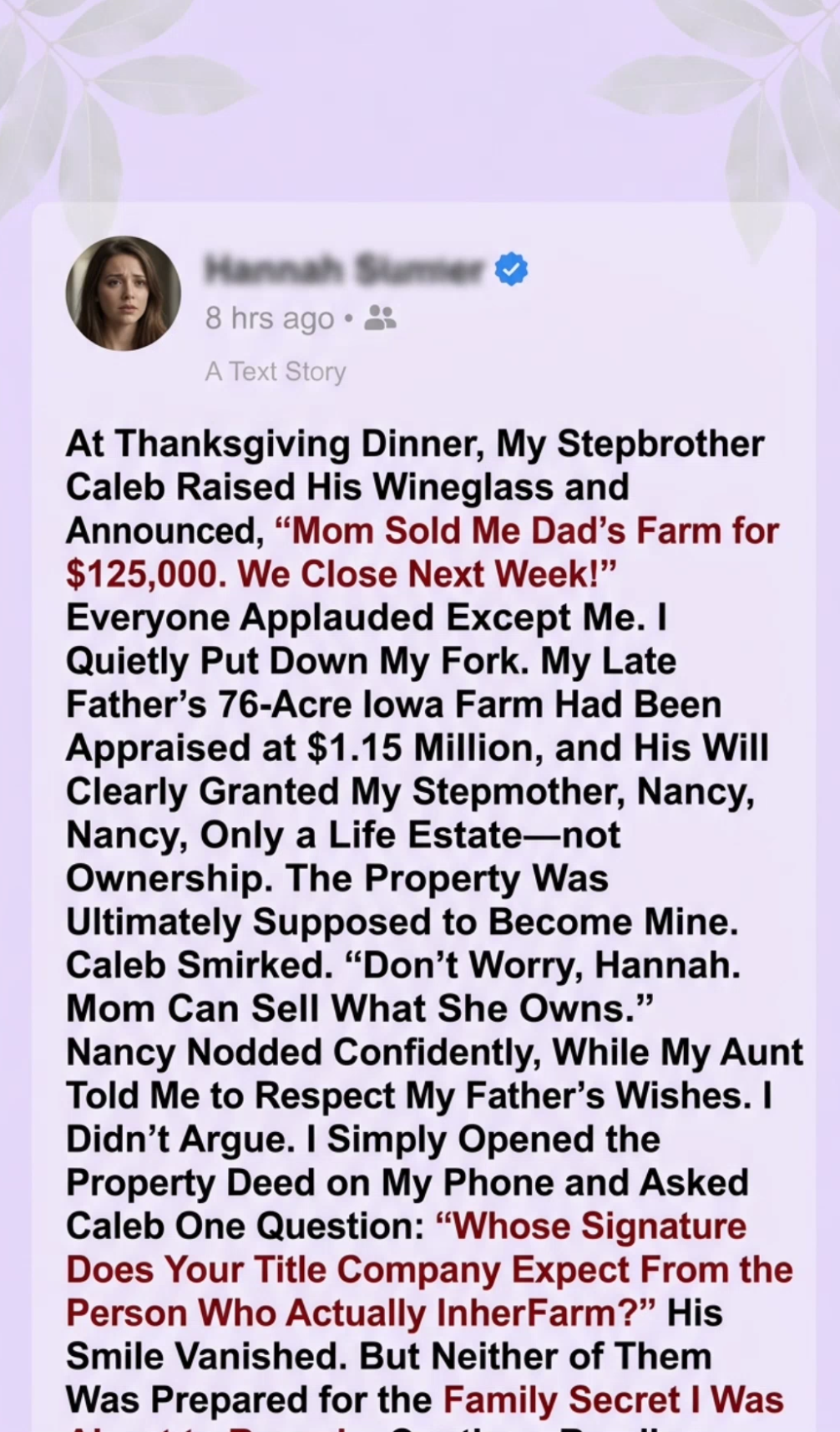
“To new beginnings!” he announced, smiling around the Thanksgiving table. “Mom sold me Dad’s farm for $125,000. We close next week!”
Everyone applauded.
My aunt Patricia clapped enthusiastically. My cousin raised his glass. Even my stepmother, Nancy, looked pleased with herself.
I didn’t clap.
I slowly placed my fork beside my plate.
My father’s farm wasn’t just a piece of property. It was seventy-six acres of Iowa farmland, a two-story farmhouse, a large red barn, several storage buildings, and a small pond surrounded by old maple trees.
My father had spent nearly forty years building that place into something valuable.
The most recent independent appraisal had valued it at approximately $1.15 million.
And according to his will, Nancy had been granted a life estate. She could live on the property and enjoy certain benefits from it during her lifetime, but she had not inherited unrestricted ownership.
The property was ultimately supposed to pass to me.
Yet Caleb was sitting across from me, celebrating a purchase that apparently had already been arranged.
He noticed my expression.
“Something wrong, Hannah?”
I looked at him.
“Did you say Mom sold you the farm?”
“That’s what I said.”
“For $125,000?”
He laughed.
“Don’t worry. Mom can sell what she owns.”
Nancy nodded confidently.
“Your father wanted me to be comfortable. This arrangement gives me the freedom to make decisions about the property.”
My aunt Patricia leaned toward me.
“Hannah, don’t start an argument at Thanksgiving. Your father wanted Nancy to be taken care of. You should respect his wishes.”
I looked at her.
“I do respect his wishes.”
“Then why are you making that face?”
I didn’t answer.
Instead, I reached for my phone.
I opened the county property records I had saved several months earlier and checked the legal description.
Then I looked directly at Caleb.
“Whose signature does your title company expect from the person who actually inherits this farm?”
His smile disappeared.
Nancy put down her glass.
“What are you talking about?”
I turned my phone toward them.
“Because according to the deed and Dad’s estate documents, you don’t own the property outright.”
For the first time that evening, nobody was applauding.
But the real story wasn’t about the $125,000.
It was about what had happened during the eighteen months after my father died—and why Caleb suddenly wanted the farm so badly.
My father, Robert Miller, had purchased the farm when he was thirty-one.
He wasn’t wealthy when he started.
He worked long hours, repaired his own equipment, and gradually expanded the property by purchasing neighboring parcels whenever he could afford them.
The farmhouse had been built decades earlier. Its floors creaked, the kitchen cabinets were outdated, and the upstairs bathroom had a window that refused to close properly.
But Dad loved it.
He loved the smell of freshly cut grass, the sound of rain against the barn roof, and the quiet mornings when the entire property seemed to belong to him alone.
I grew up there.
My mother died when I was eleven. After that, my father and I became especially close.
He taught me how to drive a tractor, identify different crops, repair a broken fence, and understand why farmers watched the weather forecast more carefully than the evening news.
When I left for college, he helped me move into my first apartment.
When I graduated, he attended the ceremony wearing his best blue shirt and carrying a camera he barely knew how to use.
He was proud of me.
Not because I had become particularly successful, but because I had built a life of my own.
Several years later, he married Nancy.
She was kind to me initially, although we never developed the relationship of a mother and daughter.
She had a son, Caleb, from her first marriage.
Caleb was three years younger than me and had grown up in a completely different environment. He was outgoing, ambitious, and interested in business opportunities.
He and my father were polite to each other, but they were never particularly close.
When Dad married Nancy, I was happy that he had found companionship.
I didn’t expect her to replace my mother.
I only hoped we could become a family without competing over who belonged.
For a while, things were peaceful.
Then Dad became ill.
His health declined gradually. He spent more time inside the farmhouse and less time walking around the fields.
I visited every weekend, helped arrange appointments, and handled errands whenever he needed me.
Caleb visited occasionally.
Nancy was there every day, and I never questioned how difficult that responsibility must have been.
When Dad died, I was devastated.
The funeral was held at a small church in town. Farmers, neighbors, former employees, and friends came to pay their respects.
People told stories about Dad’s generosity and stubbornness.
One neighbor remembered how Dad had helped him repair a damaged barn after a storm.
Another remembered how he had quietly paid for a young man’s agricultural training when his family couldn’t afford it.
After the funeral, the estate process began.
My father’s attorney, Mr. Bennett, explained that Dad had made arrangements to protect Nancy while ensuring that the farm would eventually pass to me.
Nancy was granted a life estate under the will.
The exact rights and responsibilities were governed by the estate documents and applicable Iowa law, but the central arrangement was clear: Nancy had the right to occupy and benefit from the property during her lifetime, while the future interest belonged to me.
I wasn’t surprised.
Dad had explained his intentions to me several years earlier.
He wanted Nancy to have somewhere safe to live.
He also wanted the farm to remain in the family and eventually pass to the person he had chosen.
I never argued with that arrangement.
In fact, I told Nancy she could stay as long as she needed.
I meant it.
I didn’t want her to feel that she had to leave the home she had shared with my father.
For the first year after Dad’s death, everything seemed manageable.
I visited occasionally, helped with maintenance, and paid for several repairs.
Nancy continued living in the farmhouse.
Caleb began visiting more frequently.
At first, I assumed he was simply supporting his mother.
I didn’t realize he was developing plans of his own.
The first warning came when Caleb called me about six months after the funeral.
“Have you thought about what we’re going to do with the farm?” he asked.
“What do you mean?”
“Well, Mom is getting older. Maintaining seventy-six acres isn’t easy.”
“I know. I’ve been helping her with the repairs.”
“Maybe we should sell it.”
I was quiet.
“Why?”
“It’s too much property for one person. She could move somewhere smaller, and we could divide the money.”
I reminded him that the property was subject to the estate arrangement.
He laughed.
“That’s just paperwork. Mom has rights to the farm.”
“She has a life estate.”
“Exactly. She has rights.”
“That doesn’t mean she owns the entire property.”
His voice became colder.
“You’re making this complicated.”
I ended the conversation politely.
I didn’t think much more about it until I noticed Caleb visiting the property with people I didn’t recognize.
One afternoon, Nancy mentioned that he had brought someone to inspect the barn.
“Who was it?” I asked.
“Someone who knows about agricultural buildings,” she replied.
“Why?”
“He wanted to see what the property might be worth.”
I looked at her.
“Are you considering selling?”
She quickly changed the subject.
I didn’t want to accuse her of anything, so I decided to speak with Mr. Bennett.
He reviewed the estate documents and explained that the distinction between a life estate and full ownership was important.
He also advised me not to assume that every proposed transaction was automatically invalid or automatically permitted. The specific rights involved would depend on the will, recorded instruments, and the law governing the property.
His recommendation was simple.
Keep copies of the relevant records, document any proposed transaction, and do not sign anything without independent legal advice.
I followed his advice.
I didn’t tell Caleb.
Two months later, I received a letter from a local title company.
It was addressed to me because I was listed in the estate records as the person holding the future interest in the property.
The letter asked me to confirm certain information concerning a proposed transfer.
I immediately called Mr. Bennett.
He requested a copy and reviewed it.
Afterward, he called me back.
“Hannah, I want you to be careful about something.”
“What?”
“It appears someone has begun preparing a transaction involving the farm.”
“Can Nancy sell it?”
“That depends on the nature of the transaction and the rights held by each party. She may have certain rights under the life estate, but she cannot simply treat herself as the unrestricted owner if the documents don’t give her that authority.”
I felt my stomach tighten.
“Does Caleb know?”
“I can’t tell you what he knows. But you should understand that a title company will need to examine the recorded ownership and the estate documents.”
I asked him to explain what I should do.
He told me not to confront anyone until we had reviewed the documents carefully.
He also asked me to obtain a current copy of the recorded deed and the relevant probate filings.
I did.
That was when I began to understand how serious the situation might be.
The legal description still identified the property according to the estate arrangement.
There was no recorded document showing that Caleb had become the unrestricted owner.
And there was certainly no completed transfer that erased my future interest.
I saved everything.
Then I waited.
Now, at Thanksgiving dinner, Caleb was announcing that the sale was already arranged.
I looked at him across the table.
“Have you spoken with a title company?”
He shrugged.
“Of course.”
“Did they review Dad’s will?”
“Mom handled everything.”
I turned toward Nancy.
“Did you show them the life-estate documents?”
Her face became defensive.
“Caleb has taken care of the details.”
“That’s not what I asked.”
My aunt Patricia interrupted.
“Why are you interrogating them? Your mother has every right to make decisions about her future.”
I looked at her.
“She does. But the future ownership of the property is not hers to give away simply because she wants to.”
Nancy’s voice sharpened.
“Your father wanted me to be secure. He never wanted me to feel trapped.”
“I agree. But he also made a specific estate plan.”
Caleb leaned forward.
“Look, Hannah. I know you think you’re entitled to everything because you were Dad’s biological daughter. But Mom was married to him. She took care of him. She deserves something.”
I stared at him.
“She already has something. Dad made sure of that.”
“Not enough.”
The words came out before he could stop himself.
Nancy turned toward him.
“Caleb.”
He looked away.
I felt the atmosphere change.
“Not enough?” I repeated.
Caleb rubbed his jaw.
“She deserves to have the property in her name. She shouldn’t have to ask permission from you.”
I shook my head.
“She doesn’t have to ask my permission to live there under the rights Dad gave her. That’s the point of the life estate.”
He rolled his eyes.
“You’re hiding behind legal language.”
“No. I’m reading the documents.”
I placed my phone on the table.
“Did you know the farm was independently appraised at approximately $1.15 million?”
Caleb looked at Nancy.
She didn’t answer.
I continued.
“You’ve announced a sale for $125,000. That’s less than one-eighth of the appraised value.”
My aunt gasped.
“That can’t be right.”
“It is.”
Caleb scoffed.
“Appraisals are just estimates. The property needs work.”
“Some buildings need repairs. That doesn’t explain the difference.”
He pushed his chair backward.
“You have no idea what you’re talking about.”
I looked at him.
“Then explain the deal.”
He opened his mouth.
Nothing came out.
The family dinner ended early.
My aunt Patricia left first.
My cousin followed.
Caleb went outside to take a phone call.
Nancy remained at the table.
She looked exhausted.
When everyone else had left the room, she spoke quietly.
“Hannah, I didn’t think this would become such a big argument.”
I looked at her.
“Why did you agree to sell it?”
She folded her hands.
“Caleb said he could make the property easier to manage. He said he would buy it from me, and I could move somewhere smaller.”
“Did you know the appraisal was $1.15 million?”
She hesitated.
“Yes.”
“Then why $125,000?”
“He said the land wasn’t worth as much as the appraisal suggested.”
“Did you get an independent valuation?”
“No.”
“Did you speak with Dad’s attorney?”
She shook her head.
“Caleb said we didn’t need to involve him.”
I sat back.
“Did he tell you the title company needed my signature?”
Her eyes filled with tears.
“I thought it was just a formality.”
That answer frightened me more than anything else.
“Who prepared the sale agreement?”
“Caleb.”
“Who negotiated the price?”
“Caleb.”
“Who arranged the inspection?”
“Caleb.”
I watched her carefully.
“Did you receive independent legal advice?”
She shook her head again.
I felt a deep sadness settle over me.
Nancy wasn’t a helpless woman. She had managed a household, raised a child, and made decisions for herself for decades.
But she had trusted Caleb to handle something she didn’t fully understand.
And he had taken advantage of that trust—or at least, that was what the circumstances suggested.
I didn’t want to jump to conclusions.
I wanted the records.
“Don’t sign anything else,” I told her. “Please.”
She nodded.
Then she asked a question I wasn’t expecting.
“Do you think your father would be angry with me?”
I looked at her for a long moment.
“I think Dad would want you to be safe. I also think he would want the promises he made to be respected.”
She began to cry.
The following Monday, Mr. Bennett contacted the title company.
He provided the relevant estate documents and requested that the proposed transaction be reviewed before anyone proceeded.
The title company acknowledged receipt.
A few days later, Caleb called me.
“You had no right to interfere.”
“I didn’t interfere. I provided documents they needed to review.”
“You embarrassed Mom.”
“Caleb, did you tell her the property was worth $1.15 million?”
“That’s none of your business.”
“Did you tell her that the sale price was $125,000?”
“She agreed to the price.”
“Did you tell her what rights she actually had under the will?”
He became silent.
Then he said, “You just want the farm for yourself.”
I closed my eyes.
“Yes, Dad intended for me to inherit the future interest. But that doesn’t mean I want Nancy to lose her home.”
“You’re pretending to care about her.”
“No. I’m asking why you arranged to buy a million-dollar property for $125,000 without independent advice for your mother.”
He hung up.
That afternoon, Mr. Bennett informed me that the title company had identified unresolved ownership questions and would not proceed until they were properly addressed.
The closing date was postponed.
Caleb was furious.
Nancy was frightened.
And I was beginning to realize that the Thanksgiving announcement had been only the beginning.
The family secret emerged two weeks later.
It wasn’t hidden in a safe or buried in an old letter.
It was in the farm’s business records.
My father had kept detailed records of the property for decades. He had organized maintenance receipts, equipment purchases, crop agreements, and tax documents in labeled folders inside a filing cabinet in his home office.
When Nancy agreed to let me retrieve some documents with Mr. Bennett’s guidance, I found something unexpected.
A folder marked:
Farm Improvements and Family Loans
Inside were records of several payments made over the previous five years.
The payments weren’t from my father.
They were from Caleb.
At first, I thought he had contributed money toward the farm.
But the records told a different story.
Caleb had borrowed money from my father on several occasions.
Some of the amounts were small.
Others were substantial.
One payment had been described as a loan for a business venture. Another was for a vehicle. A third was connected to a failed investment.
There were signed acknowledgments and bank records.
The total outstanding balance was more than $90,000.
I stared at the documents.
Why hadn’t Dad mentioned this?
I called Mr. Bennett.
He reviewed the records and explained that we needed to determine whether the loans were still enforceable, whether any had been repaid, and whether the estate had already accounted for them.
The records alone weren’t enough to establish every legal consequence.
But they were important.
I asked him whether Caleb’s proposed purchase might have been connected to those loans.
He paused.
“That is something we should investigate carefully.”
We arranged a meeting with Nancy.
When she saw the folder, her face went pale.
“I didn’t know about all of this,” she whispered.
“Did Caleb ever tell you he owed your husband money?”
She shook her head.
“Not like this.”
Then she picked up one of the documents.
“This was when he said he needed help starting his equipment business.”
I nodded.
“Did he repay it?”
“I thought he had.”
I looked at the bank records.
Some repayments had been made.
Others hadn’t.
The outstanding amount still needed proper accounting.
But the discovery changed the entire situation.
Caleb wasn’t simply interested in buying a farm.
He had a financial history with my father that nobody had discussed openly.
And the proposed purchase price was suspiciously convenient for someone who had outstanding obligations connected to the estate.
When Caleb finally came to meet us, he arrived angry.
Mr. Bennett was present, along with another attorney representing Nancy independently.
The documents were arranged on the conference table.
Caleb looked at the folder and immediately frowned.
“What’s this?”
I answered.
“Records of the money Dad lent you.”
He laughed nervously.
“That was years ago.”
“Some of it was.”
“Those were family arrangements.”
Mr. Bennett spoke calmly.
“We are not making conclusions today. We are reviewing the records to determine what amounts, if any, remain outstanding and how they should be treated under the estate.”
Caleb turned toward Nancy.
“Mom, why are you doing this?”
She looked at him.
“Because I don’t understand what you were asking me to sign.”
“You’re making this sound like I did something wrong.”
“I trusted you.”
He shook his head.
“I was trying to help you.”
Nancy’s voice trembled.
“Then why didn’t you tell me about the appraisal?”
He didn’t answer.
“Why didn’t you tell me about the loans?”
He looked at the floor.
“Why did you tell me we could sell the entire farm without speaking to the attorney?”
Caleb finally exploded.
“Because I wanted to keep the farm in the family!”
I stared at him.
“You wanted to buy it for $125,000.”
“Someone had to take care of it!”
“You could have proposed a fair arrangement. You could have arranged an independent valuation. You could have asked whether I wanted to discuss purchasing it or managing it.”
He pointed at me.
“You would have blocked everything.”
I shook my head.
“Maybe I would have disagreed. But at least everyone would have known what was happening.”
For a moment, the room went silent.
Then Nancy said something that nobody expected.
“Caleb, I don’t want you to buy the farm.”
He turned toward her.
“What?”
“I want to understand my rights. I want to remain in my home if that’s what I choose. And I want the estate handled properly.”
He looked betrayed.
“After everything I’ve done for you?”
Nancy began to cry.
“That’s exactly why this hurts.”
The proposed sale was eventually withdrawn.
The title company did not proceed with the transaction because the ownership interests and the authority to transfer them had not been resolved.
Nancy obtained independent advice and received a clear explanation of her rights under the estate documents.
I also obtained advice about my own responsibilities as the future beneficiary.
The farm wasn’t transferred to me immediately, because Nancy’s life estate continued according to the arrangement Dad had created.
That meant she could remain there under the terms of the estate.
It also meant I couldn’t simply take possession because I was upset with Caleb.
I had to respect the same arrangement I had been asking everyone else to respect.
The outstanding family loans were reviewed separately.
Some payments had been made, and the records were reconciled. The remaining balance was handled through the estate process after the relevant legal and financial details were confirmed.
Caleb wasn’t suddenly left without options.
He still had his own job and his own life.
But he no longer had a private deal to purchase the farm at a fraction of its appraised value.
And he was no longer able to present himself as the person who had rescued his mother.
The following spring, I visited the farm.
The grass had begun growing again, and the old maple trees were covered in fresh leaves.
Nancy was sitting on the porch with a cup of tea.
She looked smaller than I remembered.
“Your father loved this time of year,” she said.
“I know.”
She looked toward the fields.
“I was wrong to let Caleb handle everything.”
I sat beside her.
“You trusted your son.”
“I trusted him too much.”
I didn’t argue.
After a while, she reached for my hand.
“I know this farm means more to you than money.”
I looked at the barn.
“It does.”
“I don’t want you to think I was trying to take something from you.”
I considered her words.
“I think you were trying to secure your future. I just wish you had asked questions before agreeing to anything.”
She nodded.
We sat quietly for several minutes.
Then she said, “Your father would have wanted us to get along.”
I smiled faintly.
“He would have wanted us to tell the truth, too.”
She laughed softly.
“Yes. He certainly would.”
A year after Thanksgiving, the farm was still standing.
Nancy remained in the farmhouse, where she was comfortable and surrounded by familiar memories.
I visited regularly and helped arrange maintenance with local contractors.
We also established a proper plan for the property’s expenses, repairs, and agricultural use, with professional guidance to make sure the responsibilities of the life estate were respected.
Caleb and I were not close.
We exchanged occasional messages, mostly about practical matters.
He never offered a full apology.
I stopped expecting one.
My aunt Patricia eventually called to apologize for telling me to respect my father’s wishes without understanding the estate arrangement.
“I thought you were fighting Nancy,” she admitted.
“I was trying to protect what Dad had actually arranged.”
“I understand that now.”
I accepted her apology.
But the biggest change happened inside me.
Before that Thanksgiving dinner, I had believed that family loyalty meant keeping quiet whenever something uncomfortable happened.
I had thought that refusing to argue was always the kindest response.
Now I understood that silence can sometimes allow someone else to rewrite the truth.
My father hadn’t left me the farm because he wanted me to fight with Nancy or Caleb.
He had made a careful arrangement because he wanted both his wife and his daughter to have security.
Nancy had a place to live.
I had a future interest in the property.
Those two things were not supposed to compete.
The only person who had tried to turn them into a competition was Caleb.
And when he raised his wineglass that Thanksgiving, he thought he was celebrating the end of a deal.
He had no idea that the most important thing on the table wasn’t the farm’s million-dollar value.
It was the truth about what my father had actually wanted.
I still remember his words from years earlier, when we stood together beside the old barn.
“Land is valuable, Hannah. But the way people treat each other when money gets involved tells you what they’re really worth.”
I didn’t understand the full meaning then.
I do now.
And every time I visit those seventy-six acres, I remember that my father left behind more than farmland.
He left behind a promise.
This time, I made sure it was honored.
THE END.