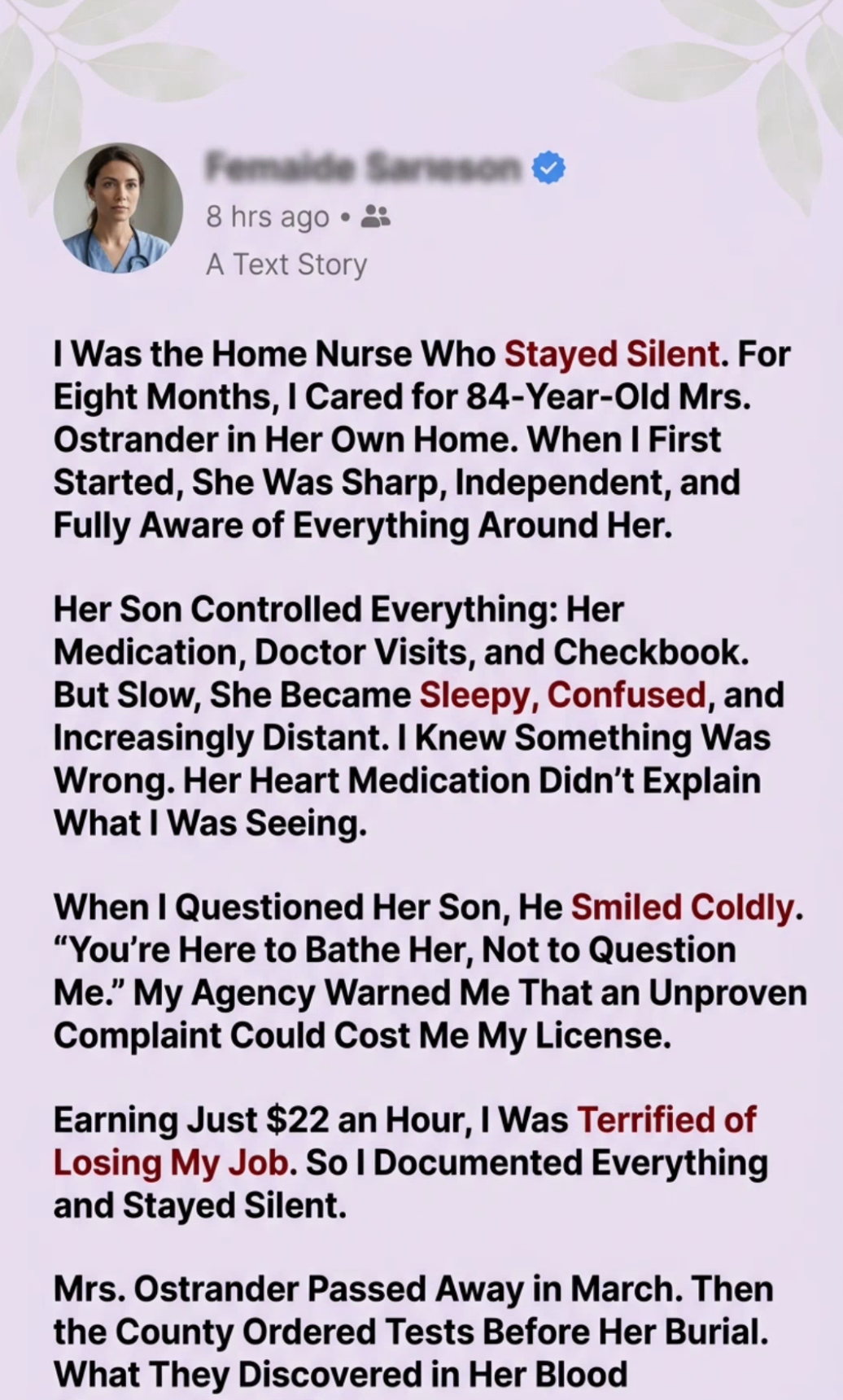
For eight months, I cared for Mrs. Eleanor Ostrander in her own home.
I was supposed to help her bathe, prepare meals, organize her daily routine, and make sure she was comfortable.
I never expected to become the person who noticed that something terrible might be happening.
When I first met Eleanor, she was eighty-four years old, sharp-minded, independent, and wonderfully stubborn.
She lived in a two-story house at the end of a quiet street. The front garden was full of roses, and a small wooden bird feeder hung beside the kitchen window.
She insisted on making her own tea.
She chose her own clothes.
She remembered the names of her neighbors, knew exactly when her favorite television programs aired, and corrected me whenever I misplaced something.
“I may be old, sweetheart,” she told me during my first week, “but I’m not furniture. You don’t have to move me around without asking.”
I laughed.
“I wouldn’t dream of it.”
She smiled.
“Good. Then we’ll get along.”
Her son, Martin, had hired my home-care agency to provide assistance after Eleanor experienced a fall.
He handled the arrangements, paid the bills, and kept the medical information in a thick folder in his study.
He explained that his mother had become difficult to manage.
“She’s stubborn,” he said. “Sometimes she forgets things. Just follow the medication schedule, and don’t let her make things complicated.”
At first, I thought he was simply an exhausted son trying to care for an elderly parent.
I didn’t know how much I would regret that assumption.
During the first month, Eleanor was doing reasonably well.
She walked slowly with a cane, needed help getting into the shower, and occasionally complained about her knees.
But she was mentally alert.
She enjoyed crossword puzzles and read the newspaper every morning.
Sometimes, she told me stories about her late husband, Walter, who had worked as a high-school science teacher.
“He was a terrible cook,” she said one afternoon.
“Really?”
“Absolutely. He once put sugar in the soup because he thought it was salt.”
I laughed so hard that I nearly dropped the dish towel.
She laughed with me.
Those were good days.
Then, gradually, things changed.
During the second month, Eleanor began sleeping through breakfast.
At first, I thought she was simply tired.
But then she started falling asleep in the middle of conversations.
She would ask me a question, listen to half the answer, and close her eyes.
By the third month, she sometimes seemed confused about the day.
She once looked at the calendar and insisted it was still Tuesday when it was Friday.
She also began forgetting conversations we had shared only an hour earlier.
I mentioned the changes to Martin.
“She’s getting older,” he replied.
“These changes seem quite sudden.”
“Old people have good days and bad days.”
“I think we should mention it to her doctor.”
He smiled without warmth.
“Her doctor knows what he’s doing.”
Then he added:
“You’re here to help her with daily care, not diagnose her.”
I apologized.
But I didn’t stop paying attention.
The medication schedule bothered me.
Eleanor took medication for her heart condition and blood pressure. She also had prescriptions for other age-related problems.
I wasn’t authorized to change her medication or make clinical decisions.
That wasn’t my job.
But I was responsible for observing her condition and reporting changes.
I began noticing that her sleepiness seemed particularly severe after Martin visited.
On some mornings, she would be awake and talkative.
Then Martin would arrive with a small medication organizer, take her into the kitchen, and spend several minutes preparing her medicines.
Afterward, she would become unusually drowsy.
I couldn’t prove there was a connection.
It might have been coincidence.
But the pattern concerned me.
One afternoon, Eleanor asked me to bring her glasses from the bedroom.
When I returned, she was staring at the medication organizer.
“Something wrong?” I asked.
She looked at me.
“Do you know what these are?”
“Your medications?”
“Yes, but I don’t recognize all of them.”
I sat beside her.
“Have you spoken with your doctor about the medication?”
She shook her head.
“Martin says everything is under control.”
I didn’t want to frighten her.
“Perhaps we can ask him to bring the medication list next time.”
She looked toward the window.
“I used to understand everything that went into my body.”
Her voice was quiet.
“Now I feel as though everyone is making decisions around me.”
I didn’t know what to say.
I gently held her hand.
“You deserve to understand your care, Mrs. Ostrander.”
She looked at me.
“Thank you for saying that.”
It was the first time she had spoken openly about feeling powerless.
And it was the moment I realized that her confusion might not be the only problem.
I started keeping detailed notes.
I recorded the times she appeared unusually sleepy, the meals she ate, her level of alertness, and any changes I observed.
I wrote down the names of medications only when I could verify them from the information available to me.
I never changed a dose.
I never removed anything from the organizer.
I simply documented what I saw.
After several weeks, my notes showed something that worried me.
Eleanor’s alertness fluctuated significantly.
Some days she could complete a crossword puzzle without assistance.
Other days she struggled to stay awake long enough to finish breakfast.
There were also occasions when she appeared confused after receiving medication.
I contacted my agency supervisor.
She listened carefully.
“Have you spoken directly with the prescribing doctor?” she asked.
“I haven’t been able to. Martin controls the appointments.”
“Have you reported your observations to him?”
“Several times.”
“And what did he say?”
“That she’s old and I’m not qualified to question him.”
My supervisor sighed.
“Be careful, Anna. You need to document observations, not make accusations.”
“I understand.”
“An unsubstantiated allegation can create problems for everyone involved, including you. Continue following your care plan and report any immediate safety concerns.”
I understood the warning.
I was earning twenty-two dollars an hour.
I had rent to pay, a car that needed repairs, and a daughter who depended on my income.
I couldn’t afford to lose my job.
But I also couldn’t pretend I wasn’t seeing something troubling.
The situation became worse during the fifth month.
One morning, I arrived to find Eleanor sitting in her bedroom wearing the same nightgown she had worn the previous evening.
Her breakfast tray was untouched.
She looked at me with tired eyes.
“Anna?”
“Good morning, Mrs. Ostrander.”
“Did I sleep all night?”
“Yes.”
She frowned.
“I don’t remember going to bed.”
I checked her condition and followed the care instructions.
She wasn’t experiencing an obvious emergency at that moment, but she was far less alert than usual.
I called Martin.
He arrived about forty minutes later.
I explained what I had observed.
He looked at the breakfast tray.
“She’s just tired.”
“She doesn’t remember going to bed.”
“That happens.”
“Could we contact her doctor today?”
His expression hardened.
“Why are you making such a fuss?”
“Because she’s becoming increasingly confused.”
He stepped closer.
“Listen carefully. You’re here to bathe her, not to question me.”
I felt my face grow hot.
“I’m only reporting what I’ve observed.”
“Then report that you did your job. Leave the medical decisions to the family.”
He walked away.
I stood in the hallway, holding my notebook.
For a few seconds, I considered quitting.
Then I heard Eleanor calling my name.
“Anna?”
I went back into her room.
She reached for my hand.
“Please don’t leave me alone.”
I sat beside her.
“I’m here.”
She closed her eyes.
And I knew I couldn’t simply walk away.
During the sixth month, Eleanor’s doctor finally visited the house.
I was present when he arrived, but Martin controlled most of the conversation.
He explained that his mother had become increasingly forgetful and was sleeping more.
The doctor reviewed her medication list and asked several questions.
I waited until Martin stepped into the hallway.
Then I quietly explained what I had observed.
“I don’t want to suggest a cause,” I told him. “But her alertness changes quite dramatically, and I’ve documented several episodes.”
The doctor listened.
“Do you have those notes?”
I handed him my notebook.
He read through several pages.
His expression became serious.
“Thank you for documenting this.”
He asked whether Eleanor had recently started any new medication.
I said I couldn’t confirm that because Martin handled the organizer.
The doctor requested a complete medication review and additional assessment.
Martin immediately objected.
“She’s already taking enough medication. We don’t need to put her through unnecessary tests.”
The doctor remained calm.
“These changes deserve investigation.”
Martin looked irritated.
But he agreed to arrange a follow-up appointment.
For the first time, I felt that someone else had noticed what I was seeing.
A week later, Martin told the agency that I was no longer needed for certain shifts.
He claimed Eleanor was doing well and that the family wanted to reduce care expenses.
My supervisor called me.
“We’re going to reassign you to another client,” she said.
“Did Martin complain about me?”
There was a pause.
“He said you were becoming too involved in medical decisions.”
I felt sick.
“I never changed her medication. I only reported observations.”
“I know what your notes say, Anna. Keep copies of your records according to agency policy.”
I wanted to argue.
Instead, I thanked her.
My hours were reduced, but I wasn’t dismissed.
I still visited Eleanor several times each week.
And I noticed something else.
Martin had begun insisting that I leave whenever he prepared her medication.
He said it was a private family matter.
I didn’t challenge him.
I simply recorded the change in routine.
In the eighth month, Eleanor deteriorated rapidly.
She was barely eating.
Her speech became slow, and she struggled to stay awake.
One morning, she looked at me and asked:
“Anna, did I do something wrong?”
My heart sank.
“Of course not.”
“Then why does everyone keep telling me I’m difficult?”
I sat beside her.
“You’re not difficult.”
She looked toward the door.
“Martin says I’m becoming impossible to care for.”
I gently adjusted her blanket.
“You’re allowed to need help. That doesn’t make you a burden.”
She stared at me for a long time.
Then she whispered:
“I don’t think he wants me to get better.”
I froze.
“Why do you say that?”
She looked frightened.
“I don’t know. I just feel strange all the time.”
Before I could ask anything else, Martin entered the room.
“What are you talking about?”
Eleanor immediately closed her eyes.
I stood up.
“She seems very tired today.”
“Then let her sleep.”
I left the room.
But her words stayed with me.
Mrs. Ostrander died in March.
It happened early in the morning.
I wasn’t working that day.
Martin called the agency and said his mother had passed away peacefully in her sleep.
When my supervisor told me, I sat in my car for several minutes.
I had known Eleanor for eight months.
She wasn’t just a client anymore.
She was a person whose jokes, preferences, stories, and small daily rituals had become part of my life.
I remembered her insisting on making her own tea.
I remembered her crossword puzzles.
I remembered the way she smiled when she talked about her husband.
And I remembered her saying she didn’t think her son wanted her to get better.
I couldn’t stop thinking about it.
The funeral arrangements were made quickly.
Martin told the agency that the family wanted a private service.
I wasn’t invited.
I understood.
I was an employee, not a relative.
Still, I left a small bouquet of white flowers at the funeral home.
I thought that would be the end of it.
I was wrong.
Two days before the burial, I received a call from my agency.
My supervisor sounded unusually serious.
“Anna, I need you to come into the office.”
“Is something wrong?”
“There’s been a development involving Mrs. Ostrander’s death.”
I felt my stomach tighten.
“What happened?”
“The county medical examiner has requested additional testing before the burial.”
I sat down.
“Why?”
“They haven’t provided us with all the details. But the death was referred for further review because of concerns raised during the final medical assessment.”
I could barely speak.
My supervisor continued.
“They’ve also requested copies of relevant care records.”
I immediately thought about my notebook.
“Do they need my observations?”
“Yes. Please bring your original records and any copies you are authorized to provide. Don’t discuss the case with anyone outside the proper channels.”
I agreed.
The following morning, I met with an investigator.
He introduced himself as Detective Harris.
He asked me to describe Eleanor’s condition when I first started working with her.
I told him everything.
How alert she had been.
How gradually her behavior changed.
How frequently she became sleepy.
How I had raised concerns with Martin.
How he had responded.
And how the medication schedule had become increasingly difficult to verify.
He listened without interrupting.
Then he asked:
“Did you ever see anyone deliberately give Mrs. Ostrander more medication than prescribed?”
“No.”
“Did you ever witness anyone harming her?”
“No.”
“Did you suspect that her medication might have been involved in her deterioration?”
I hesitated.
“Yes. But I couldn’t prove it.”
He nodded.
“That’s why we’re investigating.”
I handed him my notes.
He reviewed them carefully.
Then he asked whether I remembered the medication organizer.
I described its appearance and the way Martin handled it.
The detective wrote something down.
“Thank you, Ms. Miller. These records may be important.”
I left the interview feeling frightened.
I had spent months worrying that reporting my concerns would cost me my license.
Now I worried that remaining silent for so long might have allowed something terrible to continue.
The county’s testing took several days.
I didn’t know what they were looking for.
I didn’t know what they would find.
And I didn’t know whether my observations would matter.
Then, one afternoon, Detective Harris called.
“Anna, we need to speak with you again.”
I drove to the county office.
He sat across from me with a folder.
“We have preliminary laboratory findings.”
My hands tightened around my purse.
“What did you find?”
He took a moment before answering.
“The toxicology analysis identified a medication that was not listed on Mrs. Ostrander’s active prescription record.”
I stared at him.
“What medication?”
He told me the name.
It was a sedating medication that could cause significant drowsiness and confusion, particularly in an elderly person.
I felt cold.
“Was she given too much?”
“The laboratory identified the substance. We are still evaluating the concentration, possible sources, and the medical circumstances surrounding her death. We cannot tell you from this result alone exactly how or when it entered her system.”
I nodded slowly.
He continued.
“We’re comparing the findings with her prescription history, pharmacy records, medical records, and the information provided by the people involved in her care.”
I thought about the medication organizer.
I thought about Martin taking Eleanor into the kitchen.
I thought about the way she became sleepy afterward.
But I didn’t say what I suspected.
The detective seemed to understand.
“We’re not asking you to draw conclusions. We need you to tell us what you actually observed.”
I gave him the most accurate account I could.
Then he asked whether Eleanor had ever mentioned receiving medication she didn’t recognize.
I remembered the afternoon she had stared at the organizer.
“Yes,” I said. “She asked me what some of the pills were. She said she didn’t recognize all of them.”
The detective wrote it down.
“Did you report that?”
“Yes. I told my supervisor and raised the concern with her son.”
“Do you have the date?”
I opened my notebook.
“Here.”
He studied the entry.
Then he closed the folder.
“Thank you. This is important.”
The investigation lasted several months.
During that time, I was interviewed more than once.
The investigators reviewed pharmacy records, medical files, and the medication history.
They also examined the medication organizer and other items recovered from the house.
Eventually, the laboratory confirmed that the substance found in Eleanor’s blood was present at a level that required serious medical explanation.
The medical examiner concluded that the drug exposure had contributed to her death.
But the investigation did not stop there.
The investigators needed to determine how she had received it, whether it had been administered intentionally, and who had been responsible.
Martin initially claimed that he knew nothing about the medication.
He said he had followed the doctor’s instructions.
But the pharmacy records revealed that a prescription for the sedating medication had been obtained under circumstances that required further examination.
The investigators also discovered that the medication had not been included in the list provided to the doctor during the final review.
Martin was questioned.
He changed his explanation several times.
At first, he said the medication had been prescribed for his mother months earlier.
Then he claimed it had belonged to another family member and had accidentally been mixed with her tablets.
Later, he said Eleanor had requested something to help her sleep.
None of those explanations could be accepted without supporting evidence.
The investigators continued examining the records.
I didn’t hear every detail.
I wasn’t part of the family, and I wasn’t entitled to confidential information.
But eventually, I received a subpoena requiring me to testify about my observations.
I did.
I described the woman I had met eight months earlier.
I described the gradual changes.
I explained what I had written down and when I had raised concerns.
I never claimed to know who had caused her deterioration.
I simply told the truth.
Several months later, the county announced that Martin had been charged in connection with his mother’s death.
The case was based on the forensic findings and additional evidence gathered during the investigation.
He denied deliberately harming her.
His attorney argued that the medication findings did not establish intent and that Eleanor’s age and existing health problems complicated the medical conclusions.
The case went through the legal process.
I was called to testify.
During cross-examination, Martin’s attorney asked why I had not contacted the authorities earlier.
“Your client was becoming increasingly confused, correct?”
“Yes.”
“You believed medication might have been involved?”
“I was concerned about the possibility.”
“Yet you continued working in the house.”
I looked at him.
“I continued providing the care I was assigned to provide. I documented what I observed and reported my concerns through the agency and to the medical professionals involved.”
“But you didn’t accuse Mr. Ostrander of poisoning his mother.”
“No.”
“Because you had no proof, correct?”
“Correct. I had observations, not proof.”
He paused.
“Then you agree you don’t know what happened.”
I looked directly at him.
“I know what I saw. I know what I reported. I know what Mrs. Ostrander told me. The medical examiner and investigators determined the rest from the evidence.”
The courtroom became quiet.
I had been afraid of losing my job for months.
Now I was simply grateful that I had kept my notes.
The legal proceedings continued, and the court ultimately found Martin guilty after considering the forensic and other evidence.
I won’t pretend that the verdict made everything feel better.
Nothing could return Eleanor to the house where she had once made her own tea and solved crossword puzzles.
But the truth was no longer buried beneath the excuse that she was simply old and confused.
After the case ended, I returned to home-care work.
For a while, I couldn’t stop thinking about Eleanor.
I wondered whether I should have pushed harder.
Whether I should have contacted the doctor again.
Whether I should have escalated my concerns sooner.
My supervisor eventually arranged a meeting with me.
She apologized for the way my concerns had been handled.
“We should have had a clearer process for escalating suspected medication problems,” she said. “You shouldn’t have felt that protecting your job meant staying quiet.”
I nodded.
“I was scared.”
“I understand.”
I later completed additional training on recognizing medication-related changes, documenting observations, and reporting suspected abuse or neglect through appropriate channels.
I also learned something important about my responsibilities.
A home-care worker isn’t expected to diagnose a medical condition or prove wrongdoing.
But when an elderly client changes suddenly, becomes unusually sedated, or appears frightened about their care, those observations matter.
They must be reported through the appropriate channels.
And if the response is inadequate, there are formal escalation routes that should be used.
A year later, I visited the cemetery.
I brought white flowers.
Eleanor’s grave was beside her husband’s.
I stood there quietly for a long time.
Then I told her something I wished I had said when she was alive.
“You weren’t difficult, Mrs. Ostrander. You weren’t furniture. You were a person who deserved to be heard.”
The wind moved through the trees.
I thought about the woman who had once corrected me for moving her chair without asking.
The woman who had laughed about her husband’s terrible cooking.
The woman who had wanted to understand what was going into her body.
I had been paid twenty-two dollars an hour to help her with ordinary tasks.
But the most important thing I did was listen when she told me something wasn’t right.
I still regret that I was afraid to speak more forcefully.
I still wish I had known exactly which steps to take sooner.
But I no longer believe that being a good caregiver means staying silent to keep everyone comfortable.
Sometimes the person who needs protecting isn’t the loudest person in the room.
Sometimes they’re the quiet woman sitting beside the window, wondering why everyone else has started making decisions about her life.
And sometimes, the only thing standing between her and being forgotten is someone willing to write down what happened—and refuse to pretend they never saw it.
THE END.