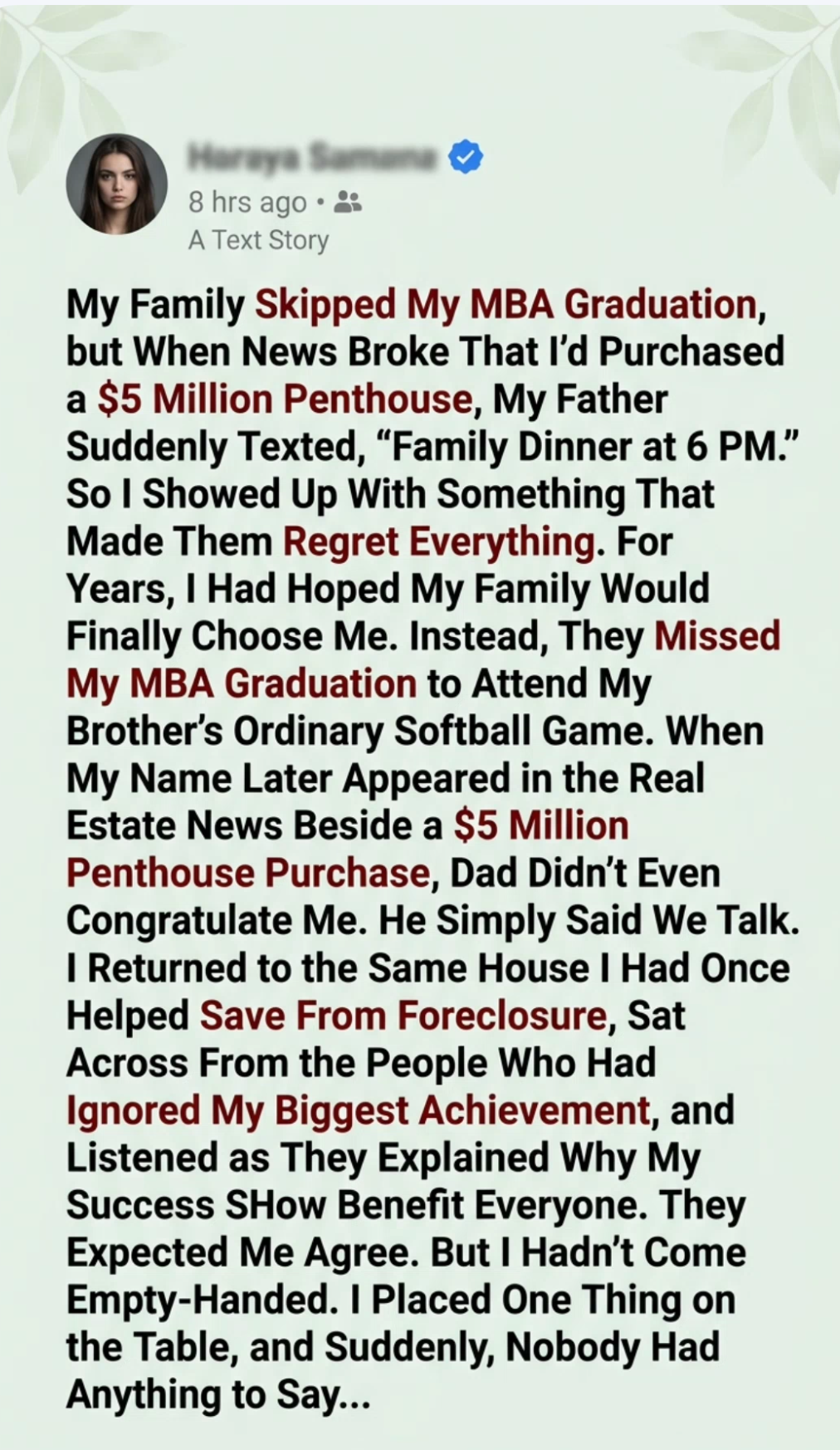
The first person I called after receiving my MBA diploma was my father.
He didn’t answer.
I called my mother.
She declined the call.
Then I called my younger brother, Ethan.
He answered, but I could barely hear him over the noise in the background.
“Hey, Olivia. What’s up?”
“I graduated today.”
“Oh, right! Congratulations!”
“Where are you?”
There was a brief pause.
“At my softball game. Mom and Dad came to watch.”
I looked across the university courtyard.
Graduates were hugging their families, taking photographs, and celebrating years of hard work.
I stood alone with my diploma in my hands.
“That’s nice,” I said.
“Yeah. Listen, I have to go. Dad’s recording the game.”
Then he hung up.
I didn’t cry immediately.
I walked to my car, placed the diploma carefully on the passenger seat, and drove home.
That evening, my family uploaded photographs from Ethan’s game.
My mother stood beside him, smiling proudly.
My father had one arm around his shoulders.
The caption read:
Our boy never gives up. So proud of you, Ethan!
There wasn’t a single mention of my graduation.
Not one.
I stared at the photograph for a long time.
Then I put my diploma in a drawer and went back to work.
I had spent years hoping my family would eventually recognize me.
That day, I finally began accepting that they might never do it.
What I didn’t know was that, several years later, the same people who couldn’t find time to attend my graduation would suddenly find plenty of time when they discovered I had purchased a five-million-dollar penthouse.
And they would arrive at dinner expecting me to share it with them.
My name is Olivia Bennett.
I was thirty-four when I bought the penthouse.
But my story began long before the real estate announcement.
I grew up in a comfortable suburban home with my parents, Richard and Diane, and my younger brother, Ethan.
My father worked in commercial construction.
My mother managed the household and occasionally helped with administrative work for his business.
Ethan was the family favorite.
He wasn’t a bad person when we were children. He was simply the child everyone seemed to organize their lives around.
When he played baseball, the entire family attended.
When he received a school award, my parents celebrated with dinner.
When he struggled with a class, my mother called his teachers and arranged extra tutoring.
I learned early that if I wanted something, I needed to figure out how to get it myself.
When I won a regional academic competition at sixteen, my father said, “That’s good, Olivia. Keep your grades up.”
When Ethan hit a home run in a weekend tournament, my father took him out for steak.
I used to wonder why the same family could respond so differently to two children.
Eventually, I stopped asking.
I earned scholarships, worked part-time, and paid for most of my undergraduate education.
After graduation, I entered the business world.
I worked for a small consulting firm, then moved into corporate strategy. My responsibilities increased, my salary improved, and I eventually became involved in large-scale acquisitions and operational planning.
I wasn’t naturally brilliant.
I simply worked hard, paid attention, and learned from mistakes.
When I decided to pursue an MBA, I did it while working full-time.
It meant late nights, weekend assignments, and more than a few meals eaten over my laptop.
My parents knew I was studying.
They occasionally asked how much longer I had left.
But they never attended a class presentation or asked to see my projects.
My father once told me:
“An MBA is useful, but don’t let school distract you from building a real career.”
I didn’t argue.
I had already learned that my accomplishments rarely impressed him.
The first time my family needed serious financial help was when my father’s construction business began struggling.
A major client delayed payment on a large project.
Several subcontractors were still owed money, and the bank had started sending notices concerning the mortgage on my parents’ house.
My mother called me one evening.
“Olivia, your father is having a difficult time.”
I was sitting in my apartment, reviewing a business proposal.
“What happened?”
She explained the situation.
They were behind on several payments. The bank had warned them that the mortgage account needed immediate attention.
My father had always presented himself as financially secure, so hearing that the family home was at risk surprised me.
“How much do you need?” I asked.
She hesitated.
“About forty thousand dollars would give us some breathing room.”
I had savings.
Not enough to spend carelessly, but enough to help.
I transferred the money after reviewing the outstanding statements.
I didn’t ask for praise.
I didn’t even tell my friends.
I simply wanted my parents to keep their home.
Over the next eighteen months, I helped them negotiate payment arrangements, organize their finances, and reduce some of their household expenses.
I also covered several urgent bills.
The house stayed out of foreclosure.
My father thanked me once, briefly, and then returned to discussing Ethan’s plans.
I didn’t expect him to celebrate me.
But I did expect him to remember.
I was wrong.
A year after the mortgage crisis, I received an offer from a larger investment and consulting company.
The position came with more responsibility, better compensation, and opportunities to work with international clients.
I accepted.
My workload increased dramatically.
I completed my MBA while managing projects that sometimes involved teams across several time zones.
There were weeks when I slept fewer than six hours a night.
But I kept going.
When graduation finally arrived, I sent my family the ceremony details three weeks in advance.
My mother replied:
“We’ll try to come, sweetheart.”
My father didn’t respond.
Ethan sent a thumbs-up emoji.
The night before graduation, I called my mother.
“Are you still coming tomorrow?”
She sounded distracted.
“Your brother has a game.”
I waited.
“Mom, my graduation is tomorrow.”
“I know, Olivia. But it’s an important game. The coach will be there, and your father promised Ethan we’d attend.”
I felt something tighten in my chest.
“What about my graduation?”
“You’re very independent. You’ll understand.”
I looked down at the ceremony ticket on my desk.
“Okay.”
She continued talking about Ethan’s game.
I ended the call.
The next morning, I graduated without them.
My university took photographs, and a colleague attended to support me.
She hugged me afterward.
“Your family must be so proud.”
I smiled.
“Yes,” I said.
It was easier than explaining.
The years that followed changed my life.
I was promoted twice.
I became a director responsible for strategic investments and business development.
I also began investing carefully outside my job.
I didn’t gamble on overnight success.
I studied property markets, reviewed financial statements, and worked with professional advisers.
Eventually, I purchased a small rental property.
Then another.
I reinvested the income and continued saving.
I also learned to say no.
When my mother asked for money to help Ethan replace his car, I told her I couldn’t contribute.
When my father asked me to cover a business expense, I requested the paperwork before considering it.
My family began describing me as difficult.
They said I had changed.
Perhaps I had.
I had finally stopped confusing love with unlimited financial assistance.
Then came the penthouse.
It was a five-million-dollar property in a prestigious downtown building, with floor-to-ceiling windows, a private terrace, and a view of the river and city skyline.
I didn’t purchase it simply to impress anyone.
It was a combination of personal enjoyment and a long-term financial decision, supported by years of planning and professional advice.
The purchase was made through the appropriate ownership structure after my advisers reviewed the financing, taxes, and legal arrangements.
The property became part of a local real estate feature about high-end residential transactions.
My photograph appeared beside the article.
The headline mentioned the sale price.
I hadn’t told my family about the purchase.
I hadn’t planned to.
But apparently, the news reached them before I could even unpack.
Three days after the article appeared, my father sent a text.
Dad: Family dinner at 6 PM. Sunday. Don’t be late.
No congratulations.
No question about how I was doing.
Just an instruction.
I stared at the message.
Then I showed it to my closest friend, Maya.
She read it and raised an eyebrow.
“Let me guess. They suddenly miss you.”
I laughed.
“Something like that.”
“Are you going?”
“Yes.”
“Why?”
I looked toward the window.
“Because I want to hear what they actually want.”
Maya studied me.
“Take your own transportation. Don’t sign anything. And don’t agree to anything because someone makes you feel guilty.”
I smiled.
“That’s the plan.”
But I was also preparing something else.
For years, I had kept records of the money I had lent or contributed to my parents.
I had done it for tax and financial reasons, not because I planned to use those records against them.
Now, I wanted everything clear.
I gathered the bank statements, transfer confirmations, and copies of the payment arrangements I had helped organize.
I also contacted the attorney who had advised me during the mortgage crisis.
I asked him to prepare a simple summary of the financial assistance I had provided and the legal status of those payments.
Some transfers had been documented as loans.
Others had been clearly described as gifts or direct household assistance.
I wanted the distinction preserved.
I wasn’t interested in inventing a debt that didn’t exist.
I simply wanted my family to stop pretending I had never helped them.
On Sunday evening, I drove to my childhood home.
The house looked almost exactly as I remembered it.
The white porch railing needed painting.
The front garden had grown over the stone path.
And the old basketball hoop still leaned slightly toward the driveway.
I parked and carried a slim leather folder inside.
My mother greeted me at the door.
“Olivia! You look wonderful.”
She hugged me.
It was the first time she had hugged me warmly in months.
My father was in the dining room.
Ethan sat at the table, scrolling through his phone.
A large meal had been prepared.
Roast chicken, potatoes, vegetables, and the expensive wine my father usually saved for special occasions.
“Look who’s finally home,” Ethan said.
I smiled politely.
“Hello, Ethan.”
My father stood.
“Congratulations on the property.”
“Thank you.”
He gestured toward the chair.
“Sit down. We have a lot to discuss.”
I took my seat.
For the first fifteen minutes, we discussed ordinary things.
My mother’s garden.
My father’s business.
Ethan’s job.
Then my father placed his glass on the table.
“We saw the article.”
“I assumed you had.”
“Five million dollars is a substantial purchase.”
“Yes.”
“That’s a lot of money to tie up in one property.”
“It’s an investment I reviewed carefully.”
He nodded.
Then he leaned forward.
“Your mother and I have been discussing the family’s future.”
I waited.
“We think it’s time we all started working together.”
I looked at him.
“What does that mean?”
He smiled.
“Well, Ethan has been considering starting a business. Your mother and I have some expenses coming up. We thought your success could help the family move forward.”
Ethan finally put his phone down.
“There’s a really good opportunity in sports management,” he said. “I just need some startup capital.”
My mother nodded.
“Your father and I also need to make a few improvements to the house.”
I looked at all three of them.
Then I asked:
“How much are you expecting?”
My father cleared his throat.
“We haven’t settled on an exact figure. But perhaps you could help Ethan with his business and assist us with the house.”
“How much?”
Ethan answered.
“Maybe two hundred thousand to start.”
I almost laughed.
“Two hundred thousand dollars?”
“It’s a serious opportunity.”
“What’s the business plan?”
He frowned.
“I haven’t finalized it.”
“Have you researched the market?”
“Not completely.”
“Have you identified clients?”
“Olivia, I don’t need an interrogation.”
I turned toward my father.
“And what do you need for the house?”
He hesitated.
“Perhaps another hundred thousand.”
I slowly nodded.
“So you invited me here to ask for approximately three hundred thousand dollars.”
My mother looked uncomfortable.
“We’re not demanding anything.”
My father corrected her.
“We’re discussing family support.”
I looked at him.
“Did you discuss family support when I was paying the mortgage?”
He frowned.
“That’s different.”
“How?”
“You were helping your parents.”
“And now I’m helping my brother.”
Ethan interrupted.
“You’re making this personal.”
I looked at him.
“It is personal.”
My father leaned back.
“Olivia, you have a five-million-dollar penthouse. You can afford to help.”
I felt a strange calm settle over me.
There it was.
Not a question about my graduation.
Not a celebration of my career.
Not even a sincere congratulations.
Just an assumption that my success belonged to everyone at the table.
I opened my leather folder.
“Before we discuss any more money, I want you to look at something.”
I placed a document in front of my father.
He looked down.
Then his expression changed.
The document was a financial summary prepared by my attorney.
It listed the assistance I had provided during the mortgage crisis and the years afterward.
There were dates, amounts, payment references, and descriptions.
At the bottom was a clear breakdown.
Some amounts were documented loans.
Others were direct payments made on behalf of my parents.
And some were gifts.
The summary did not pretend that every dollar was repayable.
It simply showed what had happened.
My father flipped through the pages.
“What is this?”
“Everything I contributed to keeping this house.”
My mother leaned closer.
“Why would you bring this?”
“Because you invited me here to discuss family support. I thought we should start with the support I’ve already given.”
Ethan picked up the document.
“Is this supposed to make us feel guilty?”
“No.”
I turned toward him.
“It’s supposed to make us remember.”
My father stopped at the final page.
The total was far higher than he expected.
He looked at me.
“You kept records of all this?”
“Yes.”
“Why?”
“Because I manage my finances carefully.”
He closed the folder.
“Are you expecting us to repay everything?”
“No. I am not claiming that every contribution was a loan. The document separates what was formally recorded as a loan from what I gave freely.”
My mother looked at me.
“Then what do you want?”
I took a breath.
“I want you to understand that I didn’t become successful because you supported me. I became successful while trying to support myself, and sometimes while supporting this family.”
Nobody spoke.
I continued.
“When I graduated, I called you because I wanted to share something important. You chose Ethan’s softball game. I wasn’t angry because he had a game. I was hurt because nobody thought my achievement deserved even one hour of your time.”
My mother lowered her eyes.
“I wanted you there,” I said. “I wanted one photograph with my parents. I wanted Dad to shake my hand and say he was proud of me.”
My father shifted in his chair.
“Olivia, we didn’t realize it meant that much.”
“You didn’t ask.”
Ethan looked uncomfortable.
I turned toward him.
“And you laughed when I told you I had graduated.”
“I didn’t laugh.”
“You were at the game. You told me Dad was recording it.”
He looked down.
I continued.
“Now you want two hundred thousand dollars for a business you haven’t properly planned. Dad wants another hundred thousand for the house. And somehow, everyone assumes that because I can afford it, I should provide it.”
My father interrupted.
“That’s not fair.”
I looked at him.
“Neither was missing my graduation.”
Then I placed the second document on the table.
It was a copy of the mortgage account history from the period when the house had been at risk.
My father recognized it immediately.
“What is this?”
“The account I helped you save.”
He looked at the pages.
“Why are you showing me this again?”
“Because there’s something you should know.”
I pointed to a particular section.
During the foreclosure crisis, I had paid a substantial amount toward the arrears.
But there was another payment arrangement that my father had made with the lender.
He had been required to contribute a fixed amount each month.
For several months, I had covered those payments directly.
The bank statements confirmed the transfers.
My father stared at the document.
Then he noticed a note attached to the final page.
It was a confirmation from the lender that the mortgage had eventually returned to good standing.
I looked at him.
“I didn’t just give you money. I spent months helping you organize the repayment plan, negotiate with the lender, and keep the house.”
He nodded slowly.
“I know.”
“Do you?”
His eyes met mine.
For the first time that evening, he looked ashamed.
Then my mother said something unexpected.
“Your father always told us that the house had been saved because he worked things out with the bank.”
I looked at her.
“He did work with the bank. But he didn’t do it alone.”
She covered her mouth.
My father looked away.
“I never said I did everything.”
“You never said I helped.”
The room became silent.
Then I closed the folder.
“I didn’t come here to collect applause for helping you. I came because I wanted you to understand why your invitation felt so insulting.”
My father finally spoke.
“What do you want us to do?”
I looked at him.
“I want you to stop treating my success as a family resource.”
He nodded faintly.
“I want you to ask before making financial assumptions about me.”
Another nod.
“I want Ethan to build his own business responsibly, not expect me to finance an idea because he hasn’t planned it.”
Ethan crossed his arms.
“So you’re not helping?”
“Not with two hundred thousand dollars.”
He looked annoyed.
I continued.
“If you prepare a real business plan, identify your costs, understand the risks, and are willing to invest your own money, I can review it professionally. That doesn’t mean I’ll fund it.”
He said nothing.
“And as for the house,” I added, looking at my father, “you need to manage your expenses based on your own income. I won’t become responsible for every renovation or financial problem.”
My mother wiped her eyes.
“Are you saying you don’t want to help us anymore?”
I paused.
“No. I’m saying help cannot be the only reason you call me.”
That sentence seemed to hurt her more than anything else I had said.
She began crying quietly.
My father stood and walked toward the window.
Ethan stared at his plate.
For the first time, nobody was asking me how much money I had.
They were being forced to consider why I had brought the documents.
I left after dinner.
Nobody followed me to the car.
My mother hugged me before I walked out, but it was a hesitant embrace.
My father said he would call.
Ethan didn’t say anything.
I drove back to my apartment and sat on the terrace for a long time.
The city lights stretched across the river.
I looked at the penthouse around me.
It was beautiful.
But I didn’t feel victorious.
I had imagined that someday my family would finally be proud of me.
I had imagined my father asking about my work, my mother wanting to see my graduation photographs, and Ethan treating me like a sister rather than a source of money.
Instead, I had spent years waiting for something they weren’t ready to give.
And I had finally stopped waiting.
Three weeks later, my mother called.
She didn’t ask for money.
She asked whether I would meet her for coffee.
I agreed.
We met at a small café near her house.
She looked tired.
“I’ve been thinking about what you said.”
I listened.
“I didn’t realize how much your graduation hurt you.”
I stirred my coffee.
“It wasn’t just the graduation.”
“I know.”
She looked down.
“Your father and I were so focused on Ethan that we stopped noticing what you were doing. We thought you were strong enough to handle everything yourself.”
I nodded.
“Being strong doesn’t mean I don’t want my family.”
She reached across the table.
“I’m sorry.”
I believed she meant it.
But I also knew that an apology was only the beginning.
We talked for nearly an hour.
She asked about my penthouse.
She asked about my work.
She asked whether I still had the photographs from graduation.
For once, she seemed genuinely interested.
Before leaving, she said:
“Could you show me your diploma sometime?”
I smiled.
“Yes.”
My father took longer.
He called a month later.
He didn’t apologize immediately.
Instead, he asked whether I would review Ethan’s business plan.
I nearly declined.
But then he said something that surprised me.
“He actually prepared one this time. He spoke to an accountant and did some research.”
I agreed to look at it.
Ethan had developed a proposal for a small sports training and equipment business.
It was still risky, but it was more complete than his earlier idea.
I reviewed the numbers and identified several weaknesses.
I suggested that he begin with a smaller operation rather than committing to an expensive lease and large inventory.
He listened.
I didn’t invest.
I didn’t promise him anything.
But I gave him professional advice because I wanted him to have a fair chance to build something of his own.
A few months later, he sent me a message.
Ethan: I know I acted like an idiot about your graduation. I’m sorry. I should have been there.
I read it twice.
Then I replied:
Me: Thank you. That means a lot.
It wasn’t a dramatic reconciliation.
It was simply a beginning.
One year after purchasing the penthouse, I hosted a small dinner.
I invited several close friends, two colleagues, and my family.
My mother arrived early and helped arrange the table.
My father brought flowers.
Ethan arrived with a bottle of wine and a nervous smile.
At one point, my mother stood near the large windows and looked out over the city.
“It’s beautiful,” she said.
“Thank you.”
My father walked beside her.
“You’ve done very well, Olivia.”
I looked at him.
He seemed uncomfortable.
“I should have told you that years ago,” he added.
I didn’t know what to say.
So I simply smiled.
Later that evening, we took a photograph together.
This time, everyone was there.
After they left, I placed the photograph beside my diploma.
For years, I had believed success would finally make my family choose me.
I thought if I earned enough, achieved enough, or became important enough, they would recognize the person I had always been.
But buying a penthouse didn’t make me more worthy of love.
And showing them my financial records didn’t make me more deserving of respect.
I had deserved those things when I was a student standing alone with my diploma.
I had deserved them when I was working late nights to pay for my education.
I had deserved them when I helped save the family home.
I had deserved them before anyone knew my name or how much money I earned.
That was the lesson I carried forward.
My five-million-dollar penthouse was something I had worked hard to afford.
But the most valuable thing I had gained wasn’t the property.
It was the understanding that I could love my family without financing their expectations, forgive them without pretending they hadn’t hurt me, and build a life that didn’t depend on their approval.
And the next time my father invited me to dinner, I hoped it would be because he wanted to see his daughter.
Not because he had seen the price of her home.
THE END.