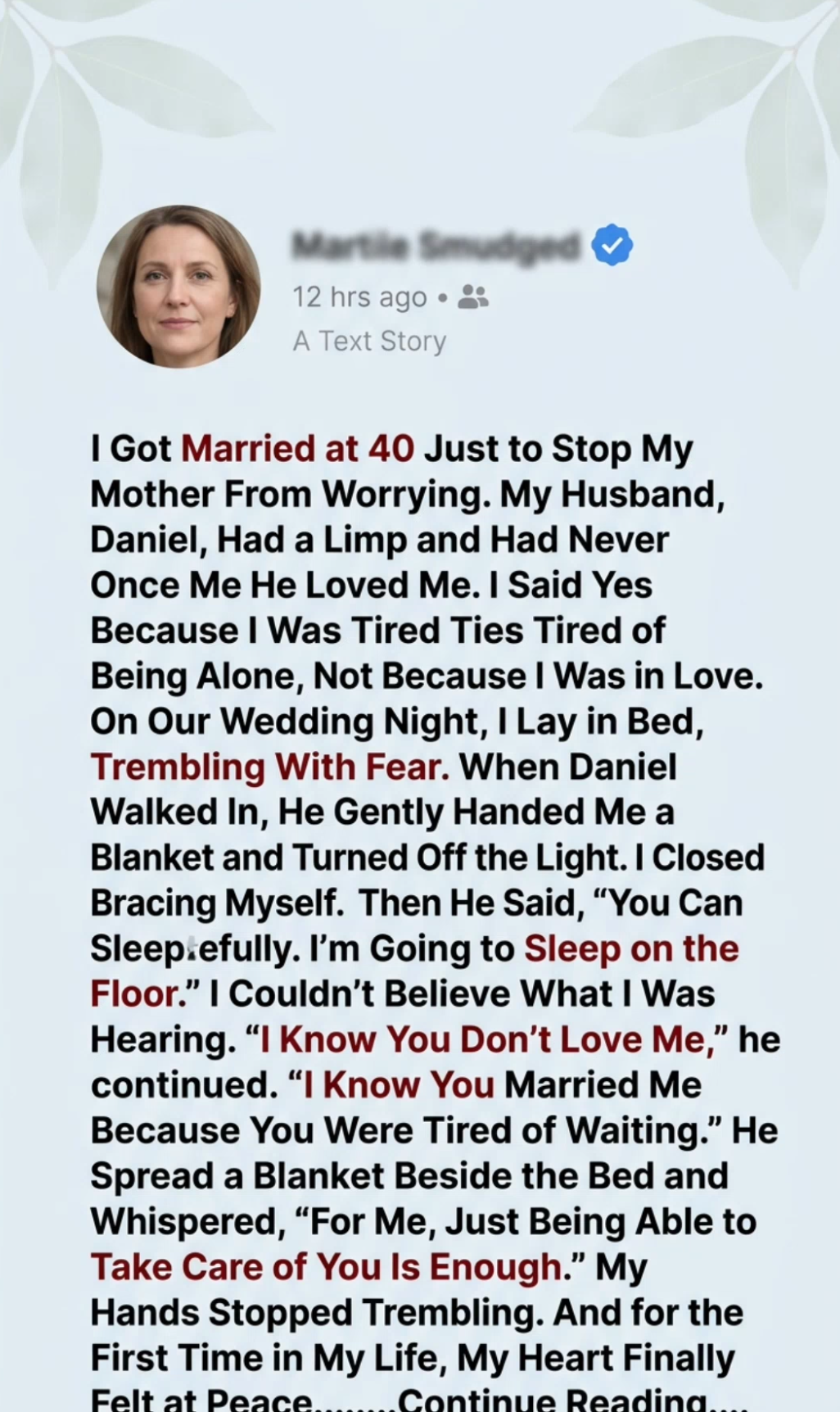
I was forty years old when I married Daniel.
People congratulated me as though I had finally accomplished something I should have done twenty years earlier.
My mother cried during the ceremony.
My aunt hugged me so tightly that I could barely breathe.
My cousins smiled and whispered that it was wonderful I had finally found someone.
Everyone seemed happy.
Everyone except me.
I wasn’t unhappy because Daniel was a bad man. He wasn’t. He was patient, polite, hardworking, and considerate.
I simply didn’t love him.
At forty, I had become accustomed to living alone. I had my own apartment, a steady job at a small accounting firm, and a routine that rarely changed.
I woke up early, made coffee, went to work, bought groceries on the way home, and spent most evenings reading or watching television.
My life wasn’t exciting, but it was peaceful.
My mother, however, saw it differently.
She was seventy-two and had spent years worrying about me.
Whenever I visited, she found a way to mention marriage.
“You’re not getting younger, sweetheart.”
“Who will look after you when you’re old?”
“I won’t be here forever.”
Sometimes she said these things gently.
Other times, she said them while looking at me with such sadness that I felt guilty for having a life she didn’t understand.
I had dated men before.
One relationship lasted nearly four years. Another ended because we wanted completely different futures. There had been a few brief romances, but none had become the kind of partnership people described in stories.
Eventually, I stopped looking.
Then Daniel entered my life.
He was forty-six, worked as a maintenance supervisor for a local hospital, and had a noticeable limp.
I first met him at a neighborhood charity event organized by my mother.
He was carrying boxes of donated food when one of the volunteers dropped a container. Daniel bent down to help her, and I noticed the way he carefully shifted his weight before standing again.
He caught me looking.
“Old injury,” he explained with a small smile.
I immediately felt embarrassed.
“I’m sorry. I didn’t mean to stare.”
“Don’t worry. I stare at my own leg sometimes and wonder why it doesn’t cooperate.”
I laughed.
That was how our first conversation began.
Over the following months, we saw each other at community events and occasionally met for coffee.
Daniel was easy to talk to.
He never asked intrusive questions. He remembered small details. He listened without interrupting.
He also never flirted in an obvious way.
If I wore a new dress, he might say it suited me.
If I mentioned being tired, he would ask whether I had been sleeping properly.
He never made me feel that I owed him anything.
One evening, he asked whether I would consider having dinner with him.
I agreed.
We met at a quiet restaurant near the hospital where he worked.
During dinner, he told me about his family, his work, and the accident that had left him with a permanent limp.
He had been thirty-one when a delivery van struck his motorcycle at an intersection.
The injuries had damaged his hip and leg. He underwent several operations and spent months learning to walk again.
He never described himself as a victim.
“It changed the way I live,” he said. “But it didn’t end my life.”
I admired that attitude.
He asked about my previous relationships, but when I said I had never married, he didn’t make a joke or look surprised.
“That doesn’t mean anything is wrong with you,” he said.
I remember those words because I had spent years feeling as though something was wrong with me.
We continued seeing each other.
Daniel never told me he loved me.
He never made grand promises.
He simply showed up.
When my car wouldn’t start one rainy morning, he came to help.
When my mother needed someone to take her to an appointment, he offered to drive.
When I had a difficult week at work, he brought dinner and left it at my apartment because he knew I didn’t feel like cooking.
He was kind.
But kindness wasn’t the same as romantic love.
I knew that.
My mother, however, was convinced Daniel was the answer to every worry she had ever carried.
One afternoon, she called me into her living room.
“I think Daniel is a good man.”
“He is.”
“Then why don’t you marry him?”
I sighed.
“Mom, marriage isn’t something you do simply because someone is good.”
She reached for my hand.
“I know. But you don’t have to feel fireworks. Sometimes a peaceful life is more important.”
I looked at her.
“Are you worried about me or worried about what people will say?”
Her eyes filled with tears.
“I’m worried that one day I won’t be here, and you’ll come home to an empty apartment with nobody to ask how your day went.”
I wanted to tell her that I wasn’t afraid of being alone.
But I couldn’t bring myself to hurt her.
A few weeks later, Daniel and I had a serious conversation.
We were sitting on a bench near the river when he asked whether I had ever considered marriage.
I looked at him.
“Have you?”
“Yes.”
“Why?”
He smiled faintly.
“Because I like having you in my life.”
I studied his face.
“Do you love me?”
He didn’t answer immediately.
Then he said, “I care about you deeply. But I don’t want to use a word you aren’t ready to hear.”
I appreciated his honesty, although it also made me realize how little romance existed between us.
He continued.
“If you ever decide you don’t want this relationship, I won’t blame you.”
I looked away.
“I don’t know what I want.”
“Then we don’t need to decide today.”
But eventually, I did decide.
Not because I had fallen in love.
Not because I dreamed of a wedding.
I said yes because I was tired of being the daughter who made her mother worry.
I said yes because Daniel was decent and dependable.
I said yes because I thought perhaps love could grow after marriage.
And because, at forty, I was frightened that I might never have another opportunity.
The wedding was small.
We invited family and a few close friends.
My mother wore a pale blue dress and cried throughout the ceremony.
Daniel stood beside me, holding my hand.
His limp was more noticeable that day because he had been standing for a long time.
When the ceremony ended, he leaned toward me.
“Are you all right?”
I nodded.
He smiled.
“Good.”
That was all.
There was no dramatic kiss, no whispered declaration, and no promise that our lives would become perfect.
Just a quiet beginning.
That evening, we returned to the apartment Daniel had rented for us.
It was a modest two-bedroom place near his workplace.
He had arranged flowers on the dining table and placed a small gift beside them.
I opened it.
Inside was a simple silver necklace.
“It’s beautiful,” I said.
“I wasn’t sure what you liked.”
“Thank you.”
He nodded and began putting away the food we had brought home.
I watched him move around the kitchen.
He seemed comfortable.
I felt increasingly nervous.
When it was time for bed, I changed into my nightclothes and sat on the edge of the mattress.
My hands were trembling.
I had never been married.
I had never shared a bedroom with someone because of a wedding vow.
And I had no idea what Daniel expected from me.
I heard his footsteps outside the bedroom.
The door opened.
He walked in carefully, carrying a folded blanket.
He noticed my expression.
Then he stopped.
“Are you frightened?”
I tried to smile.
“A little.”
He didn’t come closer.
Instead, he placed the blanket on the chair and handed me another one.
“Here. The room gets cold at night.”
I looked at him, confused.
He walked to the light switch.
“Get some sleep. You’ve had a long day.”
Then he turned off the light.
I lay down, stiff with nervousness, waiting for him to approach the bed.
But I heard the quiet sound of fabric being unfolded.
When I opened my eyes, Daniel was spreading a blanket on the floor beside the bed.
“What are you doing?”
He looked up.
“Sleeping.”
“On the floor?”
“Yes.”
I sat up.
“Why?”
He adjusted the blanket and leaned against the side of the bed.
Then he said something that made my hands stop trembling.
“You can sleep peacefully. I’m going to sleep here.”
I stared at him.
He continued in a gentle voice.
“I know you don’t love me.”
My throat tightened.
“I know you married me because you were tired of waiting. I also know your mother wanted to see you settled.”
I couldn’t speak.
He looked down at the blanket.
“I don’t want you to feel that you owe me anything because we got married today.”
I finally found my voice.
“Daniel, I didn’t say that.”
“You didn’t have to.”
He paused.
“For me, just being able to take care of you is enough.”
I felt tears gather in my eyes.
He looked toward me.
“I don’t expect you to become someone you’re not. We can take our time. We can learn how to live together. If one day you love me, I’ll be grateful. If it takes years, I’ll be patient. And if you never feel that way, I won’t use our marriage to make you feel trapped.”
I had spent so many years imagining that marriage would require me to become someone else’s responsibility.
I had never imagined that a husband might be more concerned with my comfort than with his own expectations.
“Daniel,” I whispered.
“Yes?”
“Why did you marry me?”
He was quiet for a moment.
“Because when I’m with you, I don’t feel like I have to pretend my life is easier than it is.”
I looked at him.
He continued.
“People see my limp before they see me. Some people are kind, but I can tell they’re already deciding what I can and can’t do. You never treated me like I was broken.”
I remembered our first conversation at the charity event.
He had joked about his own leg, and I had laughed.
He smiled.
“You speak to me as though I’m just Daniel. I wanted more of that in my life.”
I began crying.
Not because I suddenly loved him.
But because I realized how little I had understood about the man I had married.
He had not married me because he expected me to become a devoted wife overnight.
He had married me because he wanted companionship, and he was willing to build it slowly.
I reached down and touched his shoulder.
“You don’t have to sleep on the floor.”
He looked up.
“Are you sure?”
“Yes. You can sleep in the bed. We’ll just keep some space between us.”
He considered that, then nodded.
“All right.”
He stood slowly, favoring his injured leg.
I moved toward the other side of the bed to give him room.
He settled beneath the blanket without touching me.
That night, we slept beside each other.
Nothing happened.
And somehow, that was the first moment I felt safe in my marriage.
The following weeks were not like a romance film.
We had awkward mornings.
We disagreed about how much coffee to make.
I liked the windows open. Daniel preferred them closed.
He left his reading glasses in strange places, and I sometimes forgot to tell him when I had moved things.
We were two adults learning to share a life after decades of living independently.
But Daniel was patient.
He never treated his limp as an excuse to avoid household responsibilities, although some tasks took him longer.
I learned to recognize when his leg was hurting.
He learned that when I became quiet, I usually needed a little time before talking.
We began developing small routines.
Every Saturday morning, we walked to the bakery.
Daniel ordered the same bread every time.
I bought a pastry and pretended I didn’t want another.
He always bought two.
One evening, about three months after the wedding, I came home from work to find him sitting at the kitchen table.
His leg was elevated on another chair.
There was a half-finished crossword puzzle in front of him.
He looked up.
“How was your day?”
“Terrible.”
He pushed a cup of tea toward me.
“Then sit down.”
I did.
I told him about a difficult client, an argument with my supervisor, and a mistake I had made in a report.
He listened.
When I finished, he said, “You know, you don’t have to be good at everything.”
I laughed.
“That’s easy for you to say.”
“No. It’s difficult for me too.”
He tapped his leg.
“Some days I get angry because I can’t move as quickly as I used to. Then I remember that being frustrated doesn’t make the pain disappear.”
I looked at him.
“Do you ever wish things had been different?”
“Of course.”
“Do you wish you hadn’t married me?”
He put down his pencil.
“No.”
“Even though I don’t love you?”
He considered the question.
“I wish you felt happier. But I don’t regret knowing you.”
I looked at the crossword puzzle.
That night, I realized I had started looking forward to coming home.
Not because Daniel had become a perfect husband.
Because I no longer felt that I had to perform happiness around him.
I could be tired.
I could be irritated.
I could have a bad day.
He didn’t demand that I repay his kindness with affection.
He simply remained present.
About six months into our marriage, my mother became seriously ill.
It began with fatigue and a persistent cough. After several appointments, her doctors discovered that she needed a complicated operation.
I was terrified.
Daniel drove us to the hospital, waited through the examinations, and spoke with the nurses when I was too overwhelmed to remember what questions to ask.
He brought my mother a warm cardigan because the hospital room was cold.
He helped her adjust her pillows.
He sat beside her when I went downstairs to get coffee.
One afternoon, I returned to the room and found my mother holding his hand.
She was smiling.
“What are you two talking about?” I asked.
“Your husband is telling me that I need to stop worrying about you,” she replied.
Daniel smiled.
“She worries about you more than you realize.”
My mother looked at me.
“He’s a good man.”
I sat beside her.
“I know.”
She squeezed my hand.
“Are you happy, sweetheart?”
I looked at Daniel.
He was quietly arranging the flowers someone had brought.
For the first time, I didn’t feel pressured to give the answer my mother wanted.
“Yes,” I said. “I think I am.”
Her eyes filled with tears.
“Then I’m happy too.”
My mother recovered slowly.
During that difficult period, Daniel never complained about the long hospital visits or the extra responsibilities at home.
He did what needed to be done.
And one evening, when we returned from the hospital, I found myself reaching for his hand as we walked through the parking lot.
He looked down at our hands.
Then he looked at me.
He didn’t say anything.
He simply held mine a little more securely.
A year after our wedding, I began to understand that my feelings had changed.
I didn’t wake up one morning suddenly overwhelmed by passion.
It happened gradually.
I noticed that I worried when Daniel’s leg hurt.
I noticed that I saved interesting stories to tell him.
I noticed that the apartment felt too quiet when he worked late.
I began choosing groceries because I knew what he liked.
I started buying the coffee he preferred, even though I still thought it tasted too strong.
One Saturday, we went to a small park near our home.
Daniel walked slowly along the path.
I matched his pace without thinking.
He glanced at me.
“You don’t have to walk so slowly.”
“I know.”
“You could go ahead and wait for me.”
“I could.”
He smiled.
“But you won’t?”
I shook my head.
“No.”
He looked away, smiling to himself.
We sat on a bench beneath a tree.
After a while, I turned toward him.
“Daniel?”
“Yes?”
“I think I’m falling in love with you.”
He became completely still.
Then he looked at me.
“Are you sure?”
I laughed softly.
“No. But I think that’s how it starts.”
He smiled.
For the first time since our wedding, I saw him look almost overwhelmed.
He reached for my hand.
“I love you,” he said quietly.
It was the first time he had ever said those words.
And because he had waited until I was ready, they meant more than any grand declaration could have.
I kissed him.
It was a small, gentle kiss, but it felt like the beginning of something we had both been waiting for.
Two years after our wedding, my mother attended a family dinner at our home.
She watched Daniel helping me clear the table.
Then she pulled me aside.
“Do you remember what you told me before you married him?”
I smiled.
“I said I didn’t know whether I loved him.”
She nodded.
“And now?”
I looked toward the kitchen.
Daniel was laughing with my uncle, who was telling one of his terrible jokes.
“Now I know.”
My mother hugged me.
“I was worried you would spend your life alone.”
I held her hand.
“I was worried too. But I think I was more afraid of being alone than I was of choosing the wrong person.”
She looked at me.
“Did you choose the right person?”
I smiled.
“I chose someone who let me choose him in my own time.”
That evening, after everyone had left, Daniel and I sat together on the sofa.
He rested his injured leg on a cushion.
I leaned against his shoulder.
He looked down at me.
“Are you comfortable?”
I nodded.
“Very.”
He smiled.
Then I said something I had never imagined saying on my wedding night.
“Thank you for sleeping on the floor.”
He laughed.
“That was a terrible night for my back.”
I laughed too.
Then he became serious.
“I didn’t want you to remember our first night as something you had to endure.”
I lifted my head.
“I don’t.”
He kissed my forehead.
“Good.”
I had married Daniel because I was tired of being alone and because I wanted my mother to stop worrying.
Those were not beautiful reasons.
They were not the beginning of a passionate love story.
But they were the truth.
And the man I married never used that truth against me.
He gave me time.
He gave me respect.
He gave me the freedom to discover my own feelings without demanding that I repay his affection.
At forty, I had believed love was something I had missed.
I thought everyone else had found it while I was busy building a life on my own.
But I was wrong.
Love didn’t arrive for me as a sudden storm.
It arrived quietly, in the form of a man who noticed my trembling hands and chose to sleep on the floor.
And years later, when people asked me how I knew Daniel was the right man, I never mentioned his job, his kindness, or the fact that he had never raised his voice at me.
I told them about our wedding night.
Because that was when I learned something I wish I had understood much earlier:
The person who truly loves you will never make you feel that marriage gives them ownership over your body, your choices, or your heart. They will make you feel safe enough to give those things freely, in your own time.
THE END.