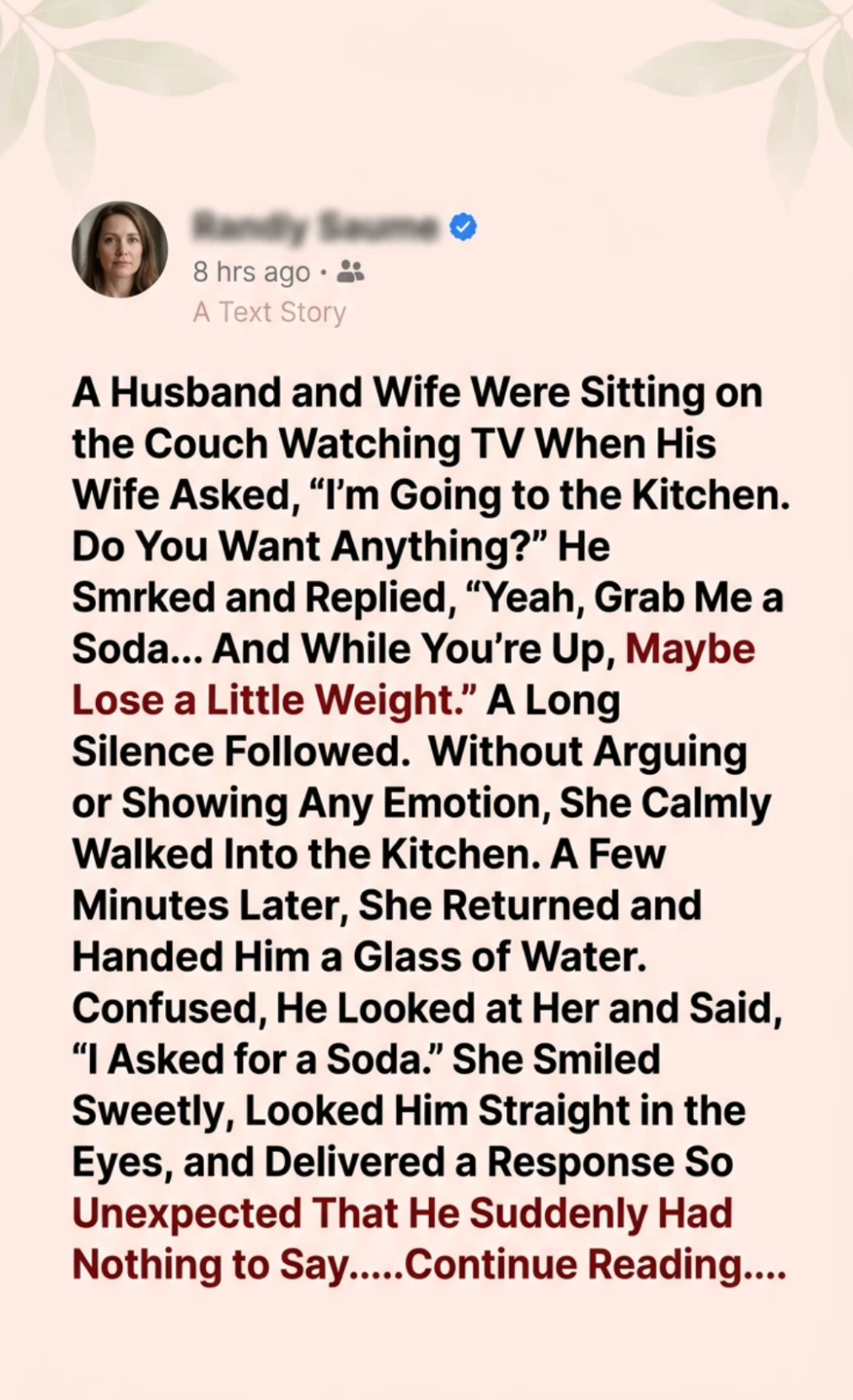
My husband and I had been married for eleven years when I finally realized that some of the deepest wounds in a marriage don’t come from shouting or dramatic arguments.
Sometimes, they come from a single sentence spoken casually by someone who knows exactly where it will hurt.
It happened on an ordinary Tuesday evening.
We were sitting on the couch watching television. Daniel was stretched out with his feet on the coffee table, scrolling through his phone during the commercials. I had just finished folding a basket of laundry and was finally enjoying a quiet moment.
“I’m going to the kitchen,” I said. “Do you want anything?”
He barely looked away from his phone.
“Yeah, grab me a soda. And while you’re up, maybe lose a little weight.”
He smirked.
I stopped walking.
For a moment, I thought he might laugh and say he was joking. He didn’t.
The television continued playing in the background, but the room suddenly felt uncomfortable.
I had gained weight over the previous two years. Between working full-time, caring for our daughter, managing the household, and helping my mother through a difficult recovery after surgery, I hadn’t had much time for myself.
Daniel knew all of that.
He also knew I’d been struggling with my confidence.
I looked at him, waiting for him to recognize what he’d said.
Instead, he returned his attention to his phone.
I didn’t argue.
I didn’t cry.
I simply walked into the kitchen.
A few minutes later, I returned carrying a glass of water.
Daniel glanced at it.
“I asked for a soda.”
I placed the glass on the coffee table.
“I know.”
He looked confused.
“So why did you bring me water?”
I smiled gently and said, “Because I thought you might be thirsty, but I didn’t want to contribute to the unhealthy habits you’re apparently so concerned about.”
His expression changed.
“Seriously? It was a joke.”
I sat down in the armchair across from him.
“Then explain the joke.”
He sighed.
“Oh, here we go.”
“No, Daniel. I’m genuinely asking. Explain what was funny about telling your wife to lose weight while she was offering to bring you something.”
He rolled his eyes.
“People joke about things like that all the time.”
“People also apologize when they hurt someone.”
He picked up the remote and turned down the television.
“Are you really going to make an entire evening out of one comment?”
I looked at him for several seconds.
“No. I’m going to stop pretending that one comment is the only problem.”
That was when he finally put his phone down.
For years, I had brushed aside remarks like that.
When I bought a new dress, he would ask whether I was sure it was flattering.
When I ordered dessert at a restaurant, he’d make a comment about my portion.
When I complained about being exhausted, he’d say I needed to exercise more because it might improve my mood.
He rarely said anything openly cruel. That was what made it difficult to explain.
Each remark was small enough to dismiss individually.
But together, they had slowly changed the way I saw myself.
I stopped wearing certain clothes.
I avoided photographs.
I sometimes changed outfits three or four times before leaving the house.
And whenever Daniel made another joke, I laughed along because I didn’t want to appear overly sensitive.
That evening, I decided I was finished doing that.
“Daniel, do you remember what I looked like when we first met?”
He frowned.
“Of course.”
“I was thinner then.”
“Obviously.”
“And do you remember what you said when I gained weight after having our daughter?”
He shrugged.
“I don’t know.”
“You told me that my body had changed because I’d carried our child. You said you loved me anyway.”
“I do love you.”
“Then why do you keep making me feel like I have to earn your affection by looking a certain way?”
He rubbed his forehead.
“I never said that.”
“You don’t have to say it directly. I hear it every time you make a comment about my body.”
He was quiet.
I continued.
“I know I’ve gained weight. I own a mirror. I don’t need you to remind me. If I decide to make changes for my health, I’ll do that because I want to—not because you make me feel embarrassed in my own home.”
Daniel leaned back.
“So now I’m not allowed to say anything?”
“You’re allowed to say anything. And I’m allowed to tell you when what you say hurts me.”
He shook his head.
“I can’t believe we’re fighting over a soda.”
I glanced at the glass of water on the table.
“We’re not fighting over a soda. We’re talking about respect.”
He didn’t answer.
I got up and went to the kitchen.
This time, I wasn’t going to bring him another drink.
I made myself a cup of tea and stood by the window, watching the streetlights come on.
A few minutes later, Daniel walked into the kitchen.
“Are you really upset?”
I turned toward him.
“Yes.”
He looked uncomfortable.
“I didn’t mean it the way you took it.”
“I believe you may not have intended to hurt me. But you did.”
He opened the refrigerator and took out a soda himself.
Then he leaned against the counter.
“You know I still find you attractive, right?”
I appreciated the attempt, but something about the statement bothered me.
“Daniel, I don’t want compliments that only appear after I tell you that you’ve hurt me. I want to feel respected even when we’re not having a serious conversation.”
He lowered his eyes.
For the first time that evening, he didn’t have an immediate excuse.
We went to bed without resolving everything.
The next morning, he made coffee and placed a cup beside me.
“I’m sorry about last night,” he said.
I thanked him.
But I also told him that an apology was a beginning, not a solution.
He nodded, although I wasn’t sure he fully understood.
Over the following weeks, I paid attention to whether anything changed.
At first, it did.
Daniel stopped making comments about my meals. He no longer joked about my clothes or suggested that I needed to exercise whenever I complained about being tired.
But old habits are difficult to break.
One Saturday, while we were getting ready to visit friends, I tried on a dress I’d bought several months earlier.
Daniel looked at me and said, “Maybe the other one would be better.”
I immediately felt that familiar embarrassment.
Then he noticed my expression.
“I’m sorry,” he said quickly. “I was about to make another comment, wasn’t I?”
I nodded.
He came closer.
“I don’t want to keep doing that.”
I looked at him.
“Then don’t.”
He sat on the edge of the bed.
“I think I’ve gotten used to making jokes without considering how they sound. My father used to tease my mother about her weight. Everyone laughed, and I grew up thinking it was normal.”
“That may explain where you learned it,” I said. “But it doesn’t make it harmless.”
“I know.”
We talked longer that afternoon than we had in months.
Daniel admitted that he’d been feeling insecure about his own appearance and aging. He had gained weight, his hair was thinning, and he was unhappy with how little time he spent exercising.
He hadn’t known how to talk about those feelings, so he’d turned them into jokes about me.
I told him that I wasn’t responsible for managing his insecurities, just as he wasn’t responsible for managing mine.
We agreed that if either of us wanted to improve our health, we could support each other without criticism or humiliation.
It wasn’t a perfect conversation.
There were moments when we became defensive. There were things I had been holding inside that surprised even me when I finally said them aloud.
But it was honest.
A few days later, Daniel suggested we start taking evening walks together.
I agreed, with one condition.
“No comments about how many calories I’m burning.”
He smiled.
“Deal.”
We started with twenty minutes around the neighborhood after dinner. Sometimes we talked about work. Sometimes we discussed our daughter’s school activities. Sometimes we barely spoke at all.
The walks weren’t about changing my body.
They were about spending time together without a television or phone separating us.
And gradually, I began feeling more comfortable in my own skin.
Not because Daniel had suddenly become perfect, but because I had stopped treating his opinion as the final authority on my worth.
Several months later, we were sitting on the same couch watching television.
Daniel stood up.
“I’m going to the kitchen,” he said. “Do you want anything?”
I smiled.
“Could you bring me some tea?”
“Of course.”
He disappeared into the kitchen and returned a few minutes later with two cups.
He placed mine in front of me.
Then he looked at the television and said, “And while you’re up—”
I raised an eyebrow.
He immediately laughed.
“Never mind. I’m learning.”
I laughed too.
But then he became serious.
“I really am sorry for the way I used to speak to you. I thought those comments were harmless because I didn’t mean them seriously. I didn’t understand how often you were carrying them with you after I had forgotten saying them.”
I reached for his hand.
“That’s what I needed you to understand.”
He squeezed my fingers.
That night, I thought again about the glass of water I’d brought him months earlier.
It hadn’t been revenge.
It hadn’t been a clever trick.
It was simply the first time I had refused to respond to disrespect by pretending everything was fine.
And that small decision opened a conversation we should have had years earlier.
I never forgot that evening, because it taught me something important about marriage.
Love doesn’t mean accepting every joke, every criticism, or every careless remark just to keep the peace.
You can love someone and still expect them to treat you with dignity.
You can forgive someone without pretending their words never hurt.
And you can work on yourself without believing that your body determines how deserving you are of love.
Daniel still occasionally makes a joke that doesn’t land.
The difference is that now, when I tell him something hurts, he listens instead of telling me I’m too sensitive.
And I no longer laugh at comments that make me feel small.
As for the soda?
He still drinks it.
I just don’t feel obligated to fetch it.
THE END.