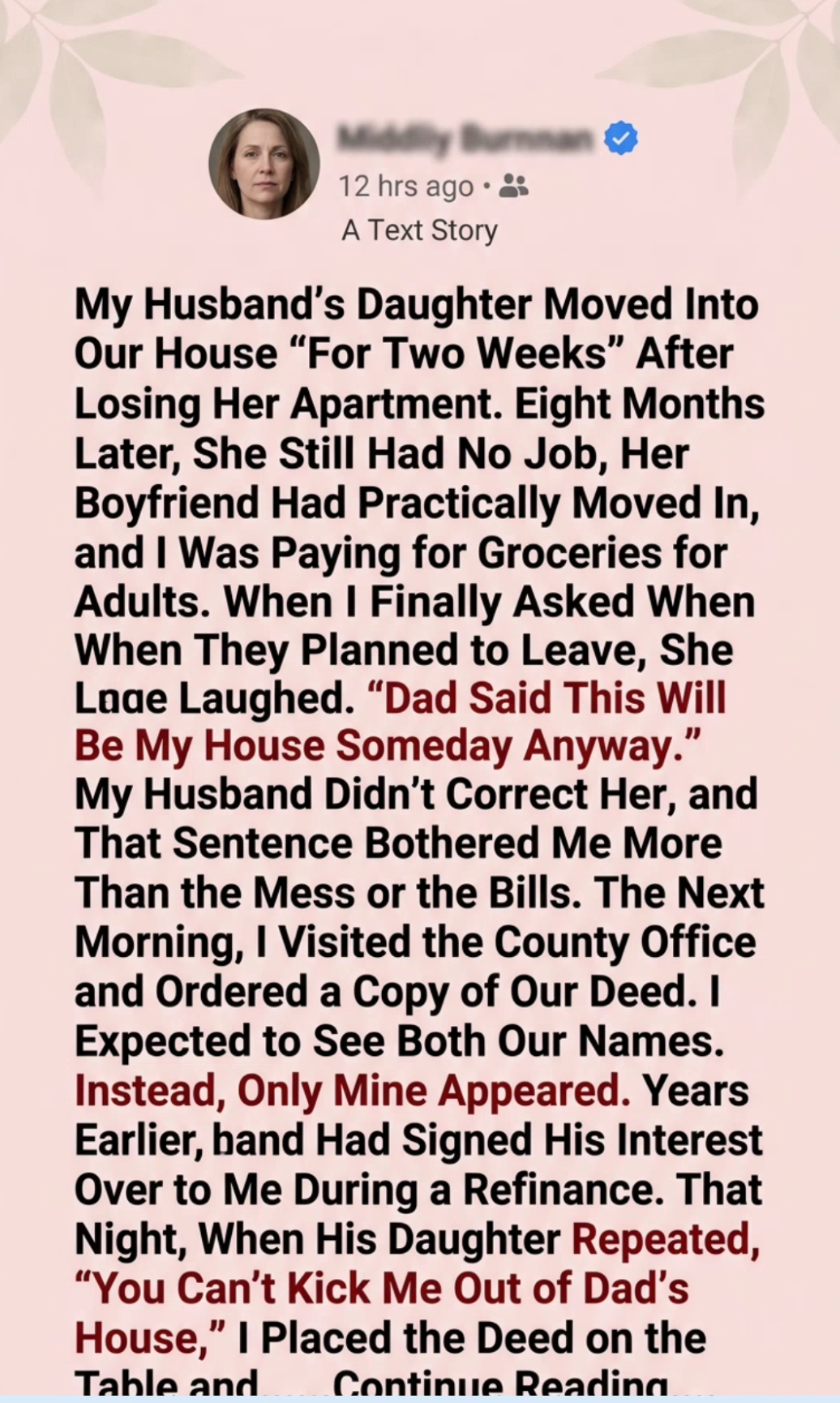
When my husband’s daughter first asked to stay with us, she promised it would only be for two weeks.
That was eight months ago.
Her name was Madison. She was thirty-two, recently separated from her boyfriend, and had lost her apartment after falling behind on rent.
My husband, Robert, felt sorry for her.
“She just needs somewhere to get back on her feet,” he told me. “We can’t leave our own daughter struggling.”
I agreed.
I wasn’t particularly close to Madison, but I had never wanted to stand between a father and his child.
I prepared the guest bedroom, cleared space in the bathroom, and made sure she had fresh towels and clean bedding.
When she arrived with three suitcases, two large shopping bags, and a collection of cardboard boxes, she hugged her father.
“Thank you, Dad. I promise I won’t be here long.”
I believed her.
During the first two weeks, everything seemed manageable.
Madison slept late, spent much of her time on her phone, and occasionally mentioned job applications.
I cooked dinner for three adults instead of two, bought extra groceries, and tried to make her feel welcome.
Then the two weeks passed.
When I asked whether she’d found somewhere to stay, she said she was waiting to hear back from an employer.
“Just another week or two,” she promised.
Robert told me not to pressure her.
“She has been through a lot.”
I agreed again.
Another month passed.
Then another.
By the third month, Madison had stopped mentioning job applications.
She began ordering food deliveries several times a week and leaving the packaging on the kitchen counter.
She also started inviting her boyfriend, Evan, over.
At first, he came for dinner.
Then he began staying overnight.
Eventually, his shoes appeared beside the front door, his toiletries occupied the bathroom shelf, and his gaming equipment took over one corner of the living room.
I asked Madison whether Evan was planning to stay.
She shrugged.
“He doesn’t really have anywhere else to go right now.”
I looked at Robert.
He gave me the same expression he always used when he wanted to avoid an uncomfortable conversation.
“Let’s not make a big deal out of it.”
But it was becoming a big deal.
I was paying for groceries for four adults.
The electricity bill had increased.
The water bill had increased.
The kitchen was constantly occupied, and I couldn’t remember the last time I’d sat down in my own living room without hearing someone else’s television or video game.
I wasn’t asking anyone to live perfectly.
I was asking for consideration.
One Saturday morning, I found Madison and Evan eating breakfast at the kitchen table.
There were empty cereal boxes, coffee cups, and dirty plates scattered around them.
I had already cleaned the kitchen once that morning.
“Could you both please put your dishes in the dishwasher when you’re finished?” I asked.
Madison didn’t look up.
“Sure.”
Two hours later, the dishes were still there.
I eventually washed them myself because I needed the kitchen to prepare dinner.
That evening, I spoke to Robert.
“I think we need to establish a date for Madison and Evan to move out.”
He looked uncomfortable.
“Why are you including Evan?”
“Because he’s practically living here.”
“He’s just visiting.”
“Robert, he has clothes in the bedroom, toiletries in the bathroom, and a gaming computer in the living room. That’s not visiting.”
Robert sighed.
“I’ll speak to her.”
But he didn’t.
The following week, I discovered that Madison had used my grocery account to order expensive items without asking.
When I questioned her, she said:
“Dad told me to get whatever we needed.”
I turned toward Robert.
He looked at his phone.
“I probably said something like that.”
“You said we could buy groceries,” I replied. “You didn’t say she could spend whatever she wanted.”
He shook his head.
“It’s not worth arguing about.”
That sentence became the soundtrack of our household.
Whenever Madison ignored a responsibility, it wasn’t worth arguing about.
Whenever Evan stayed another night, it wasn’t worth arguing about.
Whenever I complained about the bills, I was told that family should help family.
I began to feel like a stranger in the house where I had lived for years.
Then came the evening that changed everything.
It was a Tuesday.
I had just finished preparing dinner when Madison walked into the kitchen and announced that Evan’s birthday was coming up.
“We’re thinking of having people over next weekend.”
“How many people?”
“Maybe twelve.”
I put down the serving spoon.
“Twelve people?”
“Yeah. Just a small gathering.”
I looked at her.
“Have you discussed that with your father?”
She laughed.
“Dad doesn’t mind.”
I glanced toward Robert.
He was sitting in the living room, watching television.
“Robert?”
He lowered the volume.
“What?”
“Madison wants to invite twelve people here next weekend.”
He looked at her.
“That’s fine, as long as it’s not too late.”
I felt something inside me tighten.
“Who is cleaning afterward?”
Madison shrugged.
“We’ll figure it out.”
“And who’s paying for the food?”
She laughed again.
“Dad said this will be my house someday anyway. It’s not like I’m asking a stranger.”
The kitchen went silent.
I slowly turned toward Robert.
He didn’t correct her.
He didn’t say that she was mistaken.
He simply looked back at the television.
That hurt more than anything else.
I had spent years building a life with this man. I had contributed to the household, paid expenses, and maintained the property.
And now his daughter was speaking as though my home were already promised to her.
I didn’t argue.
I didn’t ask her to repeat herself.
I simply served dinner.
But that night, I couldn’t sleep.
I kept thinking about the sentence.
This will be my house someday anyway.
Was Robert telling her that?
Had he promised her the property?
Had they discussed my future without me?
I knew that years earlier, when we refinanced the house, Robert had signed paperwork transferring his ownership interest to me.
At the time, it had been part of a financial arrangement suggested by our adviser.
I remembered signing the documents at the solicitor’s office, but I hadn’t thought about them in years.
I had always assumed that the deed reflected the arrangement.
Still, I wanted to be certain.
The next morning, I drove to the county records office.
I requested a copy of the most recent recorded deed.
The clerk asked for the property information and identification required for the search.
A few minutes later, she handed me a printed copy.
I sat down at a small table and read it carefully.
There it was.
My name.
Only my name.
The deed showed that Robert had transferred his interest to me years earlier.
The transfer had been properly recorded.
I read the document again.
I wasn’t celebrating.
I wasn’t even relieved at first.
I was simply trying to understand why my husband had allowed his daughter to believe that she would inherit a house he no longer owned.
I took the document home and placed it in a folder.
Before making any decisions, I contacted an attorney to confirm exactly what the deed meant, whether there were any other recorded interests or agreements, and what legal steps would be appropriate if I needed Madison and Evan to leave.
I didn’t want to rely on assumptions.
The attorney reviewed the deed and explained that, based on the recorded ownership documents, I was the sole legal owner.
However, she also advised that Madison and Evan’s occupancy had to be handled properly. I couldn’t simply throw their belongings outside or change the locks without following the applicable local procedures.
She recommended putting my expectations in writing and giving them a reasonable opportunity to make other arrangements.
I thanked her.
Then I went home.
That evening, Madison repeated the same sentence.
We were sitting in the living room when she announced that she and Evan wanted to repaint the guest bedroom.
“I think a dark blue would look amazing,” she said. “We’ll start next week.”
I looked at her.
“Have you asked your father?”
She smiled.
“It’s fine. Dad said this would be my house someday.”
Robert was sitting beside her.
I stood up.
“Actually, Madison, I think we should discuss that.”
She frowned.
“What?”
I walked to the cabinet, retrieved the folder, and returned.
I placed the deed on the coffee table.
“Read it.”
Madison looked down.
“What is this?”
“The deed to this house.”
She picked it up.
Her eyes moved across the page.
Then she looked at Robert.
“Dad?”
Robert stared at the document.
For several seconds, nobody spoke.
Madison looked at me.
“Why is your name the only one on here?”
“Because your father transferred his ownership interest to me years ago, during our refinance.”
She turned toward him.
“Is that true?”
Robert rubbed his forehead.
“Yes.”
Madison’s expression changed.
“But you said this was your house.”
Robert finally looked at her.
“I said it was our family home.”
“No. You said it would be mine someday.”
He didn’t answer.
I sat down.
“Madison, I want you to understand something. I didn’t bring this document out to embarrass you. I brought it out because you’ve repeatedly spoken as though you have an ownership claim over this property.”
She shook her head.
“I’m Dad’s daughter. I thought—”
“I understand that you’re his daughter. But being someone’s child doesn’t automatically make you the owner of their spouse’s property.”
Evan leaned forward.
“So what are you saying? That we’re not welcome anymore?”
I looked at him.
“I’m saying that this arrangement has gone far beyond what I originally agreed to.”
Madison’s face reddened.
“You can’t kick me out of Dad’s house!”
I looked directly at her.
“It’s not your father’s house anymore. It is mine.”
Robert finally spoke.
“That’s enough. Let’s all calm down.”
I turned toward him.
“No, Robert. This is exactly why we need to talk. You allowed Madison to believe she had a future claim over this home. You watched her treat me as though I were a temporary caretaker in a property she would eventually own.”
He looked down.
“I didn’t mean for it to happen.”
“Then why didn’t you correct her?”
He had no answer.
I continued.
“I’m not asking you to choose between your daughter and me. I’m asking you to respect the person who owns this home.”
Madison put the deed down.
“So what happens now?”
I took a breath.
“You and Evan need to find another place.”
She looked at her father.
“Dad, say something!”
Robert remained silent for a moment.
Then he said, “Your stepmother is right about one thing. We should have discussed the living arrangement properly.”
Madison stared at him as though he had betrayed her.
I explained that I had already spoken with an attorney and would provide a written notice setting out the timeline and the arrangements for their departure.
I also made it clear that they could take their belongings, but they could not make changes to the property or invite additional people to stay without permission.
Madison stormed upstairs.
Evan followed her.
Robert remained on the couch.
After a few minutes, he said, “I should have told her the truth.”
I looked at him.
“Yes, you should have.”
He leaned forward.
“She kept talking about how difficult things were. I wanted to reassure her that she would always have a place in the family.”
“Then you should have told her that she would always have a place in our lives. Not that she would own our home.”
Robert nodded slowly.
I could see that he understood the difference.
But understanding it now didn’t erase the months of silence.
The following morning, Madison refused to speak to me.
She stayed upstairs until nearly noon.
Then she came down and asked whether I was really serious about making them leave.
“Yes.”
“But we have nowhere to go.”
“You have a car, two incomes between you if Evan is working, and time to find a rental. I’ll give you the period my attorney advised.”
She looked at me.
“Dad wouldn’t do this to me.”
I replied quietly.
“Your father isn’t the only person who lives here.”
For the next several weeks, the atmosphere was tense.
Madison accused me of being selfish.
Evan complained that finding another apartment was expensive.
Robert tried to keep the peace, but this time I refused to let him avoid the conversation.
We followed the attorney’s advice, communicated in writing, and allowed the proper notice period.
I didn’t touch their belongings.
I didn’t shut off utilities.
I didn’t threaten them.
I simply maintained the boundaries that should have existed from the beginning.
During that time, something unexpected happened.
Robert began taking responsibility for the situation.
He told Madison that he had made a mistake by promising something he had no right to promise.
He also explained that the deed had been transferred to me years earlier and that he had never intended to reverse that arrangement.
Madison didn’t accept it immediately.
She accused him of taking my side.
Robert replied:
“I’m not taking sides. I’m correcting something I should have corrected months ago.”
That conversation changed the atmosphere slightly.
Madison eventually found a small apartment with Evan.
It wasn’t luxurious, but it was affordable.
They moved out two days before the agreed deadline.
On their final afternoon, I found Madison standing in the guest bedroom.
The room was empty except for a few cardboard boxes.
She looked at me.
“I didn’t think you’d actually make us leave.”
I leaned against the doorframe.
“I know.”
She hesitated.
“Dad told me this house would always be part of my future.”
I looked at her.
“Your father may have wanted to make you feel secure. But he should never have done that by making promises about someone else’s property.”
She looked down.
“I guess I didn’t think about how it sounded.”
I nodded.
“I hope you think about it next time someone opens their home to you.”
She didn’t answer.
Before leaving, she gave me a brief hug.
It was awkward, but I accepted it.
Evan carried the last suitcase outside.
Robert stood beside the car and hugged his daughter.
When they drove away, the house became quiet again.
I walked through the rooms, opening windows and letting fresh air inside.
For the first time in eight months, I could hear the clock in the hallway.
That evening, Robert and I sat at the kitchen table.
He looked exhausted.
“I’m sorry,” he said.
I stirred my tea.
“For what?”
“For letting Madison speak that way. For making the decision without you. For allowing you to pay for everything while I kept pretending it wasn’t a problem.”
I looked at him.
“Why didn’t you correct her when she said the house would be hers?”
He was quiet for a long time.
Then he admitted that he had enjoyed being seen as the generous father who could promise his daughter a secure future.
He hadn’t considered what that promise meant for me.
“I didn’t want her to think I couldn’t help her,” he said.
I nodded.
“But you helped her with something that wasn’t yours to give.”
He lowered his eyes.
“I know.”
We discussed the future of our marriage and agreed that any major household decision would require an honest conversation.
I also told him that I would no longer automatically cover expenses for relatives simply because he felt uncomfortable saying no.
He agreed.
Several months later, Madison called.
She and Evan were doing better in their apartment. She had found part-time work, and Evan had taken on additional hours at his job.
She asked whether she could visit for dinner.
I said yes.
When she arrived, she brought flowers.
She apologized for the way she had behaved.
“I thought because Dad had always told me I’d have this house someday, I didn’t need to ask permission about things,” she said. “I didn’t realize how unfair that was to you.”
I accepted her apology.
But I also told her that the house was not something she should plan her future around.
She nodded.
“I understand.”
We had dinner.
It wasn’t a magical reconciliation, and we didn’t suddenly become best friends.
But we were able to sit at the same table without arguing.
And that was enough for one evening.
Later, after Madison left, Robert and I stood together by the front window.
He put his arm around my shoulders.
“I’m glad we got through that.”
I looked at him.
“So am I. But I hope you understand something now.”
“What?”
“Being generous with family doesn’t mean giving away someone else’s security.”
He nodded.
I still keep the copy of the deed in the cabinet where I store our important documents.
Not because I want to wave it in anyone’s face.
I keep it because it reminds me that I have a right to feel secure in my own home.
For eight months, I had paid the bills, bought the groceries, cleaned up after two additional adults, and listened while someone spoke about my property as though it were already hers.
The deed didn’t make me a different person.
It simply reminded everyone of something they should have respected all along.
I was not a guest in my own home.
I was not an unpaid housekeeper.
And I was not required to surrender my peace just because someone else believed family meant they could take whatever they wanted.
Sometimes, the most important boundary isn’t a locked door.
It’s the moment you finally stop allowing people to mistake your kindness for permission.
THE END.