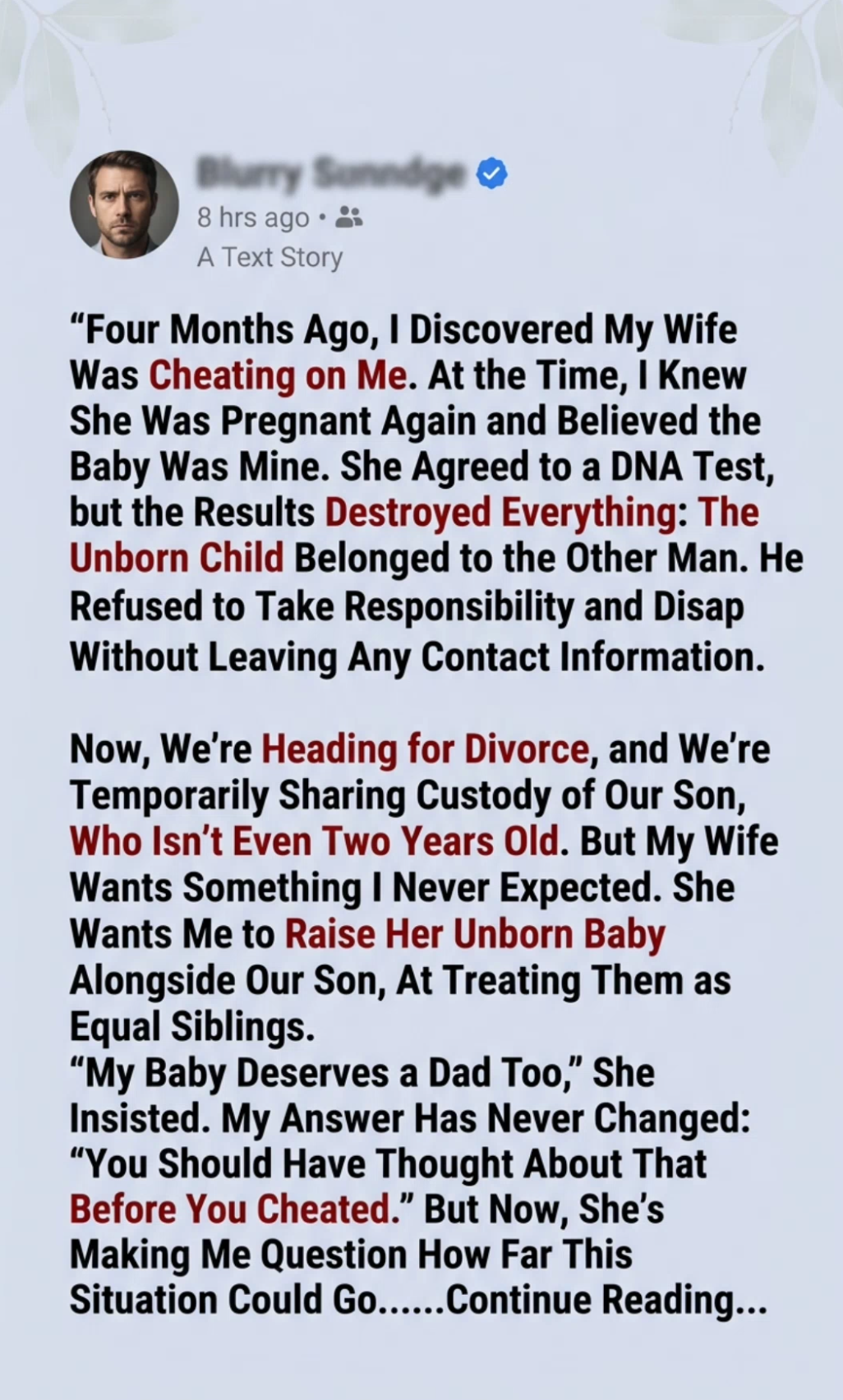
Four months ago, I discovered that my wife was having an affair.
I wish I could say I had suspected something for a long time, but the truth was that I trusted her completely.
We had been married for five years and had a little boy named Noah, who was twenty months old. He was the center of our lives. Every morning, he would climb onto our bed, pull at my blanket, and announce that it was time to get up.
My wife, Emily, was pregnant again.
When she first told me, I was surprised but happy. We hadn’t planned on having another child quite so soon, but I thought it was wonderful news.
I imagined Noah growing up with a little brother or sister. I imagined family holidays, birthday parties, and the two children running around the garden together.
I never imagined that the pregnancy would destroy our marriage.
The first warning sign appeared when Emily began guarding her phone.
She had always been comfortable leaving it on the kitchen counter or asking me to answer messages when she was driving.
Suddenly, it was always in her hand.
She changed her password, took calls outside, and became irritated whenever I asked who had contacted her.
At first, I told myself it was probably work-related.
Then one evening, while she was taking a shower, her phone lit up on the bedside table.
A message appeared from a man named Marcus.
I can’t stop thinking about yesterday. I wish things were different.
I stared at the screen.
I didn’t open the message.
I didn’t need to.
I knew Marcus.
He was someone Emily had introduced as a colleague several months earlier. He had attended a few social gatherings with us, and I had even shaken his hand at a restaurant.
I remembered him complimenting my wife.
I remembered thinking he seemed friendly.
That night, I barely slept.
The following morning, I asked Emily who Marcus was.
She looked annoyed.
“Why?”
“Because he sent you a message that didn’t sound like something a colleague would send.”
She laughed nervously.
“You’re reading too much into it.”
“Then explain it.”
She took her phone and walked away.
For the next two days, she barely spoke to me.
Then I found the truth.
I won’t describe every message or photograph. I don’t think those details matter anymore.
What mattered was that Emily had been involved with Marcus for several months.
There were hotel bookings, conversations about meeting after work, and messages discussing how difficult it was to keep their relationship secret.
I felt physically sick.
When I confronted her, she initially denied everything.
Then she sat down and began crying.
“I’m sorry,” she whispered.
I asked her how long it had been happening.
She admitted it had started before she discovered she was pregnant.
I looked at her stomach.
“Is the baby mine?”
She didn’t answer.
That silence was more painful than anything she could have said.
I asked her directly.
“Emily, is there a chance this baby belongs to Marcus?”
She covered her face.
“I don’t know.”
I felt as though someone had pulled the floor out from beneath me.
I had spent weeks imagining our second child.
I had already begun thinking about names.
I had even started putting together a small nursery.
And now I didn’t know whether I was the father.
After several difficult conversations, Emily agreed to a DNA test.
We spoke with medical professionals about the available prenatal testing options, including the risks and limitations of testing during pregnancy.
We decided to use a non-invasive prenatal paternity test through an appropriate laboratory.
The waiting period was unbearable.
Every morning, I woke up hoping the result would somehow make everything easier.
I wanted the baby to be mine.
Not because I believed that would fix the affair, but because I couldn’t bear the thought of another child becoming part of a situation neither of us had created.
When the results arrived, Emily and I were sitting at the kitchen table.
She opened the email first.
I watched her expression change.
Then she began crying.
“What does it say?” I asked.
She slid the phone toward me.
The report excluded me as the biological father and identified Marcus as the biological father with a high degree of certainty, based on the test’s findings.
I read it several times.
I wanted to find a mistake.
I wanted to believe there had been a mix-up.
But there wasn’t.
The unborn child wasn’t mine.
I pushed the phone away.
Emily was crying uncontrollably.
“I’m sorry,” she said.
I stood up.
“Don’t.”
“Please, let me explain.”
“Explain what? That you had an affair and got pregnant?”
She covered her mouth.
“I didn’t plan this.”
I looked at her.
“You didn’t plan to get pregnant, or you didn’t plan for me to find out?”
She didn’t answer.
That evening, I slept in the spare bedroom.
The next morning, I called a family lawyer.
I didn’t want to make decisions while I was angry, especially because we had a little boy who deserved better than watching his parents destroy each other.
Our lawyer explained the separation process, temporary parenting arrangements, financial responsibilities, and the importance of keeping Noah’s routine stable.
We agreed that Noah would spend time with both of us.
For the first few weeks, we tried to manage the arrangement informally.
I would collect him after work, spend the evening with him, and bring him back to Emily’s apartment.
On weekends, we alternated longer periods.
It was exhausting.
Noah didn’t understand why his parents no longer slept in the same bedroom.
He only knew that sometimes Daddy was there when he woke up, and sometimes he wasn’t.
Whenever he reached for me at handover, I felt my heart break.
But I refused to use him as a weapon against Emily.
He was innocent.
He deserved two parents who loved him, regardless of what had happened between us.
Meanwhile, Marcus had disappeared.
Emily tried contacting him.
His phone was disconnected.
His social media accounts had been deleted or made inaccessible.
The workplace where she believed he had been employed said he no longer worked there.
She eventually admitted that she didn’t have a reliable address for him.
He had promised to support her.
He had told her that he would be there when the baby arrived.
Apparently, those promises had disappeared along with him.
I wasn’t surprised.
A man willing to participate in an affair and leave a pregnant woman behind wasn’t someone I expected to suddenly become responsible.
But what happened next was something I never anticipated.
About six weeks after the DNA results, Emily asked me to meet her at a café.
She looked tired.
Her pregnancy was progressing, and she had begun showing more noticeably.
I sat across from her.
“What do you need?”
She stared at her coffee.
“I want to talk about the baby.”
I nodded.
“Go ahead.”
She took a breath.
“I know things are difficult between us, but I don’t want this child to grow up without a father.”
I looked at her.
“Then you need to find the child’s father.”
She shook her head.
“Marcus isn’t answering.”
“Then you need to pursue the appropriate legal options to establish his responsibilities.”
She began crying.
“That’s not what I mean.”
I waited.
Then she said the sentence that changed everything.
“I want you to raise the baby with Noah.”
I stared at her.
“What?”
“I want the children to grow up together. They’re siblings. Noah shouldn’t have to feel that his little brother or sister is different.”
I leaned back.
“Emily, that baby isn’t mine.”
“I know.”
“Then why are you asking me to raise the child?”
“Because you’re a good father. You love Noah. I know you would love this baby too.”
I couldn’t believe what I was hearing.
She reached across the table.
“My baby deserves a dad too.”
I slowly pulled my hand away.
“You should have thought about that before you cheated.”
She began crying harder.
“Please don’t punish an innocent child for something I did.”
I looked at her for a long time.
“I’m not punishing anyone. I’m refusing to pretend I’m the father of a child I didn’t create.”
“But what about Noah? They’re going to grow up together. What happens when he asks why you treat them differently?”
“That is something we will explain appropriately when the time comes. But I will not lie to him.”
Emily looked devastated.
“I thought you would be more understanding.”
I felt anger rising.
“Understanding? You expect me to divorce you, share custody of our son, and then become the father of the child you conceived with another man?”
She lowered her head.
“I just don’t want the baby to suffer.”
“Neither do I. But the solution isn’t to make me responsible for someone else’s choices.”
We left the café without agreeing on anything.
For the next several days, I couldn’t stop thinking about the conversation.
I wasn’t confused about the affair.
I wasn’t confused about the DNA results.
But I was beginning to wonder whether refusing to have a relationship with the unborn child would eventually hurt Noah.
The children would be siblings.
They would share a mother.
They would probably grow up in the same household for at least part of their childhood.
Would Noah feel rejected if I treated the baby differently?
Would he wonder why I loved him but didn’t act like a father to his sibling?
I discussed these concerns with my lawyer.
She reminded me that I needed to distinguish between my responsibilities as Noah’s father and any possible responsibilities toward Emily’s unborn child.
She also advised me not to make promises about the baby while emotions were high.
I needed to understand the legal position in my jurisdiction, including whether any presumptions of parentage could apply to a child conceived during marriage and what steps might be necessary to clarify the child’s legal parentage.
I had assumed the DNA result settled every possible legal question.
It didn’t necessarily.
So we made sure the issue was addressed properly rather than relying on assumptions.
I also spoke with a family counselor.
I explained that I didn’t want Noah growing up feeling that his sibling was unwanted.
The counselor asked me an important question.
“Can you separate being kind to a child from accepting a parental role you don’t want?”
I thought about it.
“Yes,” I said eventually.
“Then that’s where you need to begin.”
She explained that children shouldn’t be made responsible for adult decisions. Noah didn’t need to know the details of the affair or the DNA test. He needed predictable routines, reassurance, and permission to love his sibling without feeling disloyal to either parent.
That conversation helped me understand something.
I could refuse to become the baby’s father without treating the baby cruelly.
I could be civil.
I could support Noah’s relationship with his sibling.
I could even be present at family occasions if that was healthy and appropriate.
But none of those things required me to pretend the affair had never happened.
A week later, Emily called.
She was crying again.
“I’ve been thinking about what you said.”
I listened.
“I shouldn’t have asked you to promise to raise the baby,” she said. “I was scared, and I thought if you agreed, everything would somehow be okay.”
I didn’t respond immediately.
She continued.
“I’m terrified of doing this alone.”
“I understand that you’re frightened.”
“Marcus still hasn’t contacted me.”
“Have you spoken to a lawyer about establishing his legal responsibilities?”
“Yes. I’m going to.”
I nodded, even though she couldn’t see me.
“That’s the right step.”
Then she asked, “Does this mean you won’t ever care about the baby?”
I took a breath.
“I can’t answer that today. I don’t know what relationship I’ll have with the child. But I won’t be cruel to an innocent baby.”
She began crying softly.
“Thank you.”
I added something else.
“But I need you to stop asking me to take on a role that isn’t mine. I’m Noah’s father. That responsibility is permanent. Whatever happens with the other child must be handled honestly.”
She agreed.
For a while, things became calmer.
Our divorce proceedings continued.
We worked out a more formal parenting schedule for Noah, including arrangements for holidays, medical appointments, and communication about his development.
We also agreed that neither of us would speak negatively about the other in front of him.
It wasn’t easy.
There were days when I felt angry all over again.
There were nights when I missed the family I thought we had.
But whenever Noah ran toward me with his little arms stretched out, I reminded myself why I had to keep moving forward.
Then, about a month before the baby was due, Emily contacted me with unexpected news.
She had received a message from Marcus.
He had apparently learned that she was still pregnant and wanted to discuss the situation.
He didn’t offer an apology.
He didn’t ask how she was feeling.
He simply asked whether there was any chance the baby could be raised without his involvement.
Emily showed me the message.
I read it once.
Then I handed her phone back.
“That’s something you need to discuss with your lawyer.”
She nodded.
“I know.”
For the first time, I saw her understand that I wasn’t going to step into the empty space Marcus had left behind simply because he had abandoned his responsibilities.
A few weeks later, the baby was born.
A little girl.
Emily named her Lily.
I was at home when I received the message.
Lily arrived safely. She’s healthy.
I stared at the screen.
Then I typed:
I’m glad she’s healthy. I hope you both recover well.
I didn’t visit the hospital.
Not because I wished them harm, but because I thought it would be confusing for everyone if I appeared immediately after repeatedly explaining that I wasn’t taking on a parental role.
Instead, I waited.
When Noah came to stay with me a few days later, he was excited.
“Daddy! I have a baby sister!”
I smiled.
“Yes, you do.”
“She tiny!”
I laughed.
“Babies usually are.”
He wanted to show me photographs.
I sat with him on the couch while he pointed at the screen.
“That’s Lily. Mommy says she’s my sister.”
“She is your sister, sweetheart.”
He looked up.
“Do you love her?”
The question caught me off guard.
I took his little hand.
“She’s a new baby, and she deserves to be safe and loved. You can always love your sister.”
He smiled.
Then he returned to looking at the photographs.
I realized that Noah wasn’t asking me to become Lily’s father.
He was simply asking whether he was allowed to love her.
And the answer was yes.
A few weeks later, Emily and I met with the counselor again.
We discussed how to help Noah adjust to having a baby sibling in his mother’s home.
I told Emily I would never discourage Noah from talking about Lily or spending time with her.
But I also made my position clear.
I would not be listed as Lily’s father.
I would not take on financial responsibility for her.
And I would not make promises about raising her.
If I eventually developed a relationship with her, it would happen naturally, without pressure or guilt.
Emily accepted that.
The legal process concerning Lily’s biological father continued separately.
Marcus’s responsibilities would be determined through the appropriate legal procedures, not through promises made during emotional conversations.
As for Noah, he adjusted better than I expected.
He loved visiting his mother and seeing his baby sister.
When he came to my home, he sometimes talked about her.
I listened.
I never told him she wasn’t important.
Because she was important.
She was his sister.
And she had done absolutely nothing wrong.
My marriage to Emily eventually ended.
The divorce was finalized several months later.
There was no dramatic courtroom scene, no public humiliation, and no triumphant speech.
Just paperwork, difficult conversations, and the quiet acceptance that the relationship we had built could not continue.
Emily and I learned to communicate as co-parents.
We weren’t friends, but we became more respectful.
I continued raising Noah.
I attended his medical appointments, celebrated his birthdays, and read him bedtime stories whenever he stayed with me.
And I never asked him to choose between the people he loved.
Sometimes, when he talks about Lily, I feel a complicated sadness.
I wonder what our lives would have looked like if Emily had been honest.
I wonder whether we could have remained a family.
But I also know that I cannot build a healthy future by pretending the past didn’t happen.
One evening, Noah was sitting beside me on the couch, holding a picture of himself with Lily.
He looked up.
“Daddy, when Lily gets big, can she come play here?”
I smiled.
“Of course. We can arrange that with Mommy.”
He hugged the picture.
“She’s my sister.”
“I know, buddy.”
Then he leaned against my shoulder and fell asleep.
I looked at his little face and understood what I had struggled with for months.
I didn’t have to become Lily’s father to be a good person.
I didn’t have to raise another man’s child to prove that I was compassionate.
And I didn’t have to punish an innocent baby to protect myself from the pain of betrayal.
I could maintain my boundaries and still show kindness.
I could refuse an unfair responsibility without teaching my son to hate his sister.
My answer to Emily’s original request had never changed.
I would not pretend to be the biological or legal father of a child conceived during her affair.
But my attitude toward the baby had changed in one important way.
I no longer saw Lily as a reminder of what Emily had done.
I saw her as an innocent little girl who deserved a chance to grow up without carrying the weight of her parents’ mistakes.
And perhaps that was the most important lesson of all.
Children should never have to pay for the decisions adults make.
But neither should an innocent child become the reason another adult is forced to surrender boundaries, identity, or peace.
I lost my marriage.
I did not lose my son.
And I refused to lose myself trying to repair something I hadn’t broken.
THE END.