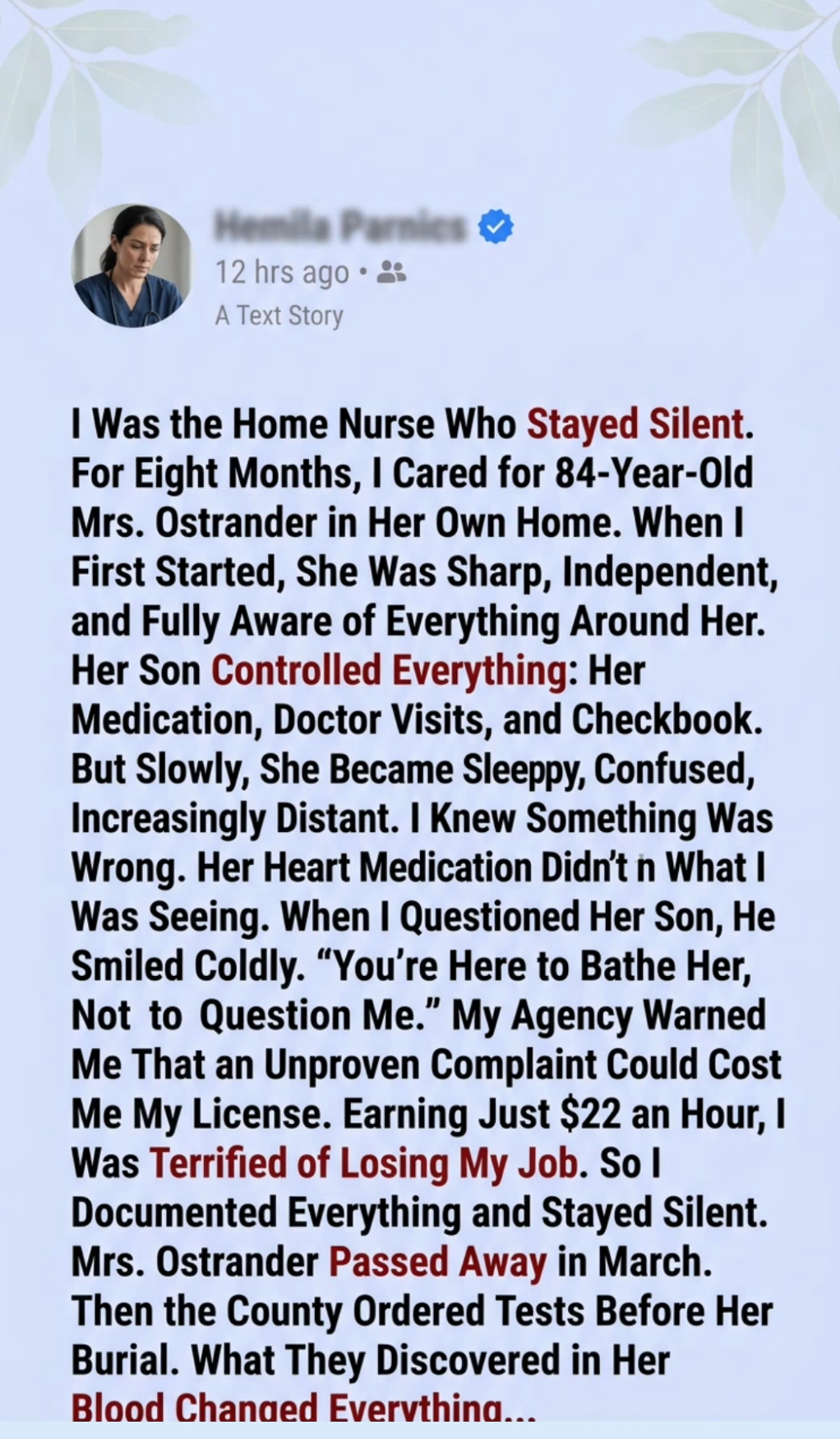
The first time I noticed something was wrong with Mrs. Ostrander, she was sitting beside her kitchen window, carefully arranging the flowers in a glass vase.
She looked up when I entered and smiled.
“Good morning, Claire. You’re early today.”
I checked my watch.
“Only by five minutes.”
“Five minutes is early when you’re eighty-four.”
She laughed.
That was the woman I remembered when I first started working in her home.
Mrs. Evelyn Ostrander was eighty-four years old, but she was remarkably sharp. She knew the names of her medications, remembered appointments without looking at a calendar, and could tell me exactly which groceries she wanted.
She lived alone in a comfortable two-story house outside Cedar Rapids, Iowa.
Her husband had died several years earlier, and her only child, a son named Martin, lived about twenty minutes away.
I had been assigned to her through a home-care agency.
My responsibilities included helping with bathing, preparing meals, monitoring her general condition, assisting with mobility, and communicating changes to her healthcare team.
I was paid twenty-two dollars an hour.
It wasn’t a fortune, but I needed the work. I was supporting myself and helping my younger sister with college expenses.
At the beginning, Mrs. Ostrander needed very little assistance.
She could walk around the house with a cane, prepare simple meals, and carry on long conversations.
She even corrected my pronunciation when I misread the name of a French perfume she had once owned.
“You can’t say it like that, dear,” she told me. “The French would never forgive you.”
I laughed.
She laughed too.
I liked working with her.
But there was one thing that made me uncomfortable from the beginning.
Her son controlled almost everything.
Martin kept her medication in a locked cabinet. He organized her doctor visits, managed her checkbook, and insisted that all communication about her health go through him.
He explained that his mother had become forgetful and that he was protecting her from making mistakes.
At first, I accepted his explanation.
Families often help elderly relatives manage complicated arrangements. There was nothing automatically suspicious about a son organizing his mother’s finances and medication.
But I noticed that Mrs. Ostrander rarely had an opportunity to answer questions for herself.
If I asked her how she felt, Martin often answered before she could speak.
If I asked whether she had experienced dizziness, he would say she was simply tired.
If I asked about an upcoming appointment, he would tell me not to worry about it.
One morning, while I was helping her get dressed, she whispered something that made me stop.
“Claire, do you know what day it is?”
“Tuesday.”
She frowned.
“Martin told me it was Friday.”
I smiled gently.
“Maybe he was thinking about the end of the week.”
She didn’t smile back.
“Sometimes I think he wants me to stop asking questions.”
I didn’t know what to say.
I simply helped her button her cardigan.
That was the first time I wondered whether her son was controlling more than her schedule.
The changes began gradually
During my first two months, Mrs. Ostrander remained independent and conversational.
Then she started sleeping during the afternoon.
At first, it seemed harmless.
She would finish lunch, sit in her favorite chair, and close her eyes.
But the naps became longer.
Sometimes she would struggle to stay awake while I spoke to her.
She also began losing track of conversations.
One morning, she asked me whether her husband was coming home for dinner.
I reminded her gently that he had passed away.
She stared at me for several seconds.
Then she looked toward the hallway.
“Oh,” she whispered. “I forgot.”
It was heartbreaking.
I understood that older adults could experience cognitive changes for many reasons. I wasn’t a physician, and I had no authority to diagnose her.
But the speed and pattern of her decline worried me.
She had been alert and independent.
Now she sometimes appeared heavily sedated.
Her speech became slower.
Her balance deteriorated.
On two occasions, I found her so sleepy that I struggled to keep her engaged during routine care.
I began documenting every change.
I recorded the time, what I observed, what she had eaten, whether she was alert, and any information available to me about her medication schedule.
I did not guess at causes.
I wrote only what I could personally observe.
One entry read:
10:15 a.m. — Patient unusually drowsy. Needed repeated verbal prompts to remain awake during breakfast. Speech slower than usual. No fall observed.
Another:
2:40 p.m. — Patient unable to recall a conversation from approximately twenty minutes earlier. Appeared unsteady when standing. Assisted to chair.
I also recorded when I contacted the agency supervisor.
I wanted a clear record in case someone later questioned what I had seen.
The medication cabinet
Martin controlled the medication cabinet.
He brought in the weekly pill organizer and prepared the medication according to what he said the doctor had prescribed.
I was allowed to assist with reminders and observe whether Mrs. Ostrander had taken medication according to the care plan.
I wasn’t permitted to change doses or independently administer anything outside my authorized duties.
One afternoon, I noticed that several medication containers had different labels from the previous week.
I couldn’t determine whether the prescriptions had changed.
I asked Martin.
“Did her doctor adjust anything?”
He closed the cabinet.
“Just routine changes.”
“She seems much sleepier lately.”
“She’s eighty-four, Claire.”
“I understand. But the change has been noticeable.”
He looked at me.
“Her heart medication makes her tired.”
I knew that certain medications could cause fatigue, dizziness, or other side effects. But I also knew that sudden or worsening confusion deserved medical attention.
“Have you mentioned the sleepiness to her doctor?”
Martin smiled.
It wasn’t a friendly smile.
“You’re here to bathe her, not to question me.”
I felt my face become warm.
“I’m not questioning you. I’m reporting a change in her condition.”
“Then report it to your agency. They can decide what to do.”
He walked away.
I stood beside the kitchen counter, looking at the closed medication cabinet.
I wanted to ask more questions.
But I remembered my agency’s training.
We were expected to remain within our professional scope, follow the care plan, and report concerns through the proper channels.
I also remembered a warning from my supervisor during orientation.
“Never make accusations you cannot support. A complaint that turns into a personal dispute can create serious problems for your employment.”
I was afraid.
I needed the job.
My sister’s tuition payment was due in a few weeks, and I had no savings large enough to survive an extended period without work.
I told myself I had done what I could.
But the worry followed me home.
The first emergency
In December, I arrived at Mrs. Ostrander’s house and found her sitting on the floor beside her bed.
She wasn’t injured, but she was confused.
She looked at me and whispered, “I don’t know how I got here.”
I called for medical assistance according to the agency’s emergency procedure.
Martin arrived before the ambulance.
He was furious.
“Why did you call them?”
“She was on the floor and couldn’t explain what happened.”
“She probably slipped.”
“She needs to be assessed.”
He stepped between me and the doorway.
“Don’t turn every little thing into an emergency.”
I didn’t move.
“Martin, I have to follow the care plan.”
The ambulance crew arrived and evaluated her.
They transported her to the hospital for further assessment.
I later learned that the doctors had found dehydration and an episode of unusually low blood pressure.
They adjusted her treatment and recommended follow-up.
When Mrs. Ostrander returned home, she seemed slightly more alert for several days.
Then the sleepiness returned.
I called my agency supervisor and reported the ongoing concerns.
This time, I asked that my report be formally documented.
My supervisor, Linda, listened.
“Claire, have you spoken with the family?”
“Yes. Martin says the medication is responsible.”
“Has the doctor reviewed the symptoms?”
“I don’t know.”
“Then we’ll need to communicate with the authorized healthcare contact.”
I explained that Martin controlled the appointments and that I had not been given direct access to the physician.
Linda sighed.
“Continue documenting. Don’t change anything. If you believe she’s in immediate danger, follow emergency procedures.”
I asked whether the agency could arrange a clinical review.
Linda said she would look into it.
I wanted to believe that was enough.
But nothing changed.
The conversation that frightened me
In January, Mrs. Ostrander began asking me to stay after my shift.
She didn’t always need help with anything.
Sometimes she simply wanted someone to sit with her.
One afternoon, she held my wrist.
“Claire, I don’t like the way I feel.”
I pulled a chair closer.
“What do you mean?”
“My head feels heavy. I can’t keep my eyes open.”
“Does it happen every day?”
She nodded.
“More and more.”
“Have you told Martin?”
Her expression changed.
“He gets angry when I ask about the pills.”
I didn’t immediately respond.
She looked toward the hallway.
“He says I have to take them because he knows what’s best.”
I felt a knot forming in my stomach.
“Do you know which medications you’re taking?”
She shook her head.
“He keeps them in the cabinet.”
“Do you remember what your doctor said?”
She looked down.
“I remember my doctor telling me I was doing well. Then suddenly everything changed.”
I wrote down her exact words after I left.
I also contacted Linda and requested that the agency’s clinical supervisor review the situation.
Linda warned me that I needed to be careful.
“Claire, I know you’re concerned, but you cannot accuse a family member of medication misuse without evidence.”
“I haven’t accused anyone.”
“Good. Keep it that way. We need observations, not conclusions.”
I understood.
But I was beginning to fear that something serious was happening inside that house.
The day Mrs. Ostrander asked for help
In February, I arrived for my morning shift and found Mrs. Ostrander sitting at the kitchen table.
Her breakfast was untouched.
Her eyes were half closed.
“Good morning,” I said.
She tried to smile.
“Claire…”
I moved closer.
“What is it?”
She reached for my hand.
“Please don’t let him give me any more.”
I felt my stomach drop.
“Who?”
She looked toward the hallway.
“My son.”
I didn’t know whether she meant medication, supplements, or something else.
I couldn’t make assumptions.
“Do you feel unwell?”
She nodded.
“My body feels strange. I want to talk to my doctor.”
I immediately contacted the agency supervisor.
I told her that Mrs. Ostrander was unusually drowsy, had requested medical assistance, and had expressed concern about medication.
Linda instructed me to follow the care plan and arrange an urgent medical assessment.
I called Martin.
He arrived twenty minutes later.
“What happened now?”
“Your mother wants to speak with her doctor. She’s unusually sleepy, and I’m concerned.”
He looked at his mother.
“Mom, you’ve been saying this for weeks.”
“I don’t feel right,” she whispered.
Martin turned toward me.
“She gets anxious. You need to stop encouraging her.”
I stayed calm.
“I’m not encouraging anything. I’m reporting what she told me.”
He took his mother by the arm.
“You’re coming upstairs.”
Mrs. Ostrander looked at me.
I wanted to stop him.
But I had no authority to physically intervene unless there was an immediate safety emergency requiring it, and I didn’t want to make the situation worse.
I called Linda again and documented the interaction.
Later that day, Martin told the agency that he no longer wanted me assigned to his mother’s case.
Linda called me that evening.
“Claire, the family has requested a different caregiver.”
I felt my chest tighten.
“Am I being removed because I reported her symptoms?”
“We can’t say that. Families can request changes in caregivers.”
“Will my reports remain in the file?”
“Yes.”
I was devastated.
I had spent eight months caring for Mrs. Ostrander, and now I wasn’t allowed to return.
I kept my documentation.
I also wrote a detailed account of the events while they were still fresh in my mind.
I didn’t know what else I could do.
Three weeks later, in March, Mrs. Ostrander died.
The agency notified me because the case had been closed only recently.
I sat in my car after receiving the message.
For several minutes, I couldn’t move.
I remembered her arranging flowers by the window.
I remembered her correcting my French pronunciation.
I remembered the way she had held my hand and asked me not to let her son give her anything else.
I wondered whether I should have done more.
That question stayed with me for months.
The county’s investigation
About ten days after her death, I received a call from a woman who identified herself as an investigator with the county medical examiner’s office.
She asked whether I had provided home-care services to Evelyn Ostrander.
I confirmed that I had.
“Would you be willing to speak with us about her condition during the months before her death?”
My heart started beating faster.
“Is something wrong?”
“We’re reviewing the circumstances surrounding her death. We need to establish a medical timeline.”
I agreed to meet.
The investigator’s name was Rebecca Shaw.
She was professional and direct.
She asked when I first noticed changes in Mrs. Ostrander’s behavior.
I described the early sleepiness, the confusion, the loss of balance, and the episodes of reduced alertness.
She asked whether I had ever administered medication outside my assigned duties.
“No.”
“Did you ever change a dosage?”
“No.”
“Did you see anyone alter a medication container?”
I hesitated.
“I noticed changes in the medication labels, but I didn’t see anyone altering a container.”
She wrote something down.
Then she asked whether I had documented Mrs. Ostrander’s statements about the medication.
I nodded.
“I have my original shift notes and the reports I sent to the agency.”
Rebecca looked up.
“May we obtain copies?”
I agreed, after confirming the proper procedure for providing the records.
A week later, I learned that the county had requested additional medical records and was conducting toxicology testing.
The family had requested an examination because the death certificate initially listed the cause as undetermined pending review of the medical history.
The investigator didn’t explain more.
But I could tell the situation was serious.
The result that changed everything
In April, Rebecca called again.
“Claire, we need to meet.”
I returned to the county office.
This time, a medical examiner was present.
He explained that toxicology testing had identified an unusually high concentration of a sedating medication in Mrs. Ostrander’s blood.
The substance was not one of the medications listed in the records initially provided to the examiner.
The concentration was significant enough to raise concern that it may have contributed to her impaired consciousness and death.
I stared at him.
“Are you saying someone gave her something she wasn’t prescribed?”
“We’re not making that conclusion yet,” he replied. “We need to establish the source, timing, and circumstances. Toxicology results must be interpreted alongside medical records, medication history, and other evidence.”
He explained that certain sedating drugs could cause severe drowsiness, confusion, impaired balance, and dangerous suppression of normal bodily functions, especially in older adults.
But he emphasized that the test alone did not establish who had administered the substance or whether it had been given intentionally.
I thought about the locked medication cabinet.
I thought about Martin’s insistence that everything was routine.
And I remembered Mrs. Ostrander saying that she wanted to speak with her doctor.
I felt sick.
Rebecca asked whether I could identify the medication containers I had seen.
I described the cabinet and the changes in labels.
She asked whether I had taken photographs.
I hadn’t.
I explained that I had never been authorized to inspect or photograph the family’s medication supply.
She nodded.
“That’s understandable. Your written notes are still important.”
Then she told me something else.
The medical examiner had found that Mrs. Ostrander’s condition had deteriorated over several months.
The pattern was not consistent with a simple, uncomplicated progression of aging.
There were medical questions that required further investigation.
For the first time in months, I felt that someone was taking my concerns seriously.
But I also felt guilty.
What if I had pushed harder?
What if I had contacted another authority sooner?
What if I had insisted that Mrs. Ostrander be seen by her doctor?
Rebecca seemed to understand what I was thinking.
“Claire, you documented what you observed and reported concerns to your agency. Our investigation is not about blaming the caregiver who raised the alarm. We need to establish what happened.”
I nodded, but the guilt didn’t disappear.
The records Martin couldn’t explain
The investigation continued for several months.
The county obtained medical records, pharmacy dispensing information, and financial documents through the appropriate legal process.
Investigators also interviewed Martin.
At first, he maintained that he had followed his mother’s medical instructions.
He said her declining condition was caused by age, heart problems, and general frailty.
But the records raised questions.
The medication identified in the toxicology results had not been prescribed to Mrs. Ostrander.
Investigators discovered that Martin had obtained it through a separate prescription under his own name.
They also found messages in which he had discussed using the medication to help his mother sleep.
He claimed that he had only given her small amounts when she became restless.
But the timing and quantity were inconsistent with his explanation.
The pharmacy records showed that he had obtained repeated supplies.
Investigators also discovered that he had not informed the doctors about giving her the medication.
The most disturbing evidence came from a message he had sent to a relative several weeks before her death.
He wrote:
She sleeps better now. I don’t have to deal with the constant questions anymore.
That message did not prove what had happened by itself.
But combined with the toxicology results, medical records, and medication evidence, it became an important part of the investigation.
The county eventually referred the case to the prosecutor.
Martin was charged in connection with the unlawful administration of medication and his mother’s death.
The charges were serious, and he pleaded not guilty.
I was asked to provide a formal statement.
I brought every original note I had kept.
I explained the changes I had observed, the conversations with Mrs. Ostrander, and the occasions when I had contacted my agency.
I also provided copies of the reports I had submitted.
The agency had initially been reluctant to treat my concerns as anything more than routine care observations.
But the documentation showed that I had repeatedly reported significant changes in her condition.
It also showed that I had asked for medical review.
My supervisor was interviewed as well.
She confirmed receiving my reports and explained the agency’s procedures.
I was never charged with wrongdoing.
My license was not suspended.
In fact, the state licensing board reviewed my records and determined that my documentation and reporting actions had been appropriate under the information available to me at the time.
That brought me some relief.
But it didn’t make me forget the months I had spent feeling powerless.
The courtroom
The case took almost a year to move through the legal process.
I was called as a witness.
The courtroom was smaller than I expected.
Martin sat beside his attorney.
He looked older, but I recognized the same expression he had worn whenever I questioned him about his mother’s medication.
During my testimony, the prosecutor asked me to describe Mrs. Ostrander when I first started working with her.
“She was alert, conversational, and able to communicate her needs clearly,” I said.
“And what changes did you observe?”
I explained the growing sleepiness, confusion, balance problems, and difficulty staying awake.
“Did you report those observations?”
“Yes. I documented them and contacted my agency supervisor.”
“Did you ever accuse Martin of poisoning his mother?”
“No.”
“Why not?”
“Because I didn’t know what was causing her symptoms. I wasn’t qualified to make that determination.”
The prosecutor showed me several pages from my shift notes.
I recognized my handwriting.
The notes had been written on ordinary workdays, sometimes after exhausting shifts.
At the time, I had thought I was simply protecting myself by recording what I saw.
Now those same notes were part of a criminal case.
Martin’s attorney questioned me.
He suggested that I had misunderstood Mrs. Ostrander’s behavior and that older adults could become confused for many reasons.
I agreed.
He asked whether I had personally witnessed Martin administer the substance.
“No.”
“Then you cannot say what he gave her.”
“Correct. I can only describe what I observed and what Mrs. Ostrander told me.”
He tried to suggest that I had a personal conflict with Martin because he had requested my removal from the case.
I explained that I had been removed after reporting concerns, but I had no financial or personal dispute with him.
I was there to tell the truth.
Other evidence was presented during the trial, including pharmacy records, toxicology findings, medical testimony, and communications recovered during the investigation.
The prosecution argued that Martin had repeatedly administered a sedating substance without medical authorization, concealing it from healthcare professionals and continuing despite his mother’s deteriorating condition.
The defense challenged the interpretation of the medical evidence and argued that her death resulted from underlying health problems.
The jury heard from medical experts who explained the toxicology findings and the risks of the substance in an elderly patient.
They also heard that the concentration detected was consistent with a potentially dangerous exposure.
After several days of testimony, the jury returned its verdict.
Martin was found guilty of the unlawful administration of a controlled medication and a related offense connected to his mother’s death.
The judge later imposed a prison sentence.
I sat quietly as the verdict was read.
I didn’t feel happy.
I didn’t feel victorious.
I felt exhausted.
The woman I had cared for was still gone.
Nothing in that courtroom could change it.
What happened to me afterward
The case received local attention.
My name was not immediately published, but people in the home-care community began discussing the investigation.
Some colleagues contacted me privately.
A few told me they had experienced similar situations in which family members controlled medication and resisted medical involvement.
Others said they were afraid of reporting concerns because they needed their jobs.
I understood that fear.
I had been earning twenty-two dollars an hour.
I had worried that one complaint could cost me my license and leave me unable to support my family.
I had told myself that documenting everything was enough.
But I learned that documentation was only one part of protecting a vulnerable person.
I also needed to understand every reporting channel available to me.
A caregiver should not have to rely entirely on a family member who may be the source of the danger.
I began speaking with my agency about clearer escalation procedures.
I asked for training on suspected medication misuse, elder abuse reporting, and situations in which a family member prevents a patient from accessing medical care.
The agency eventually updated its internal guidance.
It also created a direct process for staff to raise concerns with a clinical supervisor without having to route every report through the family contact.
I couldn’t say whether those changes would have prevented what happened to Mrs. Ostrander.
But I hoped they would help someone else.
Several months after the trial, I received a letter from Evelyn’s niece, Margaret.
She had been one of the relatives who requested the county review after noticing inconsistencies in Martin’s explanations.
She thanked me for keeping the notes.
Then she wrote something I have never forgotten:
Evelyn trusted you. Even when she could not explain what was happening, she knew you were listening.
I read the letter twice.
Then I placed it in a drawer with my original work notes.
The last thing Mrs. Ostrander taught me
I still think about the woman who arranged flowers by her kitchen window.
I remember her jokes.
I remember the way she folded napkins into neat squares.
I remember how she used to ask me whether I had eaten lunch, even when I was the one preparing her meals.
Most of all, I remember the afternoon she held my wrist and asked me not to let her son give her anything else.
At the time, I didn’t understand the full meaning of her words.
I wish I had been able to protect her sooner.
But I also know that I wasn’t a detective, a physician, or a prosecutor. I was a home-care nurse working within a limited role, trying to do the right thing with the information available to me.
I should never have been made to feel that asking for a medical review was an act of disloyalty.
And no caregiver should have to choose between protecting an elderly patient and protecting a paycheck.
Mrs. Ostrander spent her final months in a house where she should have felt safe.
Her son controlled her medication, her appointments, and much of her daily life.
She gradually lost the ability to explain what was happening to her.
But she was not completely unheard.
Someone wrote down what she said.
Someone recorded the changes.
Someone kept the notes.
And when the county finally investigated, those ordinary observations helped investigators reconstruct the months before her death.
I still earn a living caring for people in their own homes.
I still believe most families want what is best for their loved ones.
But I no longer dismiss a sudden change in an elderly person’s alertness as simply another part of getting old.
I ask questions within my professional role.
I report concerns through the proper channels.
And when someone tells me to stay quiet because I’m only there to provide basic care, I remember Evelyn Ostrander.
She wasn’t just an elderly woman who needed help bathing.
She was a person who deserved to be heard.
THE END.