My name is Daniel, and for six years, I believed I was doing the right thing.
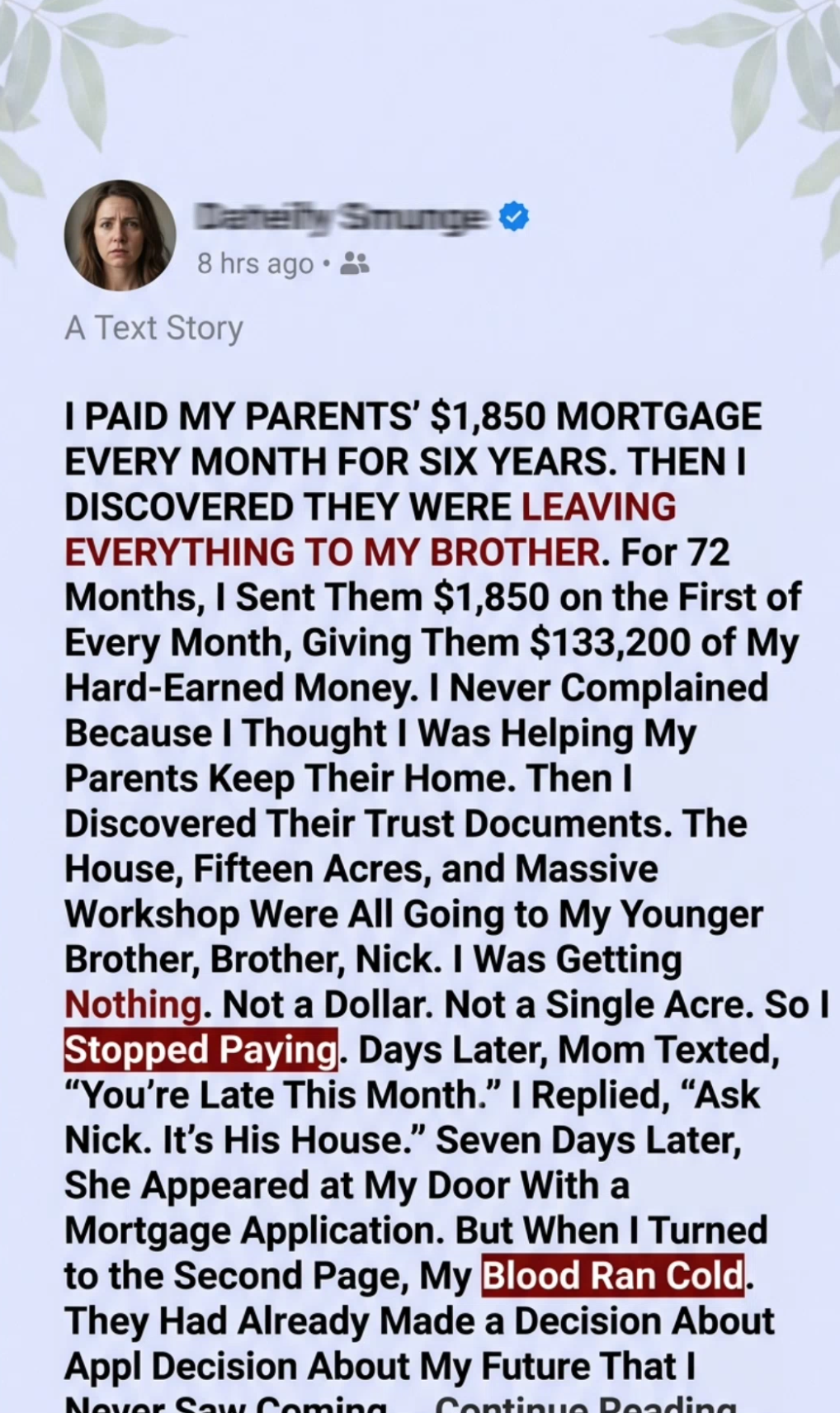
Every month, on the first day, I transferred $1,850 to my parents.
The money went toward their mortgage.
I never missed a payment.
Not when work was slow. Not when my car needed repairs. Not even when I had to postpone buying a home of my own because I wanted to keep their payments on schedule.
My parents had worked hard to buy their property.
Their house sat on fifteen acres outside a small town. Behind it stood a massive workshop my father had built over many years. He repaired farm equipment, restored old trucks, and stored tools he had collected since he was a teenager.
The property was more than a house.
It was where I had grown up.
It was where my brother Nick learned to ride a bicycle.
It was where our family celebrated birthdays, holidays, and summer barbecues.
When my father had a serious back injury, his income dropped. My mother was working part-time, and the mortgage had become difficult to manage.
One evening, my father called me.
“Daniel, I don’t like asking you this.”
I already knew what was coming.
He explained that they were struggling to cover the monthly mortgage payment. They had fallen behind on other expenses, and the bank had sent them a notice.
“How much is the payment?” I asked.
“About eighteen-fifty.”
I looked at my bank account.
I was thirty-one at the time, working as a project manager for a construction company. I had a stable salary, no children, and a modest apartment.
I could afford to help.
“I’ll cover it,” I said.
My father went quiet.
“Are you sure?”
“Yes. I’ll send it every month until things get easier.”
My mother called the next morning.
She cried while thanking me.
“We don’t know what we’d do without you.”
I told her not to worry.
I believed they would eventually recover financially.
I also believed that when the time came, my brother and I would be treated fairly.
Nick was four years younger than me.
He had always been the more difficult child.
He changed jobs frequently, struggled with money, and often needed help getting back on his feet.
My parents had supported him through several difficult periods.
When he lost his first apartment, they let him move home.
When he bought a truck he couldn’t afford, my father helped with the payments.
When he started a small equipment-repair business, my parents helped him purchase tools.
I never complained.
I thought families helped one another.
Nick eventually moved away, but he still visited regularly. My parents often described him as the one who would take over the family property someday.
I assumed they meant he would help maintain it.
I never imagined they had already made a decision about ownership.
For the first few years, the arrangement worked.
I transferred the money automatically on the first of each month.
My mother would send a short message.
“Received, sweetheart. Thank you.”
Sometimes my father called to tell me about repairs he had completed around the property.
I felt useful.
I felt responsible.
And I felt good knowing that my parents wouldn’t lose their home.
Then my own life began changing.
I met a woman named Rachel.
We dated for two years and eventually started discussing marriage.
She was practical, kind, and careful with money.
When we looked at houses together, she noticed something I had avoided thinking about.
I had been paying my parents’ mortgage for years, but I had made almost no progress toward buying a home of my own.
One night, she sat beside me with a notebook.
“Daniel, can I ask you something?”
“Of course.”
“How much have you given your parents since you started helping them?”
I shrugged.
“I don’t know. It’s been a while.”
She took out a calculator.
“Eighteen-fifty every month. Six years?”
I nodded.
She entered the numbers.
Then she turned the screen toward me.
“$133,200.”
I stared at it.
The amount seemed unreal.
Rachel didn’t criticize me.
She simply said, “That’s a lot of money. Have you ever discussed what happens to the property when your parents are gone?”
I frowned.
“Why would I need to?”
“Because you’re paying the mortgage.”
“They’re my parents.”
“I know. But you should understand what arrangement you’re part of.”
Her question stayed with me.
A few weeks later, I visited my parents for dinner.
Nick was there too.
He had recently started talking about expanding his repair business.
My father was excited.
“That workshop will be perfect for him,” he said. “He’ll have enough room to run everything properly.”
Nick smiled.
“I could turn the back section into a proper service bay.”
I looked at him.
“That sounds good.”
My mother nodded.
“Your father always hoped one of you would keep the property in the family.”
I assumed she meant both of us.
“Well, it’s a big place. There’s room for everyone.”
She smiled but didn’t answer.
A few months later, I returned to the house to help my father repair a section of fencing.
While looking for a measuring tape in his office, I noticed a folder on the desk.
It was labeled:
FAMILY TRUST — PROPERTY AND SUCCESSION DOCUMENTS
I wasn’t trying to read private paperwork.
But my name appeared on the first page.
I picked it up.
The document was a draft trust summary prepared by an attorney.
I read the first paragraph.
Then the second.
My stomach tightened.
The property was to pass to Nick.
The house.
All fifteen acres.
The workshop.
The equipment and certain other assets associated with the property.
Nick was named as the primary beneficiary.
I searched for my name.
It appeared once.
Under a section titled Other Family Members.
There was a sentence explaining that I had already established my own financial independence and was not expected to receive a share of the property.
I read it twice.
Then I noticed another paragraph.
My parents had described Nick as the family member who would continue maintaining the property and supporting their future needs.
There was no mention of my monthly mortgage payments.
Not one word.
I placed the folder back where I had found it.
My hands were shaking.
I went outside and sat in my car.
I couldn’t understand what I had just read.
Perhaps the documents were only a draft.
Perhaps my parents intended to discuss it with me.
Perhaps they had forgotten how much I had contributed.
But I couldn’t ignore what was written.
That evening, I called my mother.
“Mom, have you and Dad been working on a family trust?”
She hesitated.
“Why do you ask?”
“I saw some paperwork.”
“Oh. Yes. We’re planning for the future.”
“Is the property going to Nick?”
Another pause.
“Your brother is going to need it for his business.”
“And what about me?”
She sounded confused.
“What about you?”
“Am I receiving anything?”
“Daniel, you have your own career. You don’t need the property.”
I closed my eyes.
“I’m not asking whether I need it. I’m asking whether you intend to leave everything to Nick.”
She sighed.
“We haven’t finalized every detail.”
“But that’s what the documents say.”
“Your father thinks Nick will keep the property in the family.”
I felt my jaw tighten.
“And I’ve been paying the mortgage for six years.”
“We know, sweetheart.”
“Does that count for anything?”
My mother became defensive.
“We never forced you to help us.”
I was silent.
She continued.
“You offered. We thought you wanted to support us.”
“I did. But I thought I was helping preserve something that belonged to the family.”
“It does belong to the family.”
“Then why is everything going to Nick?”
She didn’t answer.
I ended the call.
Rachel listened while I explained what had happened.
She sat quietly for a moment.
Then she asked, “Are you still planning to send the next payment?”
I looked at my banking app.
The automatic transfer was scheduled for the following morning.
“No.”
I canceled it.
For the first time in seventy-two months, I did not send my parents $1,850.
I didn’t make an announcement.
I didn’t send an angry message.
I simply stopped.
Three days later, my phone buzzed.
It was my mother.
Mom: You’re late this month.
I stared at the message.
Then I typed:
Me: Ask Nick. It’s his house.
She called immediately.
I let it ring.
She called again.
Then my father.
I didn’t answer either.
A few hours later, my mother sent another message.
Mom: This is not funny. The mortgage is due.
I replied:
Me: I understand. You should speak with Nick about it.
She responded almost immediately.
Mom: He can’t afford it.
I stared at the screen.
Neither could I always.
I had paid for six years, even when it meant postponing my own plans.
I typed one final message.
Me: Then you need to discuss the property and the mortgage with him. I’m no longer paying for an asset that you have decided belongs entirely to him.
My mother didn’t reply.
Seven days later, she appeared at my apartment.
I wasn’t expecting her.
When I opened the door, she was standing in the hallway holding a large envelope.
“Can we talk?”
I stepped aside.
She walked into the living room and placed the envelope on the coffee table.
“Your father and I need your help.”
I looked at the envelope.
“What is it?”
“A mortgage application.”
I frowned.
“Why are you showing me this?”
She sat down.
“Your father and I spoke with the bank. We need to refinance the property.”
I didn’t understand.
“Okay.”
“The bank says we need another person to guarantee the loan.”
I stared at her.
“Who?”
She looked directly at me.
“You.”
For a moment, I thought I had misunderstood.
“You want me to guarantee your mortgage?”
“Only temporarily.”
“Why?”
“Because your father and I don’t qualify on our own.”
I picked up the envelope.
The first page contained basic information about the property and the proposed loan.
The second page was a guarantor application.
My name had already been entered.
My employment details were listed.
My salary was recorded.
My address was correct.
Even my employer’s name was correct.
I turned the page.
Under the section describing the proposed guarantor’s obligations, the document stated that I could become legally responsible for the debt if the borrowers failed to meet their payments.
I looked at my mother.
“Who filled this out?”
She looked away.
“Your father.”
“Why is my name already on it?”
“He thought it would make things easier.”
“Did you submit this to the bank?”
“No. It’s a draft.”
I turned to the next page.
Then my blood ran cold.
There was a section titled:
Relationship to Property and Future Beneficial Interest
The draft included a proposed statement that I would provide financial support as guarantor without receiving an ownership interest in the property.
Below it was another sentence.
The borrowers intended to preserve the property for Nick as the sole future beneficiary.
I looked up.
“You want me to guarantee a mortgage on a property I’m not going to own, while Nick receives everything?”
My mother shifted in her seat.
“That’s not how we see it.”
“How do you see it?”
“You’re helping us. Nick will take care of the property later.”
“Then why isn’t Nick guaranteeing the mortgage?”
She sighed.
“His income isn’t stable enough.”
I stared at her.
“So I’m financially reliable enough to take responsibility for the debt, but not important enough to receive anything from the property.”
She began crying.
“Daniel, please. We’re your parents.”
I placed the application on the table.
“That doesn’t answer my question.”
She wiped her eyes.
“Your father thought it would be fair because you’ve always been better with money.”
“Fair to whom?”
She didn’t answer.
I took a photograph of every page.
Then I handed the application back.
“I’m not signing this.”
My mother looked shocked.
“Daniel.”
“No.”
“You can’t leave us with this problem.”
“I didn’t create it.”
“Your father says the bank could take the house.”
I looked at her.
“Then you need to speak to a financial adviser and understand your options. But I’m not putting my name on a debt connected to a property that has already been promised to someone else.”
She stood.
“You’re choosing money over your family.”
I felt a familiar anger rise.
“No, Mom. I’m choosing not to take on a legal obligation without any ownership rights or protection.”
She picked up the envelope.
“Your father is going to be furious.”
“I’m sure he will be.”
She walked toward the door.
Before leaving, she turned around.
“I hope you understand what you’re doing.”
I looked at her.
“I do. I finally understand what you’ve been doing.”
She left without another word.
That evening, I called an attorney.
I explained the monthly payments, the trust documents, and the proposed mortgage guarantee.
The attorney, Ms. Reynolds, listened carefully.
She told me something important.
“Daniel, you need to separate three issues. First, the money you voluntarily paid toward your parents’ mortgage. Second, the legal ownership of the property and the trust arrangements. Third, the proposed guarantee. They are not automatically connected.”
She explained that because I had made the payments voluntarily and without a written agreement about ownership or repayment, I might not have an automatic claim to the property or reimbursement.
The exact position would depend on the documents and applicable law.
She also warned me that signing a guarantee could create significant financial exposure.
“Do not sign anything until you understand every obligation. And do not assume that a family promise will protect you if the loan goes into default.”
I thanked her.
For the first time, I felt that someone was treating my concerns seriously.
I asked her to review the trust documents.
A few days later, she contacted my parents’ attorney to request clarification about the draft trust and the mortgage application.
My parents were not pleased.
My father called me that evening.
“What are you doing?”
“I’m getting legal advice.”
“Over a family matter?”
“Yes. Because you asked me to take responsibility for a mortgage.”
He became angry.
“Your mother told me you refused to help.”
“I did.”
“After everything we’ve done for you?”
I almost laughed.
“What exactly have you done that requires me to guarantee your mortgage?”
“We raised you.”
“And I’m grateful for that. But raising me doesn’t make me responsible for your financial decisions.”
He went quiet.
Then he said, “Nick is going to maintain the property. He’ll be there when we’re older.”
“Then he should be part of the financial plan.”
“He can’t afford it.”
“That isn’t my responsibility.”
My father raised his voice.
“You have no idea what it takes to keep that property.”
“I know what it took to pay $1,850 every month for six years.”
He ended the call.
For the next month, the family situation became increasingly uncomfortable.
My mother sent messages about the mortgage.
My father left voicemails asking me to reconsider.
Nick eventually called.
I expected him to be angry.
Instead, he sounded confused.
“Daniel, what’s going on?”
I explained the trust documents and the mortgage application.
He was silent.
Then he said, “I didn’t know Mom and Dad had already put everything in the trust.”
I frowned.
“You knew they wanted you to have the property.”
“Yeah. Dad talked about it. But I didn’t know you were paying the mortgage every month.”
I felt my shoulders tighten.
“What did you think I was doing?”
“I thought you helped them sometimes. I didn’t know it was eighteen-fifty every month.”
I told him about the $133,200.
He exhaled.
“That’s a lot of money.”
“Yes.”
“Did they tell you they were leaving everything to me?”
“Not until I found the documents.”
He was quiet again.
Then he said something unexpected.
“I don’t want you thinking I asked them to do this.”
I believed him.
Nick could be irresponsible, but he wasn’t dishonest with me during that conversation.
“I don’t think you created this situation,” I said. “But you need to decide whether you really want the property and whether you’re prepared to take responsibility for it.”
He admitted that his repair business was still struggling.
He couldn’t afford the mortgage on his own.
He had assumed that our parents would continue paying until they sold or transferred the property.
He hadn’t considered how much maintenance, insurance, taxes, and repairs would cost.
For the first time, I realized that my parents had not only hidden their plans from me.
They had also made promises to Nick without ensuring he could afford them.
A few weeks later, my attorney received a response from my parents’ lawyer.
The trust had not yet been finalized.
The property remained legally owned by my parents.
The draft did name Nick as the intended primary beneficiary, but it was not a completed transfer.
That distinction mattered.
My attorney also reviewed the proposed mortgage application.
She confirmed that I should not sign it without independent advice and that the document could expose me to substantial liability.
I declined in writing.
I also sent my parents a formal letter explaining that I would no longer make mortgage payments or accept financial responsibility for the property.
I didn’t demand that they change their trust.
It was their property, and they had the right to make their own estate-planning decisions within the law.
But I also had the right not to finance a property I did not own.
That was the boundary.
Over the following months, my parents had to make difficult choices.
They met with a financial adviser and reviewed their income, debts, and property expenses.
They discovered that the mortgage was only one part of the problem.
The workshop needed repairs.
The property taxes had increased.
Insurance costs were higher than expected.
My father could no longer maintain the land alone.
Eventually, they decided to sell part of the acreage.
They kept the house and workshop, but sold several acres to a neighboring farmer.
The proceeds helped reduce their outstanding debt.
Nick offered to take responsibility for maintaining the workshop, but he could not take over the mortgage.
My parents eventually revised their financial plans.
The trust was reviewed by their estate-planning attorney, and they were advised to make sure the documents accurately reflected their intentions and did not create obligations they could not afford.
I didn’t ask for a share of the property.
I didn’t want it.
I wanted my parents to stop treating my financial support as something they could demand whenever they needed it.
About six months after my mother brought the mortgage application to my apartment, she called again.
This time, her voice was different.
“Daniel, can we have dinner?”
I hesitated.
“Is Dad going to be there?”
“Yes.”
“Are we going to discuss the mortgage?”
“No. I think we’ve said enough about that.”
I agreed to visit.
When I arrived, Nick was already there.
My father looked older than I remembered.
He didn’t stand when I entered.
We ate quietly for a while.
Then my mother put down her fork.
“We owe you an apology.”
I looked at her.
She continued.
“We became used to you helping us. We stopped thinking about it as a choice you were making.”
My father stared at the table.
My mother went on.
“We should have told you what we intended to do with the property. We should never have brought you that application with your information already filled in.”
I nodded.
“That was a serious thing to ask.”
My father finally spoke.
“I thought you would help because you always have.”
I looked at him.
“That’s exactly the problem. You assumed I would keep helping, even after you decided I wasn’t part of the future you were planning.”
He didn’t argue.
Then Nick spoke.
“I should have asked more questions too.”
I turned toward him.
He looked uncomfortable.
“I knew they wanted me to have the workshop. I didn’t know you were paying for the house. I should have understood that something didn’t add up.”
I appreciated his honesty.
But I wasn’t ready to pretend everything was fine.
“I don’t want to fight over the property,” I said. “You can leave it to Nick if that’s what you want. That’s your decision. But I won’t finance it anymore.”
My father nodded slowly.
“We understand.”
I wasn’t sure whether he truly did.
But it was the first time he hadn’t tried to change my mind.
Over the following year, our relationship became more balanced.
I visited my parents occasionally.
I helped my father with small repairs when I had time, but I no longer paid their monthly expenses.
Nick became more involved in the property and began contributing to its maintenance.
He also started keeping better financial records for his business.
Rachel and I continued saving for our own home.
We eventually bought a modest house with a small garden.
When my parents visited, my mother complimented the kitchen.
My father asked about the mortgage.
I told him we had chosen a payment we could comfortably afford.
He nodded.
“I suppose that’s important.”
“It is.”
A few months later, Nick called to tell me he had signed an agreement with our parents to use the workshop for his business.
He would pay a reasonable amount toward utilities and maintenance.
It was the first time I had heard him take responsibility for something connected to the property without expecting someone else to cover the costs.
I congratulated him.
We weren’t suddenly best friends, but we had begun speaking more honestly.
One evening, Rachel asked me whether I regretted paying my parents’ mortgage for six years.
I thought about the question.
“Sometimes,” I admitted.
“Would you do it again?”
I considered the answer.
“I would still help them if they were genuinely struggling. But I would make sure everyone understood the arrangement. I wouldn’t assume that being generous meant I had to accept every decision they made afterward.”
Rachel smiled.
“That’s fair.”
I looked out at our garden.
For six years, I had believed that I was protecting my parents’ home.
I had sent $133,200 because I loved them and wanted them to feel secure.
I didn’t regret loving them.
I regretted allowing an informal arrangement to continue without honest conversations about expectations, ownership, and responsibility.
The hardest part wasn’t learning that Nick would inherit the property.
My parents had the right to decide what happened to their assets.
The hardest part was discovering that they considered me reliable enough to carry the financial burden but not important enough to be included in the conversation.
When my mother first told me I was late with the mortgage payment, she believed I had forgotten my responsibility.
But I hadn’t forgotten.
I had finally understood that it was never my responsibility in the first place.
And when she arrived with that mortgage application, I realized how easily love could become an expectation when nobody was willing to set boundaries.
I still love my parents.
I still care about Nick.
But I no longer confuse helping my family with sacrificing my own future.
The house on fifteen acres may eventually belong to my brother.
That’s their decision.
My future, however, belongs to me.
And this time, I intend to build it on ground that I actually own.
THE END.