The envelope had arrived on a Thursday morning.
I was standing in my kitchen, trying to persuade my seven-year-old son, Oliver, to eat his breakfast while my four-year-old daughter, Sophie, searched for a missing shoe.
The envelope was thick, cream-colored, and addressed to me in careful handwriting.
It came from a law firm in Manhattan.
At first, I thought it was another letter concerning my late aunt Margaret’s estate. She had died six weeks earlier, leaving behind a complicated collection of properties and investments.
I had loved Aunt Margaret, but I had never expected to inherit anything significant.
She had been a private woman. She lived alone, traveled often, and rarely discussed her finances.
I opened the envelope while the children argued about whose turn it was to choose the music in the car.
The first page was a letter from the estate attorney.
The second was a summary of the inheritance.
I read it once.
Then again.
Then I sat down.
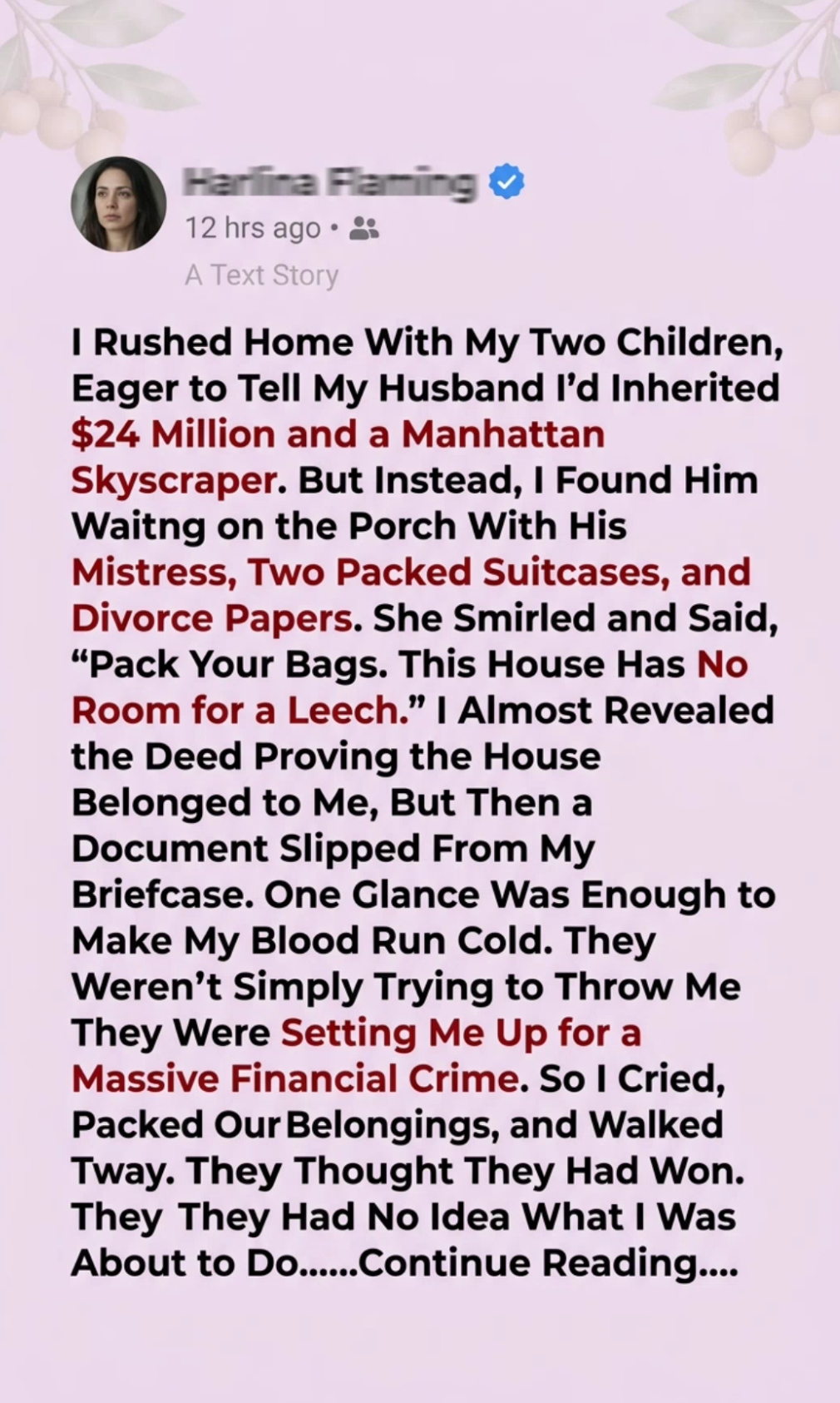
Aunt Margaret had left me an estate valued at approximately $24 million, including a commercial skyscraper in Manhattan, several investment accounts, and other property interests.
I stared at the figure.
Twenty-four million dollars.
I had to read the paragraph three times before I understood that the skyscraper was not merely an investment in a larger property group.
She had left me her ownership interest in the building through a properly documented estate transfer.
The lawyers would handle the administration, tax matters, and formal registration of the assets.
But the inheritance was real.
I covered my mouth.
Oliver looked at me.
“Mommy, are you crying?”
I laughed through my tears.
“Happy tears, sweetheart.”
I wanted to tell my husband, Michael.
We had been married for eleven years.
We had two children, a comfortable home, and what I believed was a stable marriage.
Michael worked in commercial real estate finance. He often complained about demanding clients and difficult transactions, but I had always supported him.
I imagined his reaction when I told him.
I imagined him hugging me, asking whether I was sure, and joking that perhaps we could finally take the children on the vacation we had postponed for years.
I also wanted to tell him that Aunt Margaret’s inheritance could change our children’s future.
I didn’t know that by the time I reached home, my marriage would already be over.
Or that the man I thought I knew had been preparing something much worse than a divorce.
I had taken Oliver and Sophie to school that morning.
Then I drove to the attorney’s office to confirm the next steps.
By early afternoon, I had copies of the estate documents and a list of financial matters that needed professional attention.
I didn’t discuss the inheritance with anyone.
I wanted to tell Michael first.
On the drive home, I rehearsed what I would say.
I would tell him about the building.
I would tell him about the investment accounts.
I would tell him that the children could have opportunities we had never imagined.
When I turned into our driveway, I noticed two suitcases near the front door.
A black one.
A brown one.
My husband’s car was parked beside them.
I frowned.
Then I saw him.
Michael stood on the porch wearing a gray suit, holding a folder.
Beside him was a woman in a red coat.
I recognized her immediately.
Vanessa.
His executive assistant.
She had attended several company dinners with us and had visited our home once for a work-related event.
She was standing close to him.
Too close.
Her hand rested on his arm.
Michael looked at me without smiling.
“You’re home.”
I got out of the car.
“What’s going on?”
Vanessa looked toward the children.
Then she gave me a small, satisfied smile.
“Michael has something to tell you.”
I looked at my husband.
He held out the folder.
“I want a divorce.”
For a moment, I couldn’t process the words.
“What?”
“I’ve already spoken to a lawyer. These are the papers.”
I looked at the suitcases.
“Why are there bags outside?”
Vanessa answered before he could.
“Because you need to leave.”
I stared at her.
“Excuse me?”
She tilted her head.
“Pack your things. This house has no room for a leech.”
I felt my face grow hot.
Oliver had climbed out of the car and was standing beside me.
Sophie was holding my hand.
I looked at Michael.
“Who is she to speak to me like that?”
He looked irritated.
“Don’t make this difficult.”
I glanced at Vanessa.
Then back at him.
“Are you having an affair?”
He didn’t deny it.
That silence told me everything.
For eleven years, I had believed we were building a life together.
Now my husband was standing on our porch with another woman, two suitcases, and divorce papers.
I could barely recognize him.
But I remembered something important.
The house.
The beautiful house with the wide staircase and the garden where our children played.
It belonged to me.
Not because I had inherited it that morning.
I had purchased it years earlier using the proceeds from the sale of a small property my grandmother had left me, together with savings I had accumulated before marriage.
The title had remained in my name.
Michael had lived there with me, but he had never been the legal owner.
I almost told him.
I almost said, “You don’t get to throw me out of my own house.”
But before I could speak, he opened his briefcase.
A document slipped from the side pocket and fell onto the porch.
He bent down to retrieve it.
I saw the heading.
COMMERCIAL PROPERTY TRANSFER AND GUARANTEE AGREEMENT.
Beneath it was a company name I recognized.
It was connected to a building owned by one of Michael’s clients.
I looked closer.
There was my name.
Not my signature.
My name.
And beside it was a reference to a financial guarantee I had never agreed to provide.
My blood ran cold.
I looked at Michael.
“What is that?”
He snatched the document from the ground.
“Nothing that concerns you.”
“Why is my name on it?”
Vanessa stepped forward.
“Michael, let’s go inside. We don’t need to explain everything to her.”
He looked at her.
Then he turned to me.
“You’re going to sign the divorce papers, and you’re going to leave the house. We can discuss the rest through our lawyers.”
I looked at the children.
Oliver was staring at his father.
Sophie had begun crying quietly.
I knew I had two choices.
I could start shouting.
I could tell Michael that he had no right to demand that I leave.
Or I could get my children away from the confrontation and deal with the legal problems properly.
I chose the children.
I wiped Sophie’s cheek.
“Let’s go inside and pack a few things.”
Michael looked surprised.
“Good. At least you’re being reasonable.”
I didn’t answer.
I took the children upstairs and packed their clothes, school supplies, favorite toys, and medications.
I packed enough for several days.
I left most of our belongings in place.
While I worked, my hands shook.
Oliver stood in the doorway.
“Mommy, are we moving?”
I knelt in front of him.
“We’re going to stay somewhere else for a little while.”
“Did Daddy do something wrong?”
I took a breath.
“Sometimes grown-ups have problems they need to work out. This isn’t your fault.”
He nodded, but I could see he was frightened.
Sophie climbed onto the bed and hugged her stuffed rabbit.
“Can Daddy come?”
I kissed her forehead.
“We’ll work everything out.”
When I returned downstairs, Michael was standing near the front door.
Vanessa had already moved one of the suitcases inside.
I placed the children’s bags beside mine.
Then I looked at Michael.
“I’ll communicate through my attorney.”
He laughed.
“Your attorney?”
“Yes.”
He shook his head.
“Don’t waste money. This is straightforward.”
I looked at him for a long moment.
Then I left.
He watched me drive away with the children.
I could see him smiling in the rearview mirror.
He believed he had won.
He had no idea that the document I had seen would become the most important evidence in the entire case.
That night, I checked into a hotel near my sister’s apartment.
I called her and explained what had happened.
She immediately offered to let us stay with her.
Then I contacted an attorney recommended by Aunt Margaret’s estate lawyer.
Her name was Laura Bennett.
I explained the divorce papers, the house, the affair, and the document that had fallen from Michael’s briefcase.
Laura listened without interrupting.
When I finished, she asked me to describe the document as precisely as I could.
I told her the title, the company name, and the fact that my name appeared beside a financial guarantee.
She became very serious.
“Did you sign anything related to that company?”
“No.”
“Did you authorize Michael to sign on your behalf?”
“Absolutely not.”
“Have you ever agreed to guarantee one of his business transactions?”
“No.”
“Then we need to understand why your name appears on that document.”
I emailed her the photographs I had taken from the porch.
She studied them.
Then she called me back.
“The document appears to be connected to a proposed transfer of commercial property interests and a loan guarantee. I can’t determine from these images whether it is valid or fraudulent, but your name is being used in a way that requires immediate investigation.”
I felt sick.
“What does that mean?”
“It means we need to protect your identity and financial position. Do not sign anything Michael gives you. Do not access his accounts. Preserve every message and document you already have. I’ll contact the appropriate professionals.”
The next morning, Laura began reviewing my financial records and the title documents for the house.
She also arranged for an independent forensic accountant to examine the available paperwork.
Meanwhile, Michael began sending messages.
At first, they were about the divorce.
Then they became increasingly strange.
Michael: We need to finalize the paperwork quickly.
Michael: The bank is waiting for your signature.
Michael: Don’t make this more complicated than it needs to be.
I showed Laura.
She told me not to respond to the financial requests.
Then another message arrived.
Michael: You already agreed to help with the property deal. Don’t pretend you forgot.
I stared at the screen.
I had never agreed to help with any property deal.
I sent the message to Laura.
She replied:
Do not argue with him. Preserve it.
A week later, the forensic accountant discovered something disturbing.
Michael had been working on a transaction involving a commercial property owned by a private investment company.
The deal required substantial financing.
Several financial documents had been prepared using information about my personal assets.
Some of the paperwork suggested that I had agreed to provide a guarantee secured against my property.
But the house was not the only asset listed.
A draft financial statement included my expected inheritance from Aunt Margaret.
The document had been prepared before the estate administration was complete.
I stared at the page.
“How did he know about the inheritance?”
Laura looked at me.
“Who knew you were meeting the estate lawyer?”
“Nobody except the law firm.”
“Did you tell Michael anything about Aunt Margaret’s estate?”
“No.”
The accountant reviewed the dates.
The draft financial statement had been created several days before I received the inheritance letter.
That meant Michael had somehow obtained information about the estate before I had told him.
We needed to establish how.
Laura contacted the estate attorney, who confirmed that no financial details had been intentionally released to Michael.
The estate attorney also confirmed that the building and other assets were being administered through the proper legal process.
We then discovered that Michael had been contacting a junior employee at the law firm, claiming he was my authorized financial representative.
He had requested preliminary information about the estate.
The employee had refused to release confidential documents without proper authorization.
But Michael had already obtained enough information elsewhere to prepare a financial projection.
The situation became more serious when Laura received a notice from a lender.
The lender had received a preliminary guarantee package containing a copy of my identification, financial details, and a signature that appeared to be mine.
It wasn’t.
I had never signed the guarantee.
The lender had paused the application after noticing inconsistencies.
I felt dizzy.
“Are you saying he forged my signature?”
Laura was careful.
“I’m saying the signature appears inconsistent with the verified samples we have. A proper examination will be needed. But we have enough reason to report suspected unauthorized use of your identity and investigate the transaction.”
I thought about the document that had fallen from Michael’s briefcase.
He hadn’t been trying to take only the house.
He had been trying to use my assets and expected inheritance to support a commercial transaction.
And when I refused to cooperate, he had prepared to make me look like the person who had agreed to everything.
The divorce papers had been part of the pressure.
The sudden demand that I leave the house would have removed me from the property and made it easier for him to control the situation.
At least, that was what the evidence suggested.
Laura advised me to take several immediate steps.
We obtained certified copies of the house title.
We notified relevant financial institutions that my identity might have been misused.
We requested credit reports and reviewed existing accounts.
We also reported the suspected unauthorized signature to the lender and the appropriate authorities.
I gave a formal statement about what I had seen on the porch and the messages Michael had sent afterward.
The investigation took time.
Michael initially denied everything.
He claimed I had misunderstood the documents.
He said I had agreed to help with the transaction during a conversation months earlier.
But he couldn’t produce a signed authorization from me.
The lender’s records showed that the guarantee package had been submitted by someone using an email account associated with his business.
The forensic accountant found additional inconsistencies in the financial statements.
The investigation also identified payments between companies connected to the property transaction that had not been properly disclosed.
Authorities began examining whether the documents had been prepared to obtain financing through false representations.
Michael’s company placed him on administrative leave while the matter was investigated.
Vanessa stopped contacting me.
Then, one afternoon, Michael called.
I didn’t answer.
He left a voicemail.
“Listen, we need to talk. You’ve taken this too far. The bank is asking questions, and I need you to tell them you knew about the paperwork.”
I saved the message and sent it to Laura.
She told me not to respond.
A few days later, he sent another message.
Michael: If you keep cooperating with them, you’re going to destroy everything.
I stared at the words.
For eleven years, I had tried to make our marriage work.
I had supported him when his job became stressful.
I had cared for our children when he traveled.
I had defended him when friends questioned his priorities.
And now he was asking me to lie to protect a transaction I had never approved.
I didn’t reply.
The divorce proceedings continued separately from the financial investigation.
Because the house was legally titled in my name, Laura was able to seek appropriate orders protecting my possession and preventing unauthorized transfers while the property dispute was reviewed.
Michael challenged the arrangements.
He argued that he had contributed to household expenses and improvements.
Those claims had to be examined through the normal legal process.
The fact that the house was in my name did not automatically resolve every possible marital-property issue.
But it meant he couldn’t simply declare himself the owner or force me out by handing me divorce papers.
The court process also established temporary arrangements for the children.
They remained with me during the initial proceedings, with parenting time arranged through the proper channels.
I never told Oliver or Sophie the details of the financial investigation.
They knew their parents were separating.
They didn’t need to carry anything more than that.
Months passed.
The inheritance administration continued.
The Manhattan building required professional management, insurance reviews, tax advice, and an independent valuation.
I didn’t suddenly become an expert in commercial real estate.
I hired qualified professionals to manage the property while the estate transfer was completed.
The building was valuable, but it also came with responsibilities.
There were tenants, employees, maintenance contracts, and long-term financial obligations.
I made a decision to keep the property rather than sell it immediately.
Aunt Margaret had cared deeply about the building.
She had once told me that a property was not just a number on a balance sheet.
It was a responsibility to everyone whose work and livelihood depended on it.
I remembered that when I met the building manager for the first time.
He was a serious man named Mr. Collins, who had worked there for nearly twenty years.
He looked nervous when I entered the conference room.
“Are you the new owner?”
“I’m the beneficiary of the estate. The transfer is still being completed.”
He nodded.
“Your aunt was a good woman.”
I smiled.
“I know.”
He showed me the building’s maintenance schedule, tenant agreements, and current operating budget.
For the first time since receiving the inheritance letter, I began to feel that I could use the money to build something meaningful rather than simply protect myself from Michael.
Meanwhile, the financial investigation reached an important stage.
The forensic review confirmed that several documents had been submitted using my personal information without my authorization.
The signature on the guarantee was determined to be inconsistent with my verified signature samples.
Investigators also found evidence that Michael had misrepresented the source and availability of certain assets during the financing process.
Vanessa cooperated with investigators and provided business emails and internal messages.
Those messages showed that she had helped prepare the transaction package.
They also revealed that Michael had discussed moving certain assets into a company structure before the loan was finalized.
The authorities eventually brought formal financial-fraud charges against Michael and another executive involved in the transaction.
He denied the allegations.
The case proceeded through the legal system.
I did not celebrate his arrest or make public accusations.
I had two children who still needed their father to be treated as a person, even if he had made terrible choices.
The court process took many months.
During that time, I focused on rebuilding our lives.
I moved back into my house after the temporary arrangements were settled.
I changed the locks through the proper process and secured the property records.
I created separate accounts for household expenses and made sure no one else could access my financial information.
I also began meeting with a counselor.
Some days I felt strong.
Other days, I found myself staring at the front porch, remembering the afternoon Michael had stood there with Vanessa and told me to leave.
The worst part wasn’t the affair.
It was discovering how easily he had been willing to use my identity and my children’s security to protect his own ambitions.
One evening, Oliver came into the kitchen while I was preparing dinner.
“Mom, are we going to be okay?”
I put down the knife.
“Yes, sweetheart.”
“Even if Dad doesn’t live here?”
I knelt beside him.
“Even if things change, you and Sophie will always be loved. We have a safe home, and we have people who care about us.”
He nodded.
Then he hugged me.
That was when I understood what I needed to protect most.
Not the skyscraper.
Not the money.
Not even the house.
My children’s sense of security.
The divorce was finalized after the financial matters and property claims were addressed through the appropriate process.
Michael did not receive ownership of my house simply because he had lived there.
The court considered the relevant financial and marital issues before determining the final arrangements.
The children remained primarily with me, with a parenting schedule that allowed them to maintain a relationship with their father.
The financial case took longer.
Eventually, Michael was convicted of offenses related to fraudulent financial documentation and unauthorized use of another person’s identity.
Vanessa received a separate legal outcome based on her role and cooperation with investigators.
The lender’s attempted transaction was canceled before the full financing was released.
Some of the money involved had already been moved between related companies, and recovering it required separate proceedings.
Michael faced financial penalties and a sentence determined by the court.
I didn’t receive a fortune from the case.
That wasn’t what I wanted.
I wanted the fraudulent transaction stopped, my identity protected, and my children safe.
A year after everything began, I took Oliver and Sophie to Manhattan.
I wanted them to see the building Aunt Margaret had left me.
We stood across the street and looked up.
Oliver tilted his head.
“Mom, is that really ours?”
I smiled.
“It’s part of the family estate now, yes.”
Sophie pointed at the windows.
“Are there people working inside?”
“Lots of people.”
I explained that the building housed offices and businesses, and that we had to take good care of it.
Oliver looked impressed.
“Are you going to be the boss?”
I laughed.
“Not exactly. There are people who know much more about running buildings than I do. My job is to make sure we make good decisions and treat them fairly.”
We went inside.
Mr. Collins greeted us and showed the children the lobby.
He had arranged a small tour with the building staff.
Sophie was fascinated by the elevators.
Oliver wanted to see the maintenance room.
For the first time in months, I felt genuinely happy.
Later that evening, I sat in the hotel room with the children asleep beside me.
I thought about the woman who had rushed home that afternoon, eager to share wonderful news with her husband.
She had believed her marriage was secure.
She had believed that the man waiting on the porch would celebrate with her.
She had believed that leaving the house was the worst thing that could happen.
She had been wrong.
The worst thing would have been signing a document she didn’t understand, allowing someone else to use her identity, and becoming responsible for a financial crime she had never committed.
Walking away that afternoon had protected more than my pride.
It had protected my children, my assets, and my future.
I never forgot Vanessa’s words.
“This house has no room for a leech.”
I remembered them whenever I walked through the front door.
But I no longer heard them as an insult.
I heard them as a reminder of the kind of person I refused to become.
I would never again measure my worth by someone else’s willingness to keep me.
I had a home I had legally purchased.
I had two children who needed me.
I had inherited a building that required careful stewardship.
And I had learned that wealth could change a person’s circumstances, but it could not replace judgment, trust, or character.
Michael had thought that by putting divorce papers in front of me, he could control the story.
He believed I would panic, sign what he wanted, and leave quietly.
Instead, I left with my children, preserved the evidence, and let the facts speak.
They had tried to make me the fall person for a financial crime.
But the documents they prepared became the evidence that exposed their plan.
And the day I walked away from that porch was not the day I lost my marriage.
It was the day I stopped allowing someone else to decide what my future would be.
THE END.