His name was Daniel.
He was thirty-one when he disappeared, and I was fifty-eight when I last saw him.
My husband, Robert, died three days after Daniel vanished.
The doctor said his heart had simply given out. He had suffered from high blood pressure for years, and the shock of losing our savings had made his condition worse.
But I blamed Daniel.
I blamed him for taking the money.
I blamed him for leaving without a goodbye.
And most of all, I blamed him for leaving me alone with a husband who died believing our only child had betrayed us.
For twenty-five years, I never said Daniel’s name without bitterness.
I told relatives he had stolen everything we had worked for.
I told neighbors he had disappeared because he was selfish.
I told myself that if he ever came back, I would close the door in his face.
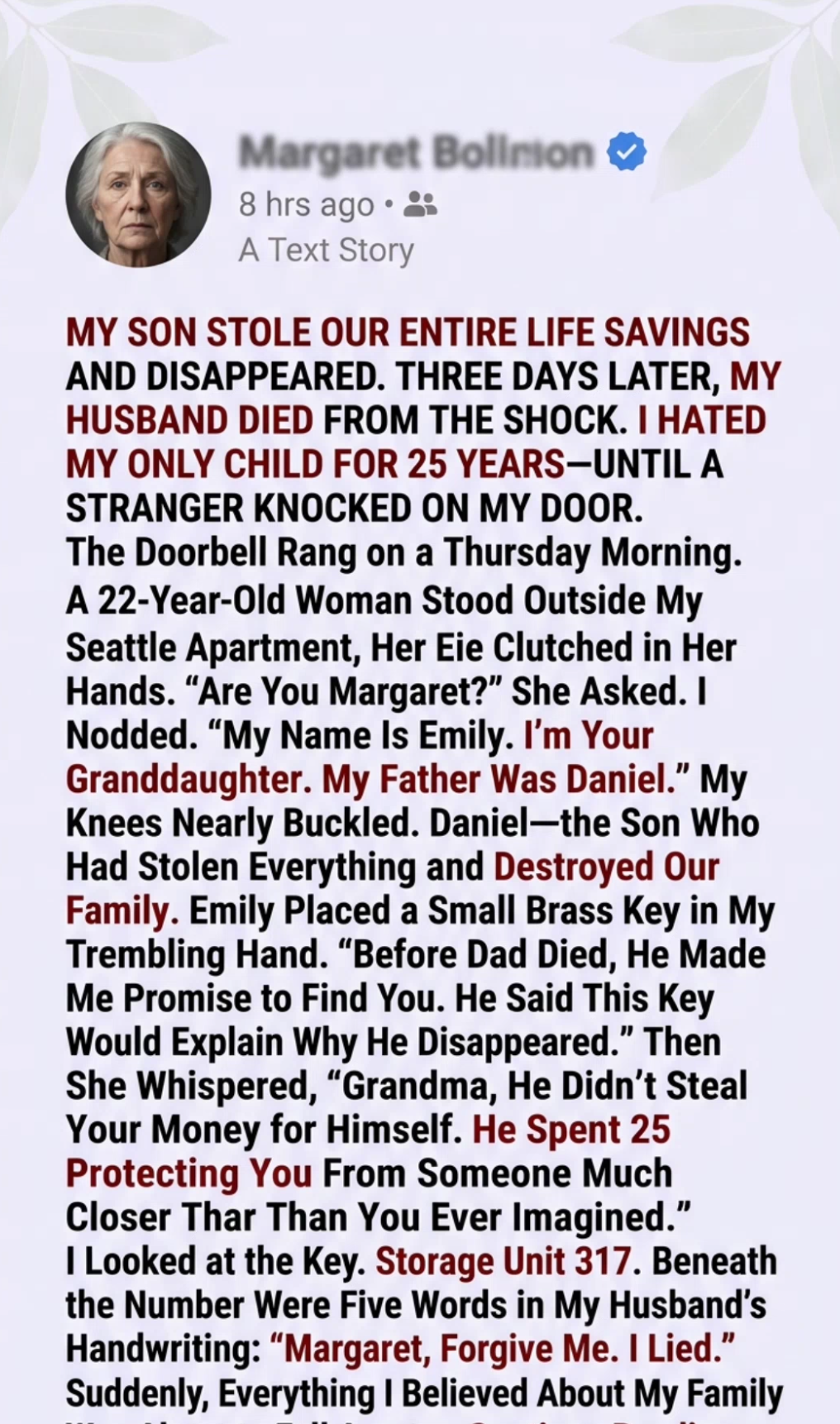
Then, on a Thursday morning, someone knocked on my apartment door.
I was seventy-nine years old.
I lived alone in a modest apartment in Seattle, Washington. My husband had been gone for decades, and I had never remarried.
I opened the door expecting a delivery.
Instead, I found a young woman standing in the hallway.
She looked about twenty-two.
Her eyes were red, and she held a small envelope in one hand.
“Are you Margaret?”
“Yes.”
She swallowed.
“My name is Emily. I’m your granddaughter.”
I gripped the doorframe.
“My what?”
“Your granddaughter. My father was Daniel.”
For a moment, the hallway seemed to tilt.
I hadn’t heard Daniel’s name spoken by someone who loved him in twenty-five years.
I stared at her face.
She had his dark eyes.
The same slightly crooked smile.
And a small dimple on her left cheek that I remembered from when he was a boy.
I wanted to ask a hundred questions.
Instead, I whispered, “Is he alive?”
Emily’s eyes filled with tears.
“No, Grandma. Dad died six weeks ago.”
I stepped backward.
She reached into her coat pocket and took out a small brass key.
“Before he died, he made me promise to find you. He said this key would explain why he disappeared.”
I looked down.
A small metal tag was attached to it.
Storage Unit 317.
Beneath the number were five words written in my husband’s handwriting.
Margaret, forgive me. I lied.
I recognized Robert’s writing immediately.
My knees nearly buckled.
I looked at Emily.
“What does this mean?”
She shook her head.
“I don’t know everything. Dad said you had to see what was inside.”
Then she handed me the envelope.
Inside was a short letter.
Mom,
I know you have spent your life believing I stole your savings and ran away. I know you probably hate me. I don’t blame you.
But I need you to understand something before you decide what kind of man I was.
I didn’t disappear because I wanted to escape you.
I disappeared because someone close to our family was using your money, and I believed staying would put you in danger.
The truth is in Unit 317.
Please go with Emily. Don’t go alone.
I’m sorry I couldn’t tell you sooner.
Daniel.
I read the letter twice.
Then I looked at the key.
For twenty-five years, I had carried one explanation for my son’s disappearance.
Now a young woman I had never met was standing in my doorway, telling me there had been another story.
And my husband’s handwriting suggested he had known it all along.
I invited Emily inside.
She sat on my sofa and held a cup of tea with both hands.
I couldn’t stop looking at her.
“Why didn’t your father contact me?”
She looked down.
“He wanted to.”
“Then why didn’t he?”
“He said it wasn’t safe.”
“Safe from whom?”
Emily hesitated.
“I don’t know. He never told me the person’s name.”
I felt anger rising again.
“Your father stole every dollar Robert and I had saved. Your grandfather died three days later. Do you understand what that did to me?”
Emily nodded.
“I know.”
“No, you don’t.”
She didn’t argue.
Instead, she opened her handbag and took out another photograph.
It showed a younger Daniel standing beside a little girl of about five.
The girl was Emily.
Behind them was a wooden house surrounded by trees.
“He kept photographs of you,” she said. “He talked about you more than you might believe.”
I looked away.
“He had a strange way of showing it.”
Emily’s eyes filled again.
“He regretted what happened every day.”
I stared at her.
“Then why didn’t he come home?”
She shook her head.
“I wish I knew.”
I wanted to believe her.
But I had spent twenty-five years learning how dangerous hope could be.
I called my longtime friend Helen.
She lived in the same apartment building and had known Robert and me before Daniel disappeared.
I explained that Emily had arrived and that we needed to visit a storage facility.
Helen insisted on coming with us.
Emily agreed.
Before we left, I called a locksmith to ask whether the key appeared to be a standard storage lock. He said it did, but reminded me that the facility might have its own access procedures.
I put the letter in my handbag.
Then I locked my apartment door.
For the first time in twenty-five years, I was going somewhere because of Daniel.
The storage facility was on the outskirts of the city.
It was an ordinary place with rows of metal doors, security cameras, and a small office near the entrance.
Emily had the rental information.
The unit had been paid for annually through an account established in Daniel’s name.
The manager checked the paperwork and asked us to provide identification.
After confirming Emily’s authorization as the named contact, he escorted us to Unit 317.
The corridor smelled faintly of dust and cold metal.
We stopped in front of a gray door.
Emily looked at me.
“Are you ready?”
I wasn’t.
But I nodded.
The brass key turned with a small click.
The door rolled upward.
Inside were several sealed boxes, two filing cabinets, a wooden trunk, and a large plastic container.
Nothing looked valuable.
There were no expensive paintings or jewelry.
No piles of cash.
Just carefully labeled boxes.
I stepped inside.
The first box was marked:
ROBERT — FINANCIAL RECORDS.
The second:
MARGARET — PERSONAL DOCUMENTS.
The third:
DANIEL — ORIGINALS.
My hands began shaking.
I opened the filing cabinet.
Inside were bank statements, copies of property documents, letters, and a thick folder containing correspondence between Robert and someone named Thomas.
I recognized the name.
Thomas was my younger brother.
He had been close to Robert for most of their marriage.
He had attended family holidays, helped with house repairs, and sometimes advised Robert about investments.
After Daniel disappeared, Thomas had been the person who helped me arrange the funeral.
He had sat beside me in the hospital.
He had told me Daniel was a disgrace.
He had encouraged me to stop hoping for an explanation.
I looked at Emily.
“Why is my brother’s name here?”
She didn’t answer.
I opened the folder.
The first document was a bank statement from twenty-five years earlier.
Our savings account had been nearly emptied.
But the transactions were different from what I remembered.
There had been withdrawals before Daniel disappeared.
Several transfers had gone to an account connected to a small investment company.
The company was registered to Thomas.
I stared at the paperwork.
“That can’t be right.”
Helen moved closer.
“What is it?”
I handed her the statement.
She read it slowly.
Then she looked at me.
“Margaret, this account belongs to your brother.”
I shook my head.
“Thomas told me Daniel took the money.”
Emily opened the wooden trunk.
Inside were more documents.
She lifted out a bundle of letters tied with string.
The first envelope was addressed to Robert.
The handwriting was unmistakably my husband’s.
I opened it.
Thomas,
I know you have been using the family account to cover the losses from your business. I gave you money because you promised to repay it, but I never agreed to let you keep taking funds without telling Margaret.
Daniel has found the transfers. He wants to confront you.
I am trying to resolve this before it destroys the family.
You need to tell us what happened.
I read it again.
Then I read the next letter.
Thomas had written back.
He admitted that he had borrowed money from Robert to cover business debts.
He said he expected to repay it.
But the amounts had grown.
Eventually, he had moved money from an account that Robert and I believed was reserved for our retirement.
He had told Robert the money was being invested.
It wasn’t.
It had been used to keep his failing construction business operating.
Some of the money had gone toward personal expenses.
Some had been transferred to creditors.
And some had disappeared into accounts that the documents did not fully explain.
My stomach turned.
Thomas had been the person who told me Daniel had stolen our savings.
He had been the person who stood beside me at the funeral and said my son had killed his father with betrayal.
And all that time, he had been hiding his own involvement.
But there was more.
The next document was a handwritten note from Daniel.
It was dated two days before he disappeared.
Dad,
I found the account records. Uncle Thomas has been taking money for years. I know you lent him some, but the transfers continued after you told him to stop.
Mom doesn’t know. I think she believes the money is still there.
I want to tell her, but you asked me to wait until we understand everything.
I don’t think we can wait much longer.
He knows I’ve seen the records.
I felt the room become smaller.
Daniel hadn’t stolen the money.
He had discovered what had happened.
I looked at Emily.
“Did your father tell you any of this?”
She shook her head.
“Not the details. He only said he had made a promise to protect you.”
I opened another folder.
Inside was a report from an accountant.
It listed the transfers from our savings account, the payments to Thomas’s company, and several transactions made using Robert’s authorization.
But the report also raised questions about the final withdrawal.
A large amount had been moved into an account Daniel had opened shortly before disappearing.
I felt my anger return.
“What is this?”
Helen read the page.
“It looks like money was transferred into an account in Daniel’s name.”
I looked at the figures.
The amount was nearly identical to the money we had believed was stolen.
For a moment, I felt vindicated in my old anger.
“See? He took it.”
Emily stepped forward.
“Please keep reading.”
The next page was a bank transfer confirmation.
The money had been moved into an account under Daniel’s name.
But it had not remained there.
Within forty-eight hours, it had been transferred to an escrow account connected to a property purchase.
The property address was listed at the bottom.
I recognized it.
It was the small house where Emily had been photographed with Daniel.
I stared at the document.
“Why would he buy a house with our money?”
Emily took a breath.
“Because he didn’t want Uncle Thomas to find it.”
I turned toward her.
“What?”
She looked frightened.
“Dad told me that the money wasn’t meant to be spent. He said he had moved it into a protected account because Thomas was trying to access it. The house was part of an arrangement with a lawyer. He said it was supposed to be temporary.”
I looked back at the papers.
There was a letter from a solicitor confirming that the property had been purchased through a trust arrangement.
The documents showed that the funds were held for the benefit of Robert and me, subject to a legal dispute over the earlier transfers.
Daniel had been named as the temporary trustee.
He had not simply taken the money and vanished.
He had moved it into an arrangement designed to prevent Thomas from accessing it.
But why had he disappeared?
I opened the next envelope.
It contained a letter from Robert.
And this one changed everything.
My dear Margaret,
If you are reading this, then I have failed to tell you the truth while I was alive.
Thomas has been taking money from us for years. I knew about some of it, but I did not understand how much until Daniel brought me the records.
I was ashamed.
I had trusted my own brother-in-law and allowed him to use our savings to keep his business alive. I believed he would repay us. I was wrong.
When Daniel discovered the full amount, he wanted to tell you immediately. I asked him to wait because I feared the truth would destroy the family.
That was my mistake.
Thomas found out that Daniel had the records. He threatened to accuse him of stealing the money and said he would make sure you believed it.
Daniel was frightened that you would be caught in the middle. He moved the remaining funds into a protected arrangement and left to keep Thomas from reaching you through him.
I agreed to the plan.
I told Daniel that I would explain everything to you once the legal matter was settled.
But I became ill before I could do it.
When Daniel disappeared, Thomas told you that our son had stolen everything. I did not correct him.
I was afraid.
I was afraid of what Thomas might do. I was afraid of the scandal. I was afraid of admitting that I had allowed this to happen.
And I let you believe the worst about our son.
Margaret, I lied to you.
I am sorry.
Robert.
I couldn’t breathe properly.
I read the letter again.
Then I pressed it against my chest.
My husband had known.
He had known Daniel was trying to protect us.
And he had let me hate our son for twenty-five years.
I sank onto a folding chair.
Helen sat beside me.
“Margaret…”
I shook my head.
“Robert knew.”
My voice broke.
“He knew, and he let me bury our son in my mind.”
I cried harder than I had in years.
Not because I had lost money.
Not because Thomas had betrayed us.
Because I had spent twenty-five years grieving a son who had apparently spent those same years believing he could never come home.
There was another envelope.
It contained a series of letters from Daniel.
Most were addressed to me.
None had been mailed.
The earliest was dated one year after he disappeared.
Mom,
I drove past your old house today.
I wanted to knock on the door, but I couldn’t.
I saw the light on in the kitchen. I imagined you making tea and Dad reading the newspaper.
I hope you’re well.
I hope you don’t believe what Uncle Thomas says.
I miss you.
The next letter was dated three years later.
Mom,
Emily started school today.
She has your patience and Dad’s stubbornness.
I wanted you to meet her. I wanted you to hold her.
But the legal matter isn’t finished, and I still don’t know whether Thomas has stopped looking for the records.
I know you probably hate me.
I hope one day I can explain.
Another letter, dated eight years after his disappearance, contained a photograph of Emily at a birthday party.
Daniel had written:
She asks why she doesn’t have a grandmother nearby. I tell her you live far away.
I’m sorry.
The final letter was dated six months before his death.
Mom,
I’m sick.
The doctors have found a serious illness, and I don’t know how much time I have.
I have spent too many years believing that silence was protecting you.
Emily is old enough now to understand what happened. I have given her the documents and the key.
If she finds you, please listen.
I never stopped being your son.
I held the letter in both hands.
Emily was crying quietly.
I reached for her.
She came closer, and I hugged her.
For twenty-five years, I had imagined Daniel living somewhere without us, enjoying a life built on stolen money.
Instead, he had raised a daughter, kept our letters, preserved the documents, and waited for a day when he could tell me the truth.
He had died without seeing me again.
And I had never known he was trying.
We didn’t leave the storage facility immediately.
There were too many documents to understand.
Helen took photographs of the records while Emily called the solicitor whose details were attached to the file.
He confirmed that the trust arrangement had existed, but he warned us that we needed to review the original documents before drawing conclusions.
He also explained that some claims might be difficult to pursue after so many years, depending on the applicable law and the evidence.
We arranged an appointment.
I didn’t want to make another mistake based on assumptions.
That afternoon, I called Thomas.
He answered on the second ring.
“Margaret! How are you?”
His cheerful voice made my stomach turn.
“I’ve found Robert’s letters.”
Silence.
“What letters?”
“The ones about the money.”
Another pause.
Then he said, “I don’t know what you’re talking about.”
“I’m at Storage Unit 317.”
His breathing changed.
“Where did you get that key?”
“Daniel’s daughter brought it to me.”
He didn’t speak.
I continued.
“I know about the transfers. I know about your company. I know Daniel didn’t steal our savings.”
Thomas sighed.
“Margaret, you don’t understand what happened.”
“Then explain it.”
“It was complicated.”
“You let me believe my son destroyed our family.”
“I was trying to protect you.”
I almost laughed.
“From what? The truth?”
He said nothing.
Then I asked the question I had carried for twenty-five years.
“Did you know Robert had written me a letter?”
Thomas’s voice became quieter.
“I knew he was upset.”
“Did you know he blamed himself?”
“Margaret—”
“Did you know Daniel was trying to protect us?”
He finally answered.
“I didn’t want things to get worse.”
I closed my eyes.
“You told me my son stole everything.”
“I thought the money was gone.”
“You knew where it was.”
“I didn’t know exactly what Daniel had done with it.”
“But you knew he hadn’t simply run away with it.”
Thomas did not answer.
I ended the call.
The legal review took several months.
The solicitor examined the original trust documents, bank records, correspondence, and the property purchase.
He confirmed that Daniel had moved the remaining funds into a legally documented arrangement after discovering the earlier transfers.
The property had been acquired as part of that arrangement, and it had eventually been sold.
The proceeds had remained in an account connected to the trust.
However, the records also showed that the earlier transfers to Thomas’s business had caused substantial losses.
Some funds had been repaid over the years.
Others had been used to settle business debts and could not be recovered.
The solicitor explained that because so much time had passed, any attempt to recover the remaining amount from Thomas would face legal obstacles.
But there was enough documentation to establish that Daniel had not simply stolen our entire savings and disappeared for his own benefit.
He had been trying to preserve what remained.
The trust had eventually distributed the recovered funds according to its terms.
The amount was far less than what Robert and I had originally saved.
But it was not nothing.
Emily had also inherited Daniel’s personal papers and a small amount of money he had saved for her.
She didn’t ask me for anything.
In fact, when the solicitor explained the financial situation, she insisted that the remaining funds be handled according to the documents rather than divided through a family argument.
I respected her for that.
The hardest conversation came later.
I visited Thomas.
He was seventy-six and living in a retirement community outside the city.
He looked much older than I remembered.
I sat across from him in a small common room.
For a while, neither of us spoke.
Then I placed a copy of Robert’s letter on the table.
“Do you remember this?”
He nodded.
“I never wanted it to happen this way.”
I looked at him.
“You took money from your sister and brother-in-law.”
“I was in trouble.”
“You could have told us.”
“I thought I could fix it before anyone found out.”
“And when Daniel found out?”
Thomas rubbed his forehead.
“I panicked.”
“You let me believe my son had stolen everything.”
He looked down.
“I know.”
“You sat beside me at Robert’s funeral and told me Daniel had destroyed his father.”
“I was ashamed.”
I felt tears rising.
“You didn’t just steal money, Thomas. You stole twenty-five years from me.”
He began crying.
I watched him.
For years, I had imagined this confrontation.
I had imagined shouting.
I had imagined demanding every dollar.
I had imagined him admitting that he had ruined our family.
But sitting there, I felt mostly exhausted.
I stood.
“I don’t know whether I can forgive you.”
He nodded.
“I understand.”
“I don’t want another explanation. I don’t want you to tell me you were trying to protect me. You were protecting yourself.”
He didn’t deny it.
I walked out.
I never visited him again.
Emily stayed in Seattle for several days.
We talked about Daniel.
She showed me photographs from his life.
His first apartment.
His wedding to Emily’s mother.
Her childhood birthdays.
The little house from the photograph.
Daniel had worked as a building inspector for many years.
He had been quiet, she said, but kind.
He cooked breakfast on Saturdays and never forgot school events.
He had told her about his parents, but he had never described me as a cruel woman.
“He always said you were a good mother,” she told me.
I looked at her.
“Even after I hated him?”
She nodded.
“He said he had made choices that hurt you, even if he believed they were necessary. He said he hoped you would understand one day.”
I cried.
I asked her whether Daniel had ever married again.
She said he had not.
He had been devoted to raising her and working.
He had kept the brass key in a small wooden box beside his bed.
When his illness worsened, he gave her the box and told her to find me.
“Why did he wait so long?” I whispered.
Emily looked at me.
“He thought the danger had passed, but he was afraid you would be pulled into the old dispute. He also said he was ashamed that he had let so much time pass.”
I looked at my granddaughter.
I had missed her entire childhood.
I had missed birthdays, school performances, scraped knees, first days, and all the ordinary moments that make a family.
There was no way to recover them.
But Emily was sitting in front of me now.
And she had come because her father had wanted us to meet.
Before Emily returned home, I took her to the cemetery.
Robert’s grave was near the back of the grounds, beneath a maple tree.
I placed a small bouquet of white flowers beside his headstone.
Then I told him everything.
I told him I had read his letter.
I told him I understood why he had been afraid.
But I also told him that his silence had destroyed something that could never be restored.
“I wish you had trusted me,” I whispered.
Emily stood beside me.
After a moment, she placed a small photograph on the grass.
It showed Daniel as a boy, sitting on Robert’s shoulders.
I looked at it for a long time.
Then I said the words I should have been able to say twenty-five years earlier.
“I forgive you, Daniel.”
I didn’t know whether I was forgiving my son for disappearing, my husband for lying, or myself for believing the worst.
Maybe it was all three.
I cried until Emily put her arm around me.
Emily and I began speaking every Sunday.
At first, our conversations were awkward.
We didn’t know each other’s habits.
I didn’t know what she liked to eat.
She didn’t know that I always made too much tea.
But gradually, we found our rhythm.
She sent me photographs.
I mailed her old family pictures.
We talked about Daniel.
Sometimes we laughed.
Sometimes we cried.
I learned that she loved books, worked as a teacher’s assistant, and wanted to return to university.
I told her about the grandmother she had never met and the grandfather who would have spoiled her terribly.
One afternoon, she visited again.
She brought the brass key.
I asked why she had kept it.
“Because Dad wanted you to have it.”
I looked at the small metal tag.
Storage Unit 317.
For twenty-five years, I had thought the key to my family’s tragedy was Daniel’s disappearance.
But the real key had been hidden in a storage unit, waiting for someone to open it.
I placed it in the drawer beside Robert’s letter.
I still missed my husband.
I still grieved the years I had lost with Daniel.
And I still felt anger toward Thomas.
But I no longer hated my son.
He had made a terrible choice by disappearing without giving me the truth.
My husband had made an even more painful choice by allowing me to believe a lie.
And my brother had spent years protecting his reputation at the expense of everyone else.
I couldn’t change any of it.
But I could stop carrying the wrong story.
The last thing Daniel had written to me was that he had never stopped being my son.
I wish I had known that while he was alive.
I wish I had heard his voice again.
I wish he had walked through my door instead of sending his daughter with a brass key.
But I had Emily.
And through her, I had one final chance to know the man I had spent twenty-five years mourning as a thief.
The money was never the most valuable thing we lost.
It was the truth.
And by the time it finally reached me, the two people who could have explained everything were already gone.
THE END.