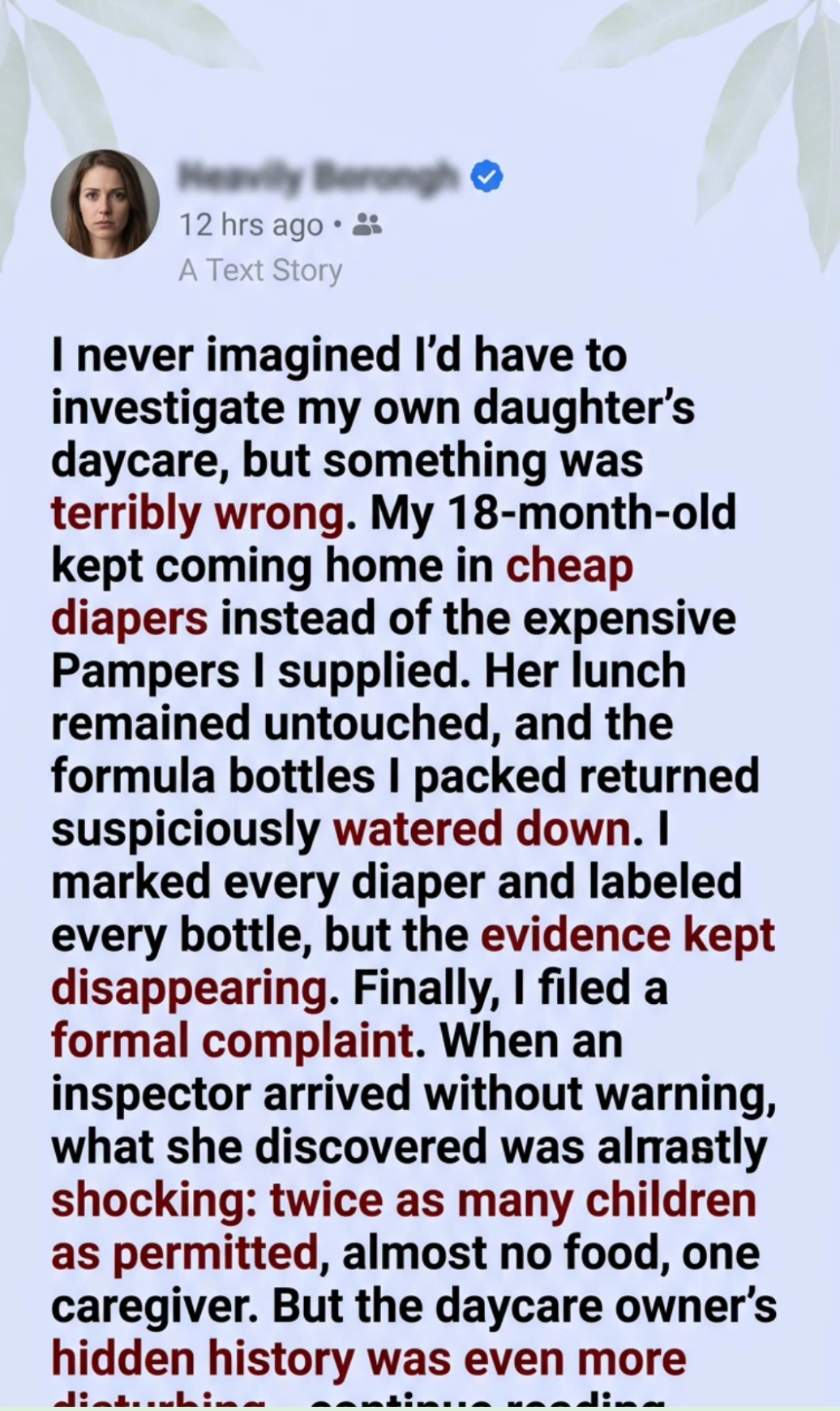
The first time I noticed something was wrong, I blamed myself.
My daughter, Lily, was eighteen months old. She had recently started attending a small daycare near our home because I had returned to work after spending most of her first year caring for her.
I had spent weeks searching for the right place.
I visited several facilities, checked their safety procedures, asked about staff qualifications, and read every review I could find. Eventually, I chose a daycare run by a woman named Vanessa. She seemed warm, organized, and experienced. The rooms were colorful, the toys appeared clean, and the children seemed happy during my visits.
Vanessa assured me that every child received individual attention.
“We treat them like family here,” she told me.
I wanted to believe her.
During the first week, Lily seemed tired when she came home, but I assumed it was because she was adjusting to a new routine.
Then I noticed her diapers.
I supplied a package of expensive Pampers every Monday, clearly marked with her name. Yet several afternoons, Lily returned wearing a different brand.
At first, I thought there had been a mix-up.
I asked Vanessa about it.
“Oh, we must have run out of hers during the day,” she replied casually. “We keep emergency diapers for situations like that.”
“That’s fine,” I said. “But could you let me know when her supply gets low?”
“Of course.”
I thought the matter was settled.
But it happened again.
And again.
The next thing I noticed was her lunch.
I packed Lily a small container of food every morning. Usually, it contained soft vegetables, rice, fruit, and something with protein. I knew she was still learning to eat independently, so I didn’t expect every bite to disappear.
But her containers came home almost untouched.
One afternoon, I opened her lunchbox and found the same pieces of food I had packed that morning. The fruit was slightly discolored, and the yogurt container was still sealed.
I asked Vanessa whether Lily had refused to eat.
“She’s a picky eater,” she said. “Some days she eats more than others.”
I accepted that explanation.
Then I noticed the formula.
Lily still drank formula during the day, and I prepared her bottles carefully before leaving home. I measured the water and powder according to the instructions, labeled each bottle, and packed them in an insulated bag.
But several times, the bottles came home unusually full.
The liquid also looked thinner than what I had prepared.
I didn’t want to accuse anyone without evidence, so I asked a simple question.
“Is Lily drinking all her bottles?”
Vanessa smiled.
“Yes, usually. She sometimes leaves a little.”
“Could you tell me how much she drinks? I want to make sure she’s getting enough.”
“Don’t worry. We know what we’re doing.”
Her answer wasn’t reassuring.
It was dismissive.
That evening, I watched Lily eat dinner. She was unusually hungry. She finished everything I offered and reached for more.
I began wondering whether she was actually receiving the meals and drinks I had been sending.
I also noticed that she sometimes cried when we arrived at the daycare entrance.
Before that, she had been curious about the other children. Now she clung to my legs and turned her face away whenever Vanessa approached.
Toddlers can struggle with separation. I knew that.
But the changes were happening together, and I couldn’t ignore them anymore.
I decided to document everything.
I photographed the diapers I supplied before placing them in Lily’s bag. I recorded the number of bottles and the amounts of formula. I kept copies of the lunch menus and noted what came home untouched.
I also started writing down the dates when something seemed unusual.
I wasn’t trying to catch Vanessa doing something wrong.
I wanted a clear explanation.
Unfortunately, the explanations became less convincing.
One Monday, I supplied a new package of diapers. By Wednesday, Vanessa told me Lily had used nearly all of them.
That seemed impossible.
I knew approximately how many diapers Lily needed each day, and the package should have lasted considerably longer.
When I asked whether other children might have used them accidentally, Vanessa became irritated.
“Are you suggesting we’re taking things from your daughter?”
“No. I’m asking because I want to understand how quickly they disappeared.”
“Perhaps you should find another daycare if you don’t trust us.”
I went quiet.
I didn’t want to create a confrontation in front of the children.
But I drove home that afternoon with a feeling I couldn’t shake.
The following week, I made an appointment with Lily’s pediatrician.
I explained the feeding concerns and showed the doctor the records I had kept.
The doctor examined Lily, reviewed her growth, and asked about her usual feeding schedule. There was no immediate evidence of serious harm, but the doctor emphasized that properly prepared formula and consistent nutrition were important.
She advised me to make sure the daycare followed the preparation instructions and to seek medical advice promptly if Lily showed signs of dehydration, poor feeding, or other concerning symptoms.
I left the appointment with more questions than answers.
That evening, I sent Vanessa a written message.
I asked her to confirm Lily’s daily feeding amounts, explain the diaper substitutions, and provide the daycare’s current staff-to-child arrangements.
She replied several hours later.
“Everything is fine. Please stop worrying. Lily is well cared for.”
I read the message twice.
There was no feeding record.
No explanation.
No answer about staffing.
I decided to contact the relevant childcare licensing authority.
I described the concerns factually. I included dates, photographs of the supplies, and copies of my written requests.
I did not claim Vanessa was stealing food or neglecting children. I asked the authority to inspect the facility and verify that it was operating within its approved capacity and staffing requirements.
I received an acknowledgment and was told the complaint would be reviewed.
For several days, nothing happened.
Then, on a Thursday morning, I received a telephone call.
The person introduced herself as an inspector named Helen.
“We’re arranging an unannounced visit to the facility,” she explained. “We may need to contact you for additional information.”
I thanked her.
I didn’t expect to hear anything immediately.
But later that afternoon, Vanessa sent a message to the parents’ group.
She announced that the daycare would close early the following day because of an unexpected maintenance issue.
Something about the timing bothered me.
I didn’t respond.
The next morning, Helen called again.
She asked whether I could attend a meeting at the licensing office the following week.
“There are several matters we need to discuss,” she said.
My stomach tightened.
“What did you find?”
“I’d rather explain the findings properly when we meet. But I can tell you that we identified concerns requiring immediate action.”
I thanked her and waited for the appointment.
That weekend was miserable.
I kept replaying every conversation with Vanessa. I wondered whether I had misunderstood something, whether I had been too trusting, and whether other parents had noticed the same things.
I also wondered about the children who couldn’t explain what happened during their day.
On Monday morning, I arrived at the licensing office with my folder.
Helen greeted me in a small meeting room. Another inspector, a man named David, joined us.
They began by explaining that the inspection had identified several serious violations.
The first involved the number of children.
The daycare had approval for a limited number of children, but inspectors found significantly more children present than the facility was authorized to accommodate.
The actual number was nearly twice the permitted capacity.
I stared at Helen.
“Twice?”
She nodded.
“Yes. The records and the number of children present did not match the facility’s approved operating capacity.”
The second problem involved staffing.
The inspectors had found only one caregiver actively supervising the children during their visit.
There were far more children present than one person could safely supervise under the applicable requirements.
The inspector explained that staff schedules, attendance records, and the facility’s registration would all be reviewed as part of the investigation.
Then came the food.
The inspectors found that the available food supplies were insufficient for the number of children present. Some items listed on the menus were not available, and the records did not adequately demonstrate that meals had been provided as promised.
There were also concerns about food storage and the handling of children’s bottles.
I felt sick.
“What about the formula?” I asked.
Helen opened a folder.
“We found inconsistencies in the preparation records. We cannot tell you yet which individual bottles were incorrectly prepared or who was responsible, but the facility’s procedures were inadequate.”
I remembered the bottles coming home nearly full.
I remembered the strange appearance of the liquid.
I remembered asking Vanessa for simple feeding records.
“Was my daughter being given watered-down formula?”
Helen didn’t pretend to know more than the evidence established.
“We have concerns about preparation practices. We are reviewing the available records and interviewing staff. I don’t want to give you a definitive answer before that work is complete.”
I appreciated her honesty, even though it frightened me.
Then David turned to another section of the folder.
“There is one additional issue,” he said. “The owner has a previous regulatory history.”
I leaned forward.
“What kind of history?”
He explained that Vanessa had previously operated another childcare service under a different business name.
That facility had been subject to regulatory action following complaints about supervision and recordkeeping.
It had eventually closed after the authority identified serious compliance problems.
Vanessa had later applied to operate the current daycare.
The inspectors were now examining whether the earlier history had been properly disclosed and whether the current registration process had been completed correctly.
I couldn’t believe it.
“How could she open another daycare?”
Helen explained that regulatory requirements varied depending on the circumstances and the nature of previous findings. The authority would need to establish whether the earlier closure should have affected her eligibility to operate the new facility and whether any information had been omitted or misrepresented.
It was not something they could decide from a single inspection.
But they were taking it seriously.
I sat back in my chair.
All those times Vanessa had told me she was experienced.
All those times she had assured me that she treated the children like family.
I wondered how many parents had trusted her without knowing about the previous facility.
Helen explained that immediate measures had been taken to protect the children while the investigation continued.
The daycare had been ordered to stop operating until the identified safety and licensing issues were addressed. Parents were being notified, and the authority was arranging follow-up inspections and reviewing the facility’s records.
I asked whether Lily had been placed at risk.
Helen said the inspection had identified conditions that could compromise children’s safety, but she couldn’t determine the exact experience of each child.
She recommended that I continue monitoring Lily’s health with her pediatrician and preserve any relevant records.
I thanked both inspectors.
Before I left, Helen gave me information about the next steps and explained how I could receive updates as the complainant.
I drove home in silence.
That afternoon, I called my husband, Mark.
He had been traveling for work when I first began raising concerns, and he had initially thought I was worrying too much.
When I told him what the inspectors had found, he went quiet.
“How many children?” he finally asked.
“Nearly twice the permitted number.”
“And only one caregiver?”
“That’s what they found.”
He exhaled slowly.
“I should have listened to you.”
I didn’t want an apology.
I wanted Lily safe.
That evening, we arranged alternative childcare.
It was difficult. We had to change work schedules, ask family members for temporary help, and contact several facilities before finding one with an available place.
But I refused to rush the decision.
I visited the new daycare twice. I asked to see its current registration, staff qualifications, emergency procedures, and feeding policies. I also asked how parents received daily reports.
The director answered every question without becoming defensive.
She showed me how bottles were labeled and stored, how meals were recorded, and how staff documented diaper changes.
Most importantly, she encouraged me to visit during operating hours.
Lily started there the following week.
The first morning was difficult.
She held my hand tightly and watched the room with suspicion.
One of the caregivers, a gentle woman named Anna, knelt beside her.
“Hello, Lily. Would you like to help me water the little plants?”
Lily looked at me.
I crouched beside her.
“You can try, sweetheart. I’ll be back after work.”
She hesitated, then followed Anna toward a small row of pots near the window.
It wasn’t a dramatic transformation.
She still cried occasionally during drop-off, and she needed time to become comfortable.
But the daily reports were consistent. Her bottles came back with accurate measurements. Her lunch containers were no longer untouched, and the staff told me when she refused something rather than pretending everything had been perfect.
For the first time in months, I felt I could trust the information I was receiving.
Meanwhile, the investigation into Vanessa’s daycare continued.
Over the following weeks, the licensing authority contacted parents and former employees. Investigators reviewed attendance records, staff schedules, food purchases, registration documents, and previous inspection reports.
They also examined the relationship between the earlier daycare and the current business.
Several parents provided information about their own experiences.
One mother reported that her son had repeatedly returned home with unexplained bruises. Another described being told that her daughter had eaten lunch when the child’s food container had remained untouched.
Those reports were allegations, not automatic proof of wrongdoing, but they gave investigators additional matters to examine.
A former employee also agreed to provide information.
She said that Vanessa had regularly accepted more children than the facility was approved to accommodate, particularly on days when parents needed emergency care.
She described being asked to manage too many children without adequate support.
The authority reviewed her account alongside the inspection evidence.
Eventually, Vanessa was formally notified of the findings and given an opportunity to respond through the regulatory process.
Her representative disputed some of the allegations and argued that certain staffing and attendance records had been misunderstood.
The authority considered those responses before reaching its decision.
The final findings confirmed multiple breaches of childcare requirements, including operating beyond approved capacity and failing to maintain adequate supervision.
The authority also determined that Vanessa’s previous regulatory history had not been properly addressed during the current registration process.
The daycare’s authorization was revoked following the required proceedings.
The authority referred certain matters for further review where appropriate, but it did not publicly identify individual children or disclose private family information.
I received a written update.
I read it at the kitchen table, the same place where I had once sorted Lily’s untouched lunches and counted the missing diapers.
I felt relieved.
But I also felt sad.
Because the decision meant that the place where I had trusted someone to care for my little girl had not been safe enough.
And because I knew other parents had experienced the same uncertainty.
Several months later, I received a message from another mother whose child had attended Vanessa’s daycare.
She thanked me for reporting the concerns.
“I thought I was imagining things,” she wrote. “My son kept coming home hungry, but I was afraid to complain because Vanessa always made me feel like a difficult parent.”
I read her message several times.
I thought about how close I had come to accepting the same explanation.
Perhaps Lily was picky.
Perhaps the diapers had been mixed up.
Perhaps I was worrying too much.
Those explanations were convenient because they allowed me to avoid a difficult confrontation.
But children depend on adults to notice when something isn’t right.
They cannot always tell us what happened while we were away.
Sometimes, the only clues are small things: a bottle that comes home too full, a lunch that hasn’t been touched, a change in behavior, or a caregiver who becomes angry when asked ordinary questions.
I still keep copies of Lily’s daycare reports.
Not because I expect every childcare provider to do something wrong, but because I have learned that asking reasonable questions is part of being a responsible parent.
Lily is now comfortable at her new daycare.
She has a favorite caregiver, a little group of friends, and a habit of waving goodbye to me without looking back.
Last week, she brought home a small painting.
It was mostly blue, with a yellow circle in the middle and several green marks that might have been flowers.
Anna had written a note on the back:
“Lily was very proud of this today. She wanted to show you as soon as you arrived.”
I placed it on the refrigerator.
It reminded me of something I had almost forgotten during those frightening months.
Childcare should not be a place where parents have to choose between trusting blindly and becoming investigators.
It should be a partnership built on transparency, proper supervision, and the understanding that every child deserves to be fed, protected, and treated with care.
I never wanted to investigate my daughter’s daycare.
I only wanted to know why she kept coming home hungry, why her bottles didn’t look right, and why the supplies I carefully prepared seemed to disappear.
But when the answers didn’t make sense, I kept asking.
And when asking wasn’t enough, I reported what I had observed.
I still don’t know exactly what happened during every hour Lily spent in that building.
I may never know.
What I do know is that the inspection uncovered problems no parent should have had to discover through a child’s untouched lunchbox.
And I will never again apologize for asking the people responsible for my daughter’s care to show me that she is safe.
THE END.