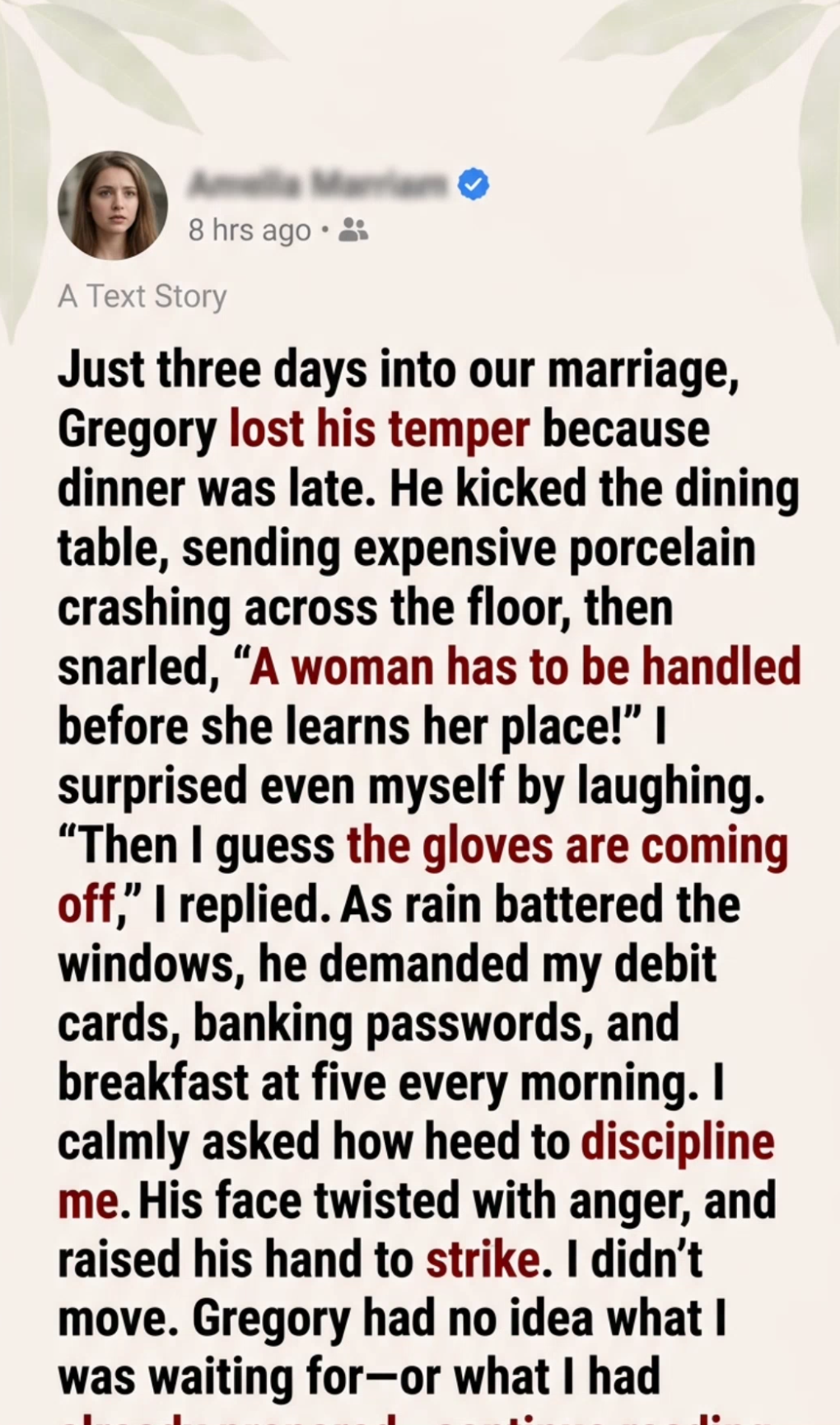
Three days into my marriage, I discovered that the man I had married was not the man I thought I knew.
His name was Gregory Hale. He was forty-one, successful, charming in public, and exceptionally good at making people believe he was a gentleman.
We had dated for fourteen months before getting married. During that time, he had never shouted at me, never insulted me, and never raised a hand in anger.
He sent flowers to my office, remembered small details about my childhood, and once drove two hours through a storm because I mentioned that I was feeling unwell.
My friends thought I had found someone special.
My mother liked him.
Even my older brother, who rarely approved of anyone I dated, said Gregory seemed dependable.
But there had been small things I ignored.
He disliked it when I disagreed with him in front of other people. He occasionally corrected my clothing choices. He once told me that after marriage, a wife should let her husband make the important decisions because men were naturally better at handling pressure.
I had challenged him.
He had laughed and kissed my forehead.
“You’re too serious, Claire. I’m only teasing.”
I believed him.
Three days after our wedding, I stopped believing him.
That evening, rain battered the windows of our newly rented house. I had spent most of the afternoon unpacking wedding gifts and organizing the kitchen. Gregory had told me he would be home by seven.
At seven thirty, he still hadn’t arrived.
At eight, I called him.
He answered impatiently.
“I’m on my way. Why?”
“Dinner is ready. I just wanted to know whether I should keep it warm.”
“Then keep it warm. It’s not complicated.”
He ended the call.
I should have recognized the warning in his voice.
Instead, I placed the food in the oven and waited.
He arrived nearly an hour later, threw his car keys onto the counter, and walked into the dining room.
He looked at the table.
Then at the food.
“Why is dinner late?”
I stared at him.
“It’s not late. I made it earlier, and I’ve been keeping it warm.”
He pulled out a chair.
“The rice is dry.”
“I can prepare another portion.”
“The chicken is cold.”
“I’ll heat it.”
He suddenly stood up.
“Do you have any idea how exhausting my day was?”
I put down the serving spoon.
“Gregory, I haven’t complained once. I’m trying to fix dinner.”
“You’re supposed to make things easier for me, not give me more problems.”
I looked at him.
“That’s not how marriage works.”
His expression changed.
He kicked the dining table.
The table shifted violently, and several pieces of expensive porcelain crashed onto the floor. A serving dish broke into large fragments. One of the wedding gift plates shattered near the wall.
I stepped backward.
“What is wrong with you?”
He pointed at me.
“A woman has to be handled before she learns her place!”
For a moment, the room seemed completely still.
Then I laughed.
Not because anything was funny.
I laughed because the man standing in front of me was so different from the person who had promised to love me three days earlier that I couldn’t connect the two.
Gregory’s face tightened.
“What are you laughing at?”
I looked at the broken plates.
“Then I guess the gloves are coming off.”
He stepped closer.
“You think you’re clever?”
“No. I think you’ve just shown me something I should have seen before.”
He grabbed a chair and pushed it away from the table.
“From tomorrow, things are going to be different. I want breakfast at five every morning. I don’t want excuses. I don’t want you questioning me. And I want your debit cards and banking passwords.”
I stared at him.
“My banking passwords?”
“Yes.”
“Why?”
“Because we’re married. I need to know what money is coming in and going out.”
“We can discuss household finances together. You don’t need my passwords.”
His eyes narrowed.
“I wasn’t asking.”
I took a slow breath.
“Then let me ask you something. How exactly are you planning to discipline me if I don’t obey?”
His expression twisted.
He raised his hand.
I didn’t move.
Gregory had no idea what I was waiting for.
And he certainly didn’t know what I had already prepared.
But before I explain what happened next, there’s something you need to understand about me.
I was not a woman who had entered marriage without financial independence.
I was thirty-six years old and had worked as a compliance manager for a regional financial services company for more than a decade. I owned an apartment before meeting Gregory, had savings in my own accounts, and maintained a separate investment portfolio.
My father had taught me something important when I was young.
“Never give someone control over your life simply because you love them,” he used to say. “Trust is a gift, not a surrender of your judgment.”
I had followed that advice.
Before the wedding, Gregory and I had discussed finances. We agreed that we would maintain individual accounts and establish a joint household account for shared expenses.
I had also retained ownership of my apartment. Gregory was moving into my property temporarily while we decided whether to purchase a larger home together.
He had agreed to those arrangements.
At least, he had agreed while we were dating.
Three weeks before the wedding, something happened that made me uncomfortable.
I received a notification from my bank about an attempted request to add a new authorized device to my online account.
I had not made the request.
I contacted the bank, changed my passwords, and asked its security department to review the activity.
They confirmed that the request had been blocked.
I was told not to share any authentication codes and to keep my account credentials private.
I didn’t immediately accuse Gregory.
I had no proof that he was responsible.
But I became more careful.
I moved my important financial documents into a secure location, updated my account recovery information, and made sure my lawyer had copies of the documents establishing my property ownership.
I also kept a record of the unusual banking notification.
I had no idea that three days into my marriage, I would need those precautions for an entirely different reason.
Now, standing in front of Gregory with broken porcelain scattered around my feet, I understood why my father had always insisted on independence.
Gregory lowered his hand slightly.
“Give me your phone.”
I shook my head.
“No.”
He stepped toward me.
“Don’t test me, Claire.”
I glanced at the clock.
It was 9:18 p.m.
Then I looked directly at him.
“Gregory, I want you to leave the room.”
He laughed.
“You’re giving me orders in my own house?”
“This is my property. And I am asking you to step away from me.”
His expression changed.
He looked around the dining room as though he had just remembered something.
The house was mine.
The furniture was mine.
The bank account he wanted access to was mine.
Even the car parked outside was registered in my name.
He had moved into my home three days earlier.
But I had never imagined he would use the word marriage as an excuse to control me.
“You’re really going to throw me out?” he asked.
“I’m telling you to stop threatening me.”
He moved closer again.
I reached into my pocket and pressed the emergency shortcut on my phone.
The call connected silently.
I had set it up after the suspicious banking incident, partly because my brother lived nearby and had offered to help if I ever felt unsafe.
The call went to him.
He knew to contact emergency services if he heard me use the agreed phrase.
Gregory didn’t notice.
“Give me the passwords,” he demanded.
“No.”
“Then maybe you’ll learn.”
He raised his hand again.
This time, I stepped backward and put the kitchen island between us.
“Don’t touch me.”
He stopped.
For the first time, I saw uncertainty in his face.
Perhaps he expected me to cry.
Perhaps he expected me to apologize.
Perhaps he thought that because we were newly married, I would be too embarrassed to tell anyone what was happening.
He was wrong.
I said clearly, “I do not consent to you touching me or taking my belongings. You need to leave.”
He pointed toward the hallway.
“You’re making a huge mistake.”
A few minutes later, someone knocked hard on the front door.
Gregory turned.
“Who is that?”
I didn’t answer.
The knocking came again.
“Claire? It’s me!”
My brother, Michael.
Gregory looked at me.
“What did you do?”
I kept my voice steady.
“I asked for help.”
He moved toward the door, but I told him not to open it.
Michael had already contacted the police. He had also called our neighbor, who had heard the shouting and agreed to wait outside.
When the officers arrived, they separated us and asked what had happened.
Gregory immediately began explaining that we had experienced a disagreement.
He claimed I was emotional because of the wedding stress.
I showed the officers the broken dishes, the damaged table, and the emergency call record.
I also explained that he had demanded my banking passwords and threatened to hit me.
One officer asked whether he had actually struck me.
“No,” I answered. “He raised his hand and threatened me. I moved away.”
I wanted the facts recorded accurately.
I did not exaggerate.
The officers spoke with Gregory separately. They advised him that he could not use intimidation or threats to force me to surrender access to my accounts.
Because the house was my property and the situation had become threatening, they explained the available legal options and helped ensure that we remained separated while the immediate situation was assessed.
Gregory eventually left with a small bag of clothes.
Before he walked out, he turned toward me.
“You’re going to regret humiliating me.”
I looked at him.
“You humiliated yourself.”
The door closed.
I stood in the hallway for several minutes, listening to the rain.
My brother came inside and put his arms around me.
“Are you hurt?”
“No.”
“Are you sure?”
I nodded.
Then I began crying.
Not because I wanted Gregory back.
I was grieving the person I had believed I was marrying.
The following morning, I contacted my attorney, Helen Morris.
She had reviewed our prenuptial financial arrangements and handled the property documentation before the wedding.
I told her everything.
She listened without interrupting.
When I finished, she said, “First, we’re going to make sure you’re safe. Second, we’re going to protect your property and finances. And third, we’re going to deal with the marriage through the proper legal process.”
I asked whether I could immediately remove Gregory from every financial arrangement.
“Any joint access, authorization, or shared account needs to be reviewed individually,” she explained. “We’ll contact the banks and make sure no one has authority they shouldn’t have. We also need to preserve evidence and avoid making assumptions about the attempted account access until the bank finishes its review.”
We began that process immediately.
The bank confirmed that the earlier device-registration attempt had originated from a device that was not recognized as mine. It could not establish with certainty who had initiated it, but it had preserved the security records.
I submitted the information to the appropriate department.
I also saved the emergency call record, photographs of the damaged dining room, and messages Gregory had sent after leaving.
He sent several.
The first said I was overreacting.
The second said he had only been trying to establish household rules.
The third demanded that I apologize for involving my brother and the police.
I did not respond.
Helen advised me to keep all communication in writing and avoid meeting him alone.
Two days later, Gregory’s mother called.
Her name was Patricia.
She had always been pleasant toward me before the wedding, although she often made comments about how fortunate I was to have found a man who could provide a comfortable life.
“Claire, what happened?” she asked.
“Your son threatened me.”
“Oh, he would never hurt you. He’s just under pressure.”
“He kicked the dining table and raised his hand to strike me.”
There was a pause.
Then she said, “You know how men get when they are frustrated. You shouldn’t have laughed at him.”
I closed my eyes.
“Patricia, I’m not discussing this with you.”
“Marriage requires patience.”
“Marriage also requires respect.”
She sighed.
“You’re going to destroy a good relationship over one argument.”
I ended the call.
A few hours later, Gregory sent another message.
My mother says you’re refusing to speak to her. This is becoming ridiculous. You need to stop involving other people in our private matters.
I finally responded.
Threats and intimidation are not private marital disagreements. Please communicate through my attorney.
He didn’t reply.
The next week, he attempted to collect more of his belongings.
My brother and a neutral third party were present. Gregory was allowed to retrieve his personal items, and we documented what he took.
He tried to start an argument when he saw that I had placed the damaged porcelain in a box.
“You’re keeping that?”
“It’s evidence of what happened.”
He laughed.
“You really think a broken plate is going to prove anything?”
I looked at him.
“No. But the photographs, the emergency call, the police record, and your messages may help establish what happened.”
His expression changed.
For the first time, he seemed to realize that I was not going to erase the incident simply to protect his reputation.
He left without another argument.
The divorce process began shortly afterward.
Gregory initially insisted that I was ending the marriage over a single disagreement. He argued that he had merely lost his temper and that I had deliberately provoked him.
But the issue was not just the broken dishes.
It was his demand for my banking credentials, the threats, the attempted intimidation, and the fact that he believed marriage gave him the right to control my decisions.
During the legal proceedings, we reviewed the financial arrangements, property records, and the evidence surrounding the incident.
The court process did not produce an overnight victory or a dramatic punishment.
It involved paperwork, statements, legal advice, and several difficult conversations.
Gregory eventually accepted that the marriage could not continue.
The divorce was finalized through the appropriate process.
I retained my apartment and personal assets in accordance with the applicable property arrangements. We had no children, no jointly owned real estate, and no significant shared debts.
The damaged dining table and porcelain were small financial losses compared with what I had almost surrendered emotionally.
A few months later, I learned that Gregory had told several mutual acquaintances that I had been impossible to live with.
He claimed I was controlling because I refused to share my banking passwords.
One friend asked me whether I regretted not giving him a chance to adjust to married life.
I thought about that question.
Then I replied, “A person doesn’t need months of adjustment to understand that threatening their spouse is wrong.”
That was the last time I discussed the marriage with her.
I replaced the dining table.
I bought new porcelain, but I chose a simple set instead of the expensive wedding collection.
I also changed the layout of the dining room.
For a while, I couldn’t sit at the same table without remembering the sound of the plates hitting the floor.
Eventually, that changed.
One Sunday morning, I invited Michael over for breakfast.
He looked at the new table and smiled.
“Much better.”
I laughed.
“At least this one has survived a meal.”
We sat down, ate quietly, and talked about ordinary things.
For the first time in months, my home felt peaceful.
A year after the divorce, I received a message from Gregory.
It was short.
I know I handled things badly. I was under pressure, and I didn’t know how to be a husband. I hope one day you can forgive me.
I read it.
I didn’t feel anger.
I didn’t feel longing.
I simply recognized that the man who had threatened me had finally found a way to describe his behavior without blaming me.
I replied with one sentence.
I hope you learn to treat the next person in your life with the respect you demanded from me.
Then I blocked his number.
I never learned whether he changed.
That was no longer my responsibility.
For a long time, I thought the most important thing I had done that night was refuse to hand over my banking passwords.
But looking back, it was something much simpler.
I refused to accept the idea that marriage gave another person ownership of my dignity.
Gregory had entered my house believing that a wedding ring gave him authority.
He thought he could demand my money, control my schedule, and punish me for disagreeing.
He expected fear to make me obedient.
Instead, he discovered that I had boundaries, support, documentation, and the courage to use them.
I had waited for him to reveal who he really was.
And when he finally did, I didn’t waste another year hoping he would become someone else.
THE END.