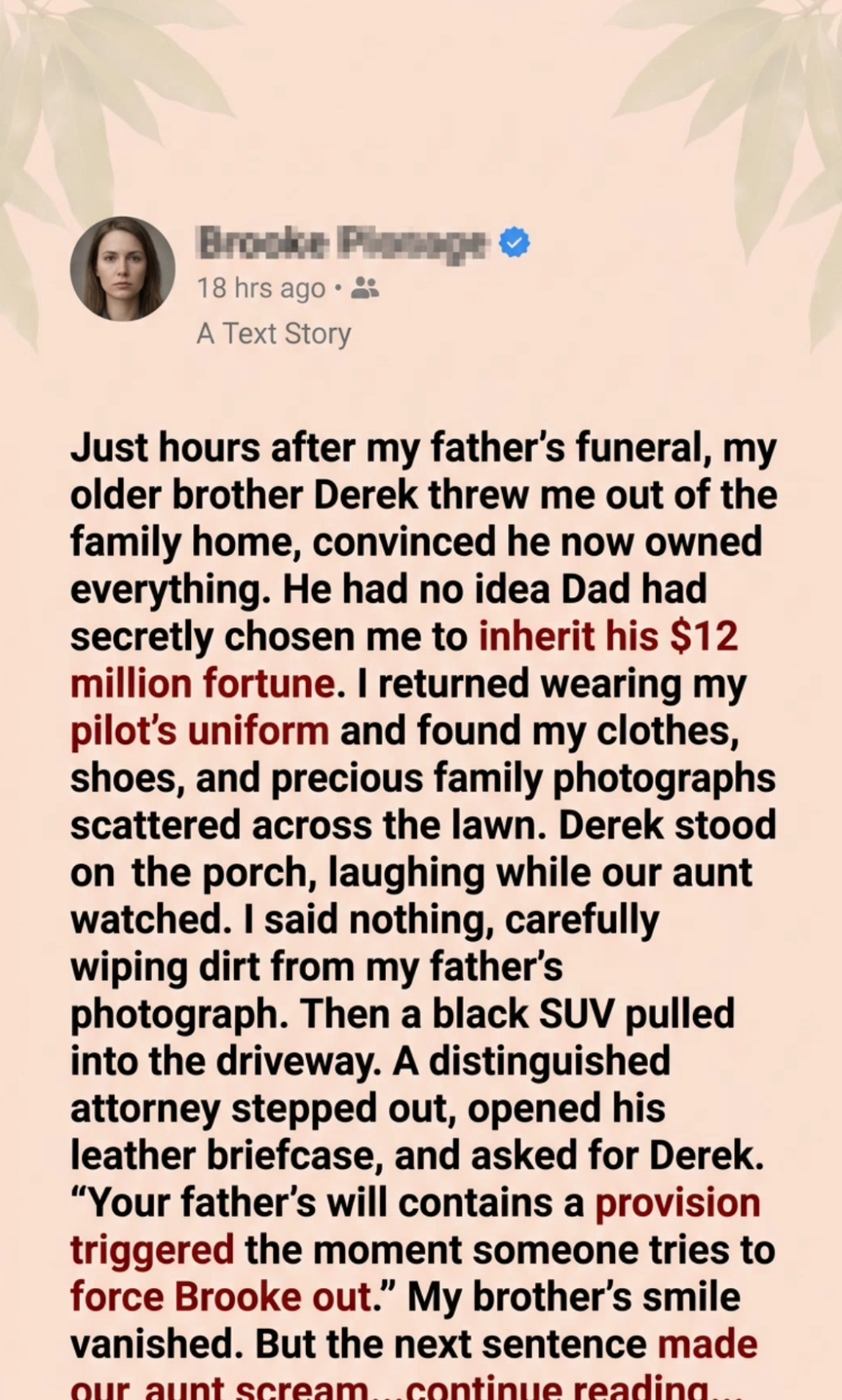
My name is Brooke Mitchell, and the day my father was buried was the day my older brother decided I no longer belonged to our family.
I had just returned from the cemetery.
My father’s coffin had been lowered into the ground less than three hours earlier. I was still wearing the black dress I had chosen for his funeral, and my eyes were swollen from crying.
I had spent the previous six months traveling between airports, hospitals, and our family home because my father had been seriously ill. I was a commercial airline pilot, and whenever my schedule allowed, I flew home to care for him.
My older brother, Derek, had visited occasionally.
He usually arrived with expensive gifts, talked about business, and left before the difficult work began.
He was forty-two, charming when he wanted something, and convinced that being the oldest son gave him authority over everyone else.
I was thirty-six.
Our father, Richard Mitchell, had built a successful aviation equipment and logistics company over four decades. He started with a small repair workshop and eventually expanded into aircraft maintenance, cargo handling, and specialized transportation services.
By the time he died, the business and his other investments were estimated to be worth approximately $12 million.
Derek had always assumed he would inherit everything.
He had never hidden that belief.
During family dinners, he referred to the company as his future business. He discussed which properties he planned to renovate and which investments he intended to sell.
When Dad corrected him, Derek laughed.
“Come on, Dad. We both know I’m the one taking over eventually.”
Father usually replied with the same sentence.
“We’ll discuss the future when the time comes.”
Derek interpreted that as agreement.
I never did.
I had my own career, my own apartment, and no desire to compete with my brother for Father’s money.
I loved flying.
My father had been the person who encouraged me to pursue it. When I was seventeen, I told him I wanted to become a pilot.
He had looked at me across the kitchen table.
“Then work for it,” he said. “Don’t let anyone convince you that your dreams are too big.”
He helped me pay for my first aviation training course, although I eventually repaid every dollar.
He attended my graduation and sat in the front row, smiling so proudly that I thought he might burst.
Derek had not attended.
He said he had an important business meeting.
That was the difference between us.
I wanted to make Father proud.
Derek wanted to inherit what Father had built.
Unfortunately, by the time our father became ill, those differences had become impossible to ignore.
During his final months, I took extended leave from work and arranged my schedule around his medical appointments.
I helped organize his medications, spoke with doctors, and made sure the house was comfortable.
Derek visited twice during that period.
The first time, he complained that the company was becoming disorganized.
The second time, he asked Father whether he had updated his will.
I was in the hallway when I heard the question.
“Dad, we need to settle the inheritance situation before things become complicated.”
Father looked exhausted.
“Your sister is sitting right there.”
Derek glanced toward me.
“I’m just trying to make sure everything is organized.”
Father closed his eyes.
“We’ll discuss it with the attorney.”
That evening, Father asked me to sit beside him.
“Brooke, don’t let your brother turn everything into a fight.”
I held his hand.
“I won’t, Dad.”
He looked at me for a long moment.
“Promise me you’ll keep your head when things get difficult.”
I didn’t understand what he meant.
I promised anyway.
Two weeks later, he died peacefully in his sleep.
The funeral was beautiful, but I barely remember the service.
I remember the flowers, the rain, and the feeling that the world had become strangely quiet.
After the burial, relatives returned to the family home.
I wanted to go upstairs, change clothes, and sit in Father’s study for a while.
Instead, Derek met me at the entrance.
“We need to talk.”
I looked at him.
“Can it wait?”
“No. It can’t.”
He held out a set of keys.
“You’re going to need to make arrangements to leave.”
I stared at him.
“What?”
“This is my house now.”
I thought he was joking.
“Derek, Dad has only just been buried.”
“And?”
“We haven’t even had the will reading.”
He laughed.
“Do you honestly think Dad would leave everything to you? I’ve been running parts of the business for years.”
“You haven’t been running the business. You’ve been visiting it.”
His expression hardened.
“Don’t start.”
I looked past him.
Our aunt, Patricia, was standing near the living room doorway. She had been close to Father for years, and I had always trusted her.
She didn’t say anything.
Derek continued.
“I’ve already spoken to the estate people. You need to collect your belongings and find somewhere else to stay.”
I was stunned.
“This has been my family home since I was a child.”
“You’re thirty-six, Brooke. You have a job. You have an apartment. You don’t need to live here.”
I stared at him.
“I stayed here because Dad needed me.”
“And now he’s gone.”
Those words hurt more than I expected.
I looked toward Aunt Patricia.
“Are you going to say something?”
She avoided my eyes.
“Brooke, perhaps it’s best not to argue today.”
I felt something inside me collapse.
Not because Derek had ordered me out.
Because the person I expected to defend me had chosen silence.
I went upstairs.
I packed two suitcases, a few boxes, and the personal belongings I had left in my childhood bedroom.
I also took Father’s favorite photograph.
It was taken when I had completed my first solo flight. I was standing beside a small training aircraft, wearing an oversized flight jacket, while Father stood beside me with his arm around my shoulder.
He looked happier in that photograph than I had ever seen him.
When I came downstairs, Derek was waiting.
“You’re taking all that?”
“These are my belongings.”
“Don’t take anything that belongs to the house.”
I looked at him.
“The photograph belongs to me.”
He stepped aside.
I carried my boxes outside.
But when I reached the lawn, I stopped.
My remaining clothes, shoes, and several boxes of personal belongings had already been thrown onto the grass.
Some of the boxes were open.
My father’s photograph lay face down near the garden path.
A corner of the frame had cracked.
I dropped my suitcase and hurried toward it.
Dirt had collected along the glass.
I knelt and carefully wiped it away with my sleeve.
Behind me, Derek laughed.
“Look at you. Making a scene over an old photograph.”
I didn’t turn around.
Aunt Patricia stood on the porch, watching.
I picked up the photograph and held it against my chest.
Then I heard an engine.
A black SUV turned into the driveway.
It moved slowly past the scattered boxes and stopped near the front steps.
A distinguished-looking man stepped out.
He was in his late sixties, wore a dark suit, and carried a leather briefcase.
I recognized him immediately.
Mr. Samuel Bennett.
He had been Father’s personal attorney for more than twenty years.
Derek’s smile widened.
“Perfect timing. We need to discuss the estate.”
Mr. Bennett looked at the lawn.
Then at me.
Then at Derek.
His expression changed.
“Mr. Mitchell, I need to speak with you.”
Derek straightened his jacket.
“Of course. I was just explaining the situation to my sister.”
Mr. Bennett looked at the boxes.
“Is this how you are explaining it?”
Derek laughed awkwardly.
“Brooke is emotional. She’s having difficulty accepting that Dad’s estate needs to be managed by someone responsible.”
Mr. Bennett opened his briefcase.
“Your father’s will contains a provision triggered the moment someone attempts to force Brooke out of this property.”
Derek’s smile vanished.
Aunt Patricia stepped forward.
“What provision?”
Mr. Bennett removed a sealed document.
“Before I explain, I want everyone to understand that I am here in my professional capacity as the estate’s attorney. I will not allow anyone to misrepresent your father’s instructions.”
Derek folded his arms.
“Fine. Let’s hear it.”
Mr. Bennett looked directly at him.
“Your father anticipated that someone might attempt to remove Brooke from the family home before the estate was formally administered. He specifically instructed that any attempt to interfere with her lawful access or personal belongings be documented and reported to the executor.”
Derek laughed nervously.
“That’s ridiculous. I’m his son.”
“That does not give you authority to disregard the estate administration process.”
Mr. Bennett turned toward me.
“Miss Mitchell, did your brother give you notice to leave?”
I nodded.
“Yes.”
“Did he claim ownership of the property?”
“Yes.”
“Did he remove your belongings?”
I looked at the lawn.
“Yes.”
Mr. Bennett made a note.
Then he turned back to Derek.
“Your father also appointed an independent executor. You are not the executor, and you do not have authority to distribute estate property.”
Derek’s face turned red.
“Who is the executor?”
Mr. Bennett opened the document.
“An independent professional trustee named Jonathan Reeves.”
Derek looked at Aunt Patricia.
She seemed equally confused.
Mr. Bennett continued.
“Now, regarding the inheritance.”
He removed another document.
“Your father executed his final will approximately fourteen months before his death. It was prepared after independent legal advice, witnessed correctly, and accompanied by a separate capacity assessment.”
Derek interrupted.
“Just tell us who gets what.”
Mr. Bennett nodded.
“Your father left the controlling interest in Mitchell Aviation Holdings to a family trust. The trust has been established to preserve the company and its operating assets.”
Derek frowned.
“Who controls it?”
“The independent trustees.”
“That doesn’t answer my question.”
Mr. Bennett looked at him.
“Your father appointed Brooke as the primary beneficiary of the trust’s long-term distributions and designated her as the successor chair of the family holding structure, subject to the trust’s governance requirements.”
I stared at him.
“Me?”
He nodded.
“Yes.”
Derek laughed.
“That’s impossible.”
Mr. Bennett continued without reacting.
“The estimated value of the assets allocated through the trust and related personal estate is approximately twelve million dollars, subject to final valuation and outstanding liabilities.”
Aunt Patricia gasped.
Derek stood completely still.
“You’re saying Dad left her twelve million dollars?”
“I’m saying your father structured the estate so that Brooke would receive the principal economic benefit of the designated assets, while the company would remain professionally managed under independent governance.”
Derek pointed at me.
“Why her?”
Mr. Bennett closed the folder briefly.
“Your father explained his reasoning in a separate letter.”
He removed another envelope.
“This letter is to be read in the presence of his children and his sister.”
He unfolded the pages.
Then he began reading.
“My dear Brooke and Derek,
“If you are hearing this letter, then I am no longer able to explain my decisions personally.
“I know that my estate plan may surprise some of you. I also know that people often confuse inheritance with reward. I do not believe money should be used to reward someone simply for being born first or for demanding it most loudly.
“I built my company over forty years. I made mistakes, lost money, trusted the wrong people, and worked through years when I wasn’t sure whether we would survive another month.
“Brooke was never the person who asked what she would receive when I was gone. She was the person who asked whether I had eaten, whether I had taken my medication, and whether I needed someone to sit with me.
“She built her own career and never treated my business as her future inheritance.
“Derek, I love you. But I have watched you confuse authority with responsibility. You have often wanted control without accepting the obligations that come with it.
“I have not excluded you from everything. You have been provided for in the estate, and you may receive distributions under the terms I have established. But you will not control the company simply because you believe you deserve it.
“Brooke, I am leaving you the responsibility of protecting what I built. That does not mean you must run every department or sacrifice your own career. It means you must ensure that the business is managed honestly, that its employees are treated fairly, and that our family’s name is not used as an excuse for greed.
“Please remember that the house is not the most important thing I am leaving you.
“The people who helped build this family are.”
Mr. Bennett stopped reading.
I was crying.
Not because I had heard about the money.
Because my father had understood.
He had noticed the things I had done when nobody else was watching.
Derek looked furious.
“This is nonsense. He was sick. He wasn’t thinking clearly.”
Mr. Bennett calmly placed the letter on the table.
“Your father’s capacity was assessed by an independent medical professional. The will was prepared with independent legal advice, witnessed, and properly executed. If you believe there are grounds for a formal challenge, you may obtain your own legal counsel. But shouting in the driveway will not change the documents.”
Derek turned toward me.
“You knew about this.”
I shook my head.
“No.”
“Don’t lie!”
“I didn’t know what Dad had written.”
He stepped toward me.
Mr. Bennett immediately moved between us.
“Mr. Mitchell, I strongly advise you to step back.”
Derek stopped.
Then Aunt Patricia suddenly spoke.
“Samuel, what about the letter he gave me?”
Mr. Bennett turned.
“What letter?”
Patricia’s face had become pale.
She looked at Derek, then at me.
“Your father asked me to keep something safe. He told me not to give it to anyone until after the funeral.”
Derek stared at her.
“What are you talking about?”
She swallowed.
“It was a document.”
Mr. Bennett’s expression became serious.
“Do you still have it?”
Patricia nodded slowly.
She went inside and returned several minutes later carrying a small envelope.
It was sealed with red wax.
Mr. Bennett examined it.
“Is this the document your brother asked you to keep?”
She nodded.
“Yes.”
He opened it carefully.
Inside was a handwritten note and a copy of an older company document.
He read the note silently.
Then he looked at Derek.
“Your father specifically instructed that this document be provided to the executor if anyone attempted to remove Brooke from the family home before the estate was administered.”
Derek looked confused.
“What is it?”
Mr. Bennett turned the page.
“It concerns a company transaction.”
He explained that several months before his death, Father had become concerned about certain financial decisions Derek had made while managing one of the company’s regional operations.
There had been a proposal to sell a warehouse and transfer several maintenance contracts to a new company.
The transaction had been presented as a way to reduce operating costs.
However, the new company was controlled by an associate of Derek’s.
Father had questioned the arrangement and ordered an independent review.
The review identified conflicts of interest and several payments that required further explanation.
The documents did not establish that Derek had committed a crime, but they showed that he had failed to disclose important business relationships.
Father had removed Derek from certain management responsibilities while the review was completed.
Derek’s face went pale.
“That was a business disagreement.”
Mr. Bennett nodded.
“It may have been. The documents will be reviewed by the independent trustees and the company’s advisers.”
Aunt Patricia looked at Derek.
“You told me your father had approved that transaction.”
Derek snapped.
“Stay out of this.”
Mr. Bennett continued.
“Your father instructed the executor to preserve these records and ensure that the company was not transferred or restructured without independent review.”
I looked at my brother.
Suddenly, his behavior made more sense.
He had not simply assumed he would inherit the company.
He had expected to control it.
And he had believed that removing me from the house would give him an advantage before anyone else could intervene.
But Father had anticipated that possibility.
The next sentence from Mr. Bennett made Aunt Patricia scream.
He looked at her and said:
“Your brother also instructed me to inform you that the $180,000 he transferred to your account was not a gift or an inheritance. It was an advance that he expected to be returned to the estate if it was not supported by legitimate expenses.”
Patricia covered her mouth.
“What?”
Derek turned toward her.
“Don’t say anything.”
Mr. Bennett continued.
“The bank records show that the transfer was made shortly before your father’s final hospitalization. The executor will need to establish its purpose and determine whether repayment is required.”
Patricia began crying.
“I thought it was for my medical treatment.”
Derek looked furious.
“It was!”
“Then why did your father call me and tell me to keep the money separate?” she cried.
The attorney raised a hand.
“These matters will be handled formally. Nobody should make accusations until the records have been reviewed.”
I stood beside the lawn, still holding my father’s photograph.
The day had become something I could never have imagined.
My brother had tried to throw me out of our childhood home hours after burying our father.
Our aunt had watched.
And now both of them were facing questions about decisions they had made while Father was alive.
But I wasn’t celebrating.
I was exhausted.
I wanted my father back.
I wanted to walk into his study and hear him complain about the weather. I wanted to sit beside him while he told the same stories about his first business failures.
I didn’t want twelve million dollars.
I wanted one more ordinary afternoon with him.
Mr. Bennett approached me.
“Brooke, there is something else your father requested.”
I looked at him.
“What?”
“He wanted you to have access to his study once the property had been secured and the executor had completed the initial inventory.”
I nodded.
He turned to Derek.
“The house remains an estate asset until the executor determines how it will be administered. Nobody is authorized to remove personal property or change access arrangements without approval.”
Derek said nothing.
For the first time that day, he seemed to understand that the house was not his to command.
The executor arrived the following morning.
He reviewed the property, documented the condition of my belongings, and arranged for the house to remain secure while the estate administration continued.
Derek was instructed to return the keys he had taken from the property office.
He was also advised to obtain independent legal representation if he intended to challenge the will or the business review.
I was allowed to retrieve my belongings and return to the house temporarily while the executor considered the appropriate arrangements.
The process was not quick.
There were valuations, company audits, legal correspondence, and discussions about the trust’s governance.
Derek hired an attorney and challenged several provisions.
He argued that Father had been influenced by me because I had been his primary caregiver.
But the independent capacity assessment, the solicitor’s records, and the evidence of Father’s long-standing estate planning supported the validity of the will.
The challenge did not succeed.
The company investigation also continued.
The independent review found that Derek had failed to disclose a financial relationship connected to the proposed warehouse transaction. The trustees removed him from the relevant management responsibilities while the company reviewed the affected contracts.
There was no instant criminal conviction or dramatic courtroom punishment.
Instead, there was a careful corporate investigation, a negotiated resolution of certain financial issues, and a formal decision that Derek would not be given control of the company.
He remained a beneficiary under the estate, but he was not allowed to manage the business.
Aunt Patricia also had to provide documentation regarding the $180,000 transfer.
She eventually returned the portion that could not be supported by legitimate expenses after reaching an agreement with the executor.
She later apologized to me.
It happened in Father’s garden.
I was sitting on the old wooden bench where he used to drink his morning coffee.
Patricia approached slowly.
“Brooke, can we talk?”
I nodded.
She sat beside me.
“I should have defended you.”
I looked at her.
“Yes.”
“I thought Derek was going to take care of everything. He told me your father had promised him the company.”
“Did you believe him?”
She looked down.
“I wanted to.”
I didn’t respond.
She continued.
“When I saw your belongings on the lawn, I knew it was wrong. But I was afraid of upsetting Derek. I thought I could stay out of it.”
I looked toward the house.
“Sometimes staying out of something is still a decision.”
She began crying.
“I know.”
I didn’t immediately forgive her.
But I listened.
Over time, our relationship became less strained. We remained family, but I no longer trusted her with important matters simply because we shared a surname.
As for Derek, our relationship changed permanently.
Several months after the estate administration began, he asked to meet.
I agreed to see him at the office of the estate attorney.
He looked tired.
“I never thought Dad would do this.”
I looked at him.
“He didn’t do this to you. He made decisions about his own estate.”
“He gave you everything.”
“No. He gave me responsibility. And he made provisions for you too.”
Derek shook his head.
“You always were his favorite.”
I took a breath.
“Dad loved both of us. But he didn’t trust us with the same responsibilities.”
He looked away.
Then he said something I had never expected.
“I thought if I controlled the company, everyone would finally respect me.”
I studied his face.
“Did you think throwing my belongings onto the lawn would make Dad respect you?”
He didn’t answer.
For a moment, I felt sorry for him.
He had spent years believing that money and authority would prove his worth. He had mistaken Father’s patience for approval and Father’s silence for permission.
But understanding why he had behaved that way didn’t mean I had to excuse it.
“I don’t want to fight with you for the rest of our lives,” I said. “But I won’t let you treat me that way again.”
He nodded.
“I’m sorry.”
It was not a perfect apology.
He didn’t mention every insult, every lie, or every decision.
But it was the first time he had acknowledged that he had done something wrong without blaming me.
I told him I needed time.
Then I left.
A year after Father’s death, the family trust completed its first major review.
The company remained operational, with professional management overseeing its daily business. Several long-serving employees received recognition for their contributions, and the trust established a scholarship fund for young people pursuing careers in aviation maintenance and engineering.
I accepted the role of successor chair within the trust’s governance structure, but I continued working as a pilot.
I did not suddenly become a business executive who knew everything about running an aviation company.
Instead, I hired experienced advisers, listened to the employees, and learned what I needed to know.
I also made sure the company continued to honor the standards my father had established.
The family home was eventually transferred into the trust under the estate plan, with provisions allowing me to live there and maintain it. I kept Father’s study almost exactly as it had been.
His desk remained beside the window.
His old aviation manuals stayed on the shelves.
And his photograph from my first solo flight was placed in a new frame.
One evening, I was sitting in his study when I found a small envelope tucked beneath a drawer.
It contained a handwritten note.
There were only four sentences.
Brooke, never confuse what you inherit with what you deserve.
Money can disappear.
Reputation can be damaged.
But the way you treat people is what remains.
I read it several times.
Then I placed it beside his photograph.
I finally understood why he had asked me to keep my head when things became difficult.
He knew Derek might challenge the estate.
He knew people might become angry.
And perhaps he knew that the family would be tested in ways none of us could predict.
I still remember the afternoon Derek threw my belongings onto the lawn.
I remember kneeling in the dirt, wiping the glass of my father’s photograph while he laughed from the porch.
But I remember something else too.
When that black SUV arrived, I didn’t need to shout, threaten, or demand anything.
The truth was already documented.
My father’s decisions had been made long before the funeral.
And no amount of confidence from my brother could change them.
I never wanted my father’s money to become the reason my family fell apart.
But I also learned that being family does not give someone the right to take what isn’t theirs, humiliate you, or decide that your place in the world is smaller than theirs.
My father left me an inheritance worth millions.
Yet the most valuable thing he left was the knowledge that I didn’t need to fight for my dignity.
I only needed to refuse to surrender it.
THE END.