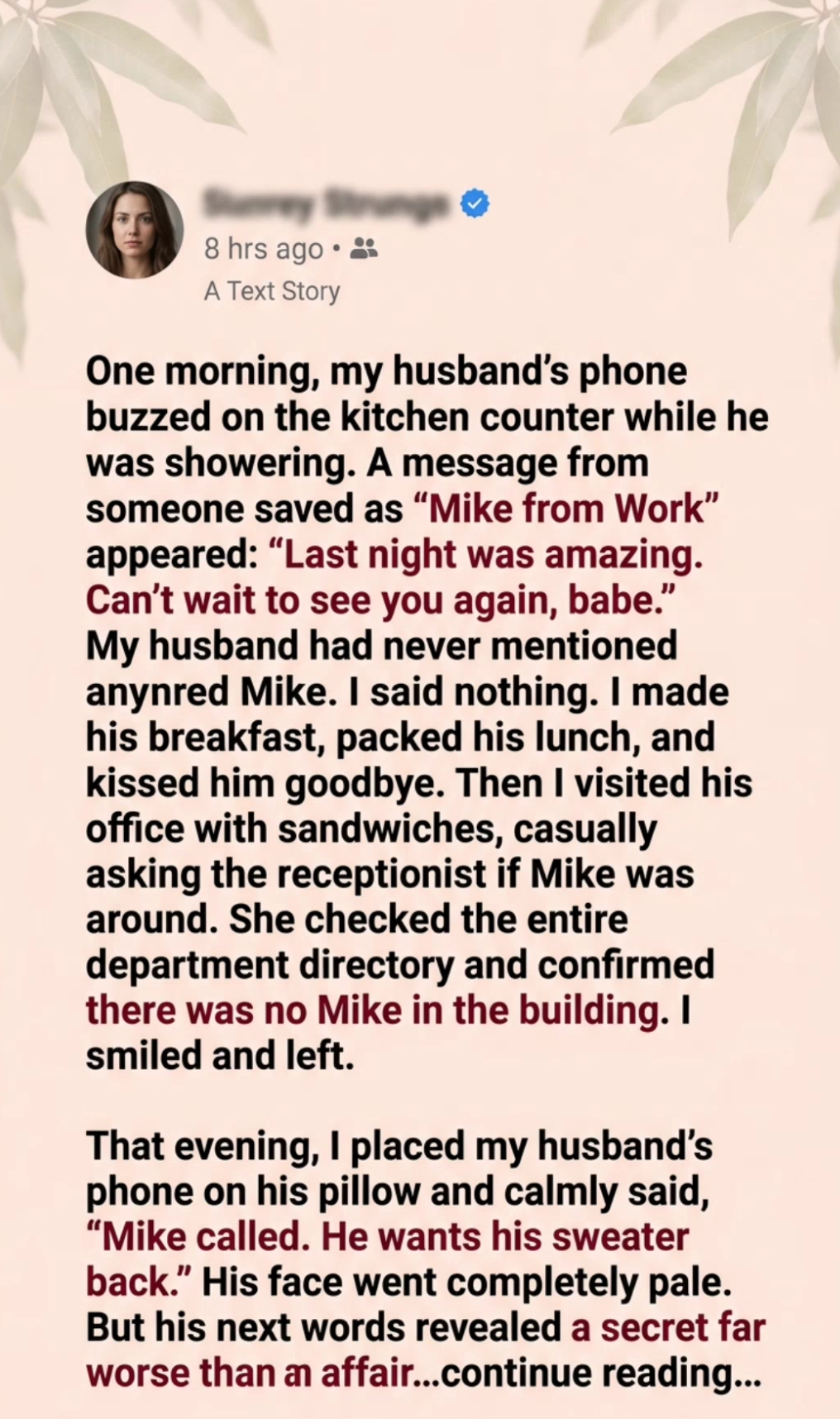
The message appeared at 7:18 on a Tuesday morning.
My husband, Daniel, had left his phone on the kitchen counter while he showered. I was preparing breakfast when the screen lit up.
I wasn’t looking for anything.
I wasn’t suspicious.
I was simply standing close enough to read the notification.
Mike from Work: Last night was amazing. Can’t wait to see you again, babe.
I stopped cutting the strawberries.
For several seconds, I stared at the screen.
My husband had never mentioned anyone named Mike.
He worked in a financial consulting company with nearly two hundred employees. I knew several of his colleagues by name. I’d met his manager, his assistant, and even the woman who organized his department’s holiday dinners.
But Mike?
There was no Mike.
I heard the shower turn off.
I put the knife down, finished making breakfast, and placed his coffee beside his plate.
When Daniel entered the kitchen, he was wearing his usual gray shirt and adjusting his watch.
“Morning, sweetheart.”
“Morning.”
He kissed my cheek.
I handed him his lunch bag.
“Turkey sandwich today.”
“Perfect. Thank you.”
I smiled.
Then I kissed him goodbye.
“Have a good day.”
“You too.”
He walked out.
I waited until the front door closed before picking up my phone.
I didn’t call him.
I didn’t send a message.
I didn’t even take a screenshot.
Instead, I did something that would give me an answer without giving him a warning.
I visited his office.
And by the time I returned home that evening, I knew that the man I had married was hiding something much bigger than another relationship.
My name is Laura Mitchell. I was thirty-six years old, and Daniel and I had been married for nine years.
We had a comfortable home in a quiet neighborhood outside Chicago. We had no children, although we had talked about starting a family several times.
Daniel was thirty-nine and worked as a senior financial consultant.
He was organized, ambitious, and usually considerate.
At least, that was the man I believed I knew.
I worked as an interior designer. My business was small but successful, and I had built a steady client base through referrals.
We shared household expenses and maintained separate personal accounts.
Daniel handled most of our long-term investments because he had more financial experience.
I trusted him.
That trust was about to become the most painful part of our marriage.
At 10:40 that morning, I arrived at Daniel’s office carrying a paper bag.
I had brought sandwiches, two coffees, and a small container of the cookies he liked.
The receptionist recognized me.
“Laura! What a lovely surprise.”
“Hi, Melissa. I was nearby and thought I’d bring Daniel lunch.”
She smiled.
“He’s in a meeting, but I can let him know.”
“That’s fine. I don’t want to interrupt him.”
I looked casually toward the employee directory displayed on a monitor near the reception desk.
“Actually, can I ask you something?”
“Of course.”
“Is Mike working today?”
She frowned slightly.
“Mike?”
“Yes. Mike from Daniel’s department. I think they work together.”
Melissa turned toward her computer.
“Do you know his last name?”
I smiled.
“Unfortunately, no. I only know the first name.”
She searched the company directory.
Then she checked the department list.
She even asked another receptionist to verify the names.
After a moment, she turned back.
“I’m sorry, Laura. I don’t see anyone named Mike in Daniel’s department.”
“Maybe another department?”
She checked again.
“No Mike in the office directory at all.”
I nodded.
“That’s strange. I must have misunderstood.”
Melissa smiled.
“Would you like me to call Daniel?”
“No, don’t worry. I’ll leave these for him.”
I handed her the bag.
Then I thanked her and walked out.
I didn’t feel triumphant.
I felt sick.
Because I had just discovered that my husband’s explanation, if he ever gave me one, would need to be more complicated than a colleague sending an inappropriate message.
That afternoon, I called my older sister, Natalie.
She had been married for fourteen years and was usually the person I called when I needed someone to tell me the truth without making me feel foolish.
I told her what I had seen.
She listened quietly.
When I finished, she asked, “Did you check his phone?”
“No.”
“Did you ask him?”
“Not yet.”
“Laura, don’t turn this into a guessing game. You need to find out what’s happening.”
“I know.”
“Are you safe?”
I almost laughed.
“Yes. Why?”
“Because sometimes people react badly when they realize they’ve been caught.”
I thought about Daniel.
He had never hit me, threatened me, or behaved violently.
But I understood what she meant.
“He’s never been like that.”
“Then I hope he isn’t now. But be careful.”
I promised I would.
Then I asked her something I had been avoiding.
“What if it’s exactly what it looks like?”
Natalie sighed.
“Then you deal with the truth, not the person you hoped he was.”
Daniel came home at 6:32 p.m.
He put his keys in the bowl near the entrance and walked into the kitchen.
“Smells good.”
“Chicken and roasted potatoes.”
“Perfect.”
He kissed my forehead.
I watched him carefully.
He looked completely ordinary.
That was what made everything so strange.
He asked about my day.
I told him I had finished a design proposal.
He talked about a client meeting.
We ate dinner.
He laughed at something on television.
Then he went upstairs.
I waited until he was in the bedroom.
I picked up his phone from the kitchen counter.
I carried it upstairs and placed it on his pillow.
When he came out of the bathroom, he stopped.
I was standing beside the bed.
“Mike called,” I said calmly. “He wants his sweater back.”
Daniel’s face went completely pale.
For a moment, he didn’t move.
Then he looked at the phone.
“Laura…”
“Who is Mike?”
He swallowed.
“Where did you hear that name?”
I stared at him.
“That’s your first question?”
He sat on the edge of the bed.
“Please don’t jump to conclusions.”
“I visited your office today.”
His eyes lifted.
“Why?”
“I brought you lunch. I asked the receptionist whether Mike was there.”
Daniel closed his eyes.
“And?”
“She checked the entire department directory. There is no Mike in the building.”
He looked toward the window.
I waited.
Finally, he said, “Mike isn’t real.”
I felt my stomach tighten.
“Then who sent the message?”
He rubbed his face.
“Laura, I can explain.”
“Then explain.”
He looked at me.
“It’s someone I know.”
“Someone?”
He nodded.
“Her name is Michael.”
I blinked.
“Her?”
“Michael is a woman. She uses Mike as her contact name.”
I stared at him.
“Why would you save a woman under a man’s name?”
He didn’t answer.
“Daniel, are you having an affair?”
He looked down.
Then he said, “Yes.”
The word landed between us.
I felt my knees weaken.
I sat in the chair opposite him.
“How long?”
“About eight months.”
I stared at him.
Eight months.
Eight months of breakfasts, grocery shopping, weekend plans, and ordinary conversations.
Eight months of him kissing me goodbye while knowing he was seeing someone else.
“Who is she?”
“Her name is Michelle.”
“Where does she work?”
He hesitated.
“She’s not connected to my office.”
“How did you meet?”
“Through a client event.”
I looked at him.
“And the sweater?”
He swallowed.
“She left it at my apartment.”
I frowned.
“Your apartment?”
Daniel closed his eyes.
That was when I understood.
There was another secret.
A much bigger one.
I stood up.
“What apartment?”
Daniel looked at me.
“Laura, please sit down.”
“No. Answer the question.”
He took a long breath.
“I’ve been renting a place downtown.”
I felt as though the floor had shifted beneath me.
“How long?”
“Almost a year.”
“Almost a year?”
He nodded.
“Why?”
He didn’t answer immediately.
I looked at him.
“You rented an apartment so you could see another woman?”
“At first, yes.”
“At first?”
He looked down.
“Then it became complicated.”
I laughed once, without humor.
“Explain complicated.”
Daniel stood and walked toward the dresser.
He opened a drawer and removed a folder.
“I didn’t know how to tell you.”
He placed it on the bed.
Inside were lease documents, bank statements, and several receipts.
The apartment had been rented under a company Daniel controlled.
The rent was paid through an account that I had never seen.
I picked up the bank statements.
There were transfers from an investment account we had both contributed to.
I looked at him.
“Is this our money?”
He didn’t answer.
“Daniel?”
“Some of it.”
I read the figures again.
The total was far more than I expected.
Over the previous ten months, more than $68,000 had been transferred into the account used to pay for the apartment, travel, and other expenses.
I felt sick.
“You used our savings?”
“I was going to replace it.”
“When?”
“When things settled down.”
I stared at him.
“You stole money from our future to finance another life.”
He shook his head.
“That’s not how I saw it.”
“How did you see it?”
He looked exhausted.
“I was unhappy.”
I felt the words like a slap.
“Then you should have told me.”
“I know.”
“You could have asked for counseling. You could have asked for a separation. You could have told me you didn’t want to be married anymore.”
“I was afraid.”
“Of what?”
“Of losing everything.”
I looked around our bedroom.
The furniture we had chosen together.
The photographs from our honeymoon.
The house we had worked to afford.
Then I looked at the man sitting on the edge of our bed.
“You were afraid of losing everything, so you built another life using our money?”
He covered his face.
“I didn’t plan for it to happen like this.”
I couldn’t listen anymore.
I walked downstairs.
I needed air.
The next morning, I called a lawyer.
Her name was Patricia Wells.
She had represented a friend during a difficult divorce and had a reputation for being calm, direct, and thorough.
I explained the situation.
She asked me to send the financial records.
“Don’t confront him about the money again until we understand the account structure,” she advised. “Don’t transfer joint assets, close accounts, or remove property. We need to preserve the records and establish exactly what happened.”
I agreed.
She also suggested that I secure my personal documents and change passwords to my private accounts.
I did.
For the first time in nine years, I realized that being married did not mean I should remain financially unaware.
Over the next few days, Patricia and her financial specialist reviewed the statements.
They discovered that Daniel had created a consulting company several years earlier.
He had told me it was a side business that helped him manage occasional financial projects.
The company had a separate bank account.
Some of the transfers into that account came from his personal income.
Others came from joint savings.
There were also payments from a joint investment account that had not been discussed with me.
The apartment was not the only expense.
There were restaurant bills, hotel stays, furniture purchases, and several large cash withdrawals.
The financial specialist calculated that approximately $68,000 of marital funds had been used without my knowledge.
But the review revealed something else.
The consulting company had received payments from two clients connected to Daniel’s employer.
I didn’t understand why that mattered until Patricia explained it.
“Did Daniel ever tell you that he was providing consulting services outside his employment?”
“No.”
“Did he have permission from his employer?”
“I don’t know.”
Patricia looked at the records.
“That needs to be examined separately.”
A week later, Daniel asked me to meet him.
He wanted to explain everything.
We met in the living room.
He looked as though he hadn’t slept.
“Michelle and I are finished,” he said.
I didn’t respond.
“I ended it.”
“Why?”
“Because I don’t want to lose you.”
I stared at him.
“Is that why you ended it, or because I found out?”
He looked down.
“I know how it sounds.”
“Then explain the consulting company.”
His expression changed.
“What?”
“Your company received payments from clients connected to your employer. Why?”
He rubbed his forehead.
“Those were legitimate projects.”
“Did your employer know?”
He hesitated.
That was enough.
“Daniel, did you receive money from clients who were doing business with your employer without disclosing the relationship?”
He stood up.
“You’re turning this into something it isn’t.”
“I’m asking a question.”
“It’s complicated.”
“Everything seems to be complicated when I ask for the truth.”
He walked toward the window.
Then he said something that changed the entire situation.
“I was planning to leave my job.”
“Why?”
He looked at me.
“Because they were going to investigate me.”
I felt my heart begin to race.
“What investigation?”
He took a breath.
“One of the clients complained about an invoice. They said I had arranged consulting payments outside the approved process.”
I stared at him.
“Did you?”
He didn’t answer.
“Daniel, did you?”
He finally nodded.
“I received payments.”
“From clients of your employer?”
“Yes.”
“Did you disclose them?”
“No.”
I sat down.
The affair was one betrayal.
The financial deception was another.
But now there was a possible professional misconduct issue that could affect his entire career.
“Why didn’t you tell me?”
“Because I thought I could fix it.”
I looked at him.
“You had an apartment, another woman, a hidden company, and undisclosed payments. What exactly were you planning to fix?”
He started crying.
I felt nothing like the sympathy I once would have felt.
Patricia advised me not to investigate Daniel’s employment issue myself.
That was for his employer and the appropriate professionals to handle.
I focused on protecting my own legal and financial position.
Daniel’s employer eventually began an internal review.
He was placed on administrative leave while the company examined the payments and client relationships.
The review found that he had received undisclosed consulting fees from two clients while participating in decisions that affected their business with his employer.
The company determined that he had breached its conflict-of-interest policies.
He resigned before the disciplinary process was completed.
The matter was referred to the company’s legal department for further review, but there was no dramatic arrest or instant criminal conviction.
There were lawyers, interviews, financial records, and months of uncertainty.
Meanwhile, our divorce proceedings began.
Daniel initially argued that the money transferred into his consulting company should be treated as his separate business income.
Patricia challenged that position with the bank records.
The financial specialist traced the funds and identified the portions that had come from marital accounts.
The settlement process required a full review of our assets, debts, and financial contributions.
Daniel was required to account for the $68,000.
The court considered the evidence and the applicable marital-property rules when dividing our finances.
He did not simply get to keep the money because he had placed it in a company account.
Three months after I discovered the message, I met Michelle.
I had not planned to.
She contacted me through an email address she found in Daniel’s old correspondence.
Her message was short.
I think you deserve to know that Daniel told me you were already separated.
I read it twice.
I agreed to meet her in a public café.
She arrived ten minutes late.
She was in her early thirties, with dark hair and a nervous expression.
She looked nothing like the person I had imagined.
“Thank you for coming,” she said.
I didn’t answer.
She took a breath.
“Daniel told me you had been living separately for almost a year.”
I stared at her.
“We were living in the same house.”
Her face changed.
“He said the marriage was over.”
I felt anger rise.
“Did he tell you he was using our joint savings to pay for the apartment?”
She shook her head.
“No.”
“Did he tell you he was still sleeping in our bed?”
She looked down.
“No.”
I waited.
She began crying.
“I know I made a mistake. I should have asked more questions.”
I studied her.
“Yes. You should have.”
She wiped her face.
“I didn’t know he was still married in the way he told me he was.”
I didn’t believe every word she said.
But I also knew that Daniel had lied to both of us.
I stood.
“I don’t want to be part of your relationship with him. Whatever happens between you is no longer my concern.”
She nodded.
Before I left, I asked one final question.
“Did he ever tell you about Mike?”
She looked confused.
“Mike?”
“The name he saved you under.”
She shook her head.
“I told him to use my nickname because I didn’t want messages appearing under my real name.”
I looked at her.
“Then you knew he was hiding you.”
She didn’t answer.
I left.
The divorce took almost a year to finalize.
There were difficult negotiations, financial disclosures, and several arguments about the apartment and the money taken from our joint accounts.
In the end, the settlement reflected the evidence.
I retained the house after accounting for the mortgage and the other assets.
Daniel received his share of the marital property, but the funds he had improperly diverted were considered during the financial settlement.
We closed the joint accounts and divided the remaining investments.
I did not seek to ruin his career or publicly expose his private life.
I wanted the truth documented, my finances protected, and the marriage ended.
Daniel eventually moved into a smaller apartment.
He found consulting work with a firm that knew about his employment history and required additional compliance disclosures.
He and Michelle did not remain together.
I learned that from a mutual acquaintance several months later.
By then, I no longer cared.
The first birthday after the divorce was difficult.
I had spent nine years celebrating it with Daniel.
That year, I invited Natalie and a few close friends to dinner.
My sister brought a cake.
We laughed.
We talked about work.
And for the first time in months, I didn’t feel like I was waiting for something bad to happen.
After dinner, Natalie helped me clear the table.
She looked at the empty chair where Daniel used to sit.
“Do you miss him?”
I thought about the question.
“I miss who I thought he was.”
She nodded.
“That’s different.”
“Very different.”
I walked to the kitchen counter and picked up my phone.
There were no messages from Daniel.
No secret names.
No explanations.
Just a quiet screen.
A year later, I received a letter from Daniel.
He apologized.
He admitted that he had been selfish and dishonest. He said he had convinced himself that keeping two lives separate would prevent anyone from getting hurt.
He acknowledged that he had used money that belonged to both of us and had avoided difficult conversations until the consequences became unavoidable.
He also said he hoped we could eventually be friends.
I read the letter twice.
Then I placed it in a drawer.
I didn’t reply.
Not because I wanted revenge.
Because I had finally learned that forgiveness did not require reopening a door.
I could accept that he was sorry without inviting him back into my life.
Two years after the morning I saw that message, I renovated the kitchen.
I replaced the old counter, changed the lighting, and installed a large wooden table near the window.
It was the first time I had redesigned the space without considering what Daniel would like.
I chose the colors I loved.
I bought the chairs I wanted.
And I placed a small vase of fresh flowers beside the coffee machine.
One morning, I stood in the same spot where I had read the message.
The sunlight fell across the new counter.
I made coffee and thought about how much had changed.
That single notification had exposed an affair, a hidden apartment, secret financial transfers, and professional misconduct.
But the worst secret wasn’t the woman named Mike.
It was the realization that my husband had built an entire private life while allowing me to believe we were building a shared one.
I had once thought the strongest marriages were the ones that survived every difficult moment.
Now I believed something different.
A marriage cannot survive on one person’s patience while the other person uses that patience as permission to lie.
I finished my coffee.
Then I opened the window and let the morning air into the kitchen.
I was no longer waiting for someone to come home.
I was finally home with myself.
THE END.