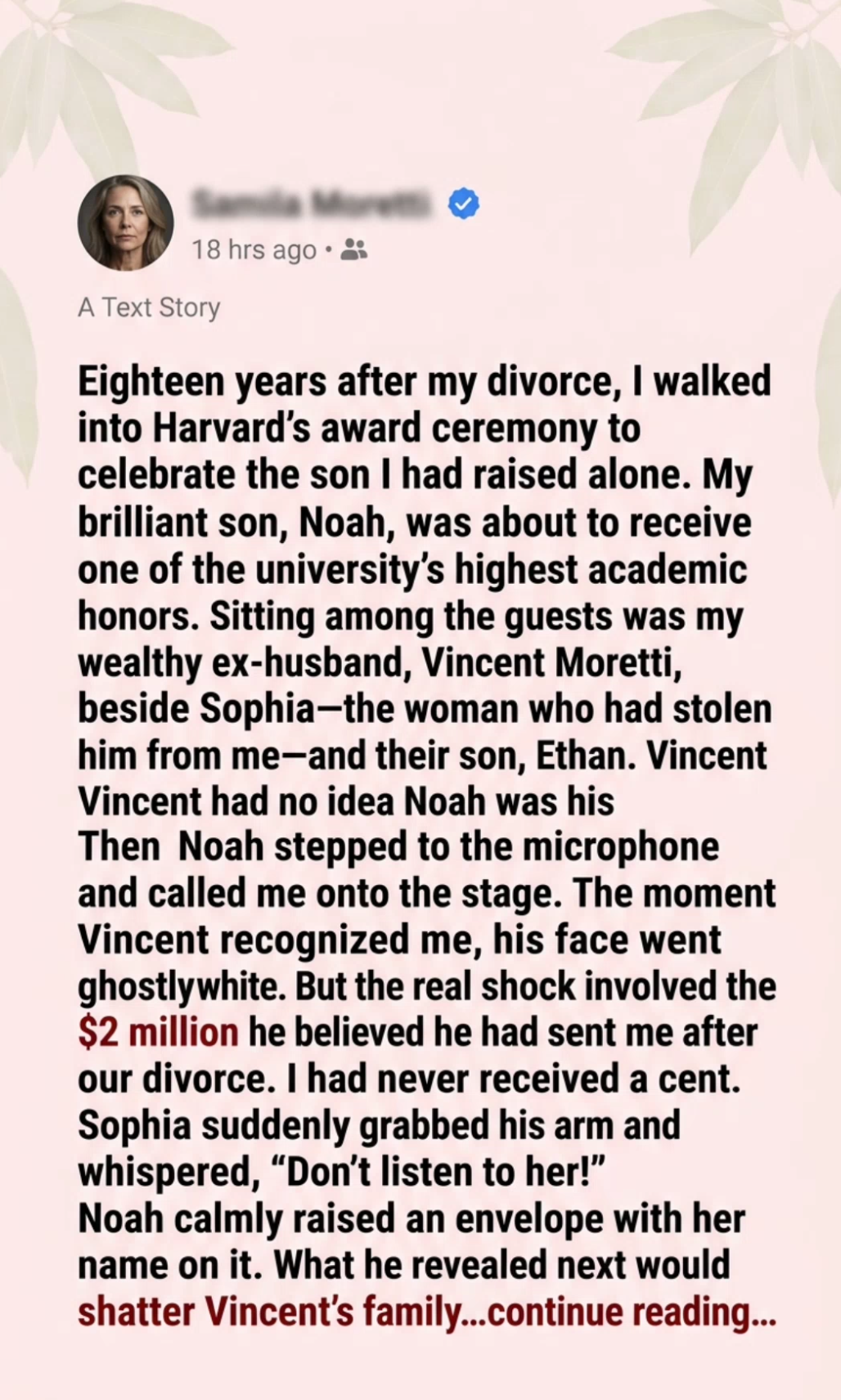
For eighteen years, I had imagined what it would feel like to see Vincent Moretti again.
Sometimes I pictured myself walking past him without looking back. Sometimes I imagined telling him everything I had kept inside since the day our marriage ended.
But I never imagined our reunion would happen inside Harvard University, beneath the golden lights of an auditorium filled with professors, distinguished guests, and proud families.
And I certainly never imagined that our son would be the one to bring us together.
My name is Claire Bennett. I was forty-five years old when I attended the ceremony that changed everything.
The boy I had raised alone, Noah, was twenty-one. He had just completed an extraordinary academic journey, earning recognition for his research in computational medicine. That evening, Harvard was presenting him with one of its highest student honors.
I had spent years working extra shifts, packing lunches before sunrise, and falling asleep beside textbooks I could barely afford to buy. I had watched him struggle through difficult subjects, lose confidence, recover, and eventually become a young man whose determination amazed me.
I didn’t care about the applause.
I didn’t care about the cameras.
I only wanted to see him walk across that stage.
What I didn’t know was that my past had purchased a seat in the front row.
And it was about to come back into my life.
Vincent Moretti had once been the person I trusted more than anyone.
We met when I was twenty-two. He was charming, ambitious, and working his way up in the financial industry. He spoke about building a future together, owning a home, traveling, and having children.
I believed him.
We married three years later.
For a while, our life was ordinary and happy. We rented a small apartment, saved money, and celebrated every promotion as if it were a family victory.
Then Vincent’s career accelerated.
He started working longer hours. His business dinners became frequent, and his phone seemed permanently attached to his hand.
That was when Sophia entered our lives.
She was a consultant at a company Vincent worked with. Beautiful, confident, and socially polished, she always seemed to know exactly what to say.
At first, I didn’t suspect anything.
Vincent described her as a professional contact. He said she understood the financial world better than most people and could help him with important clients.
Then I began noticing the small things.
He changed his passwords.
He stopped leaving his phone on the kitchen counter.
He became irritated when I asked simple questions.
One evening, I found a hotel receipt in his coat pocket.
When I asked him about it, he said it was from a business trip.
I believed him because I wanted to believe him.
But a few weeks later, I received an email from an unknown address.
It contained a photograph of Vincent and Sophia leaving a restaurant together, holding hands.
There was no explanation.
There didn’t need to be.
I confronted him that night.
He didn’t deny it.
Instead, he sat across from me at the dining table and said something I would remember for the rest of my life.
“I think we’ve both known this marriage was over for a while.”
I was stunned.
“We have a child on the way,” I said.
I was twelve weeks pregnant.
Vincent looked down at the table.
“I’ll take responsibility.”
That was all.
Not an apology. Not a promise to change. Not even an attempt to understand what he was doing to me.
He had already made his decision.
The divorce process began soon afterward.
Vincent’s lawyers handled most of the paperwork. His financial circumstances were considerably better than mine, and I was overwhelmed by the legal language, the meetings, and the sudden reality of becoming a single mother.
During one meeting, Vincent made an offer.
He said he would arrange a financial settlement of $2 million.
The money, he explained, would cover my living expenses and ensure that our child had a secure future.
I was shocked by the amount.
“Are you sure?” I asked.
He nodded.
“I don’t want you struggling. Whatever happened between us, the baby deserves a good life.”
For a brief moment, I saw the man I had married.
I signed the settlement documents after my lawyer reviewed them. The agreement stated that the payment would be transferred into an account designated for me after the divorce became final.
The divorce was completed.
Vincent moved on with Sophia.
And I prepared for the arrival of my son.
But the money never arrived.
At first, I thought the transfer was delayed.
Then I contacted the lawyer who had represented me during the divorce.
He said he would investigate.
A week later, he told me the settlement had apparently been handled through Vincent’s financial representatives and that he was trying to obtain confirmation.
Then his office closed after he relocated.
I contacted Vincent.
He didn’t answer.
I sent an email.
No response.
Eventually, I received a short message from an assistant saying that Vincent considered the settlement complete and that any further questions should be directed through legal counsel.
I was confused.
I had never received the money.
But I was pregnant, exhausted, and trying to find somewhere affordable to live.
I couldn’t spend every day chasing an answer from a man who had already abandoned our marriage.
I found a small apartment, took a job in administration, and gave birth to Noah.
Vincent never attended the birth.
He never called to ask how his son was doing.
He never sent a birthday card.
For eighteen years, he remained absent.
I raised Noah without telling him stories designed to make him hate his father. When he asked questions, I answered honestly but carefully.
“Your father and I couldn’t make our marriage work,” I would say.
“Does he know about me?”
“Yes.”
“Does he want to see me?”
I would pause.
“I don’t know, sweetheart.”
I didn’t know how to explain that I had once believed Vincent would be a good father, only to discover that he had chosen another life.
So I focused on the life Noah and I could build together.
Noah was a remarkable child.
He loved puzzles, computers, and science documentaries. When he was nine, he built a small weather station from inexpensive electronic components.
When he was thirteen, he started volunteering at a community learning center, helping younger students with mathematics.
At sixteen, he earned a scholarship to a prestigious preparatory program.
I was proud of him, but I also worried.
He was so determined to succeed that sometimes he forgot he was allowed to be young.
One night, during his final year of school, I found him studying at the kitchen table after midnight.
“You need sleep,” I told him.
“I just need to finish this section.”
“You said that two hours ago.”
He smiled.
“One more hour.”
I sat beside him.
“Noah, listen to me. I don’t need you to become extraordinary to make me proud.”
He looked up.
“I know.”
“I mean it. I would be proud of you even if you decided to do something completely different.”
He closed his laptop.
“I want to do this, Mom. Not because I have to. Because I want to.”
That was when I realized he wasn’t chasing success to repay me.
He genuinely loved what he was doing.
His work eventually attracted the attention of university researchers. He received financial aid and scholarships, and after graduating from high school, he was admitted to Harvard.
I cried when the acceptance letter arrived.
Noah hugged me and laughed.
“Mom, you’re going to make me cry too.”
“Too late,” I said.
I had spent eighteen years trying to give him a future that wasn’t limited by the circumstances of his birth.
Now he was building one for himself.
The ceremony invitation arrived three weeks before the event.
Noah called me while I was at work.
“Mom, you need to come early.”
“Why?”
“I have something planned.”
“What kind of something?”
“You’ll find out.”
I assumed he wanted to surprise me with a special seat or perhaps introduce me to one of his professors.
I bought a new navy-blue dress and a modest pair of shoes.
I didn’t own expensive jewelry. I wore the small silver necklace my mother had given me before she died.
On the evening of the ceremony, I arrived at the auditorium and found my assigned seat.
Then I saw Vincent.
He was sitting in the front section.
Eighteen years had changed him. His hair was mostly gray, and his face had become heavier, but I recognized him immediately.
Beside him sat Sophia.
She looked almost exactly as I remembered: elegant, composed, and perfectly dressed.
A young man sat on her other side. He appeared to be about seventeen.
Ethan.
Vincent and Sophia’s son.
I knew his name because I had seen it in a newspaper article about Vincent’s company.
I froze.
I had never expected to encounter them there.
Vincent was looking toward the stage, speaking quietly with a university representative. He hadn’t noticed me.
Sophia leaned toward him and whispered something.
Then she turned slightly.
Her eyes met mine.
For a moment, her expression disappeared.
She recognized me.
I considered leaving.
I didn’t want to create a scene at Noah’s most important academic celebration. I didn’t want my past interfering with his achievement.
Then the lights dimmed.
The ceremony began.
I sat quietly, holding my program with both hands.
Noah’s name appeared among the honorees.
My heart started beating faster.
A professor introduced his research, describing how his work had contributed to a promising approach to improving the analysis of certain complex medical conditions.
Then Noah walked onto the stage.
The audience applauded.
I stood with everyone else.
He accepted the recognition, shook hands with the university official, and approached the microphone.
“Thank you,” he began.
He spoke about his professors, his research partners, and the people who had supported him.
Then he paused.
“There is one person I need to thank before I finish.”
He looked toward the audience.
“My mother.”
I felt tears forming.
Noah continued.
“She worked when she was exhausted. She studied beside me when she had no reason to understand the things I was learning. She made sacrifices that I didn’t fully understand until I became old enough to recognize them.”
He smiled.
“She never allowed me to believe that my circumstances determined my future.”
Then he looked directly at me.
“Mom, would you please come up here?”
The audience turned.
I stood slowly.
As I walked toward the stage, I noticed Vincent finally looking in my direction.
His face changed.
First confusion.
Then recognition.
Then something that looked almost like fear.
He stood halfway from his seat.
“Claire?”
His voice was barely audible, but I heard it.
Sophia grabbed his arm.
“Vincent, sit down.”
He didn’t.
He stared at me as though eighteen years had disappeared.
I reached the stage and hugged Noah.
He whispered, “I’m glad you came.”
“I wouldn’t miss this for anything.”
He turned toward the microphone again.
“There’s something else I want to explain.”
He held up a sealed envelope.
It was cream-colored, with a name written across the front.
Sophia Moretti.
Sophia’s smile vanished.
Noah looked toward the audience.
“Some people might wonder why I am mentioning a private family matter at an academic ceremony. I understand that. But the person whose name is on this envelope has spent many years telling a story about my mother that isn’t true.”
Vincent turned toward Sophia.
“What is he talking about?”
She tightened her grip on his arm.
“Don’t listen to her!”
Noah shook his head.
“I’m not asking anyone to believe a story without evidence. This envelope contains documents I obtained through a legal investigation. I am not going to reveal anyone’s private financial information beyond what is necessary, but I believe the people involved deserve to know the truth.”
He looked at Vincent.
“My name is Noah Bennett. I am twenty-one years old. And you are my biological father.”
The auditorium became completely silent.
Vincent looked as though the air had been knocked out of his lungs.
“What?”
Noah continued calmly.
“My mother never hid who you were. She never told me to hate you. She simply waited for you to show an interest in knowing me.”
Vincent slowly turned toward me.
“Claire, is that true?”
I could barely speak.
“Yes.”
He looked back at Noah.
“You’re my son?”
Noah nodded.
Vincent sat down heavily.
Sophia stood.
“This is ridiculous. Anyone could make a claim like that.”
Noah opened the envelope.
“That’s why I have a certified copy of my birth certificate, the original divorce settlement, and the results of an independently conducted DNA test.”
Vincent stared at the documents.
“Why didn’t you tell me?”
I finally found my voice.
“I tried.”
He looked at me.
“I sent you messages. I contacted your office. I asked your representatives to confirm the settlement. You didn’t answer.”
Vincent shook his head.
“I was told you wanted nothing to do with me.”
“Who told you that?”
He looked confused.
“Sophia.”
The room seemed to grow colder.
Sophia stepped forward.
“Vincent, this is a setup. They’re trying to embarrass you.”
Noah held up the envelope.
“Then perhaps you can explain why your name appears on the documents connected to the $2 million settlement.”
Vincent turned toward her.
“What documents?”
Sophia didn’t answer.
Noah explained that he had not discovered the financial issue by accident.
During his second year at university, he had been working on a research project involving financial data integrity and digital document verification. One of his professors had encouraged him to learn more about how financial records could be authenticated.
Around that time, I had finally told Noah the full story about the divorce settlement.
I showed him the copy of the agreement.
He asked whether I had ever received the money.
I told him the truth.
Not one cent.
He was furious, but I asked him not to do anything reckless.
“I don’t want you wasting your future fighting an old battle,” I told him.
He promised he would be careful.
He began by asking a lawyer to review the settlement documents. The lawyer explained that the next step was to obtain the relevant financial records through lawful channels.
With my permission, the lawyer contacted the firm that had handled the payment.
After several requests, they located archived correspondence and transaction records.
The settlement had been authorized.
But the account that received the money was not mine.
It belonged to a company connected to Sophia.
The payment had been described as an investment-related transfer, not a personal settlement.
The records showed that a financial representative had received instructions to redirect the money.
One document contained a signature attributed to me.
I had never signed it.
The lawyer advised that the apparent authorization needed to be investigated as a possible forgery.
Noah then requested a formal accounting of the settlement through legal representatives.
That process revealed an even more troubling detail.
The account receiving the money had been established shortly after my divorce.
Sophia was listed as its controlling beneficiary.
Vincent had believed the $2 million had been paid to me.
I had believed he had never fulfilled his promise.
For eighteen years, both of us had lived with a lie.
And someone had benefited from it.
Vincent stood again.
“That’s impossible.”
Noah looked at him.
“Then ask your financial advisers. Ask your lawyers. Ask the bank. The documents are all there.”
Sophia’s voice rose.
“Those records are being misinterpreted!”
Vincent turned to her.
“Did you receive the money?”
She looked at him.
“I managed the account. It was complicated.”
“Did you tell me the settlement had been transferred to Claire?”
Sophia hesitated.
“I was trying to protect our family.”
Vincent’s face tightened.
“Answer the question.”
She looked around the auditorium.
“Not here.”
But Vincent was no longer listening to her.
He looked at me.
“Claire, I thought you received it. I swear I thought you received it.”
I felt a strange mixture of anger and sadness.
“You never checked?”
He didn’t answer.
“You never asked for proof that our child had been supported? You never wondered whether I had received the money?”
“I was told everything was handled.”
“By the woman who received it?”
Vincent lowered his head.
For eighteen years, I had imagined him apologizing.
Now that he was standing in front of me, I realized that an apology could not return those years.
Noah stepped between us.
“Mom doesn’t owe you an answer tonight.”
Then he turned toward Vincent.
“And I don’t owe you a relationship simply because you have finally learned my name.”
Those words seemed to hurt Vincent more than anything else.
Ethan, who had been sitting silently, stood up.
“Dad?”
Vincent turned.
Ethan looked at Sophia.
“Did you know?”
She reached for him.
“Ethan, this is complicated.”
“Did you know he had another son?”
Sophia said nothing.
Ethan stepped away.
For the first time that evening, I saw the young man rather than the wealthy family’s son.
He looked confused and embarrassed.
He had not caused any of this.
I hoped he understood that.
The university’s event staff quietly brought the ceremony to a close.
Noah had not planned to turn his award into a public confrontation. He had intended to recognize me and make the truth known to Vincent privately after the ceremony.
But when he saw Sophia in the audience, he decided that the documents should be presented while everyone involved was present.
I was uncomfortable with the public attention.
Yet I understood why he had done it.
For years, Sophia had controlled the story Vincent heard about me.
Now he had finally heard my side.
After the auditorium emptied, we met in a private conference room with Noah’s lawyer, who had been waiting nearby.
Vincent arrived without Sophia.
He looked older than he had an hour earlier.
He sat across from me.
“I don’t know what to say.”
“Then don’t say anything you don’t mean.”
He rubbed his forehead.
“I should have checked. I should have contacted you directly.”
“Yes.”
“I should have known about Noah.”
“Yes.”
He swallowed.
“Can I speak to him?”
I looked toward Noah.
He stood near the window.
“That’s his decision,” I said.
Vincent turned to him.
“Noah, I know I can’t make up for eighteen years. But I’d like a chance to know you.”
Noah considered him for a long moment.
“I don’t know you either.”
“I understand.”
“You don’t get to walk into my life and expect me to call you Dad.”
Vincent nodded.
“I’m not asking for that.”
“Good.”
Noah looked at the envelope.
“First, I want the money issue investigated properly. Not because I need it. My mother and I built a life without it. But because she was entitled to that settlement, and someone took it.”
Vincent agreed to cooperate.
He also agreed to preserve all relevant records and communicate through the lawyers while the financial investigation continued.
It was the first responsible thing I had seen him do in eighteen years.
But it did not erase what had happened.
The investigation lasted several months.
Financial specialists examined the old transfer, the company that received it, and the documents used to authorize the payment.
They discovered that the $2 million had been divided between several accounts over time.
A portion had been used to purchase investment assets.
Another portion had paid expenses connected to Sophia’s private business interests.
The investigators also found correspondence indicating that Sophia had been aware that the settlement was intended for me.
One email was particularly important.
It showed that she had asked a financial representative whether Vincent would be able to identify the destination account.
The representative had warned that the transfer could be questioned.
Sophia responded that Vincent had already been informed the settlement was complete.
That correspondence became part of the formal investigation.
Sophia denied stealing the money. Her lawyers argued that she had been managing funds under Vincent’s instructions and that the documents did not establish criminal intent.
But the evidence led to civil proceedings and a separate criminal investigation into the allegedly falsified authorization.
Vincent also discovered that Sophia had repeatedly assured him that I had declined further financial support and wanted no contact with him.
There was no evidence that I had ever made such a request.
The case was eventually resolved through a combination of court proceedings and a negotiated financial settlement.
A substantial portion of the original money, together with agreed interest and costs, was recovered and transferred to an account in my name under the settlement terms.
Sophia faced legal consequences for the conduct established by the investigation.
Her marriage to Vincent did not survive.
But I did not celebrate her divorce.
By then, I had learned that someone else’s downfall could not give me back my lost years.
Vincent contacted Noah several times after the ceremony.
At first, Noah didn’t respond.
Then, after discussing it with me, he agreed to meet him for lunch.
I didn’t attend.
It was important that Noah make his own decision.
They met at a quiet restaurant near campus.
When Noah returned that evening, he looked thoughtful.
“How was it?” I asked.
“Strange.”
“Did he say anything?”
“He apologized.”
I waited.
“He said he didn’t know I existed.”
I looked at him.
“Do you believe him?”
Noah shrugged.
“I believe he may not have known. But he chose not to check. That’s different.”
I nodded.
“You’re allowed to take your time.”
“I know.”
He sat beside me.
“Mom, are you angry that I met him?”
“No.”
“Even after everything?”
I smiled sadly.
“He’s your father. You deserve the freedom to decide what that means to you.”
Noah rested his head against my shoulder.
“I already know who raised me.”
I kissed the top of his head.
And for the first time in a long while, I felt that the past was finally losing its hold on us.
A few months later, I received an invitation from Noah.
He had arranged a small dinner to celebrate the completion of his academic year.
There were no cameras, no university officials, and no speeches.
Just family and friends.
Noah had invited Vincent.
I wasn’t sure how I felt about that, but I agreed to attend.
Vincent arrived carrying a modest gift.
He looked nervous.
He greeted me politely, then turned toward Noah.
“I wasn’t sure what to bring you.”
Noah smiled.
“You didn’t have to bring anything.”
They spoke for a while about university, research, and work.
It was awkward, but not hostile.
Ethan was not there. He had chosen to remain with his mother while he processed the situation. Noah respected that.
At the end of the evening, Vincent approached me.
“I know an apology isn’t enough,” he said.
“No, it isn’t.”
“I can’t change the fact that I wasn’t there.”
“No.”
He looked down.
“But I want you to know that I regret believing someone else’s version of events without speaking to you.”
I studied his face.
There was no satisfaction in seeing him regret his choices.
Only a quiet understanding that the life we once shared was gone.
“I hope you learn to listen before you make decisions about people,” I said.
He nodded.
“I will.”
I didn’t forgive him that night.
Maybe I never would.
But I no longer needed him to understand my pain in order to move forward.
As I left the restaurant, Noah caught up with me.
“Mom?”
“Yes?”
“Are you happy?”
I looked at him.
He was no longer the little boy who used to fall asleep over mathematics homework at our kitchen table.
He was a confident young man with a future he had earned through his own work.
I thought about the years when I had worried about rent, worked late, and wondered whether I was giving him enough.
Then I thought about the $2 million that had disappeared, the marriage that had ended, and the man who had finally discovered the son he had missed.
I smiled.
“I’m proud of the life we built.”
Noah took my hand.
“Me too.”
That night, I finally understood something.
The greatest achievement of my life wasn’t seeing my son receive an honor at Harvard.
It wasn’t recovering money that should have been mine.
And it certainly wasn’t watching the woman who had once humiliated me face the consequences of her decisions.
It was the fact that, despite everything, Noah had grown into a kind and thoughtful man.
He had been raised without the money, the privilege, or the protection his father could have provided.
But he had never been raised without love.
And when he finally stood before the people who had shaped his past, he didn’t use his success to ask for revenge.
He used his voice to give his mother the truth she had been denied for eighteen years.
THE END.