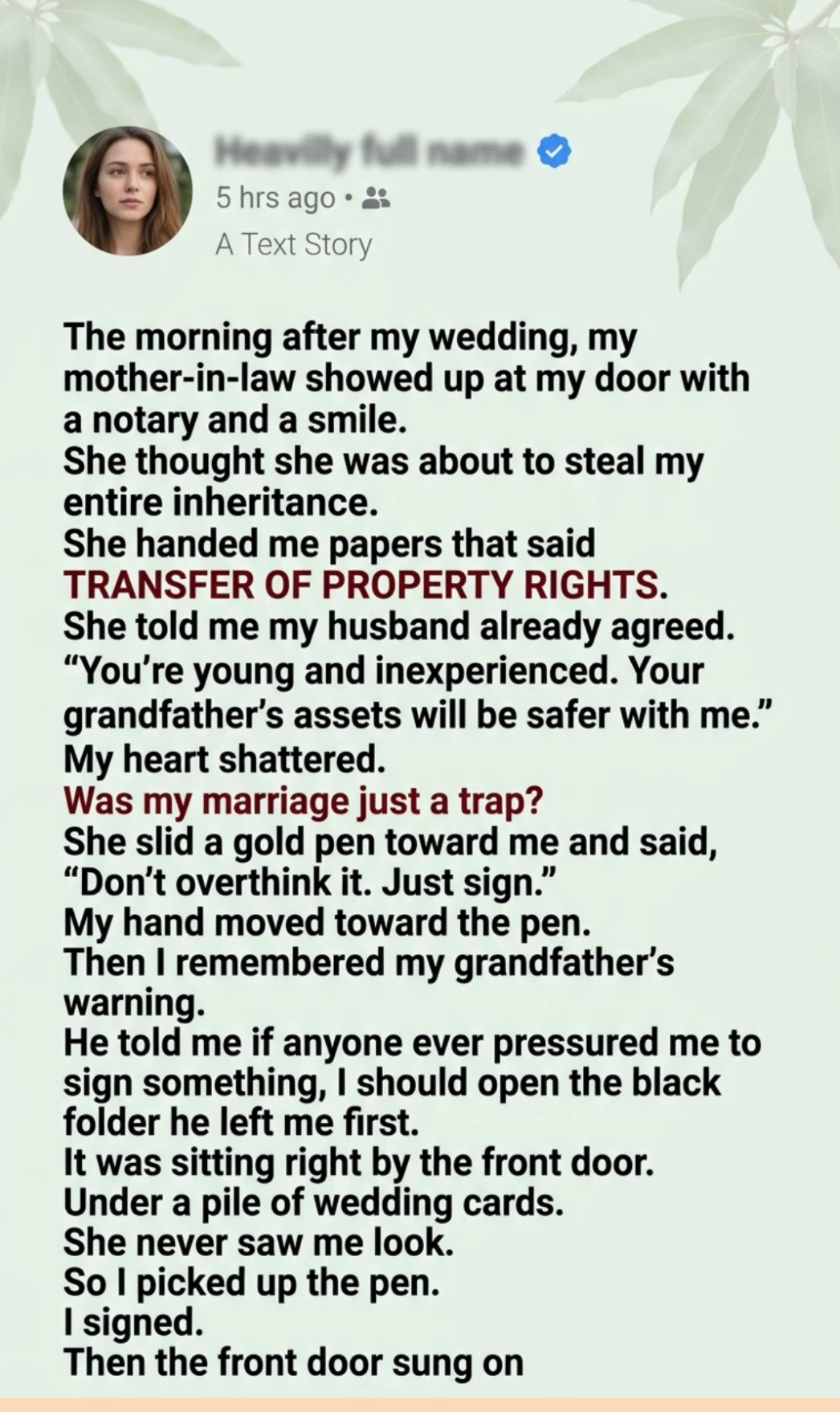
The morning after my wedding, my mother-in-law arrived at my front door with a notary, a leather handbag, and a smile that made my stomach tighten.
She was carrying a folder.
Not a wedding gift.
Not flowers.
Legal documents.
“Good morning, sweetheart,” Margaret said brightly. “I hope you had a wonderful wedding night.”
I stood in the doorway wearing an oversized sweater, my hair still messy from the previous evening.
“Margaret? What are you doing here?”
She stepped inside without waiting for an invitation.
“This won’t take long. I brought someone who can make everything official.”
The man behind her introduced himself as Mr. Lewis, a licensed notary. He carried a small briefcase and looked uncomfortable.
Margaret placed the folder on my dining table.
“Now, let’s get this settled before your husband gets home.”
I looked down.
Across the first page were four words:
TRANSFER OF PROPERTY RIGHTS.
My heart began beating faster.
“What is this?”
“Just some paperwork concerning your grandfather’s estate.”
“My grandfather’s estate?”
Margaret smiled.
“Your husband and I have discussed it. He agrees that the assets would be safer under my management.”
I stared at her.
“My husband discussed my inheritance with you?”
“Of course. He’s concerned about you. You’re young and inexperienced when it comes to managing substantial property.”
My grandfather had left me three properties, a portfolio of investments, and a controlling interest in a small manufacturing company he had built over thirty years.
It wasn’t an enormous international empire, but it was enough to give me financial independence for the rest of my life.
And he had been very clear about one thing.
Everything was mine.
Not my husband’s.
Not his parents’.
Mine.
“Why would your son agree to transfer my inheritance?” I asked.
Margaret sighed as though I were being unreasonable.
“Because he understands responsibility. You two are married now. We should behave like a family.”
She pushed the documents toward me.
“Your grandfather was old-fashioned. He left everything in your name without considering what would happen when you married. I’m simply helping you correct that mistake.”
I felt something cold settle inside me.
My grandfather had died eight months earlier.
During his final months, he had warned me that some people might become interested in his estate after his death.
I had assumed he meant distant relatives or business acquaintances.
I had never imagined he was talking about the family I was about to marry into.
Margaret tapped the signature line.
“Just sign, dear. We can discuss the details later.”
I looked at the notary.
“Have you reviewed these documents?”
He adjusted his glasses.
“I was asked to witness the signatures and verify identities. I haven’t been retained to advise you on the legal effect of the transfer.”
“So you can’t tell me whether signing this would transfer ownership?”
“Correct. You should obtain independent legal advice before signing anything you don’t understand.”
Margaret’s smile tightened.
“Oh, please. Don’t make this complicated. We’re family.”
I looked at the document again.
It wasn’t a simple management authorization.
It was a transfer of ownership.
If I signed it as written, I could surrender rights to property that had belonged to my grandfather for decades.
“Where is Daniel?” I asked.
“My son is at work.”
“Did he actually agree to this?”
Margaret’s eyes narrowed.
“He knows what’s best.”
That wasn’t an answer.
My husband, Daniel, and I had been married for less than twenty-four hours.
We had dated for two years.
During that time, he had seemed patient, affectionate, and supportive. He had never asked me for money. He had never directly requested access to my grandfather’s assets.
But his mother had always been unusually interested in my inheritance.
At family dinners, she asked about the properties.
She wanted to know how much rent the commercial building generated.
She asked whether my grandfather had left shares in the manufacturing company.
Once, she even suggested that Daniel should become the person responsible for managing everything.
I had dismissed those comments as ordinary curiosity.
Now I wondered how much of my marriage had been built around those questions.
Margaret slid a gold pen across the table.
“Don’t overthink it. Just sign.”
I looked toward the front door.
Beside the shoe cabinet sat a pile of wedding cards and gift envelopes.
Underneath them was a black folder.
My grandfather had given it to me three weeks before he died.
He had held my hand and said something I had never forgotten.
“Listen carefully, Evelyn. If anyone ever pressures you to sign something involving my estate, don’t argue. Don’t explain. Open the black folder first.”
At the time, I had asked him why.
He simply answered:
“Because the truth is sometimes easier to recognize when you have the documents in front of you.”
The folder was still there.
Margaret hadn’t noticed it.
I reached for the gold pen.
“All right,” I said quietly.
Her expression brightened.
“Wonderful. I knew you’d understand.”
Mr. Lewis looked at me with concern.
“Are you certain you wish to proceed?”
I held his gaze.
“I’m certain I want this matter completed.”
Then I signed.
Margaret watched every movement.
When I finished, she quickly collected the documents.
“Excellent. I’ll take these to the lawyer today.”
I placed the pen on the table.
“Of course.”
She stood, looking extremely pleased with herself.
Then the doorbell rang.
Margaret turned.
“Who could that be?”
I walked toward the entrance and opened the door.
A woman in a charcoal suit stood outside, holding a briefcase.
Behind her was an older man carrying a document case.
“Good morning, Evelyn,” the woman said. “I’m Rachel Morgan. We spoke yesterday. Your grandfather’s estate attorney.”
Margaret’s smile disappeared.
“Why is she here?”
Rachel looked at her.
“Because Evelyn contacted our office last night.”
Margaret turned toward me.
“You contacted a lawyer?”
“I wanted to make sure everything was in order.”
Rachel stepped inside.
She glanced at the documents in Margaret’s hand.
“Are those the transfer papers?”
Margaret tightened her grip.
“This is a private family matter.”
Rachel didn’t argue.
“I’m afraid it may no longer be private. May I see the documents?”
Margaret looked at me.
“Evelyn, tell her there’s been a misunderstanding.”
I took a breath.
“Rachel, I signed them.”
Margaret smiled again.
“Exactly. Everything is settled.”
Rachel didn’t smile.
“Then we need to discuss what was signed, how it was presented, and whether the transfer can legally take effect.”
Margaret’s face changed.
“What do you mean?”
Rachel opened her briefcase.
“Before we discuss the documents, Evelyn, did you read the black folder your grandfather left you?”
I looked toward the shoe cabinet.
“No. Not yet.”
“Then I suggest we do that first.”
Margaret laughed nervously.
“What is this ridiculous folder supposed to prove?”
I picked it up.
It was heavier than I remembered.
Inside were several sealed envelopes, copies of property records, company documents, and a handwritten letter.
The first envelope was marked:
“Open only if someone attempts to take control of my granddaughter’s inheritance.”
My hands trembled as I opened it.
My grandfather’s handwriting filled the page.
My dear Evelyn,
If you are reading this, someone has probably tried to convince you that your inheritance should belong in someone else’s hands.
I hope I am wrong.
I hope the people around you love you for who you are and not for what I worked so hard to leave you.
But I have learned that money can make people reveal things they would otherwise keep hidden.
So I made arrangements.
I turned the page.
The properties are held through a structure designed to protect your ownership and prevent unauthorized transfers. No relative, spouse, or family member has authority to manage or transfer those assets simply because of a marriage.
You may choose to appoint someone to assist you, but that choice must be voluntary and properly documented.
I looked up at Rachel.
She nodded.
“Your grandfather established an estate holding company and a separate management arrangement. The property titles were transferred into that structure before his death. You are the sole beneficial owner of the interests designated for you.”
Margaret frowned.
“What does that mean?”
“It means,” Rachel replied, “that the papers you brought today may not be sufficient to transfer the properties in the way you intended.”
Margaret’s face reddened.
“But she signed!”
Rachel examined the documents.
“Signing a document does not automatically make every provision valid or enforceable. We need to review the wording, the authority of the parties, the relevant ownership records, and the circumstances under which the signature was obtained.”
I continued reading.
The next page contained something that made my stomach drop.
My grandfather had written:
I became concerned after Daniel and his mother requested financial information about the estate through several different channels.
I looked at Margaret.
She was staring at the folder.
Rachel continued explaining.
“Your grandfather also instructed the company administrator to monitor requests for changes in ownership and management authority. No transfer can be processed without the required independent verification.”
I turned another page.
There was a copy of an email.
It had been sent to my grandfather’s estate office six months earlier.
The sender was Daniel.
He had asked whether my marriage would give him any legal rights over the properties.
The response from the estate office explained that marriage alone would not make him an owner.
But Daniel hadn’t stopped there.
A second email, sent three weeks later, asked whether my grandfather had created any restrictions that could be removed after his death.
The estate administrator had flagged both messages and informed my grandfather.
I read the emails again.
Daniel had been asking about my inheritance before he proposed.
My hands went cold.
Margaret suddenly stood.
“This is absurd. Daniel was only asking questions because he wanted to protect his future family.”
Rachel closed the folder.
“Then he should have discussed those concerns with Evelyn openly rather than arranging a transfer of assets without her independent advice.”
Margaret turned toward me.
“Your grandfather was suspicious of everyone. He made you paranoid.”
I looked at her.
“Why did you tell me Daniel had already agreed?”
She hesitated.
“He did agree.”
“Then I’ll call him.”
I took out my phone.
Margaret moved quickly.
“There’s no need to involve him.”
I looked at her.
“You said he agreed. Why shouldn’t I ask him?”
She didn’t answer.
I called Daniel.
He picked up after several rings.
“Hey, sweetheart. Everything okay?”
“Your mother is here.”
There was a pause.
“What?”
“She brought a notary and documents transferring my inheritance to her.”
Silence.
Then Daniel said, “What documents?”
“She told me you agreed.”
His voice changed.
“Evelyn, don’t sign anything.”
I looked at the papers in Margaret’s hand.
“I already signed.”
He went quiet.
Then he asked, “Did you sign the transfer?”
“Yes.”
I watched Margaret carefully.
She looked relieved.
Daniel’s voice became urgent.
“Why would you do that?”
I answered calmly.
“Because your mother told me you had already approved it.”
He said something under his breath.
Then he told me he was coming home immediately.
I ended the call.
Rachel asked me to preserve every document and message and not to make any further agreements until the legal review was complete.
Mr. Lewis, the notary, looked increasingly uncomfortable.
“I want to make one thing clear,” he said. “I witnessed the signature. I did not tell Ms. Carter that the transfer was advisable, and I did not provide legal advice.”
Rachel nodded.
“Thank you. We will record your role accurately.”
Margaret grabbed her handbag.
“This is a family misunderstanding. I’m leaving.”
“Please don’t take the signed documents,” Rachel said. “We need to make copies and document exactly what was presented.”
Margaret looked furious.
“You cannot keep my paperwork!”
Rachel answered evenly.
“We are not taking your property. We are preserving copies of documents signed by our client so that their legal effect can be reviewed.”
Margaret reluctantly placed the folder on the table.
About twenty minutes later, Daniel arrived.
He walked straight into the living room.
“What is going on?”
His eyes moved from his mother to Rachel, then to the black folder.
“Evelyn, can we talk privately?”
“No,” I said. “You can explain here.”
He looked uncomfortable.
“Mom was trying to help.”
“Help with what?”
“With managing the estate. She has experience with property.”
I stared at him.
“Why did you email my grandfather’s estate office before we were engaged?”
Daniel’s face changed.
“What?”
I held up the printed emails.
Rachel had already made copies.
He looked at the pages.
Then he looked at his mother.
Margaret immediately spoke.
“Daniel, tell her we discussed this. Tell her you wanted everything organized.”
He didn’t answer.
I asked him one question.
“Did you know she was coming here today with a notary?”
Daniel rubbed his forehead.
“I knew she wanted to talk to you.”
“That isn’t what I asked.”
He looked at the floor.
“Yes.”
My chest tightened.
“And did you agree that my inheritance should be transferred to your mother?”
“I thought it would be easier if she managed it.”
“Why?”
“Because she knows how these things work.”
I took a step toward him.
“You’ve been married to me for one day. You haven’t even asked whether I wanted someone else managing my assets.”
He raised his hands.
“I was trying to make things easier for us.”
“Then why didn’t you ask me?”
He had no answer.
Rachel interrupted gently.
“Before anyone makes further statements, I recommend that all communication about the signed documents go through independent legal counsel.”
Daniel looked at her.
“Can the transfer still happen?”
Rachel replied carefully.
“That depends on the documents, the ownership structure, the governing law, and whether the necessary legal requirements have been met. We will not make assumptions. But the fact that Ms. Carter signed under the circumstances described today requires careful review.”
Margaret suddenly became angry.
“You tricked us!”
I looked at her.
“You brought a notary to my home the morning after my wedding. You told me my husband had agreed. You said I was too inexperienced to manage my own inheritance. And you expected me to sign without independent advice.”
“I was protecting the family!”
“Which family?”
She opened her mouth.
Then closed it.
Daniel stepped toward me.
“Evelyn, please. We can work this out.”
I looked at the wedding ring on my finger.
Only yesterday, I had promised to build a life with this man.
Today, I was discovering that he and his mother had discussed my inheritance before I had even become his wife.
“Did you marry me because you loved me?” I asked.
Daniel’s expression softened.
“Of course I did.”
“Then why did you make plans for my money before we were married?”
“I didn’t make plans to steal anything.”
“You made plans to control something that wasn’t yours.”
He looked away.
Rachel collected the signed documents and explained that her office would review the situation immediately. She also recommended that I avoid further contact about the transfer until the legal position was clear.
Margaret left first.
Daniel remained in the doorway.
“Are you really going to let a lawyer come between us on our second day of marriage?”
I looked at him.
“No. You and your mother brought the lawyer into our marriage.”
He had nothing to say.
That evening, I stayed at my sister’s apartment.
I barely slept.
I kept remembering the wedding photographs, Daniel’s vows, his smile when he put the ring on my finger.
I wondered whether he had meant any of it.
Over the next several weeks, Rachel and her team examined the documents.
The review established that the properties were held through the estate structure my grandfather had created. The transfer papers did not satisfy the requirements for changing the beneficial ownership of those assets.
More importantly, the documents attempted to grant Margaret broad control over property that she had no existing right to manage.
The legal team notified the relevant administrators that the signed papers were disputed and instructed them not to process any change without proper authorization.
An independent solicitor reviewed the circumstances of the signature.
Because I had been told that my husband had approved the transfer and had been pressured to sign immediately, the documents required further legal assessment. My grandfather’s estate arrangements and the governing property law provided protections that Margaret had apparently not understood.
Eventually, the attempted transfer was formally rejected by the relevant administrators.
The properties remained under the estate structure.
I remained the sole beneficial owner of my inheritance.
But the most painful discovery came later.
During the legal review, Daniel’s messages to his mother were produced.
In one exchange, he wrote:
“She’ll probably sign if you tell her it’s already been discussed. She hates conflict, especially when she feels like she’s disappointing family.”
Margaret replied:
“I’ll bring the notary. Once it’s signed, she’ll have to accept that it’s done.”
Daniel answered:
“Just make sure she doesn’t call Rachel first.”
I read the messages in silence.
They hadn’t simply made a poor decision.
They had planned to use my trust and my fear of disappointing people against me.
I filed for an annulment review and sought independent legal advice about ending the marriage. The process took time, and the outcome depended on the applicable legal requirements, not simply on how terrible their behavior had been.
Daniel tried to contact me repeatedly.
He sent flowers.
He wrote long messages.
He asked to meet.
He said his mother had pressured him.
He said he had never expected things to go this far.
But I had already learned something important.
A person who truly loves you does not help someone else prepare documents to take away your independence.
And a person who respects you does not need to trick you into signing.
Several months later, I returned to my grandfather’s old house.
I sat in his study, opened the black folder, and read his letter again.
At the bottom of the final page, there was one more sentence:
“Your inheritance is not just money or property, Evelyn. It is the freedom to choose your own life. Never sign that freedom away because someone tells you it would make you easier to love.”
I cried for a long time.
Not because I had lost my marriage.
Because I finally understood why my grandfather had been so careful.
He had not tried to teach me to distrust everyone.
He had tried to teach me that love and financial control were not the same thing.
I eventually rebuilt my life.
I kept the properties, continued managing the family company with professional advisers, and stopped feeling obligated to explain my financial decisions to people who had never earned the right to make them.
I also kept the black folder.
Not as a reminder of Margaret.
Not even as a reminder of Daniel.
But as a reminder of the morning I nearly signed away everything because I wanted to believe my new family had good intentions.
The gold pen was still in my desk drawer.
I never used it again.
THE END.