My sister wore white to the funeral.
Not cream. Not pale gray. Not even the soft beige people sometimes choose when they want to look elegant without attracting attention.
White.
She arrived at the church in a designer dress, carrying a small black handbag, with her diamond wedding ring flashing whenever she moved her hand.
Her name was Vanessa.
She was thirty-eight years old, beautiful, ambitious, and very good at making people believe that everything happening in her life was exactly what she had planned.
The man in the coffin was Daniel Whitmore.
He was forty-three.
He had died unexpectedly four months after marrying my sister.
And he had once been my husband.
My name is Claire Bennett. I was forty-one when Daniel died, and I had spent the previous seven years trying to forget the marriage we had shared.
Daniel and I had been married for nine years.
When we first met, he was a quiet financial analyst working for a regional investment firm. He wore inexpensive suits, drove an old sedan, and rented a modest apartment.
He wasn’t wealthy.
He wasn’t influential.
He wasn’t even particularly confident.
But he was thoughtful.
He remembered small things. He brought me coffee when I worked late. He called my mother on her birthday. When I was sick, he sat beside my bed and read aloud because he knew I hated being alone.
I loved that man.
We built our life slowly.
I worked as an accountant, and Daniel moved through several financial positions before eventually joining a private investment group.
His career changed dramatically when he helped restructure a struggling portfolio of commercial properties.
A few years later, he established his own investment company.
Success arrived faster than either of us expected.
The first office was small. Then came larger clients, commercial acquisitions, private investment partnerships, and eventually a portfolio worth tens of millions.
Daniel became wealthy.
And somewhere along the way, our marriage began to disappear.
He worked longer hours. He traveled constantly. He hired assistants and advisers who seemed to know more about his schedule than I did.
He began treating our home like another property he owned rather than a place where we lived together.
At first, I blamed the pressure.
Then I discovered that he had been having an affair with a woman from his business circle.
We argued for months.
Daniel apologized, promised to change, and then continued behaving as though his success entitled him to make his own rules.
Eventually, I filed for divorce.
We separated without children and without a prolonged courtroom battle. Our attorneys negotiated the division of the marital assets, and the divorce was finalized.
I received a fair settlement and retained my own savings.
Daniel kept his investment company and the assets that belonged to him.
We had no reason to remain in contact.
For several years, we didn’t.
I moved on with my life.
I changed jobs, bought a smaller home, and concentrated on building a career that didn’t revolve around someone else’s ambitions.
I occasionally heard about Daniel through mutual acquaintances.
He was becoming extremely wealthy.
He had purchased commercial properties, invested in several technology companies, and developed relationships with people whose names regularly appeared in financial magazines.
Then I heard he was dating Vanessa.
My younger sister.
Vanessa and I had never been particularly close.
We grew up in the same house, attended the same schools, and shared the same parents, but we had very different personalities.
I was practical.
Vanessa was competitive.
When we were children, she always wanted the better dress, the bigger birthday cake, and the most attention.
As adults, that behavior became more sophisticated.
If I bought a house, she would mention the neighborhood she was considering.
If I received a promotion, she would talk about a business opportunity that could make her even more successful.
She wasn’t always unkind.
But she had a habit of measuring her life against mine.
When she first told me she was dating Daniel, I thought she was joking.
We were having lunch at a restaurant when she casually mentioned his name.
“Daniel Whitmore,” she said, stirring her coffee.
I nearly dropped my fork.
“Which Daniel?”
She smiled.
“You know which one.”
I stared at her.
“You’re dating my ex-husband?”
“We’re seeing each other.”
“How long?”
“About six months.”
I felt my face become hot.
“Why didn’t you tell me?”
“Because I knew you’d react like this.”
“Like what?”
“Like I did something wrong.”
I put my fork down.
“Vanessa, you know what happened between us.”
She shrugged.
“That was years ago. You divorced him. You don’t own him.”
“I never said I did.”
“Then why are you upset?”
I looked at my sister.
I wanted to believe there was some innocent explanation.
Perhaps Daniel had changed.
Perhaps Vanessa had met him without knowing how deeply our marriage had ended.
But she knew.
She had known about the affair.
She had sat beside me during the divorce and listened while I cried about the things he had done.
Now she was dating him.
“I hope you know what you’re doing,” I said.
Vanessa smiled.
“Trust me. I know exactly what I’m doing.”
She married Daniel seven months later.
The wedding was held at a luxury hotel overlooking the coast.
I received an invitation.
I didn’t attend.
My mother called me afterward and accused me of embarrassing the family.
“Your sister wanted you there,” she said.
“Then she shouldn’t have married my ex-husband.”
“That’s unfair. Daniel is a different man now.”
“I’m glad if he is.”
“Then why can’t you be happy for her?”
I didn’t answer.
There were some arguments that became exhausting long before they became productive.
I sent Vanessa a short congratulatory message.
She replied with a photograph of her wedding ring.
Thank you. Everything happens for a reason.
I deleted the conversation.
Four months later, Daniel died.
The announcement came from a mutual acquaintance.
He had collapsed during a private business meeting and was taken to a hospital. Despite emergency treatment, he died that evening.
The cause was later determined to be a sudden cardiac event.
He was forty-three.
I felt strangely disconnected when I heard.
I hadn’t loved Daniel for years.
But I had once loved him deeply.
His death brought back memories I thought I had buried.
I remembered our first apartment.
The cheap furniture.
The evenings when we ate takeout on the floor because we couldn’t afford a proper dining table.
The way he used to laugh when I burned dinner.
I remembered the man he had been before wealth changed the shape of our marriage.
I also remembered the man he had become.
Both memories were true.
I attended the funeral because my mother asked me to.
Vanessa sat in the front row.
She looked devastated, although she maintained a composed expression whenever relatives approached.
I sat several rows behind her.
After the service, she approached me.
“Claire.”
I turned.
“I’m sorry about Daniel,” I said.
She looked at me for a moment.
“Thank you.”
Then she glanced at my clothes.
“You didn’t have to come.”
“Mother asked me.”
“I know.”
There was something unpleasant in her voice.
She leaned closer.
“Daniel and I were very happy.”
I nodded.
“I’m glad.”
“He loved me.”
I looked at her.
“I hope you had a good marriage.”
Her expression changed.
For a moment, I thought she might say something cruel.
Instead, she simply walked away.
Three weeks later, I received a letter from a law firm.
It was from Daniel’s estate attorney, a man named Thomas Reed.
He requested that I attend a formal meeting concerning Daniel’s will.
I assumed there had been an administrative issue.
Perhaps Daniel had forgotten to update an old beneficiary designation.
Perhaps he had left some personal property that belonged to me.
I called Thomas’s office.
His assistant confirmed that I was specifically named in the estate documents.
“Can you tell me why?” I asked.
“I’m afraid Mr. Reed needs to explain that in person.”
I considered declining.
Then I remembered Daniel’s habit of keeping old documents and letters.
Perhaps there was something important I needed to know.
I agreed to attend.
The meeting was scheduled for Tuesday morning.
The attorney’s office occupied the seventh floor of a modern building.
I arrived ten minutes early.
Vanessa was already there.
She sat beside the conference table, wearing a fitted black dress and a diamond necklace.
She looked at me when I entered.
“Claire.”
“Vanessa.”
She glanced at the chair across from her.
“Interesting. I didn’t know you were invited.”
“Apparently, I was.”
She gave a small laugh.
“Daniel must have left you something sentimental.”
I didn’t answer.
Her attorney sat beside her, reviewing a folder.
Thomas Reed entered a few minutes later.
He was in his early sixties, with silver hair and a calm manner.
He greeted everyone and placed a thick estate file on the table.
“Thank you for coming,” he said.
Vanessa immediately leaned forward.
“Can we get this over with? I have several appointments.”
Thomas looked at her.
“Of course. We will proceed according to the documents.”
Vanessa settled into her chair.
She looked confident.
I understood why.
Daniel’s estate was substantial.
His investment company held interests in commercial real estate, private funds, and several operating businesses.
The estimated value was approximately $68 million, although the final estate valuation had not yet been completed.
Vanessa believed she would inherit nearly everything.
She had told relatives as much.
She had already discussed selling one of Daniel’s properties and purchasing a larger home.
She seemed to think the will reading was simply a formality.
Thomas opened the file.
He began with the usual matters: funeral expenses, outstanding obligations, estate administration, and the appointment of the personal representative.
Then he turned to the inheritance provisions.
Vanessa smiled.
Thomas read several paragraphs.
The first portion of the estate was directed toward settling taxes, liabilities, and administrative expenses.
A charitable foundation would receive a specified contribution.
Several employees would receive payments under existing agreements.
Daniel’s sister was named as a beneficiary of a separate investment account.
Vanessa’s smile remained.
Then Thomas turned another page.
He paused.
“There’s also a sealed letter attached to the will.”
Vanessa frowned.
“What letter?”
Thomas removed a cream-colored envelope.
It had Daniel’s handwriting across the front.
He looked at it for several seconds.
Then he said, “This letter is addressed to Claire Bennett.”
Vanessa stopped smiling.
I felt my stomach tighten.
Thomas opened the envelope.
He unfolded the letter.
Then he looked directly at me.
And began reading.
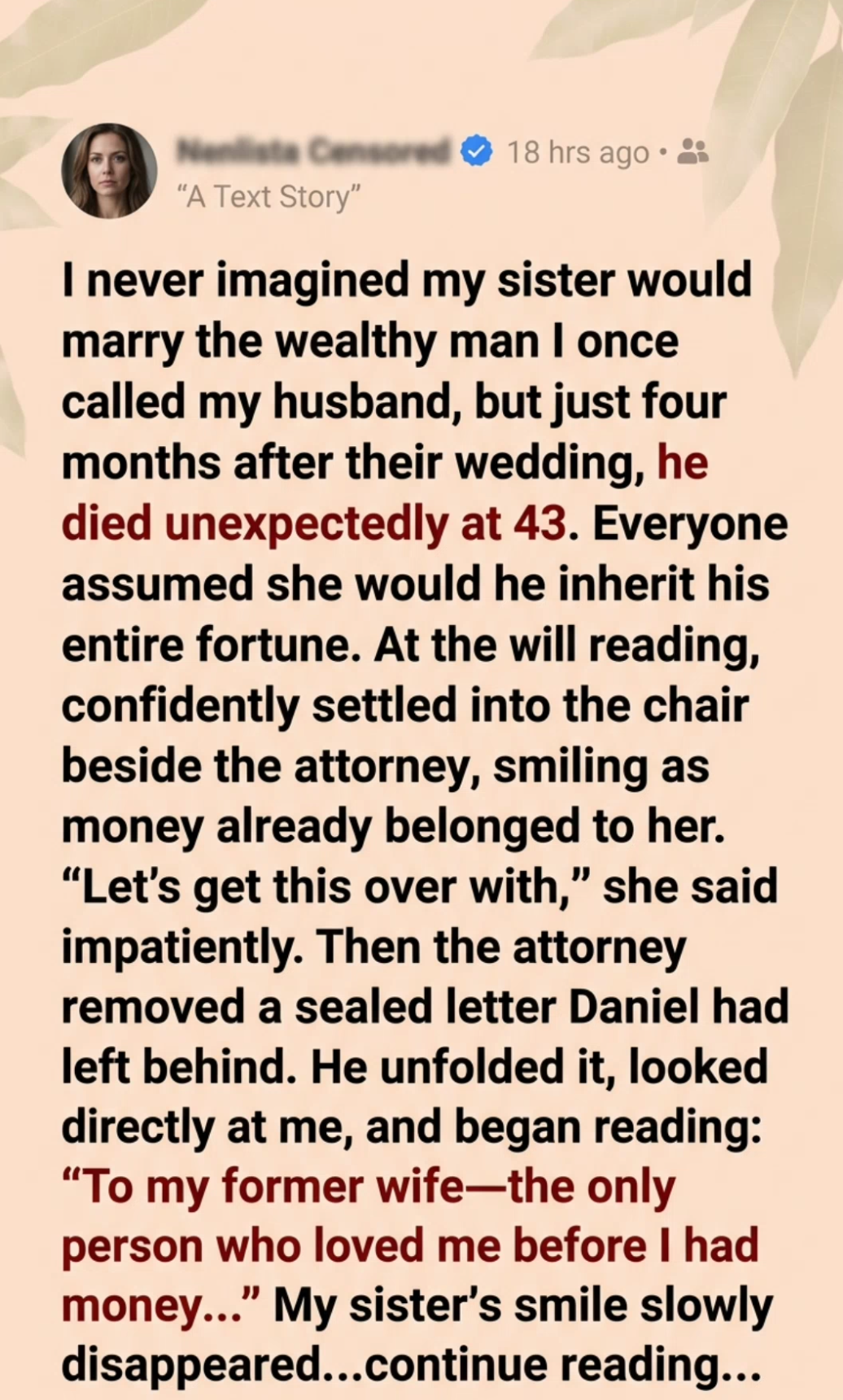
“To my former wife, Claire—the only person who loved me before I had money…”
The room became silent.
Vanessa slowly turned toward me.
Her expression had changed completely.
Thomas continued.
“If you are hearing these words, then I am no longer alive to explain why I am writing to you. I know I have no right to ask for your forgiveness. I know I hurt you in ways that cannot be repaired. But there is something I need you to understand before my estate is distributed.”
Thomas paused.
Then he continued.
“Claire, I did not leave you because you were not enough. I left because I became someone I no longer recognized, and I was too cowardly to admit it.”
I lowered my eyes.
I hadn’t expected to hear those words.
Daniel continued through the letter.
He admitted that his ambition had become an obsession.
He had measured his worth by the size of his portfolio, the people who returned his calls, and the number of properties he could acquire.
He had allowed his business success to become an excuse for selfishness.
He acknowledged that his affair had destroyed the trust between us.
He also admitted something I had never known.
During our marriage, I had been offered a senior position at an international technology firm.
The offer would have required relocation.
I had declined it because Daniel had asked me to stay and support his business during a difficult period.
At the time, I believed we were making a decision together.
Daniel’s letter revealed that he had remembered that sacrifice.
He wrote:
“You gave up an opportunity because you believed we were building something together. I accepted that sacrifice as though it were your responsibility. I never properly thanked you.”
I felt my throat tighten.
Vanessa shifted in her chair.
“Can we get to the will?” she asked.
Thomas looked at her.
“This letter is part of the estate documents.”
“Fine. But why is he writing to her?”
Thomas continued.
“After our divorce, I spent years trying to understand why money had made me so unhappy. I eventually realized that I had confused being admired with being loved. I had many people around me, but very few who knew who I was before I became wealthy.”
Vanessa’s fingers tightened around her handbag.
Thomas reached the next paragraph.
“Claire, I have not written this letter to reopen our marriage or to ask you to return to my life. You built your own life, and I hope you are happy. I am writing because I want to correct one final mistake.”
Thomas stopped reading.
He turned to the next page.
And then he read the provision that changed everything.
Daniel had established a charitable trust several years earlier.
It had been created after he funded a medical assistance program for families facing unexpected hospital expenses.
The trust was not part of his ordinary business operations.
It had its own independent trustees, its own governing documents, and a separate funding arrangement.
Daniel had named me as one of three independent trustees.
Not because I was his former wife.
Because I had spent years volunteering with a local financial assistance organization and had helped him design the original program.
I had forgotten about it.
We had discussed it shortly before our separation.
I had helped him prepare a basic budget and suggested that the organization use an independent committee to evaluate applications.
Daniel had later developed the project with professional advisers.
According to the letter, he wanted me to continue serving as a trustee if I was willing.
The trust was funded with $6 million.
It would support emergency medical expenses, rehabilitation costs, and temporary assistance for families who had lost their primary income.
I looked at Thomas.
“Why am I being told this now?”
He explained that the trust had already been established and funded. My appointment was subject to the acceptance process and the trust’s governing documents.
I would not receive the money personally.
I would have a responsibility to oversee its charitable purpose alongside the other trustees.
Vanessa looked furious.
“That’s it?”
Thomas turned toward her.
“There’s more.”
He opened the will again.
Daniel had also left me a personal bequest of $750,000.
It was a specific gift.
It did not include a claim over the remainder of his estate.
It did not make me a beneficiary of his investment company.
It was simply a personal inheritance.
Vanessa stared at him.
“Seven hundred and fifty thousand dollars?”
“Yes.”
“Why?”
Thomas placed the letter on the table.
“Mr. Whitmore provided his reasons in writing.”
Vanessa turned toward me.
“You knew about this?”
“No.”
“Don’t lie.”
“I didn’t know.”
She looked back at Thomas.
“He was my husband. We were married. Why would he leave that much money to his ex-wife?”
Thomas remained calm.
“The will was executed according to the applicable legal requirements. The estate will be administered under those documents.”
Vanessa stood.
“This is ridiculous.”
Her attorney touched her arm.
“Please sit down.”
She ignored him.
“He was married to me when he died. I should be receiving everything.”
Thomas closed the folder.
“Mrs. Whitmore, the will does not provide for that.”
Vanessa turned toward me.
“You manipulated him.”
I looked at her.
“I haven’t spoken to Daniel in years.”
“You were always waiting for something.”
That accusation hurt more than I expected.
Not because it was true.
Because it showed how little she understood the person she had married.
I stood.
“I didn’t know he was leaving me anything. I came here because his attorney asked me to.”
Vanessa laughed bitterly.
“Of course. The poor ex-wife gets a fortune.”
I looked at her for a long moment.
“Seven hundred and fifty thousand dollars is a lot of money. But it isn’t a fortune compared with what he built. And it doesn’t make me responsible for what you expected to receive.”
Then I sat down again.
I wanted to hear the rest of the will.
Thomas continued reading.
Vanessa was not disinherited.
Daniel had left her the marital home, several personal assets, and a substantial investment portfolio.
She was also entitled to the benefits of a separate marital agreement that had been executed before their wedding.
That agreement was important.
It protected certain business assets and established how the estate would be administered.
The majority of Daniel’s business interests were placed under a succession structure.
His company would continue operating under an independent board.
A portion of the estate would pass to designated family beneficiaries.
Another portion would remain within the investment structure.
Vanessa would receive significant assets, but she would not personally control the entire $68 million estate.
The will also included a provision requiring an independent review of certain outstanding business transactions.
Thomas explained that Daniel had been concerned about several financial decisions made during the final year of his life.
He had instructed the estate administrator to review them before releasing certain distributions.
Vanessa’s attorney asked whether that review involved her.
Thomas answered carefully.
“The review concerns the company’s records and the estate’s financial obligations. It is not an allegation against any beneficiary.”
Vanessa sat down slowly.
For the first time that morning, she looked uncertain.
I watched her.
I didn’t feel victorious.
I felt sad.
Daniel had left behind a complicated estate, a grieving family, and two women who had loved different versions of him.
And I was beginning to understand that the letter was not the most important part of what he had left behind.
It was the explanation for why he had written it.
After the meeting, Thomas asked me to remain.
Vanessa left with her attorney.
Before closing the door, she turned back.
“You think you’ve won something,” she said.
I shook my head.
“I didn’t come here to compete with you.”
She stared at me.
“Daniel chose you.”
“No. Daniel made a decision about his estate. That’s different.”
She walked away.
Thomas waited until the door closed.
Then he handed me a second envelope.
“This was not part of the formal will reading,” he said. “Mr. Whitmore asked that you receive it privately.”
I opened it.
Inside was a photograph.
It showed Daniel and me standing in front of our first apartment.
We were both younger.
He wore a simple gray sweater. I was holding two paper cups of coffee.
We were laughing.
I remembered that day.
We had just signed our first lease, and the apartment was so small that we could barely fit the furniture we owned.
There was another note beneath the photograph.
I hope you remember that we were happy before I convinced myself happiness had to look expensive.
I sat quietly.
Thomas gave me time.
Then he explained something else.
“Daniel asked me to tell you that he never expected you to forgive him. He wanted the letter delivered regardless of whether you accepted the bequest or the trusteeship.”
“Did he know he was ill?”
Thomas hesitated.
“He had been receiving medical care for a condition that increased his cardiovascular risk. His death was unexpected, but he had discussed his estate planning with me several months earlier.”
I looked at him.
“Did he know he might die?”
“He understood there were risks. He did not know when or whether a serious event would occur.”
I folded the letter.
“Thank you.”
Thomas nodded.
“I should also tell you that you are under no obligation to accept the charitable trusteeship.”
“I need time to think.”
“Of course.”
I placed the photograph inside my handbag.
Then I left.
Vanessa called me that evening.
I almost didn’t answer.
But I wanted to hear what she had to say.
“Claire.”
“Yes?”
“I want to talk.”
“About what?”
“The will.”
I closed my laptop.
“What about it?”
“Daniel left you $750,000.”
“Yes.”
“And he appointed you to that medical trust.”
“Yes, subject to the formal process.”
She exhaled sharply.
“You knew he was planning this.”
“No.”
“You must have known he still cared about you.”
I thought about the letter.
“I knew he regretted what happened between us. That’s not the same thing.”
She went quiet.
Then she said, “I gave up a lot for him.”
I didn’t answer immediately.
She continued.
“I moved into his house. I left my apartment. I changed my plans. I thought we were going to build a future together.”
“I understand.”
“No, you don’t. You were married to him when he had nothing. You got the years when he was still becoming successful. I married him when he could finally afford the life I wanted.”
Her voice began to break.
“And now he’s dead, and everyone is looking at me like I only married him for money.”
I felt an unexpected wave of sympathy.
“I don’t know what everyone thinks.”
“Do you think that?”
I took a breath.
“I think you married him knowing he was wealthy. I also think you loved him in your own way. I can’t decide what was in your heart.”
She began crying.
“Then why did he leave you that letter?”
“Because he wanted to apologize.”
“He was my husband.”
“He was also my former husband.”
She became quiet.
Finally, she said, “I hate that he remembered you.”
I didn’t know what to say.
Then she ended the call.
Over the following months, the estate administration became complicated.
The business review uncovered several questionable transactions made during the final year of Daniel’s life.
One investment partnership had received payments without complete supporting documentation.
Another company had been promised funding that the estate had not authorized.
There was no immediate evidence that Vanessa had personally participated in any wrongdoing.
However, the estate’s administrators needed to determine whether the transactions represented legitimate business expenses, unpaid obligations, or losses.
Daniel’s investment company had employed more than forty people.
The independent board wanted to preserve the business and avoid unnecessary disruption.
Thomas asked whether I would consider helping with the charitable trust.
I agreed to attend an initial meeting.
The other trustees included a retired hospital administrator and a financial adviser who had worked with Daniel for many years.
They explained the trust’s purpose.
Families facing sudden medical emergencies could apply for assistance through approved hospitals and social service organizations.
The money would not be handed out casually.
Applications would be reviewed, eligibility would be verified, and payments would generally be made directly to providers.
I liked the structure.
It was practical.
It was transparent.
And it reflected something Daniel and I had once discussed when our marriage was still good.
I accepted the appointment.
My first responsibility was to help review the trust’s application process.
I insisted that we create clear eligibility standards and independent financial controls.
The other trustees agreed.
We began with a small number of cases.
A single mother whose child needed emergency surgery.
A construction worker who had lost his income after a serious accident.
An elderly couple facing rehabilitation costs after a stroke.
The trust didn’t solve every problem.
But it gave people breathing room when they needed it most.
And that made the work worthwhile.
Six months after the will reading, Vanessa requested another meeting.
This time, she came without her attorney.
She looked tired.
The inheritance had not made her life as simple as she had expected.
The estate was still being administered. Several business interests were subject to independent management, and she had to make decisions about the home and other assets.
She sat across from me in a quiet café.
“I wanted to apologize,” she said.
I waited.
“For accusing you of manipulating Daniel.”
I nodded.
“Thank you.”
She looked down at her hands.
“I was angry. I thought I would inherit everything, and when I found out about the letter, I felt humiliated.”
“Why?”
“Because I realized he had never told me the whole story about your marriage.”
I remained quiet.
“He told me you were difficult. That you didn’t understand his ambitions. He said the divorce was inevitable.”
I looked at her.
“Some of that may have been how he saw it.”
“But the letter said he was the one who changed.”
“Yes.”
She rubbed her forehead.
“I don’t know what to believe anymore.”
I understood that feeling.
For years, I had believed Daniel’s ambition was simply a phase. I had believed that if I were patient enough, the man I married would return.
He never did.
Vanessa had married the wealthy man who emerged afterward, only to discover that wealth could not protect her from his unfinished past.
“I can’t give you an explanation for everything he did,” I said. “Only he could have done that.”
She nodded.
Then she asked something I hadn’t expected.
“Do you hate me?”
I thought carefully.
“I was hurt when you started dating him. You knew what happened between us, and you chose to enter that relationship anyway. But I don’t want to spend the rest of my life hating you.”
Her eyes filled.
“I really thought I had won.”
I looked at her.
“Daniel wasn’t a prize, Vanessa.”
She began crying.
For once, I didn’t try to comfort her with empty words.
I simply sat with her until she was ready to leave.
A year after Daniel’s death, the first annual report from the medical trust was completed.
It showed that the fund had supported dozens of families through emergency medical expenses and rehabilitation assistance.
The trustees agreed to expand the program through partnerships with two additional hospitals.
I attended the meeting and signed the annual oversight report.
Afterward, Thomas handed me a copy of Daniel’s original letter.
“Would you like to keep this?” he asked.
I looked at the pages.
“Yes.”
That evening, I placed the letter and photograph in a small box in my study.
I didn’t display them.
I didn’t want Daniel’s apology to become the center of my life.
It was simply part of my history.
The following weekend, I visited the first apartment we had shared.
The building had been renovated, and the old entrance had been replaced.
I stood outside for a few minutes, remembering the young man who had carried boxes up three flights of stairs because we couldn’t afford movers.
I remembered the woman I had been.
I didn’t wish I could return to those years.
I was grateful I had experienced them.
Daniel’s wealth had changed his life.
His mistakes had ended our marriage.
His final letter had acknowledged what he had done.
But none of those things could change the fact that I had built a life beyond him.
I returned to my car and drove home.
Two years later, Vanessa and I were no longer close, but we were no longer enemies.
We occasionally exchanged messages about our mother.
She had kept the house Daniel left her and sold several other assets after obtaining independent financial advice.
She did not receive the entire estate, but she received enough to live comfortably.
The investment company continued under its independent board.
The medical trust expanded.
I remained one of its trustees.
Sometimes, when I reviewed an application from a family facing a medical crisis, I remembered the hospital room where Marcus had once delivered divorce papers in another story of my life.
I understood how frightening it was to be vulnerable and uncertain about the future.
I understood why financial security mattered.
But I also understood that money alone could not repair the damage people caused when they forgot how to treat one another.
Daniel had left me $750,000.
It was a significant gift, and I was grateful for it.
But the greater responsibility was the trust.
I never used it as a monument to Daniel or as a way to prove that he had loved me more than Vanessa.
It was there to help people who needed assistance.
That was enough.
One evening, I received a message from Vanessa.
I found another photograph of you and Daniel from your first apartment. Would you like me to send it?
I replied:
Yes, please.
A few minutes later, she sent a picture of us standing outside a small café.
Daniel had his arm around my shoulder.
We looked happy.
I saved the photograph.
Then Vanessa sent one more message.
I think he was happiest before everything became about money.
I looked at the photograph for a long time.
Finally, I replied:
I think so too.
And for the first time since Daniel’s death, I felt no anger toward my sister.
Only sadness for a man who had once possessed something money could never buy, then spent years believing he needed more.
Daniel’s letter had begun with the words:
To my former wife—the only person who loved me before I had money.
I used to think the tragedy of our marriage was that Daniel had become wealthy and forgotten how to love.
Now I understood something more complicated.
He hadn’t forgotten how to love.
He had forgotten what love required.
And by the time he understood the difference, the woman who had once loved him had already learned how to live without him.
THE END.