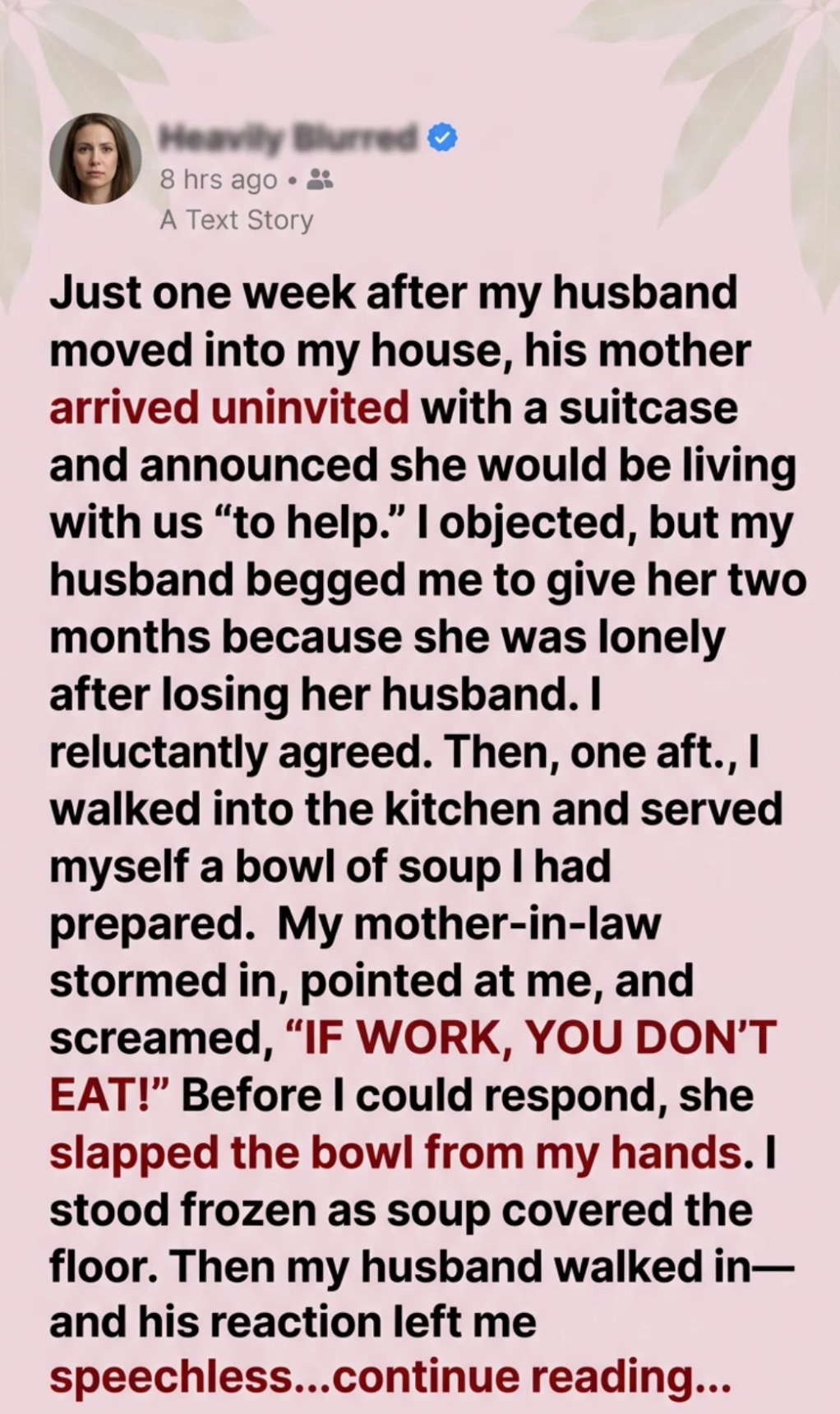
The soup was still warm when it hit the floor.
One second, I was standing in my kitchen holding a bowl of homemade chicken soup. The next, my mother-in-law had slapped it from my hands so violently that the ceramic bowl shattered against the cabinets.
Hot broth splashed across the tiles.
A piece of carrot landed near my bare foot.
I stood completely still.
Margaret Whitmore was pointing at me, her face red with anger.
“IF YOU DON’T WORK, YOU DON’T EAT!”
I couldn’t believe what I had just heard.
I had cooked that soup myself. I had bought the ingredients, prepared the vegetables, cleaned the kitchen, and spent nearly an hour making it.
I was not unemployed.
I was not living off her money.
And I was certainly not living in her house.
I was standing in my own kitchen.
Before I could answer, I heard footsteps behind me.
My husband, Daniel, had just walked through the back door.
He looked at the broken bowl, the soup covering the floor, and his mother standing with one hand still raised.
Then he looked at me.
I expected him to defend me.
I expected him to ask his mother why she had done it.
Instead, he said something that left me speechless.
“Mom, I told you not to start until I got home.”
For a moment, I genuinely thought I had misheard him.
Margaret lowered her hand.
Daniel placed his keys on the counter.
And suddenly, I understood that the argument I had just witnessed wasn’t the beginning of something.
It was the continuation of something they had already discussed without me.
My name is Emily Carter. I was thirty-nine years old, and until that afternoon, I had believed I was building a marriage with a man who respected me.
I was about to discover how wrong I was.
Daniel and I had been married for seven months.
We met through a mutual friend at a charity dinner. He was forty-two, recently divorced, and worked as a regional operations manager for a logistics company.
He was polite, attentive, and seemed unusually considerate.
He remembered my coffee order. He called when he said he would. He never made me feel rushed.
I owned a three-bedroom house in a quiet neighborhood.
I had purchased it six years before meeting Daniel, using my savings and a mortgage that I had been paying down steadily.
I worked as a freelance commercial designer. My clients were small businesses, property developers, and several regional companies.
I had built my career gradually, and I enjoyed being able to work from home.
Daniel rented a small apartment when we started dating.
After our wedding, he suggested moving into my house.
He said it would make financial sense because I already had a home and he could contribute toward the household expenses.
I agreed, but we discussed the arrangement carefully.
We would share utilities, groceries, and ordinary household costs.
I would continue paying the mortgage because the property was mine, and Daniel would contribute an agreed amount toward living expenses.
We wrote down the arrangement and signed it.
It seemed reasonable.
Daniel moved in on a Saturday.
Seven days later, his mother arrived.
It was a Wednesday afternoon.
I was working at my desk when I heard a car door slam outside.
Daniel came into the house first.
Behind him stood Margaret, holding a large suitcase and a handbag.
She was sixty-eight, recently widowed, and had spent most of her life living with her husband in a house about forty minutes away.
“Emily,” Daniel called. “Can you come downstairs?”
I walked into the hallway.
Margaret smiled.
Not warmly.
It was the kind of smile someone gives when they have already decided something and are waiting for everyone else to accept it.
“Hello, dear,” she said.
I glanced at the suitcase.
“Are you visiting?”
Daniel cleared his throat.
“Mom is going to stay with us for a while.”
I looked at him.
“For how long?”
“Just two months,” he replied quickly.
Margaret stepped past him.
“Your husband thought it would be good for me to come here. I’ve been terribly lonely since Robert died.”
I understood that losing her husband had been painful.
I had attended the funeral. I had sent flowers. I had called her several times during the weeks afterward.
But nobody had asked me whether she could move into my home.
“Daniel,” I said quietly, “we didn’t discuss this.”
He took my hand.
“Please, Emily. Just two months. She’s not doing well alone.”
I looked at Margaret.
She was already examining the hallway.
“Is this the guest room?” she asked.
I didn’t answer immediately.
Daniel squeezed my hand.
“She needs family right now.”
I was uncomfortable, but I didn’t want to appear cruel.
I agreed to two months.
I made one condition.
“We need to respect each other’s space. This is temporary, and I still need to work from home.”
Margaret nodded.
“Of course, dear.”
Daniel kissed my forehead.
“Thank you. I knew you’d understand.”
I should have paid attention to how quickly he had arranged everything.
He had already brought her suitcase.
He had already decided where she would sleep.
And he had already promised her that she could stay.
My agreement had apparently been the only thing missing.
The first few days were manageable.
Margaret kept mostly to herself.
She watched television in the guest room, occasionally made tea, and spoke about her late husband.
I tried to be considerate.
I bought the groceries she liked. I showed her how to use the washing machine. I even offered to take her to a nearby garden center because she said she missed tending plants.
But gradually, small disagreements began.
She didn’t like the way I arranged the kitchen.
She complained that the living room was too cold.
She said my working hours were strange because I sometimes started early and finished late.
One morning, I found her moving my office equipment.
“Why are you touching my desk?” I asked.
“I needed somewhere to put these things.”
“That’s my work area.”
“You have a whole house. Surely you can make room.”
I moved my equipment back.
She looked offended.
That evening, Daniel told me I was being too sensitive.
“She’s grieving,” he said.
“I understand that. But she can’t rearrange my office.”
“She’s not trying to upset you.”
“Then she should ask.”
Daniel sighed.
“Can we please avoid making every little thing an argument?”
I went quiet.
I didn’t want to fight.
But I began noticing that whenever Margaret crossed a boundary, Daniel explained her behavior.
Whenever I objected, he described mine.
By the third week, Margaret had begun treating the house as though she were in charge.
She started deciding what we should eat.
She criticized the groceries I purchased.
She told Daniel that the furniture needed replacing.
One Saturday, she invited two of her friends over without asking me.
I returned from shopping to find three women sitting in my living room, drinking coffee.
Margaret introduced me as if I were a tenant.
“This is Emily. Daniel’s wife.”
One of the women smiled.
“Your home is lovely.”
“Thank you,” I said.
Margaret immediately added, “It needs a little more warmth. I’m trying to help them make it comfortable.”
I looked at her.
“They?”
She ignored me.
Later, I asked Daniel why his mother had invited people into my home without telling me.
He shrugged.
“She wanted company.”
“Then she could have asked.”
“Emily, she’s lonely.”
I began to realize that the word lonely had become a permanent excuse.
It allowed Margaret to do whatever she wanted.
And it allowed Daniel to avoid confronting her.
The real problem started with money.
Daniel had agreed to contribute toward household expenses.
But after Margaret arrived, he began paying for several things for her.
That was not inherently wrong.
She was his mother.
However, he started reducing his contribution to our shared expenses.
He told me he needed to help her with her medical bills, insurance, and other costs.
I understood.
But I also noticed that Margaret was buying expensive clothing, ordering beauty products, and arranging outings with her friends.
When I asked Daniel about it, he became defensive.
“Are you keeping track of every dollar I spend?”
“No. I’m asking why you’re paying less toward the household expenses we agreed on.”
“I’m dealing with a lot right now.”
“So am I.”
He looked irritated.
“Mom lost her husband. She needs support.”
“And I need a husband who keeps his agreements.”
He walked away.
I decided to stop arguing and began documenting the household expenses.
Not because I wanted to punish anyone.
Because I needed to understand what was happening.
Then Margaret made a comment that changed how I saw her.
One afternoon, she was speaking to a friend on the phone in the kitchen.
I was walking down the hallway when I heard her say:
“Daniel is finally getting settled. He has a proper house now. I just need to help him organize things the right way.”
I stopped.
She continued.
“Emily is very independent, but she doesn’t really understand how a family should work. Daniel needs someone to guide him.”
I quietly walked away.
She wasn’t simply grieving.
She was trying to establish authority.
And she believed my marriage gave her the right to do it.
The afternoon of the soup incident began like any other.
I had spent the morning completing a design project for a commercial client.
By lunchtime, I was hungry.
I prepared chicken soup using vegetables, herbs, and broth I had made the previous evening.
Daniel had left for work early.
Margaret was upstairs.
I poured myself a bowl and sat at the kitchen counter.
I had barely taken two spoonfuls when she entered.
She looked at the bowl.
“What are you eating?”
“Chicken soup.”
“Did you make enough for everyone?”
“Yes. There’s more in the pot.”
She frowned.
“Daniel hasn’t eaten.”
“He can have some when he gets home.”
She walked closer.
“You should have waited.”
I looked up.
“Why?”
“Because he’s the one working.”
I put my spoon down.
“I work too, Margaret.”
She gave a dismissive laugh.
“You sit at a computer all day. That’s not the same.”
I took a breath.
“I earn my own income, and I contribute to this household.”
She pointed at the bowl.
“IF YOU DON’T WORK, YOU DON’T EAT!”
I stared at her.
“What did you just say?”
“You heard me.”
I stood.
“I’m not going to be spoken to like that in my own home.”
She stepped closer.
“Your home? Daniel lives here now. This is his home too.”
“And he contributes to it. That doesn’t give you the right to insult me.”
Her face tightened.
Then she slapped the bowl from my hands.
The ceramic struck the floor.
Soup splashed across the cabinets and tiles.
I froze.
It wasn’t the mess that shocked me.
It was the fact that she had physically attacked me over a bowl of food.
I heard Daniel enter.
He looked at the floor.
Then he looked at his mother.
“Mom, I told you not to start until I got home.”
I turned toward him.
“What does that mean?”
He looked uncomfortable.
Margaret folded her arms.
“She needs to learn that she can’t keep behaving this way.”
Daniel rubbed his forehead.
“Emily, can we talk?”
I looked between them.
“Did you two plan this?”
Neither answered.
Then Margaret said, “Your husband and I have discussed the situation. Someone needs to take responsibility in this house.”
I stared at Daniel.
“What situation?”
He sighed.
“Mom thinks you haven’t been contributing enough to the household.”
I laughed once.
Not because anything was funny.
Because I couldn’t believe the words were coming out of his mouth.
“I own this house.”
“You own the property,” he replied.
“Yes. I pay the mortgage. I pay the insurance. I buy most of the groceries. I work from here. What exactly do you think I haven’t contributed?”
Margaret interrupted.
“You need to stop acting as though money gives you the right to disrespect people.”
I turned toward her.
“You just slapped food out of my hands.”
“You were being disrespectful.”
Daniel raised his voice.
“Both of you, stop.”
I looked at him.
“No. You stop. I want to know why you said you told her not to start until you got home.”
He hesitated.
Then he finally told me.
Daniel had been discussing a new arrangement with his mother.
He wanted her to stay beyond the two months.
In fact, he wanted her to remain permanently.
He believed that because she had become widowed, she should live with us indefinitely.
He had also been discussing how we should divide household responsibilities.
Margaret believed I should handle most of the cooking, cleaning, and domestic work because I worked from home.
Daniel had agreed with her.
He told her that I would eventually understand.
When I continued objecting to her behavior, Margaret became frustrated.
Daniel had promised her he would speak to me.
He had not told me any of this.
Instead, he had allowed his mother to believe that I would eventually accept her authority.
The soup incident was supposed to be a confrontation.
He had told Margaret he would come home early so they could discuss the household arrangements together.
But she had lost her temper before he arrived.
I listened without interrupting.
When he finished, I asked one question.
“Did you ever intend to ask me?”
Daniel looked down.
“I thought you would agree once you understood how important it was.”
I stared at him.
“You moved into my house one week before your mother arrived. You promised me two months. And behind my back, you planned to make her a permanent resident?”
“She has nowhere else to go.”
“She owns a house.”
Daniel looked up.
“It’s too much for her to maintain.”
Margaret stepped forward.
“Your husband is trying to take care of me.”
I turned toward her.
“Then he can help you maintain your own house.”
She looked offended.
“You would send a grieving widow away?”
“I would not allow someone to assault me in my own kitchen.”
Daniel raised his hands.
“Emily, please. Let’s calm down.”
I looked at him.
“Your mother just hit a bowl out of my hands, and you are asking me to calm down?”
He had no answer.
Then he said something that made my decision easier.
“Maybe you should spend a few nights somewhere else until everyone settles down.”
I looked at him.
“I’m the one who should leave?”
“Just temporarily.”
I nodded slowly.
Then I walked to the counter, picked up my phone, and called someone.
Daniel frowned.
“Who are you calling?”
“My attorney.”
His expression changed.
“Emily, don’t be dramatic.”
I looked at the broken bowl.
“I don’t think you understand how serious this is.”
My attorney was named Rebecca Shaw.
She had helped me purchase the house and had reviewed several financial agreements for me over the years.
I explained what had happened.
She asked whether I was injured.
I told her that the bowl had struck my wrist, leaving a red mark, but I didn’t believe I needed medical treatment.
She advised me to photograph the injury and the damage, preserve any relevant messages, and avoid further confrontation.
She also explained that Daniel’s residency and any rights he might have would need to be handled according to the applicable law.
I was not to change locks, remove his belongings, or take steps that could create legal problems without proper advice.
I followed her instructions.
I photographed the kitchen.
I saved the messages.
I wrote down the time and what had happened while the details were fresh.
Then I called a cleaning service to remove the broken ceramic and clean the soup from the floor.
Daniel stood in the hallway watching me.
“Are you seriously doing this?”
“Yes.”
“Over a bowl of soup?”
I turned toward him.
“Not over the soup. Over the fact that you planned to make my home a place where I had no authority over my own life.”
He shook his head.
“You’re exaggerating.”
I looked at him.
“Your mother hit something out of my hands, and you blamed me.”
“She was upset.”
“So was I.”
He walked into the living room.
Margaret remained in the kitchen.
She looked at me with cold satisfaction.
“You’ll regret turning your husband against his family.”
I didn’t answer.
I was beginning to understand that I hadn’t turned Daniel against anyone.
He had simply chosen where he stood.
The next morning, Rebecca arranged a formal meeting.
She advised Daniel that the original two-month arrangement was not permission for an indefinite stay and that any change required my agreement.
She also explained that the incident in the kitchen had been documented and that I expected it not to happen again.
Daniel became defensive.
He said his mother was emotionally vulnerable and that I was making a difficult situation worse.
Rebecca calmly replied that grief did not excuse physical aggression.
She recommended that Margaret return to her own home while the family considered longer-term care options.
Daniel refused.
He insisted his mother had a right to stay.
Rebecca explained that he could not unilaterally grant someone a permanent right to occupy a property he did not own.
The exact legal position would depend on local law and the circumstances, but my ownership and the original agreement were important.
The meeting ended without an agreement.
That evening, Daniel came home and told me his mother wasn’t leaving.
I looked at him.
“Then you need to decide whether you want to live here under the original agreement or find somewhere else.”
He laughed.
“You wouldn’t throw me out.”
I didn’t respond.
He continued.
“We’re married. This is our home.”
I looked around the living room.
My furniture.
My photographs.
My books.
My mortgage.
My years of work.
“Being married doesn’t mean you can make decisions for me without my consent.”
He walked away.
Two days later, I discovered something I hadn’t expected.
Margaret had been telling relatives that I was financially exploiting Daniel.
She claimed that he paid for the house while I kept my money for myself.
She also told them I had refused to support her after her husband’s death.
One of Daniel’s cousins contacted me.
“Emily, I heard you’re making Margaret leave.”
I took a breath.
“Did you hear what happened in my kitchen?”
There was a pause.
“Margaret said you threw food at her.”
I closed my eyes.
Of course she had.
I explained the incident briefly.
I didn’t exaggerate.
I didn’t call Margaret names.
I simply told him what had happened.
He was quiet for a moment.
Then he said, “That’s not what she told us.”
“I know.”
He apologized.
After that, I stopped trying to defend myself to everyone.
I had evidence.
I had legal advice.
And I didn’t need to convince every relative to believe me.
A week later, Daniel came home with a proposal.
He wanted Margaret to stay for another six months.
He also wanted me to agree to a new household arrangement.
He had written it down.
Margaret would have full use of the guest room and shared living areas.
I would be responsible for preparing dinner on weekdays because I worked from home.
Daniel would handle major expenses.
Margaret would help with light household duties.
I read the page.
Then I looked at him.
“Who wrote this?”
“Mom and I discussed it.”
“You didn’t discuss it with me.”
“I knew you would be difficult.”
I placed the paper on the table.
“Daniel, your mother assaulted me in the kitchen. Why are we negotiating a meal schedule?”
“She apologized.”
“When?”
He looked away.
I had never received an apology.
Margaret had not spoken to me except to complain.
Daniel sighed.
“She’s not good at apologizing.”
I stood.
“Then she can learn.”
He looked frustrated.
“You’re making me choose between my wife and my mother.”
I shook my head.
“No. I’m asking you to choose whether you believe your wife deserves basic respect.”
He said nothing.
I continued.
“Your mother can be lonely. She can be grieving. She can need help. None of that means she gets to control my home or hit things out of my hands.”
Daniel picked up the proposal.
“So you’re saying she has to leave?”
“I’m saying the original agreement ends in the time we agreed. She needs to return to her own home or arrange another living situation.”
He stared at me.
Then he walked upstairs.
The following week, Margaret announced that she was staying.
She said Daniel had promised her she could remain.
I didn’t argue with her.
I contacted Rebecca.
We reviewed the original arrangement and the messages in which Daniel had described the stay as temporary.
Rebecca sent a formal notice setting out the end of the agreed period and requesting that Margaret make arrangements to leave.
The notice was delivered properly.
Daniel was furious.
“You’re humiliating my mother.”
“No. I’m enforcing the agreement we made.”
“She has nowhere to go.”
“She has her own house.”
“She doesn’t want to live there alone.”
“Then help her find another arrangement.”
He stared at me.
“You’re unbelievable.”
I didn’t answer.
Because I was finally tired of explaining why my home mattered.
The situation became more difficult when Daniel’s sister, Laura, arrived.
She came on a Saturday afternoon carrying a folder.
“I think we need to talk,” she said.
I invited her into the living room.
She looked uncomfortable.
“Mom told me everything.”
I nodded.
“Then you probably heard her version.”
Laura opened the folder.
Inside were several documents concerning Margaret’s house.
It turned out that Daniel and Margaret had been discussing selling it.
Margaret owned the property outright, but it needed repairs.
Daniel had suggested selling it and using the proceeds to purchase a smaller apartment closer to him.
That might have been a reasonable idea if Margaret wanted it.
But Laura had discovered that Daniel had also discussed using some of the proceeds to cover debts connected to his own financial problems.
I looked at her.
“What debts?”
She hesitated.
“His credit cards. A personal loan. Some money he borrowed from a former business partner.”
I felt my stomach tighten.
“How much?”
“Laura believes it’s around $47,000.”
I looked at her.
“Why are you telling me?”
“Because Mom thinks Daniel is helping her. But I don’t think she knows everything.”
I leaned back.
“Did Daniel ask her to sell the house?”
“Yes.”
“And did he tell her where the money would go?”
Laura shook her head.
“I don’t think so.”
Suddenly, the situation made more sense.
Daniel had not only wanted his mother living in my house.
He had also wanted her to sell her own property.
If she did, she would become more financially dependent on him.
And if he controlled the sale proceeds, he could use them to solve his personal problems.
I thanked Laura.
Then I called Rebecca.
The financial issue required careful handling.
Margaret was an adult and legally entitled to decide what to do with her property.
Nobody could simply prevent her from selling it because another family member disagreed.
But she needed independent advice.
Rebecca suggested that Margaret consult her own solicitor and obtain an independent valuation before signing anything.
Laura agreed to help arrange that.
Margaret initially refused.
She accused Laura of turning against her.
But when an independent solicitor reviewed the proposed sale arrangements, several concerns emerged.
The draft documents did not clearly explain how the proceeds would be distributed.
The proposed purchase of the smaller apartment was also not properly documented.
Margaret was advised not to sign until everything was clarified.
She eventually withdrew from the proposed sale.
Daniel was furious.
He accused Laura of interfering.
Then he accused me of putting ideas into her head.
I told him the truth.
“I didn’t ask Laura to do anything. She brought me the information.”
He stared at me.
“Why does everyone suddenly think I’m doing something wrong?”
I looked at him.
“Maybe because you keep making decisions that affect other people without telling them.”
He left the room.
The two-month period finally ended.
Margaret packed her belongings on a Thursday morning.
Daniel helped carry her suitcase downstairs.
She refused to look at me.
At the front door, she turned.
“I hope you’re happy.”
I looked at her.
“I hope you find somewhere comfortable to live.”
She shook her head.
“You’ve destroyed my family.”
I said nothing.
Daniel placed the suitcase in the car.
Then he returned to the house.
He stood in the hallway for a long time.
“Are you satisfied now?” he asked.
“No.”
“What do you want from me?”
I thought about the months that had passed.
“I wanted a husband who would stand beside me when someone mistreated me. I wanted someone who could care for his mother without sacrificing our marriage. I wanted you to respect the home I had built before you moved into it.”
He looked away.
“I didn’t think it would become this serious.”
“That’s the problem, Daniel. You didn’t think about how it would affect me.”
He walked upstairs.
That evening, he told me he wanted to stay at a hotel for a few days.
I agreed.
He left with a suitcase.
I didn’t stop him.
A week later, Daniel asked for a meeting with Rebecca.
He said he wanted to discuss our marriage.
I agreed to meet him in a neutral location.
He arrived looking tired.
He apologized for the kitchen incident.
He said his mother had been difficult since his father’s death and that he had been trying to keep her happy.
He admitted that he had allowed her to believe she could stay permanently.
He also admitted that he had been under financial pressure and had hoped the sale of her house would help him.
I listened.
Then I asked him one question.
“Did you marry me because you wanted to build a life with me, or because I already had a house?”
He looked shocked.
“That’s not fair.”
“Then answer.”
He rubbed his face.
“I loved you.”
“Did you?”
“Yes.”
“Then why did you let your mother treat me like a servant in my own home?”
He looked down.
“I didn’t know how to handle her.”
“You could have told her no.”
He nodded.
“I should have.”
I waited.
He continued.
“I thought you would eventually accept things.”
I felt a quiet sadness.
“You thought I would become someone who didn’t object.”
He didn’t answer.
We ended the meeting without making a decision.
Over the next month, I spoke with a counselor and considered whether the marriage could be repaired.
But something had changed.
I no longer trusted Daniel to protect our boundaries.
I no longer believed that an apology would prevent the same pattern from happening again.
Eventually, I decided to file for divorce.
It wasn’t because of one broken bowl.
It was because of the decisions that had led to it.
The divorce was finalized several months later.
Daniel did not receive ownership of my house.
The property remained mine, subject to the legal arrangements and financial disclosures reviewed during the proceedings.
We divided the marital assets according to the applicable law and our documented contributions.
The process was not dramatic.
There were no shouting matches in court.
No miraculous hidden document.
Just attorneys, financial records, negotiations, and difficult conversations.
Margaret eventually returned to her own home.
Laura helped her arrange maintenance and occasional support.
She also began attending a grief support group.
I heard later that she had apologized to Laura for some of the things she had said.
She never apologized to me.
I accepted that I might never receive one.
A year after the divorce, I renovated my kitchen.
I replaced the damaged cabinets, installed new flooring, and bought a beautiful ceramic bowl from a local craft market.
It was simple, deep blue, and slightly uneven around the rim.
The first evening I used it, I made chicken soup.
I sat at the kitchen counter, exactly where I had been standing that afternoon when Margaret slapped the bowl from my hands.
The house was quiet.
No one was criticizing the food.
No one was deciding who deserved to eat.
No one was telling me how to arrange my own kitchen.
I took a spoonful.
It was good.
I smiled.
My phone vibrated.
It was a message from Laura.
Mom asked me to tell you she hopes you’re doing well. She says she’s been thinking about what happened.
I read it twice.
Then I replied:
I hope she’s doing well too.
I didn’t ask whether Margaret had apologized.
I didn’t need to.
I had learned that forgiveness could not be forced, and neither could reconciliation.
Sometimes the healthiest thing you could do was accept that another person might never understand the damage they caused.
I finished my soup and washed the bowl.
Then I placed it carefully on the shelf.
For months, Daniel had told me I was making a problem out of nothing.
Margaret had told me I didn’t work and didn’t deserve to eat.
But the truth was simple.
I had worked for everything I owned.
I had built my home before either of them arrived.
And I had every right to decide who was allowed to live there and how I would be treated.
The afternoon Margaret broke that bowl, I thought I had lost control of my marriage.
In reality, I had finally stopped surrendering control of my life.
THE END.