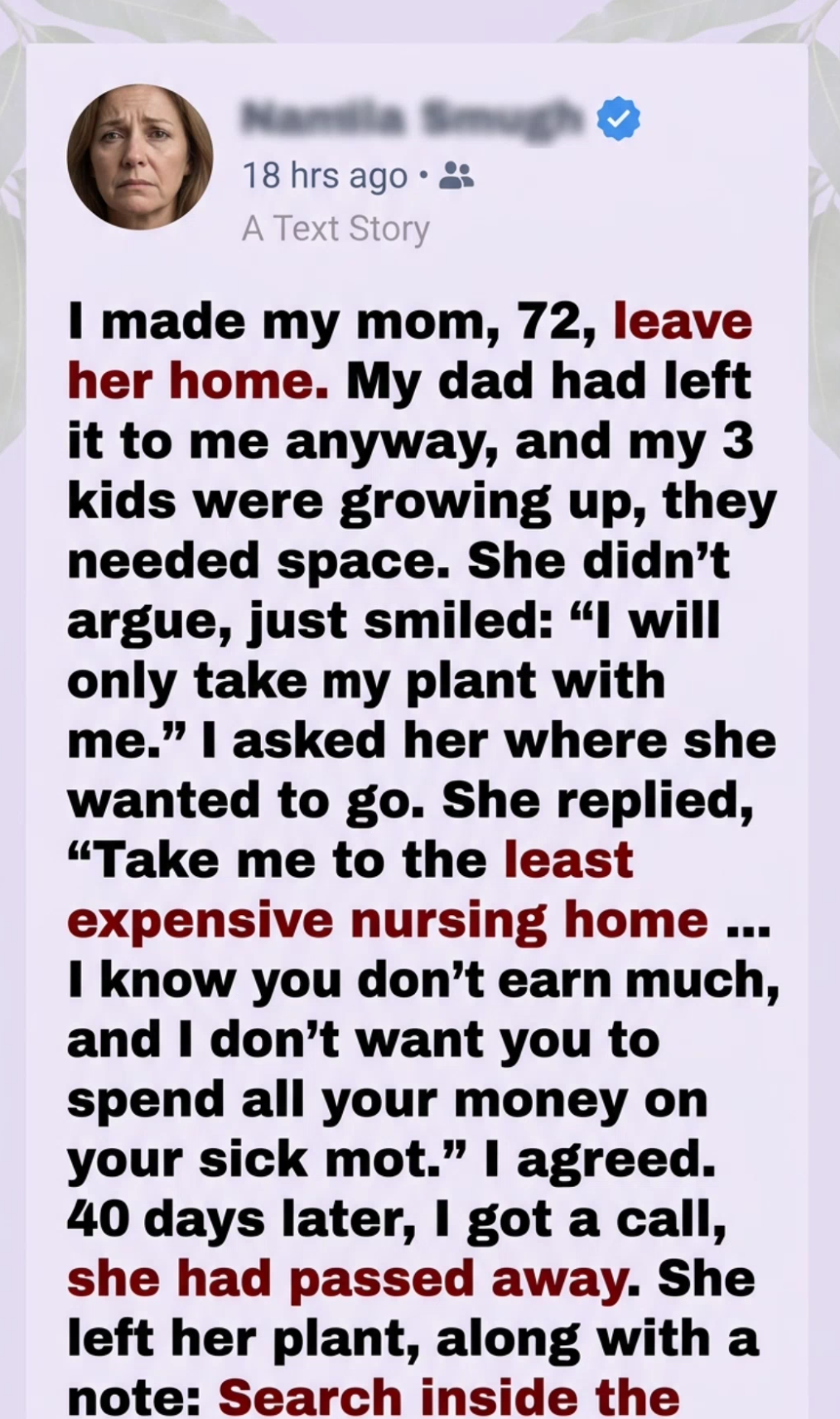
When I told my mother she had to leave her home, she didn’t cry.
She didn’t raise her voice, accuse me of being ungrateful, or remind me how many years she had sacrificed for me. She simply stood beside the living-room window, looked around the house where she had spent most of her adult life, and smiled.
My father had left the house to me before he died. His will was clear, and after his passing, the property officially became mine. At the time, I convinced myself that taking possession of it was the sensible thing to do.
I was forty-three, married, and raising three children. They were growing quickly, sharing bedrooms, fighting over space, and needing somewhere to study and play. My mother was seventy-two, increasingly frail, and living alone in a house with more rooms than she needed.
I told myself the arrangement made sense.
“We need the space, Mom,” I explained. “The children are getting older. It would be better if you moved somewhere smaller, somewhere with people who could help you.”
She looked at me for a long moment.
Then she nodded.
“Of course, sweetheart.”
Her calmness made the conversation easier than I expected. I almost felt relieved.
She walked slowly toward the hallway and pointed to a small green plant sitting beside the kitchen window. It was an ordinary-looking plant in a faded clay pot. Its leaves were slightly uneven, and the soil had been changed so many times that the pot looked older than anything else in the room.
“I will only take my plant with me,” she said.
I glanced at it.
“That’s fine. You can take it.”
I began asking where she wanted to live. We discussed a few possibilities, but she interrupted me with an answer I wasn’t prepared for.
“Take me to the least expensive nursing home you can find.”
I frowned.
“Mom, we can look for somewhere comfortable.”
She shook her head gently.
“I know you don’t earn much. You have three children, a household to support, and your own responsibilities. I don’t want you spending all your money on your sick mother.”
I wanted to tell her that she wasn’t a burden.
But the truth was that money was tight. My salary covered the mortgage, school expenses, groceries, and everything else that seemed to become more expensive every month. My wife and I had argued about finances more than once.
So I agreed.
I found a modest care facility on the outskirts of town. It wasn’t beautiful, but it was clean, had nurses on duty, and offered basic meals and medical assistance.
My mother said it would be fine.
On the morning we moved her, she packed only a few clothes, some photographs, her medicine, and the little plant.
I carried the plant to the car.
She stood in the doorway for several seconds, looking at the house.
“Are you ready?” I asked.
“Yes, sweetheart.”
She locked the door for the last time and handed me the key.
I placed it in my pocket without thinking much about it.
At the nursing home, a staff member showed us her room. It was small, with a single bed, a narrow wardrobe, and a window overlooking the courtyard.
My mother carefully placed her plant on the windowsill.
Then she turned toward me and smiled.
“Thank you for bringing me here.”
I hugged her quickly.
“I’ll come visit.”
“I know.”
I left before I could see whether she was disappointed.
During the first week, I called twice. She always sounded cheerful and asked about the children. She wanted to know whether my youngest had started reading properly and whether my middle child was still playing football.
I answered while checking emails, preparing dinner, or getting ready for work.
Sometimes I promised to visit on Sunday.
Sometimes Sunday came and went.
The children had activities. My wife needed help. I was tired. There was always something that seemed more urgent.
My mother never complained.
Whenever I called, she said the same thing.
“Don’t worry about me. Take care of your family.”
On the twenty-third day, I finally visited.
She looked thinner.
Her hands trembled slightly when she poured tea, and her breathing seemed heavier than I remembered. But she was still smiling.
The plant sat beside her window. A small new leaf had appeared.
“You’ve been taking good care of it,” I said.
She touched one of its leaves.
“It likes the sunlight here.”
We talked for about twenty minutes. Before I left, she asked whether I could bring the children next time.
“They haven’t seen Grandma in a while,” she said.
“I’ll arrange it.”
She nodded.
I didn’t bring them.
The following week, I received a call from the nursing home. A nurse explained that my mother had been feeling weak and had experienced a decline in her health. They recommended that I visit as soon as possible.
I told my manager I needed to leave early.
But by the time I arrived, she was resting.
A nurse told me my mother had been struggling with a serious illness that had gradually worsened. Her condition had become more difficult to manage, and they had been monitoring her closely.
I sat beside her bed.
“Mom, it’s me.”
Her eyes opened slowly.
She recognized me and gave me a faint smile.
“You’re busy,” she whispered.
“Not today. I’m here.”
She reached for my hand.
“How are the children?”
“They’re fine. They miss you.”
It was a lie. They hadn’t asked about her in days.
She squeezed my fingers weakly.
“Tell them Grandma loves them.”
“I will.”
She closed her eyes again.
I stayed for a while, then went home, believing I would have more time.
Forty days after I had taken her to the nursing home, my phone rang.
It was the facility.
My mother had passed away.
I remember standing in the kitchen, holding my phone, unable to understand how someone who had been asking about my children only days earlier could suddenly be gone.
My wife came toward me.
“What happened?”
I couldn’t answer immediately.
Then I said, “Mom died.”
The funeral was small. A few relatives, some former neighbors, and the nursing-home staff attended. The children stood beside me, confused and unusually quiet.
After the funeral, I returned to the facility to collect her belongings.
There wasn’t much.
A small bag of clothes. Her photographs. A medicine box. And the plant.
I carried it home.
My wife placed it near the kitchen window, where my mother used to keep it.
For several days, I couldn’t bring myself to touch it.
Then, while watering the plant, I noticed something unusual.
The soil looked strangely compacted on one side, as if someone had buried something beneath it.
I remembered my mother’s final words about taking only the plant.
I also remembered that she had spent years caring for it, carrying it from one window to another depending on the sunlight.
Curiosity finally got the better of me.
I took the plant outside, carefully lifted it from the clay pot, and began removing the soil.
At first, I found only roots and small stones.
Then my fingers touched something hard.
I stopped.
Beneath the roots was a small waterproof plastic pouch, wrapped tightly and secured with an old rubber band.
My heart began beating faster.
I carefully removed it and opened the pouch.
Inside was a folded letter, a small key, and several envelopes.
The letter had my name written on the front in my mother’s handwriting.
I sat down on the kitchen floor.
My hands were shaking as I unfolded it.
“To my dear son,
If you are reading this, then I am no longer there to explain things to you.
Please don’t be frightened by what you find. I never wanted to make your life more difficult, and I never wanted you to feel that you owed me anything.
I know you have been struggling. I know the children need things, and I know you and your wife worry about money.
That is why I asked you to take me somewhere inexpensive.
I wanted you to believe I was making things easier for you.
But there is something your father and I never told you.”
I paused.
My father had died six years earlier. I had always believed he had left the house to me because he wanted to make sure I had a secure future.
The letter continued.
“Your father knew about the illness I was carrying. He knew I might not have many years left. Before he died, he asked me to promise that I would never sell the house simply because life became difficult.
He wanted our family to have somewhere to return to.
But he also knew that you would one day have your own children and your own responsibilities.
So we made another arrangement.
The house was never meant to be the only thing you inherited.”
I looked at the small key.
Beneath the letter were several bank documents, carefully arranged in envelopes. There were statements from an account I had never known existed, along with records of long-term savings and investment certificates.
I didn’t understand everything immediately.
I called my mother’s former bank the following morning. After verifying my identity and providing the necessary documents, I learned that the account had been maintained for many years.
The money had not appeared overnight.
My mother had built it slowly.
She had saved small amounts from the money my father left her, from occasional work she did after his death, and from years of careful spending. She had never lived extravagantly. She repaired old clothes, cooked inexpensive meals, and rarely bought anything for herself.
The account was intended to help support her grandchildren.
The documents also included a letter from an independent estate solicitor explaining that the money had been placed into a properly documented arrangement, with the children’s education and welfare named as its intended purpose.
The small key belonged to a secure document box at the bank.
Inside were more records, including a second letter from my father.
I read it at the solicitor’s office.
“My son,
If your mother has given you these documents, it means she has decided the time is right.
I know you sometimes feel that life has been unfair to you. I know raising a family is difficult, and I know you have worried about giving your children opportunities we could never afford.
But your mother has always believed that a parent’s greatest responsibility is to make sure the next generation has a better chance.
We did not save this money to make you wealthy.
We saved it so your children could study without carrying the same financial worries we carried.
Your mother has worked hard to protect it. Please don’t mistake her modest life for a life without resources. She chose simplicity because it gave her freedom to help the people she loved.
And please remember something important:
A house can provide shelter, but it cannot replace the person who made it feel like home.”
I couldn’t finish reading.
I covered my face and cried.
For forty days, I had thought my mother was simply an elderly woman who needed somewhere inexpensive to live.
I had thought I was doing her a favor by finding a place where she could receive care without putting pressure on my finances.
But I had never really asked what she wanted.
I had never asked whether she was frightened.
I had never asked whether she felt lonely.
And I had never understood how much she had quietly done for us.
The money wasn’t the part that hurt most.
It was the realization that my mother had spent her final days trying to protect me from feeling guilty about the very decision that had separated her from her home.
I returned to the nursing home and spoke with the manager. I wanted to understand more about her final weeks.
The staff told me she had been polite, considerate, and grateful. She had rarely asked for anything. She sometimes sat beside the window, talking to the plant as though it were an old friend.
One nurse remembered that my mother had asked her to take a photograph of the little plant on the day she became too weak to care for it herself.
“She said she wanted her family to remember that it was still growing,” the nurse told me.
I asked whether my mother had been unhappy.
The nurse was quiet for a moment.
“She never said anything unkind about you. But sometimes, in the evenings, she would ask whether her grandchildren might visit.”
I lowered my eyes.
“Did she think they would come?”
The nurse nodded.
“She always said they were busy growing up.”
That sentence followed me home.
I brought the children into the kitchen and showed them the plant.
I explained that Grandma had left something for them. I showed them the letters and told them about the money she had saved for their education.
My youngest began crying.
“Why didn’t Grandma just stay with us?”
I had no answer that could make the truth easier.
My oldest asked whether Grandma had been angry with me.
I looked at the plant.
“No,” I said quietly. “I don’t think she was angry. I think she loved us so much that she kept trying to make things easier for everyone, even when it meant making things harder for herself.”
That evening, I moved the plant to the center of the kitchen window.
I made a decision to use the money only according to the arrangements my parents had established. I contacted the solicitor, completed the required paperwork, and made sure the funds would be managed responsibly for the children’s future.
But I also made another decision.
I would never again confuse providing for someone with making them feel loved.
The house was still mine legally. The children eventually had more space, just as I had wanted.
But I changed the way we used it.
I kept my mother’s room untouched for several months. Then, rather than turning it into another bedroom, we made it a small family room. Her photographs remained on the wall, and her favorite chair stayed beside the window.
The plant continued growing.
Every time a new leaf appeared, the children would call me to look.
My youngest eventually began watering it every Saturday morning. My oldest learned how to repot it. My middle child gave it a little handwritten label:
Grandma’s Plant.
Months later, I found another tiny note tucked beneath the plastic wrapping around the pot.
It contained only one sentence.
“Please teach the children that love is not measured by how much money we spend, but by how much time we are willing to give.”
I placed it in a small frame beside her photograph.
I still think about the day I drove my mother away from the home she had shared with my father.
I remember how she smiled.
At the time, I thought that smile meant she understood my decision.
Now I wonder how much pain she had hidden behind it.
I cannot bring her back. I cannot give her another afternoon in her old kitchen, another cup of tea beside the window, or another chance to hear her grandchildren laughing in the hallway.
All I can do is make sure her sacrifice doesn’t become something we remember only when we need money.
The little plant is still alive.
And every morning, when sunlight falls across its leaves, I think of the woman who asked for almost nothing when she left her home.
She had spent a lifetime giving us everything she could.
I wish I had understood, while she was still here, that what she needed most was not a bigger room, a cheaper room, or even a beautiful home.
She needed her son to sit beside her and make her feel that she still belonged.
THE END.