I chose Red Lobster because it was where we had gone on our first anniversary.
Thirty years earlier, we had been young, broke, and excited about building a life together. We couldn’t afford anything fancy, so we shared an inexpensive seafood platter and laughed about how one day we’d order whatever we wanted without checking the prices.
Now we were sixty and fifty-eight, respectively, sitting across from each other in a restaurant neither of us visited very often.
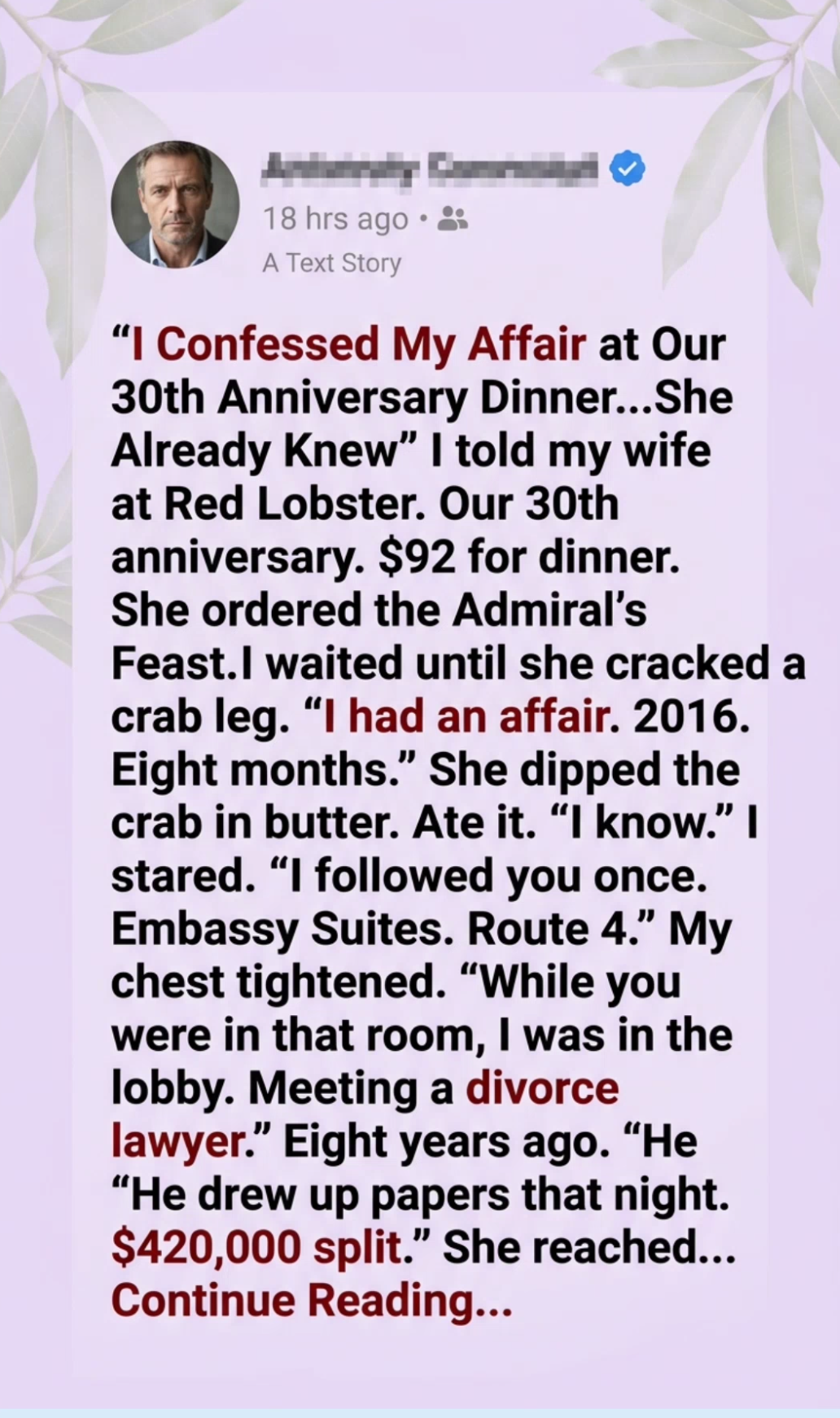
Our anniversary dinner cost $92.
My wife, Margaret, ordered the Admiral’s Feast.
I ordered grilled salmon.
She seemed unusually relaxed. She asked about our grandchildren, complained about the price of groceries, and told me that our daughter had finally found a house she liked.
I barely heard her.
There was something I had decided to tell her that evening.
For weeks, I had rehearsed the confession in my head. I had imagined her crying, shouting, asking questions, or walking away.
I had chosen our anniversary because I wanted to stop carrying the secret into another year of our marriage.
It was a terrible choice.
But I didn’t understand that until later.
Margaret cracked open a crab leg and dipped the meat into melted butter.
I cleared my throat.
“There’s something I need to tell you.”
She looked up.
“What is it?”
I stared at my plate.
“I had an affair.”
She stopped chewing.
I continued before I lost my nerve.
“It happened in 2016. It lasted about eight months.”
She placed the crab leg down.
I expected the questions.
Who was she?
Where did it happen?
Did you love her?
Instead, Margaret picked up her fork and took another bite.
Then she said two words.
“I know.”
I stared at her.
“What?”
“I know, David.”
My chest tightened.
“You knew?”
She nodded.
“I knew.”
I looked around the restaurant, suddenly aware of the families talking at nearby tables and the waiters moving between them.
“How long have you known?”
She wiped her fingers with a napkin.
“Since October 2016.”
Eight years.
I had spent eight years believing I had successfully hidden the affair.
She had known almost from the beginning.
“How?”
Margaret took a sip of water.
“I followed you once.”
I felt my stomach turn.
“Where?”
“Embassy Suites. Route 4.”
I stopped breathing.
That was where I had met the woman.
Her name was Lisa. She worked in the same regional office as I did. Our relationship began with conversations after meetings, then lunches, then messages that became increasingly personal.
I had convinced myself that it was harmless.
Then I had crossed a line.
For eight months, I had lied about work trips, late meetings, and appointments.
I had even told Margaret that I was attending a professional conference when I was actually spending time with Lisa.
I had thought I was clever.
Apparently, I wasn’t.
Margaret continued.
“When you went into that hotel, I parked across the street. I watched you walk through the entrance.”
I lowered my eyes.
“Why didn’t you come inside?”
She gave a small, tired smile.
“Because I didn’t want to see anything else.”
I swallowed.
“What did you do?”
She placed her napkin beside her plate.
“While you were upstairs, I was in the hotel lobby meeting a divorce lawyer.”
I looked at her.
“A lawyer?”
“Yes.”
“That night?”
“That night.”
She explained that she had already suspected something was wrong. My behavior had changed gradually. I had started guarding my phone, taking more work calls in private, and becoming irritated whenever she asked about my schedule.
She hadn’t immediately assumed there was another woman.
But one evening, she found a hotel receipt in the pocket of a jacket I had left at home.
The date matched a business trip I had described differently.
She began paying attention.
Eventually, she followed me.
And that night, while I was upstairs with Lisa, Margaret sat in a hotel lobby with a divorce attorney.
“He drew up the papers that night,” she said.
I stared at her.
“What papers?”
“Divorce papers.”
My mouth went dry.
“Did you sign them?”
“No.”
“Why not?”
She looked at me for a long moment.
“Because I wasn’t ready.”
I tried to speak, but she continued.
“The lawyer explained our financial position. He told me what separation could involve, how the house and retirement accounts might be handled, and what information I would need before making a final decision.”
She reached for her water.
“He estimated that our assets could be divided in a way that left me with approximately $420,000 in cash and retirement value, depending on the final figures.”
I stared at her.
“Four hundred and twenty thousand?”
“Approximately. It was an early estimate, not a final settlement.”
I looked at her as though I were seeing a stranger.
“Why didn’t you tell me?”
She gave a quiet laugh.
“Why didn’t you tell me?”
I had no answer.
She went on.
“I went home that night and looked at you sleeping beside me. I wondered whether I could walk away from thirty years of marriage because of something I suspected but hadn’t yet fully understood.”
She paused.
“Then I found out enough.”
I felt my face burning.
“Did you know Lisa?”
“I knew her name. I knew where she worked. I knew she was married, too.”
I looked down.
Margaret picked up another crab leg.
“I also knew you were spending money on hotel rooms and dinners that you told me were business expenses.”
I felt sick.
I had never considered how much of the affair she might have uncovered.
I had thought the only damage was the betrayal itself.
But she had been living with the evidence while I continued pretending nothing had happened.
“Why did you stay?” I asked.
She didn’t answer immediately.
Then she said, “Our daughter was twenty-six. Our son was twenty-eight. Both were building their lives. I didn’t want to make a decision out of anger. And I wanted to know whether I could ever trust you again.”
I shook my head.
“So you’ve known for eight years, and you’ve never said anything?”
“Not about the affair.”
“How could you sit across from me all these years?”
She looked at me.
“How could you?”
That ended the conversation for several seconds.
Our waitress came over to ask whether everything was all right.
Margaret smiled politely.
“Everything is fine, thank you.”
The waitress walked away.
I leaned forward.
“Did you ever consider leaving?”
“Every year.”
“Every year?”
“Yes.”
I looked at her hands.
She had removed her wedding ring.
I hadn’t even noticed.
“Where’s your ring?”
She glanced down.
“In my purse.”
My heart began beating faster.
“Why?”
“Because I wanted to decide whether I was still wearing it because I loved you or because I had become accustomed to it.”
I felt tears forming.
“Margaret, I know I did something terrible. But I love you.”
She nodded.
“I believe that you love me.”
I looked relieved.
Then she added:
“But love doesn’t automatically make someone trustworthy.”
I had no response.
She told me that she had spent the first year after discovering the affair considering divorce almost every day.
She had even consulted another solicitor to understand what would happen if we separated.
But eventually, she chose to stay.
Not because she had forgotten.
Not because she believed the marriage was perfect.
She stayed because she wanted to make a decision based on her own future, not simply as a reaction to my betrayal.
She had also started rebuilding parts of her life that had become too dependent on me.
She returned to work part-time.
She reconnected with friends.
She began taking weekend trips with her sister.
She opened a separate savings account using her own earnings and maintained accurate records of her financial contributions.
She wasn’t hiding money from me.
She was making sure she could stand on her own if she ever decided to leave.
I listened, ashamed of how little I had noticed.
“You’ve been preparing to leave me for eight years.”
Margaret shook her head.
“Not exactly. I’ve been preparing to survive if I needed to.”
That distinction stayed with me.
I asked whether she had told anyone.
She said she had spoken to her sister and one close friend. She hadn’t told our children because she didn’t want to turn them into judges of their parents’ marriage.
I was grateful.
Then she said something I hadn’t expected.
“I didn’t come here tonight expecting to divorce you.”
I looked at her.
“Then why did you come?”
“Because I wanted to see whether you would finally tell me the truth.”
I felt my throat tighten.
She explained that she had noticed changes in me over the previous few months. I had become distant, unusually attentive, and strangely emotional whenever we discussed our anniversary.
She suspected I was preparing to confess.
She had decided to let me speak.
I looked at the untouched salmon on my plate.
“I wanted to tell you because I didn’t want to carry it anymore.”
Margaret nodded.
“That’s understandable.”
I waited.
“But you need to understand something, David. Confessing because you are tired of carrying a secret doesn’t automatically repair the damage caused by keeping it.”
I looked at her.
She was right.
I had imagined that telling the truth would make me feel lighter.
I hadn’t considered what the truth would do to her.
The bill arrived.
Margaret reached for her handbag.
I stopped her.
“I’ll pay.”
She looked at me.
“Of course you will.”
It wasn’t sarcastic.
It was simply a statement.
I paid the $92.
We walked outside together.
The evening air was cool, and the parking lot was almost empty.
I asked whether she wanted to ride home with me.
She shook her head.
“My sister is picking me up.”
I felt a wave of panic.
“You’re not coming home?”
“Not tonight.”
“Where are you going?”
“To my sister’s.”
I wanted to ask whether she was leaving permanently.
But I had already asked too many questions that evening.
Before she got into the car, she turned toward me.
“David, I want you to do something.”
“Anything.”
“Don’t call our children and tell them your version of what happened. Don’t make me the villain because I haven’t forgiven you. And don’t tell them I stayed because I didn’t care.”
I nodded.
“I won’t.”
She looked at me for a moment.
“Good night.”
Then she left.
I drove home alone.
For the first time in eight years, I understood that I wasn’t the only person who had been living with the affair.
I had spent years protecting myself from the consequences.
Margaret had spent years preparing for them.
The following morning, I found a message from her.
“We need some time apart. Please arrange to stay somewhere else for the next few weeks. I will contact you when I’m ready to discuss our next steps.”
I read it several times.
I didn’t argue.
I packed a suitcase and stayed in a small apartment belonging to my brother.
During the next few weeks, Margaret and I communicated mostly through email.
She asked for copies of our financial records, retirement statements, and mortgage documents.
I provided them.
She wanted to know whether there had been any other affairs or hidden financial commitments.
I told her there hadn’t been.
She asked for the truth about Lisa.
I explained that the relationship had ended in 2017, after Lisa accepted a position in another state.
Margaret asked whether I had contacted her since.
I said no.
She asked whether I had kept photographs or messages.
I admitted that some old messages were still stored in an archived account. I provided the relevant information rather than deleting anything.
We agreed to meet with a marriage counselor before deciding whether to proceed with divorce.
I wasn’t sure she would ever want to stay.
But I knew I had no right to demand that she do so.
At our first counseling session, Margaret spoke calmly.
She described the hotel, the lawyer, and the eight years she had spent wondering whether I would ever tell her.
Then she explained what the affair had done to her.
“I wasn’t only hurt because he slept with another woman,” she said. “I was hurt because I couldn’t trust the ordinary parts of our life anymore.”
She described how every late meeting had become suspicious, every business trip had become a question, and every unexplained expense had reminded her that she might not know the truth.
The counselor asked me what I had understood about her experience.
I admitted that I had mostly thought about my own guilt.
I had not understood the daily uncertainty I had created for her.
Margaret looked at me.
“That’s what I mean. Even your confession was about making yourself feel better. You didn’t think about what it would do to me.”
I had no defense.
The counselor asked whether I was willing to accept that forgiveness might never come.
I said yes.
Margaret asked whether I was willing to answer questions honestly, even if the answers made me look worse.
I said yes.
We continued counseling for several months.
Some sessions were painful.
Others were surprisingly productive.
I learned that Margaret had not stopped loving me in 2016. But she had stopped trusting me, and those were two very different things.
She also learned that I had been avoiding difficult conversations for years, not only about the affair but about work, money, family expectations, and our relationship.
None of that excused what I had done.
But it helped us understand the marriage we had actually been living.
Eventually, Margaret made her decision.
She wanted a legal separation and then a divorce.
I was devastated.
I asked whether there was anything I could do to change her mind.
She shook her head.
“I don’t want to spend the rest of my life wondering whether the next honest conversation will come eight years late.”
We met with separate solicitors.
Our finances were reviewed, and we negotiated a settlement based on the law and the actual value of our assets. The old $420,000 estimate from the hotel consultation was not treated as an agreed amount; the final figures were established through proper disclosure and negotiation.
We divided our property and retirement interests fairly.
There were difficult conversations about the house, our savings, and how to handle family gatherings.
But there was no public scandal.
No dramatic confrontation with Lisa.
No attempt to turn our children against one another.
Just two people ending a marriage that had once meant everything to them.
On the day the divorce was finalized, Margaret and I met briefly outside the solicitor’s office.
She wore the same blue coat she had worn at our anniversary dinner.
I asked whether she was all right.
She smiled faintly.
“I’m going to be.”
I wanted to say that I was sorry again.
But I had said it many times.
Instead, I told her that I hoped she would have a good life.
She nodded.
“I hope you learn to be honest before the truth becomes unavoidable.”
Then she walked away.
Months later, I received a small envelope in the mail.
Inside was a photograph of us from our tenth anniversary.
We were standing outside a restaurant, laughing. Margaret had her arm around my waist, and I was holding two paper cups of coffee.
On the back, she had written:
“I don’t regret the thirty years we shared. I only regret the years we spent pretending the truth didn’t matter.”
I sat with that photograph for a long time.
I had confessed my affair at our thirtieth anniversary dinner because I thought honesty would finally set me free.
But I learned that honesty offered after years of deception does not erase what happened.
It only gives the other person the information they should have had all along.
Margaret had known for eight years.
She had gone to a lawyer while I was upstairs with another woman.
She had understood the financial consequences, considered her choices, and quietly prepared for a future without me.
And still, she had stayed long enough to give our marriage a chance.
I used to think the most painful part of betrayal was being caught.
Now I understand that the deepest damage happens long before anyone says a word.
It happens when someone you love has to learn how to protect themselves from you.
THE END.