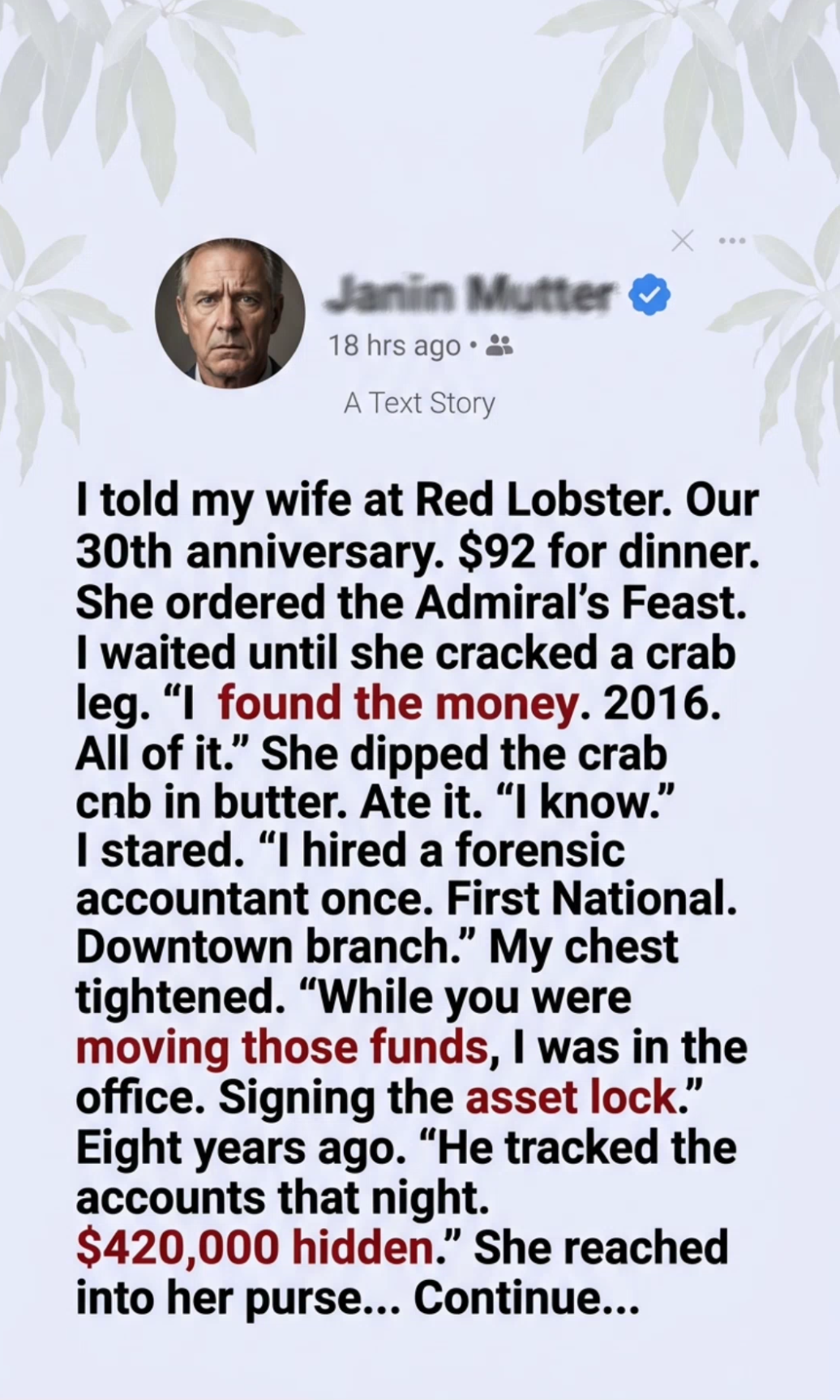
The bill was $92.
Thirty years of marriage, and we were celebrating at Red Lobster.
My wife, Margaret, had ordered the Admiral’s Feast. I ordered a steak, a baked potato, and a glass of iced tea.
We had been married long enough that neither of us needed an expensive restaurant to prove anything. We had celebrated anniversaries in fancy hotels when we were younger, but lately we preferred familiar places where nobody expected us to dress up.
That evening, however, I had come with something to say.
Something I had kept inside for eight years.
Margaret cracked a crab leg, dipped the meat into melted butter, and took a bite.
I watched her carefully.
“Margaret, I found the money.”
She didn’t look up.
“What money?”
“The money from 2016. All of it.”
She chewed, swallowed, and reached for her napkin.
“I know.”
I felt my stomach tighten.
“You know?”
She nodded.
“I hired a forensic accountant once. First National, downtown branch.”
I stared at her.
“When?”
“Eight years ago.”
My hands went cold.
She continued eating as though we were discussing the weather.
“While you were moving those funds, I was in the office signing the asset lock.”
I couldn’t breathe properly.
“An asset lock?”
“Your accountant tracked the accounts that night. Four hundred and twenty thousand dollars. Several transfers, three institutions, and one account you thought nobody would connect to us.”
She placed her fork down.
“Did you really think I wouldn’t notice?”
I looked around the restaurant.
A waiter passed carrying a tray of drinks. A family at the next table was celebrating a child’s birthday. Someone laughed near the entrance.
Everything seemed strangely normal.
I leaned closer.
“Why didn’t you confront me?”
Margaret opened her purse.
She removed a small cream-colored envelope and placed it beside my plate.
“Because I wanted to know why.”
I stared at the envelope.
“What is that?”
“Something you should have received eight years ago.”
I didn’t open it.
Instead, I looked at my wife.
For thirty years, I had believed I understood her. She was practical, patient, and careful with money. She remembered every bill, every birthday, every appointment.
She had been the person who kept our household running while I built my career.
And I had secretly moved $420,000 without telling her.
I had convinced myself I was protecting our future.
Now I wasn’t sure I had ever understood what protecting someone meant.
“Margaret,” I said quietly. “I need to explain.”
She nodded.
“You’ve had eight years.”
I looked down.
And finally, I began.
In 2016, I was fifty-eight and working as a regional operations director for a commercial construction company.
I had spent twenty-seven years building my position. I had started as a site supervisor, worked through two recessions, and eventually become responsible for several large projects.
Margaret had supported me through all of it.
She worked part-time at a medical office and handled most of the household finances. We had two children, both grown, and a mortgage that was nearly paid off.
Our life wasn’t extravagant, but it was comfortable.
Then my younger brother, Peter, came to me with a business opportunity.
He wanted to purchase a small commercial property and convert it into a storage facility.
He had found a location near a growing industrial district. The numbers looked promising, and he claimed he already had investors.
He needed $180,000 to secure the property.
I told him I couldn’t afford it.
He came back a week later.
This time, he brought paperwork.
He showed me projected rental income, contractor estimates, and a letter from a potential business partner.
I began to consider it.
Peter had always been the risk-taker in our family. I was the cautious one.
But he was my brother.
He reminded me how our father had helped us when we were young.
“You know what Dad always said,” Peter told me. “Family doesn’t let family drown.”
I agreed to invest $180,000.
I didn’t tell Margaret.
I told myself I would explain once the business started generating income.
Then Peter needed more.
The building required repairs. The contractor had underestimated the electrical work. A zoning issue delayed the opening.
Another $70,000.
Then another $40,000.
By the end of the year, I had transferred $290,000.
The business still wasn’t operating.
When I asked Peter for financial records, he became defensive.
“You don’t trust me?”
“I want to know where the money is going.”
“You’re acting like a bank.”
I should have stopped then.
Instead, I kept funding the project.
I moved money from a personal investment account and borrowed against a retirement account. I transferred funds through an account Peter had helped establish for the business.
I began telling myself that the money would return once the facility opened.
It never did.
In early 2017, I discovered that Peter had used some of the funds to pay personal debts.
He had also borrowed money from two other people without telling me.
The business property was eventually sold to cover outstanding obligations.
My $420,000 was gone.
Not all of it had disappeared into fraud. Some had paid contractors, taxes, legal expenses, and property costs.
But the investment had failed, and Peter had no realistic way to repay me.
I was terrified.
I imagined Margaret finding out.
I imagined the retirement we had planned disappearing.
I imagined her looking at me and realizing that the man she had trusted for thirty years had gambled away a significant part of their future.
So I did something worse.
I began hiding the losses.
I sold investments without explaining why.
I moved money between accounts.
I changed statements to arrive electronically at an address I controlled.
I told Margaret that one of our retirement accounts had underperformed.
I said I had made a conservative adjustment.
She believed me.
Or at least, I thought she did.
For the next eight years, I lived with the secret.
I worked longer.
I stopped spending unnecessarily.
I took consulting assignments after retirement.
Every extra dollar went toward rebuilding what I had lost.
I never asked Margaret for money.
I never told her about Peter.
I told myself that if I could replace the $420,000, I could confess without destroying our marriage.
But the money wasn’t the only thing I had hidden.
I had hidden my fear.
My shame.
And my brother’s betrayal.
I looked across the table.
“Peter lost the investment,” I said. “I kept putting money in because I thought I could save it.”
Margaret listened.
“I lost everything I invested. I was ashamed. I thought if I could replace it before you found out, nobody would have to suffer.”
She folded her napkin.
“You thought I wouldn’t suffer if I didn’t know?”
I looked down.
“I thought I was protecting you.”
“No,” she said. “You were protecting yourself from having to face me.”
The words landed heavily.
I couldn’t argue.
She opened the envelope.
Inside was a copy of a financial report dated October 2018.
The report had been prepared by an independent forensic accountant.
It listed the transfers, the accounts, the dates, and the institutions involved.
There was also a second document.
A legal agreement between Margaret and me.
I looked at her.
“What is this?”
“An asset protection agreement.”
She explained that after noticing unexplained withdrawals in 2018, she had become concerned.
At first, she thought there might have been identity theft.
She contacted the bank, requested copies of historical statements, and arranged a consultation with a forensic accountant.
The accountant traced the transfers.
He identified the money that had left our accounts and the institutions through which it had moved.
He also found the business records connected to Peter.
Margaret had learned about the failed investment before I knew she was investigating.
She had not immediately confronted me.
Instead, she consulted an attorney to understand our financial position and protect the assets that remained.
The agreement established a clear record of the money each of us had contributed to our retirement savings and clarified how certain jointly held assets would be handled if either of us became unable to manage them.
It did not secretly transfer everything to her.
It did not give her ownership of money that wasn’t hers.
It simply created transparency and safeguards after she discovered financial activity she couldn’t explain.
“Why didn’t you confront me?” I asked again.
She looked at me for a long moment.
“Because I wanted to give you the opportunity to tell me.”
I felt my face grow hot.
“How long did you wait?”
“Two years.”
Two years.
She had known.
She had watched me eat breakfast, go to work, return home, and sit beside her on the sofa.
She had waited for me to tell her the truth.
“And you never said anything?”
“I asked you questions.”
I remembered those conversations.
She had asked why I was reviewing old statements.
She had asked why my retirement account had changed.
She had asked whether Peter’s business was doing well.
I had answered every question with a half-truth.
I had even become irritated with her for asking.
“I thought you trusted me,” I whispered.
“I did trust you.”
She paused.
“That’s why I was so disappointed.”
I reached for the report.
“Did you tell the children?”
“No.”
“Why?”
“Because they weren’t responsible for our marriage. And because I wanted you to have the chance to be honest without turning this into a family scandal.”
I looked at her.
For eight years, I had believed my silence was protecting our family.
Meanwhile, my wife had been carrying the knowledge of my betrayal without using it against me.
“What did you want me to do?” I asked.
“Tell me the truth.”
“I was afraid.”
“So was I.”
She reached into her purse again and removed another document.
This one was a printed bank statement.
It showed a balance of $420,000.
I stared at it.
“What is this?”
“Your money.”
I looked up.
“Where did you get that?”
“Not from the business. Not from Peter. And not from anything I took from you.”
She explained that over the years she had continued working, saved part of her income, and invested cautiously.
She had also received a modest inheritance from her aunt in 2020.
She had never hidden those funds from me. They were documented in her personal financial records.
She had not accumulated the entire amount to replace my loss.
But she had kept a separate emergency fund and built it steadily.
When the account reached $420,000, she printed the statement.
“I wasn’t planning to give this to you,” she said.
“Then why show me?”
“Because I wanted you to understand something.”
She leaned forward.
“I didn’t need you to replace the money. I needed you to stop treating our marriage like a problem you could solve by yourself.”
I couldn’t speak.
She continued.
“When you lost the money, you lost more than an investment. You lost your ability to trust yourself. And instead of letting me stand beside you, you decided I was too fragile to know the truth.”
I looked at the statement again.
She had not been waiting to punish me.
She had been waiting for me to stop hiding.
“Did you ever think about leaving?” I asked.
She didn’t answer immediately.
“Yes.”
The word was quiet.
But it was honest.
“More than once?”
“Yes.”
I felt my chest tighten.
“What stopped you?”
She looked at her wedding ring.
“Thirty years doesn’t disappear in one afternoon. We built a life together. We raised two children. We buried your mother. We survived unemployment, illness, and every ordinary difficulty that comes with sharing a home.”
She looked directly at me.
“But I wasn’t going to spend the rest of my life married to someone who believed he had the right to make every important decision alone.”
I nodded.
“I understand.”
“No,” she said gently. “I don’t think you do yet.”
She placed the report back inside the envelope.
“I don’t want a dramatic apology tonight. I don’t want you promising to become a different man tomorrow. I want the truth, all of it.”
So I told her everything.
I told her about Peter’s original proposal.
I told her about the contractors, the failed zoning application, and the money he used to pay his personal debts.
I told her about the false explanations I had given her.
I admitted that I had changed the delivery settings on some statements.
I told her that I had continued sending Peter money even after I knew the business was failing because I couldn’t accept that I had made such a terrible mistake.
Margaret listened.
She didn’t interrupt.
When I finished, she asked one question.
“Does Peter know that I know?”
“No.”
“Does he still owe you money?”
“Yes.”
“Have you spoken to him recently?”
“Not in months.”
She nodded.
“Then we need to deal with that separately.”
I looked at her.
“We?”
She gave me a tired smile.
“If we are going to repair this marriage, we need to understand the damage. That doesn’t mean I’m going to pay your brother’s debts or pretend this didn’t happen.”
I nodded.
“I wouldn’t expect you to.”
“Good.”
For the first time that evening, she reached across the table and touched my hand.
Not affectionately, exactly.
But not coldly either.
“We have thirty years behind us,” she said. “I’m not going to throw them away without thinking. But I won’t spend another thirty years living with secrets.”
I looked at her wedding ring.
“I don’t want that either.”
We paid the bill.
The waiter brought the receipt, and Margaret insisted on paying her share.
We walked to the car together.
The drive home was quiet.
At the house, she went upstairs while I sat in the living room.
I thought about Peter.
For years, I had blamed myself for the failed investment. I had treated his decisions as mistakes I should have prevented.
But he had taken money from me without giving me accurate information.
He had used funds for personal expenses.
And when I asked questions, he had made me feel guilty for wanting answers.
The next morning, I called him.
He answered casually.
“Hey, big brother.”
“Margaret knows about the money.”
Silence.
Then he sighed.
“How much does she know?”
“Everything.”
He was quiet.
“Look, I was going to make it right.”
“You’ve been saying that for eight years.”
“I’ve had problems.”
“So have I.”
He started explaining the business again.
I interrupted.
“I don’t want another explanation. I want a complete accounting of what happened to the money.”
“You’re making this sound like I stole from you.”
“Did you use money for personal debts without telling me?”
He didn’t answer.
“Did you tell me the property was worth more than it was?”
Silence.
“Did you use money from me to cover obligations you hadn’t disclosed?”
He finally said, “I was trying to keep the business alive.”
“That doesn’t answer my questions.”
He became angry.
“You’re my brother. I thought you’d understand.”
I looked through the window at the garden Margaret had planted.
“I was your brother. That’s why I trusted you. You used that trust instead of respecting it.”
He hung up.
I didn’t call him back.
Over the next month, Margaret and I began financial counseling.
We met with an independent adviser and reviewed every account, investment, debt, and retirement document.
We hired an attorney to examine the old business arrangement and determine whether any funds could realistically be recovered.
The process was uncomfortable.
There were questions I didn’t want to answer.
There were documents I had avoided looking at for years.
But this time, I didn’t hide anything.
Peter eventually agreed to provide some records. They confirmed that much of the money had been spent on business expenses, while a portion had gone toward personal obligations.
The attorney explained that recovering the full amount would be difficult. Some claims were time-barred, some transactions lacked sufficient documentation, and Peter had limited assets.
We reached a written settlement for the portion he could reasonably repay.
It was not the $420,000 I had lost.
It was not even close.
But it was an acknowledgment of responsibility.
I stopped expecting the money to restore my relationship with my brother.
That relationship would have to be decided separately.
Margaret and I also made changes.
We established joint access to all household financial records.
We agreed that significant investments would require both of us to review the documents.
We created separate personal spending accounts while maintaining our shared retirement and household accounts.
We also began meeting with a marriage counselor.
At first, I thought the sessions would focus on the money.
They didn’t.
They focused on the years of silence.
Margaret talked about how lonely she had felt when she realized I was hiding something.
I talked about the shame of admitting I had made a terrible financial decision.
The counselor helped me understand that my shame had become a wall between us.
I had convinced myself that telling the truth would destroy our marriage.
Instead, refusing to tell the truth had been destroying it slowly.
Six months after our anniversary dinner, Margaret and I returned to Red Lobster.
We sat at the same table.
She ordered the Admiral’s Feast again.
I ordered the same steak.
When the waiter brought our drinks, Margaret looked at me and smiled.
“Are you going to tell me anything tonight?”
I laughed.
“No.”
“Good.”
She picked up a crab leg.
I reached across the table and took her hand.
“I am sorry,” I said. “Not because you found out. Because I made you live beside me while I hid something that affected both of us.”
She squeezed my fingers.
“I know.”
“I should have trusted you.”
“Yes.”
“I don’t expect you to forget.”
“I won’t.”
Then she smiled faintly.
“But I am willing to keep building something honest with you.”
We sat quietly for a moment.
Then she broke another crab leg.
And I realized that the most important thing I had recovered wasn’t the money.
It was the chance to stop living as a man who believed he could repair every mistake alone.
The $420,000 had changed our retirement.
The secrecy had nearly changed our marriage.
And the woman sitting across from me had known the truth for eight years, yet still given me the opportunity to tell it myself.
Thirty years earlier, I had promised to share my life with her.
It had taken me thirty-eight years of marriage to understand that sharing a life meant sharing the difficult truths, too.
That night, when we returned home, I placed the old financial report in our joint records folder.
Not hidden in my desk.
Not locked away.
Beside the other documents that belonged to both of us.
Then I wrote a note on the first page:
No more secrets. No more decisions made alone.
Margaret read it over my shoulder.
She didn’t say anything.
She simply took my hand.
And for the first time in eight years, I felt like we were sitting on the same side of the table again.
THE END.