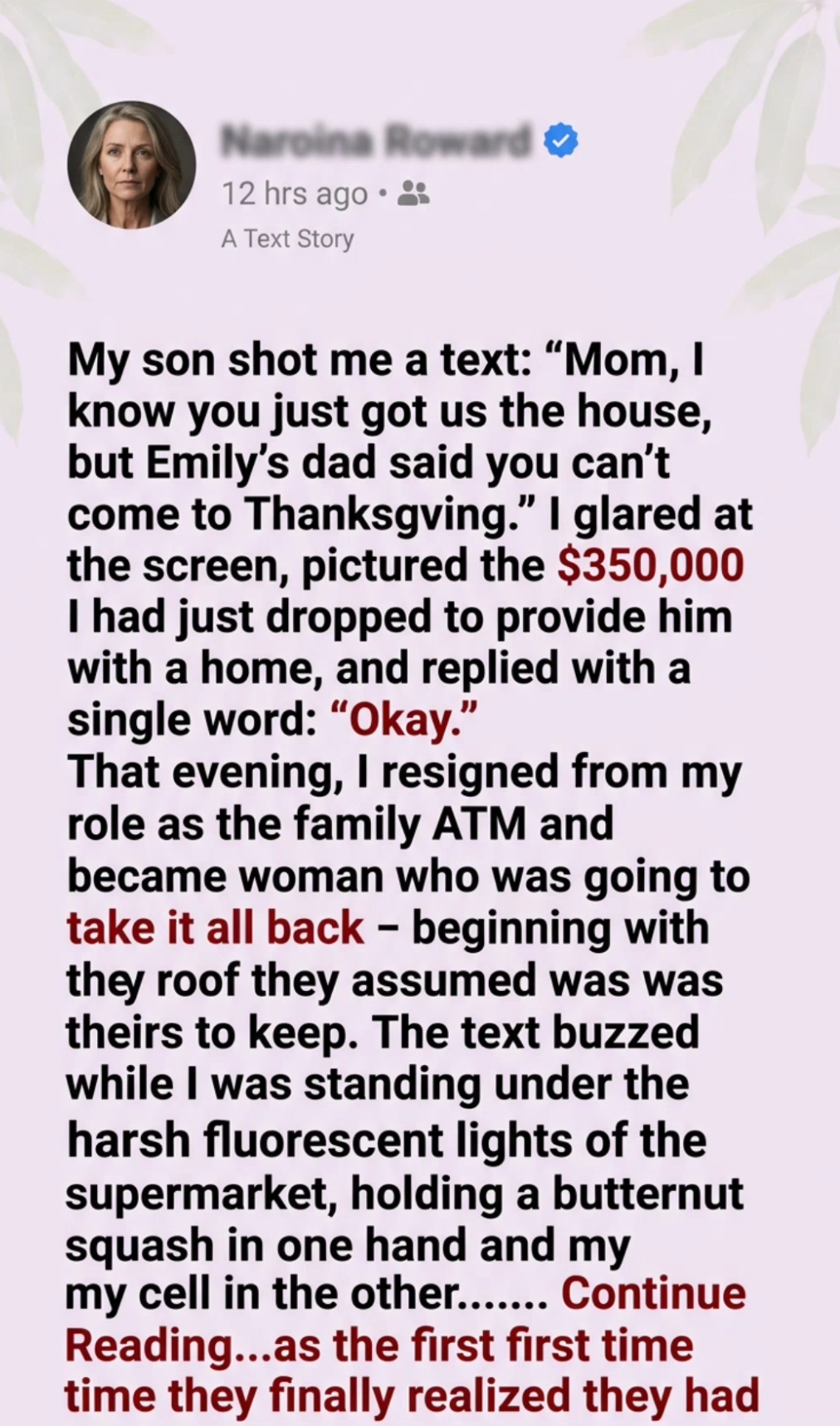
The supermarket was crowded, the checkout lines were long, and I was standing in the produce aisle trying to decide whether one butternut squash would be enough for Thanksgiving dinner when my phone buzzed.
It was a message from my son, Nathan.
Mom, I know you just got us the house, but Emily’s dad said you can’t come to Thanksgiving.
I read it once.
Then again.
I had just spent $350,000 helping Nathan and his wife, Emily, buy a beautiful four-bedroom house. I had used money I had saved over thirty years, money I had planned to use for my own retirement, because my son had told me he wanted to give his children a stable home.
And now I wasn’t welcome to sit at their Thanksgiving table.
I stood there holding the squash, surrounded by shoppers choosing pies and potatoes, while the meaning of his message settled over me.
I didn’t call him.
I didn’t ask what Emily’s father had against me.
I didn’t remind him how much I had sacrificed.
I simply typed one word.
Okay.
Then I put the squash back.
I left the supermarket without buying anything.
By the time I reached my car, I had made a decision that would change my relationship with my son forever.
I was finished being the person who paid for everything and was invited only when convenient.
And I was going to begin with the house.
But there was something Nathan and Emily had never bothered to understand.
The house was not an unconditional gift.
Not even close.
My name was still on the ownership documents, and the agreement we had signed gave me rights they had treated as meaningless.
They had assumed that because I loved my son, I would never enforce them.
They were about to discover how wrong they were.
My name is Margaret Ellis. I was sixty-seven years old when this happened.
I had been a widow for eleven years. My husband, Robert, died after a short illness, leaving me with a modest pension, a paid-off townhouse, and enough savings to live comfortably if I was careful.
I wasn’t wealthy in the way people imagine when they hear that someone can contribute $350,000 toward a house.
I had simply spent decades being disciplined.
Robert and I had worked, saved, avoided unnecessary debt, and invested what we could. We never bought expensive cars. We rarely traveled far. We believed that security was something you built slowly.
After Robert died, I continued living much the same way.
Nathan was our only child. He had always been affectionate, although adulthood had made our relationship more complicated. He married Emily when he was thirty-one, and they had two children, Sophie and Lucas.
I adored those children.
I attended school performances, bought birthday presents, and watched them whenever Nathan and Emily needed help.
But over the years, I noticed that family visits increasingly came with requests.
Sometimes Nathan needed help with a car repair.
Sometimes Emily needed money for the children’s activities.
Sometimes they were short on a monthly payment.
I helped because I could.
Then Nathan called me one evening and said they had found a house.
Their apartment had become too small. The children shared a bedroom, and Emily wanted a yard. Nathan said they had found a property in a good school district, but the down payment was beyond their reach.
He sounded embarrassed.
“Mom, I hate asking,” he said. “But we could really use some help.”
I asked how much they needed.
After several calculations, the number came to $350,000.
I nearly dropped the phone.
“That is a lot of money, Nathan.”
“I know. I know it’s unreasonable. We can keep renting. I just thought I’d ask.”
I didn’t answer immediately.
That night, I sat in Robert’s old armchair and looked at the photographs on the bookshelf.
I imagined Sophie and Lucas having a backyard. I imagined them growing up in one home instead of moving every few years. I imagined the relief on my son’s face if I could make it happen.
The next morning, I called him.
“I’ll help,” I said. “But we’re going to do this properly.”
He was so excited that he nearly shouted.
He and Emily visited me that weekend. We discussed the arrangement, and I made one condition clear: the money would not be handed over casually.
I wanted a written agreement prepared by an independent attorney.
Nathan agreed immediately.
At the attorney’s office, we established that I would contribute $350,000 toward the purchase, while retaining a recorded ownership interest in the property. Nathan and Emily would live there, make the agreed household payments, maintain the property, and have the right to acquire my remaining interest under a defined arrangement.
The agreement also specified what would happen if they sold the house, stopped meeting their obligations, or substantially changed the living arrangement.
It wasn’t a simple loan, and it wasn’t an outright gift.
It was a carefully documented family property arrangement.
I understood it.
The attorney explained it.
Nathan and Emily signed it.
At the time, everyone seemed comfortable.
Nathan even squeezed my hand afterward.
“Thank you, Mom. I promise we’ll never make you regret this.”
I believed him.
The house closed six weeks later.
It was a lovely place on a quiet street, with a wide porch, a fenced backyard, and a kitchen large enough for the entire family.
I helped them choose curtains and bought the children new beds.
For the first few weeks, Nathan called almost every evening.
Then the calls became less frequent.
I didn’t think much of it.
They were busy settling in.
The first Thanksgiving after the purchase was supposed to be special.
I had already volunteered to bring several dishes. Emily had mentioned that her father, Richard, would be hosting the main meal at Nathan’s new house because his side of the family had more relatives coming.
I thought that was perfectly reasonable.
I had no problem sharing the holiday.
A few days before Thanksgiving, I asked Nathan what time I should arrive.
He didn’t answer immediately.
Instead, he sent the message I had read in the supermarket.
Mom, I know you just got us the house, but Emily’s dad said you can’t come to Thanksgiving.
I drove home in silence.
I put my handbag on the kitchen counter and sat down.
For several minutes, I tried to make sense of it.
Why would Richard decide I couldn’t attend?
And why would Nathan agree?
I called my son.
He answered after the fourth ring.
“Hey, Mom.”
“Can you explain your message?”
He sighed.
“It’s just complicated.”
“What is complicated about Thanksgiving?”
“Emily’s dad is hosting. He thinks it would be better if his family had the house to themselves this year.”
“Your house?”
“Our house, Mom.”
I paused.
“Then why does he get to decide whether your mother can enter it?”
“Please don’t make this into a big thing.”
I closed my eyes.
“Nathan, I gave you the money to buy that house. I helped you because I wanted you and your children to have a home. And now you’re telling me I can’t come to dinner because your father-in-law prefers it that way?”
“He’s helped us a lot too.”
I waited.
Then Nathan added, “You know how he is. He doesn’t like tension.”
“What tension?”
“He feels like you’ve been too involved.”
I almost laughed.
Too involved?
I had helped with the purchase, chosen a few household items, and occasionally visited my grandchildren.
I hadn’t tried to control their lives.
“Did you tell him I was coming?”
Nathan was quiet.
“Emily told him.”
“And what did you say?”
“I said we’d figure something out.”
That was the answer.
He hadn’t defended me.
He hadn’t told Richard that his mother was welcome.
He had simply allowed someone else to make the decision.
I didn’t argue.
I didn’t cry.
I said, “All right, Nathan. Enjoy Thanksgiving.”
Then I hung up.
The next morning, I called my attorney, Helen Price.
I explained what had happened and asked her to review the property agreement.
She didn’t express outrage. She didn’t tell me to punish my son.
She simply asked whether I wanted to understand my legal position or whether I had already decided what to do.
“I want to understand exactly what I signed,” I said.
We met that afternoon.
Helen reviewed the recorded ownership documents, the agreement, and the payment history.
She explained that my contribution had given me a genuine legal interest in the property. Nathan and Emily had the right to occupy it under the agreement, but they did not have the unrestricted ownership they appeared to believe they had.
The agreement also required them to respect the agreed access and inspection provisions and prohibited them from treating my ownership interest as though it had disappeared.
“Does this mean I can take the house back because they excluded me from Thanksgiving?” I asked.
“No,” Helen said firmly. “You cannot use the agreement as a weapon simply because they hurt your feelings. We need to distinguish the emotional dispute from any actual contractual breach.”
I appreciated that answer.
I wasn’t looking for revenge.
But I was no longer willing to pretend the agreement didn’t matter.
Helen suggested sending a formal notice clarifying the parties’ obligations and requesting a meeting to discuss the property arrangement.
Before we did anything, she asked me a question.
“Margaret, if your son apologizes tomorrow, will you still want to change the arrangement?”
I thought about it.
“Yes,” I said. “I don’t want to own a piece of a house where my place in the family depends on whether someone else approves of me. I want a fair exit from this arrangement.”
Helen nodded.
“Then we’ll work toward that. But it has to be done properly.”
I spent Thanksgiving alone.
I cooked a small chicken, roasted vegetables, and a pumpkin pie.
I set the table for one.
At six o’clock, I received a photograph from Nathan.
It showed Sophie and Lucas sitting beside a large turkey. Emily’s parents were at the center of the picture.
The caption read:
The kids had a great day. Hope you had a nice Thanksgiving.
I stared at it for a long time.
Then I put my phone away.
The next morning, I received another message.
This one was from Emily.
Margaret, I hope you understand that we were trying to avoid uncomfortable family dynamics. Richard is very sensitive about these things.
I typed a response, deleted it, and decided not to send anything.
Helen had already prepared the formal letter.
It arrived by tracked mail the following week.
The letter did not accuse anyone of wrongdoing. It simply confirmed my recorded ownership interest, reminded Nathan and Emily of the agreement’s terms, and requested that they arrange a meeting to discuss a mutually acceptable path forward.
Nathan called within an hour of receiving it.
“Mom, what is this?”
“It’s a letter from my attorney.”
“Why would you send a lawyer after us?”
“I haven’t sent anyone after you. I asked for a meeting about the property agreement.”
“You’re threatening to take our home?”
“No. I’m asking us to discuss the arrangement we all signed.”
He sounded angry.
“After everything we’ve been through, you would do this to your own son?”
I looked out the kitchen window.
“Nathan, I helped you buy that house. I didn’t sign away my right to be treated respectfully.”
“You’re making this about Thanksgiving.”
“No. Thanksgiving showed me something I had been avoiding.”
He went silent.
Then he said, “Emily is upset.”
“I imagine she is.”
“And Richard thinks this is completely unreasonable.”
“Richard is welcome to discuss the agreement with his own attorney.”
Nathan hung up.
The meeting took place ten days later.
Helen’s office was quiet and professional.
Nathan arrived with Emily and Richard.
Richard walked in looking irritated, carrying a leather folder.
He sat down and immediately began speaking.
“I think this has gotten out of hand,” he said. “This is a family disagreement. We shouldn’t be involving lawyers.”
Helen replied calmly.
“Then it should be easy to resolve. We are here to discuss the documented arrangement and possible next steps.”
Richard looked at me.
“Margaret, you have plenty of money. Why create problems for a young family?”
I didn’t answer immediately.
Then I said, “Because I am not a bank, Richard. I’m a person.”
He shook his head.
“That’s not what anyone said.”
I looked at Nathan.
“Did you tell Richard that I wasn’t welcome?”
Nathan stared at the table.
Emily answered instead.
“Dad thought it would be more comfortable if we kept Thanksgiving to our side of the family.”
“Your side of the family includes Nathan and the children,” I said. “It doesn’t erase me.”
Richard leaned back.
“I paid for plenty of things when they were getting started. I think I have a say in what happens at my daughter’s house.”
Helen opened the agreement.
“Mr. Carter, the question today is not who has contributed more to the family’s comfort. It is what the parties agreed to when this property was purchased.”
She walked everyone through the relevant sections.
My ownership interest was documented.
The occupancy arrangement was clear.
The agreement established a process for selling or buying out my interest.
Nathan and Emily had signed it willingly.
Richard had no ownership interest and no authority under the agreement.
For the first time, he stopped talking.
Nathan looked at me.
“Mom, why didn’t you just tell us you wanted the money back?”
“I didn’t want the money back when I helped you. I wanted to help you build a home. But I don’t want to remain financially tied to people who believe they can accept my help while excluding me from their lives.”
Emily crossed her arms.
“So what do you want?”
“A fair buyout of my interest, or a sale of the property under the agreement. I want an independent valuation. I want the children to have as much stability as possible. And I want this handled without pretending that my contribution was a gift after the fact.”
Nathan looked frightened.
“We can’t afford to buy you out right now.”
“Then we need to look at the options.”
Helen explained that they could seek financing to purchase my interest, negotiate a sale, or agree on another arrangement that satisfied the contract and protected everyone’s rights.
There would be no immediate eviction.
There would be no changing the locks.
There would be no surprise removal of anyone’s belongings.
The process would take time.
I was prepared for that.
Richard, however, seemed to have expected a different outcome.
He had apparently believed that I would threaten them, become emotional, and eventually back down.
Instead, he was looking at a legal agreement that had existed long before the Thanksgiving argument.
He gathered his folder.
“This is ridiculous,” he muttered.
Then he walked out.
The following weeks were difficult.
Nathan called several times, sometimes angry, sometimes pleading.
He told me the children were worried.
I assured him that I wasn’t trying to separate them from their home or their grandmother.
I asked to speak with Sophie and Lucas regularly.
I didn’t discuss the property with them.
They were children. They had nothing to do with the adults’ decisions.
Eventually, Nathan and Emily met with a mortgage adviser.
They explored refinancing, but the numbers were difficult. The house had increased somewhat in value, but not enough to make a buyout easy without taking on a substantial new payment.
They also discussed selling.
That possibility frightened Nathan.
He had become attached to the house, and the children loved their rooms and backyard.
I understood.
But I also understood that the arrangement could not continue indefinitely.
After several meetings, we reached a compromise.
Nathan and Emily would have a fixed period to arrange financing for a buyout at a value established by an independent property valuation. If they could not complete it within that period, the property would be listed for sale, with the proceeds distributed according to the agreement.
They would not be forced out overnight.
They would have time to find another suitable home if necessary.
And I would no longer be responsible for their ongoing expenses.
Nathan signed the revised agreement.
Emily signed too.
Richard did not attend the final meeting.
He had finally realized that the property was not his to control.
Three months later, Nathan and Emily secured financing.
The process was not easy. They had to reduce their spending, sell a second vehicle, and make financial changes they had postponed for years.
But they managed to buy out my ownership interest.
The final payment arrived on a Wednesday morning.
I looked at the confirmation and felt something unexpected.
Not triumph.
Not revenge.
Relief.
The financial connection was finally over.
Nathan called that evening.
“Mom, we finished everything,” he said.
“I saw the payment.”
“I know things have been awful.”
“Yes.”
He took a breath.
“I owe you an apology.”
I waited.
“I should never have let Richard decide whether you could come to Thanksgiving. It was our home. I should have told him you were welcome.”
I said nothing.
“And I should have remembered what you did for us. I kept thinking about how uncomfortable the dinner would be, but I didn’t think about how hurtful my message was.”
His voice became quieter.
“I’m sorry, Mom.”
I believed that he meant it.
But I also knew that forgiveness did not mean returning to the old arrangement.
“Thank you for saying that, Nathan.”
“Can we start over?”
“We can try.”
The following Thanksgiving, I received an invitation from Nathan.
It was a simple message.
Mom, we’re having dinner at our house this year. We’d really like you to come. Just us, Emily’s family, and the kids. No conditions. No awkward arrangements. You’re welcome.
I read it carefully.
Then I replied:
I’d love to come. I’ll bring the pie.
When I arrived, Sophie ran down the front steps and wrapped her arms around me.
“Grandma! You came!”
I hugged her tightly.
Lucas appeared behind her, holding a handmade paper turkey.
“Look what I made for you!”
Inside the house, Nathan was setting the table.
He walked over and took my coat.
“I’m glad you’re here,” he said.
I looked at him for a moment.
“I’m glad to be here too.”
Dinner was not perfect.
There were too many dishes, the turkey was slightly dry, and Richard made a few comments about the weather that nobody particularly needed.
But I had a seat at the table.
And nobody made me feel as though my presence was an inconvenience.
After dinner, Nathan walked me to my car.
“Mom,” he said, “I know paying for that house changed everything.”
I looked at him.
“It did.”
“I thought the money meant you trusted us. I didn’t realize how much responsibility came with it.”
“Trust doesn’t mean you never have to respect the person who trusts you.”
He nodded.
I got into my car and drove home.
I didn’t regret helping my son.
I regretted believing that helping him meant I had to accept whatever treatment came afterward.
The house had cost me $350,000.
The lesson had cost me much more.
But I finally understood that being a loving mother did not mean surrendering my dignity, my savings, or my right to be included.
I could love my son without financing his life.
I could forgive him without pretending nothing had happened.
And I could be a grandmother without allowing anyone to treat me like an unwanted guest.
That year, I brought the pie.
But I left my checkbook at home.
THE END.