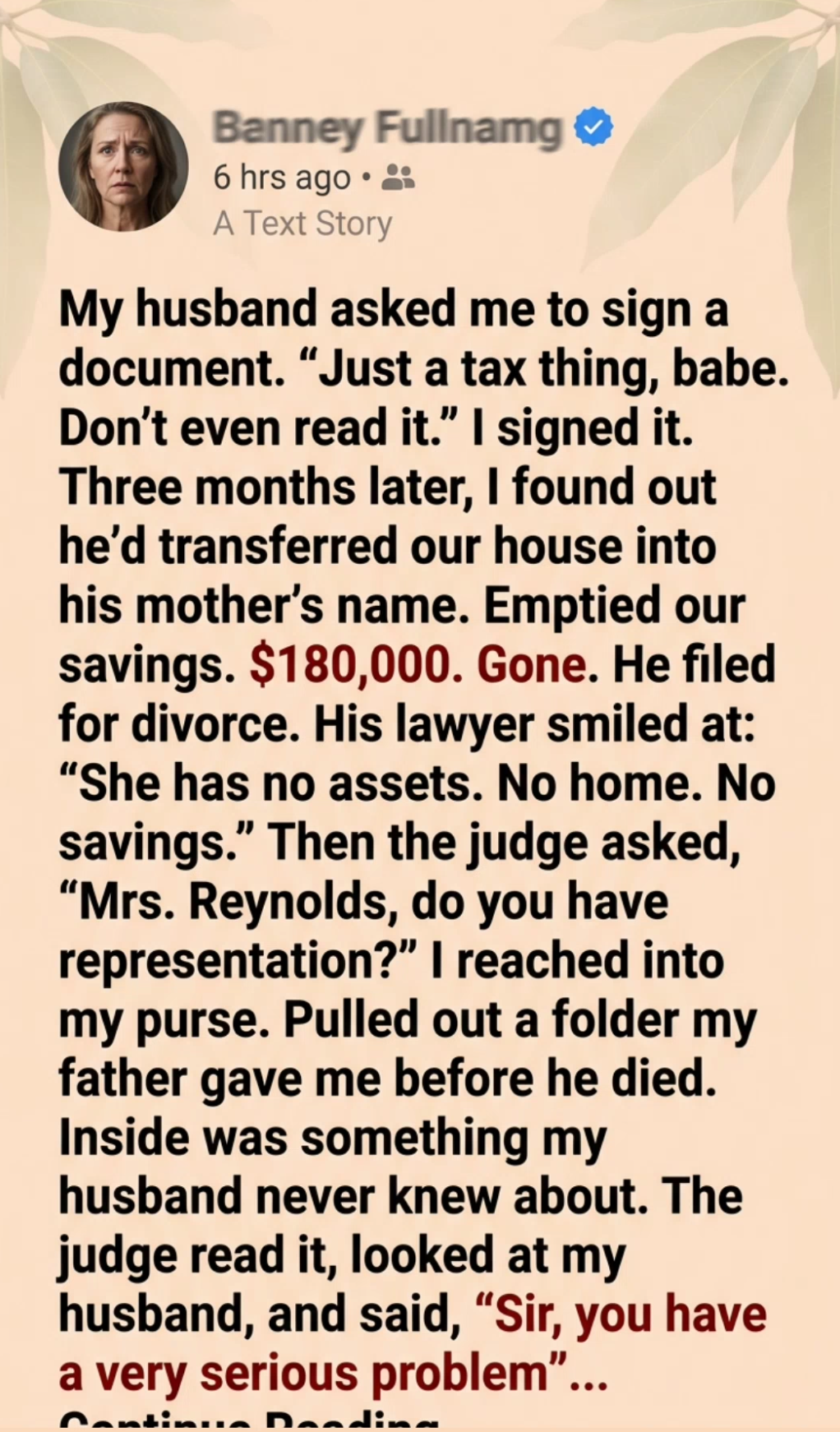
The document was only two pages long.
My husband, Daniel Reynolds, placed it beside my coffee one Tuesday morning and handed me a pen.
“Just a tax thing, babe,” he said. “Our accountant needs it before the end of the month. Don’t waste time reading all that legal language.”
I was getting ready for work, and our daughter had missed her school bus. I was distracted, tired, and running late.
I trusted him.
So I signed.
Three months later, I discovered that the document had authorized a transfer of our family home into his mother’s name.
Our joint savings account, which held nearly $180,000, had also been emptied.
Then Daniel filed for divorce.
His attorney stood in court and described me as a woman with no assets, no property, and no savings. Daniel sat beside him wearing the same confident expression he had worn when he handed me that pen.
I thought I had lost everything.
Then the judge asked whether I had legal representation.
I reached into my purse and removed a folder my father had given me shortly before he died.
I had carried it for years without fully understanding why he had insisted I never throw it away.
Inside was a document Daniel had never seen.
The judge read the first page.
Then the second.
He slowly removed his glasses, looked directly at my husband, and said:
“Mr. Reynolds, you have a very serious problem.”
Daniel’s confident expression disappeared.
And for the first time in months, I realized that my husband might not have been as clever as he believed.
My name is Eleanor Reynolds. I was forty-five when my marriage ended.
Daniel and I had been together for seventeen years and married for fourteen. We had one daughter, Grace, who was thirteen at the time.
For most of our marriage, I believed we were a normal family.
Daniel worked as a regional sales director for a commercial equipment company. I managed payroll and administration for a medical supply business.
We weren’t wealthy, but we were comfortable.
We owned a three-bedroom house in a quiet neighborhood, had two cars, and maintained a savings account for emergencies and Grace’s future education.
The house had been our biggest achievement.
We bought it eight years earlier, after saving for years and making a substantial down payment. My parents had helped us with some of the closing costs, but Daniel and I had paid the mortgage together.
My father, Arthur, had always been cautious about money.
He had owned a small engineering company and believed that financial security came from understanding what you signed.
He used to tell me:
“Never sign something because someone you love tells you to. Read it because you love yourself.”
I thought he was simply being protective.
My father died six years before Daniel’s betrayal.
Before he passed, he gave me a thick folder containing several legal and financial documents. He told me to keep it somewhere safe and never let anyone convince me that it was unnecessary.
I placed it in a locked cabinet in my bedroom.
Then life continued.
I worked, raised Grace, paid bills, and built a marriage with Daniel.
At least, I thought I was building one.
The first signs of trouble were small.
Daniel began keeping his phone face down.
He started traveling more frequently, sometimes returning home late without explaining where he had been.
When I asked about our savings, he told me the money was being moved into a higher-interest account.
I asked to see the statements.
He said he would send them later.
He never did.
Whenever I brought up financial questions, he became irritated.
“Why do you suddenly need to know every little thing?” he asked.
“Because it’s our money.”
“I’m handling it.”
I eventually stopped asking.
That was my mistake.
I had always believed that a marriage meant dividing responsibilities. Daniel handled more of the investments, and I managed the household expenses.
I didn’t realize that he had begun treating my trust as permission to hide things.
Then came the document.
It was a Tuesday morning in March.
Daniel was standing near the kitchen counter, already dressed for work.
“Eleanor, I need your signature.”
I looked at the pages.
“What is it?”
“Tax paperwork. Our accountant wants it signed.”
“Can I read it tonight?”
He sighed.
“It’s two pages. It’s nothing complicated. If we miss the deadline, we’ll have to pay extra fees.”
Grace was upstairs looking for her school shoes.
My phone was ringing.
I had a meeting in forty minutes.
Daniel tapped the signature line.
“Just sign here and here.”
I did.
He collected the pages immediately and put them inside his briefcase.
I didn’t think about them again.
The truth emerged three months later.
I was organizing our household files when I noticed that our property tax statement had been redirected.
Instead of arriving at our home, it had been sent to an address I didn’t recognize.
I called the county property office.
The representative asked for the property identification number and checked the record.
Then she said something that made my hands go cold.
“According to the latest filing, the property was transferred to Patricia Reynolds.”
Patricia was Daniel’s mother.
I asked her to repeat the information.
She did.
The property had been transferred six weeks earlier.
I immediately asked for a copy of the recorded deed.
When I received it, I saw my signature.
It was on the same document Daniel had placed beside my coffee.
But the title was not a tax declaration.
It was a deed transferring our ownership interest to his mother.
I read every page.
The document had been prepared by a law office Daniel had used for business matters. It identified the transfer as a gift.
I had never agreed to give our home away.
I called Daniel.
He didn’t answer.
I called again.
Then I sent a message.
Why is your mother’s name on our house?
He replied twenty minutes later.
We need to talk when I get home.
I knew then that something was terribly wrong.
But I still didn’t understand the full extent of it.
That evening, Daniel came home and placed his keys on the counter.
He didn’t look surprised when I showed him the deed.
“You signed it,” he said.
I stared at him.
“You told me it was tax paperwork.”
“I explained that we were restructuring the property.”
“No, you didn’t.”
He rubbed his forehead.
“Mom needed to protect the house from certain financial issues. It was temporary.”
“Then why didn’t you tell me?”
“Because you would have made it complicated.”
I felt as though the room had shifted.
“You transferred our home without telling me what I was signing.”
“I didn’t steal anything. Your signature is right there.”
I looked at him.
“That isn’t permission if you lied about the document.”
He shrugged.
“Talk to a lawyer if you don’t believe me.”
That was the moment I realized he had already prepared himself for this conversation.
He wasn’t afraid.
He thought the paperwork had made him untouchable.
The next morning, I contacted our bank.
I wanted to check the savings account.
The balance was almost zero.
The account had held $180,000.
Now it showed a remaining balance of $2,416.
I asked the bank representative for the transaction history.
The money had been moved through several transfers over the previous eight weeks.
Some had gone into an account controlled by Daniel.
Others had gone to a business account connected to a company owned by his mother.
I felt sick.
That money was not just spare cash.
It represented years of saving, tax refunds, investment earnings, and money we had set aside for emergencies and Grace’s education.
I asked whether the bank could reverse the transfers.
The representative explained that the transactions had been authorized through the account access Daniel held. The bank could investigate suspicious activity, but it could not simply return the money because I disputed the reason for the transfers.
I requested copies of everything.
Then I called a lawyer.
Her name was Melissa Grant.
I explained what had happened, including the property transfer and the missing savings.
She listened carefully.
“Do not confront him again until we understand the documents,” she said. “And do not sign anything else.”
I agreed.
She requested copies of the deed, bank statements, and the document Daniel had presented to me.
When she saw the paperwork, she became very serious.
“This is not a simple family disagreement,” she said. “We need to determine whether the transfer was obtained through misrepresentation, whether the deed can be challenged, and where the money went.”
She also asked whether my father had ever prepared an estate plan or any property-related documents involving me.
I remembered the folder.
I told her about it.
“Bring it to me,” she said.
That evening, Daniel told me he wanted a divorce.
He sat at the dining table while Grace was upstairs.
“I think we’ve grown apart,” he said.
I looked at him.
“Is that why you transferred the house?”
He didn’t answer.
“I don’t want to keep fighting,” he continued. “We should make this easy.”
Then he slid a document across the table.
It was a proposed separation agreement.
It stated that Daniel would retain the property, that each party would keep whatever assets remained in their possession, and that neither would pursue further financial claims.
I read the first page.
Then I stopped.
“You want me to agree that I have no claim to the house?”
“It’s in my mother’s name now.”
“And the savings?”
“We both used the account.”
“The money is gone, Daniel.”
He leaned back.
“You signed the property document. The account transfers were authorized. What exactly do you expect me to do?”
I looked at him for a long time.
Then I pushed the agreement back.
“I’m not signing this.”
His expression hardened.
“You’re going to make this ugly.”
“No. You already did.”
Melissa met me the next morning.
I brought the old folder my father had given me.
It was worn around the edges, with a small brass clasp. Inside were several documents, including an old family trust instrument, a property schedule, and a letter written in my father’s handwriting.
Melissa read through them slowly.
Then she asked me to sit down.
“Eleanor, your father was very careful.”
I looked at her.
“What does that mean?”
She pointed to the trust instrument.
Years before his death, my father had established an irrevocable family trust for my benefit. It held certain assets, including a protected investment portfolio and a separate interest in a property holding company.
I had known that my father left me something, but I had never understood the structure.
The trust had been created to provide financial security and prevent the assets from being casually transferred or used as collateral by someone else.
My father had appointed an independent trustee.
The document also contained a provision stating that the trust property remained separate from any personal debts or obligations I might incur, subject to the applicable law and the trust’s terms.
More importantly, the trust records showed that my father had transferred a minority interest in a property company into the trust.
That company had a secured financial interest connected to the house Daniel had transferred to his mother.
I blinked.
“What does that mean?”
Melissa examined the supporting schedule.
“It means your husband may have transferred an interest he did not have the authority to transfer without addressing the company’s existing rights.”
I stared at the document.
The house wasn’t simply a property that Daniel and I owned together.
There was an old, properly recorded financial arrangement that had to be considered before any transfer could be treated as clean.
My father had established it years before Daniel and I bought the house.
I had never thought it would matter.
Melissa called the trustee and requested confirmation of the records.
By the end of the day, we had the information we needed.
The trust’s interest had not disappeared.
And Daniel’s deed did not erase it.
The divorce proceedings began several weeks later.
Daniel’s attorney was a confident man named Richard Cole.
He spoke quickly, wore expensive suits, and appeared certain that he had already won.
His initial filings portrayed me as financially dependent on Daniel.
They argued that I had voluntarily signed the property transfer and that the money in the savings account had been spent on shared household expenses.
Daniel also claimed that I had no meaningful separate assets.
At the first hearing, Richard stood beside his client and addressed the judge.
“Your Honor, my client is prepared to resolve this matter efficiently. The respondent has no real estate, no significant savings, and no independent financial resources. The house is legally held by Mr. Reynolds’s mother.”
I sat beside Melissa, holding my hands together.
Richard continued.
“Mrs. Reynolds voluntarily signed the transfer documents. She cannot now claim that she was unaware of what she signed.”
The judge looked at the paperwork.
Then he turned toward me.
“Mrs. Reynolds, do you have representation?”
For a moment, I was surprised.
Then I reached into my purse.
I removed the folder my father had given me.
Melissa stood.
“Your Honor, we have additional documents that directly concern the ownership history and the validity of the transfer.”
Richard smiled faintly.
“More family paperwork?”
Melissa did not respond to him.
She handed the folder to the court clerk.
The judge opened it.
He examined the trust instrument.
Then the property schedule.
Then the letter from the independent trustee.
He stopped at one page and read it again.
His expression changed.
He turned to Daniel.
“Mr. Reynolds, did you know about this trust?”
Daniel shifted in his chair.
“No, Your Honor.”
“Did you know that the property holding company had a recorded financial interest connected to this residence?”
Daniel looked at Richard.
Richard leaned forward.
“Your Honor, we have not had an opportunity to review these documents.”
The judge raised a hand.
“I understand. But I am looking at a recorded interest that appears to predate the transfer.”
He turned another page.
Then he looked at the deed.
“Mr. Reynolds, you represented this transfer as a gift to your mother. Were all existing interests disclosed?”
Daniel didn’t answer.
Richard stood.
“We would request time to investigate.”
The judge nodded.
“That may be appropriate. But I want to be very clear. If this deed was executed through material misrepresentation, or if the transfer attempted to defeat a valid recorded interest, the consequences could be significant.”
He looked directly at Daniel.
“Sir, you have a very serious problem.”
The courtroom became silent.
Daniel’s face had gone pale.
For the first time since I discovered the deed, he looked uncertain.
The hearing was adjourned so the parties could investigate the trust documents and property records.
Over the next several weeks, Melissa and the trustee worked together to establish the history of the arrangement.
The records showed that the trust’s company had held a secured interest related to the property from the beginning.
The interest had not been disclosed in Daniel’s transfer paperwork.
The transfer to Patricia had therefore created a serious title dispute.
The trust itself did not automatically give me ownership of the entire house, and it did not magically erase the rights of other parties. But it gave us an independent legal position that Daniel’s attorney had not anticipated.
The bank investigation also produced new information.
The $180,000 had not been spent on ordinary family expenses.
A substantial portion had been transferred to a business account controlled by Daniel’s mother. Another portion had gone toward payments on a commercial property Daniel had been trying to purchase with a business partner.
The transfers were documented.
They were not random withdrawals.
Daniel had moved the money deliberately.
Melissa filed the necessary applications seeking financial disclosure and appropriate orders concerning the property and missing funds.
She also challenged the deed on the basis of the circumstances under which my signature had been obtained.
The court ordered Daniel to provide complete financial records.
He was required to explain the transfers and disclose the accounts that had received the money.
For the first time, he could no longer answer every question with, “You signed it.”
The case had become about the full financial history.
And the full history was not in his favor.
Patricia eventually contacted me.
She asked whether we could meet.
I agreed to a meeting in a public café, with Melissa’s advice that I keep the conversation focused and avoid making any agreements.
Patricia arrived looking nervous.
She placed her handbag on the table.
“I didn’t know he was going to do this,” she said.
I looked at her.
“Your name is on the house.”
“He told me it was a temporary arrangement.”
“Did you know I hadn’t agreed to give it to you?”
She lowered her eyes.
“He said you understood.”
I felt a familiar sadness.
“Did you ask me?”
She shook her head.
Patricia explained that Daniel had told her he was protecting the family home from possible financial claims. She said he had asked her to sign several documents and had assured her that everything was legal.
I asked whether she had received any of the money from our savings.
She hesitated.
Then she admitted that a large transfer had gone into an account connected to her small property business.
She said Daniel had told her it was money he had earned.
I asked her whether she would provide the records voluntarily.
She agreed.
Before leaving, she looked at me.
“I never wanted you to lose your home.”
I believed that she might be telling the truth.
But I also understood that her good intentions did not erase the consequences of what had happened.
“Then help us establish what happened,” I said.
She nodded.
And she eventually did.
Her records helped trace part of the missing savings and showed that Daniel had used the business account to move money between several entities.
The final settlement took months.
The court did not simply hand me the house because I had produced my father’s folder.
There were hearings, financial disclosures, property valuations, and negotiations.
The deed transfer was challenged, and the parties ultimately agreed to unwind it as part of a broader resolution.
Patricia signed the necessary documents to return the property to the appropriate ownership structure while the remaining claims were settled.
Daniel was required to account for the money he had transferred.
Some funds were recovered from the business accounts. Other amounts were addressed through the financial settlement and repayment obligations.
The court also considered the fact that I had signed the deed after Daniel had represented it as tax paperwork.
That issue became central to the dispute.
The final order recognized that my signature did not prevent me from challenging the transfer where there was evidence of material misrepresentation.
The divorce was eventually finalized.
I retained the house under the settlement, subject to the mortgage and the financial adjustments agreed upon.
The recovered funds were divided and accounted for according to the final financial orders.
Daniel did not receive the clean financial escape he had expected.
He also had to deal with the consequences of his own decisions outside the divorce proceedings.
I never celebrated his troubles.
I was too exhausted.
I wanted my daughter to have stability, and I wanted to stop waking up every morning wondering what else he had hidden.
The hardest part was telling Grace.
She knew her parents were having problems, but she didn’t know about the house transfer or the savings.
I sat with her in the living room one evening.
“Your father and I are getting divorced,” I said.
She looked down at her hands.
“Is it because you fight?”
“Not because of anything you did. This is between adults.”
“Are we going to lose the house?”
I reached for her hand.
“No, sweetheart. We have worked out an arrangement, and we’re going to stay here.”
She began crying.
I held her until she calmed down.
I didn’t tell her that her father had lied to me.
I didn’t ask her to take sides.
She deserved to have a relationship with both parents without carrying the weight of our conflict.
Over time, she adjusted.
Daniel continued seeing her under the parenting arrangement.
Our communication became limited to school, medical appointments, and practical matters.
I stopped expecting him to explain himself.
Some people never offer the apology you deserve.
You eventually have to stop waiting for it.
A year after the first hearing, I returned to my father’s grave.
I brought flowers and sat quietly for a while.
I thought about the folder.
I thought about his old advice.
Never sign something because someone you love tells you to.
Read it because you love yourself.
For years, I had interpreted that as a warning about strangers, business partners, and dishonest people.
I had never imagined I would need it because of my own husband.
I placed my hand on the folder inside my handbag.
It was still there.
The paper had protected more than a financial interest. It had reminded me that my father had wanted me to have something independent, something that would remain mine even when life became uncertain.
Daniel had believed that my trust made me weak.
He had believed that a signature could silence me.
He had believed that if he moved the house and money quickly enough, I would have no way to challenge him.
But he had forgotten one important thing.
I had spent years building a life of my own before I ever became his wife.
And I was still capable of standing on my own after the marriage ended.
I never used the folder to punish him.
I used it to protect myself and my daughter.
Today, I still live in the house where Grace grew up. The kitchen has been repainted, the old garden has new flowers, and the locked cabinet in my bedroom contains fewer documents than it once did.
But the folder remains.
Not because I expect another betrayal.
Because I never want to forget the lesson.
Love should never require you to surrender your judgment.
Trust should never mean signing away your future without understanding what you’re agreeing to.
And the person who asks you to close your eyes while signing a document may be the very person from whom you need protection.
THE END.