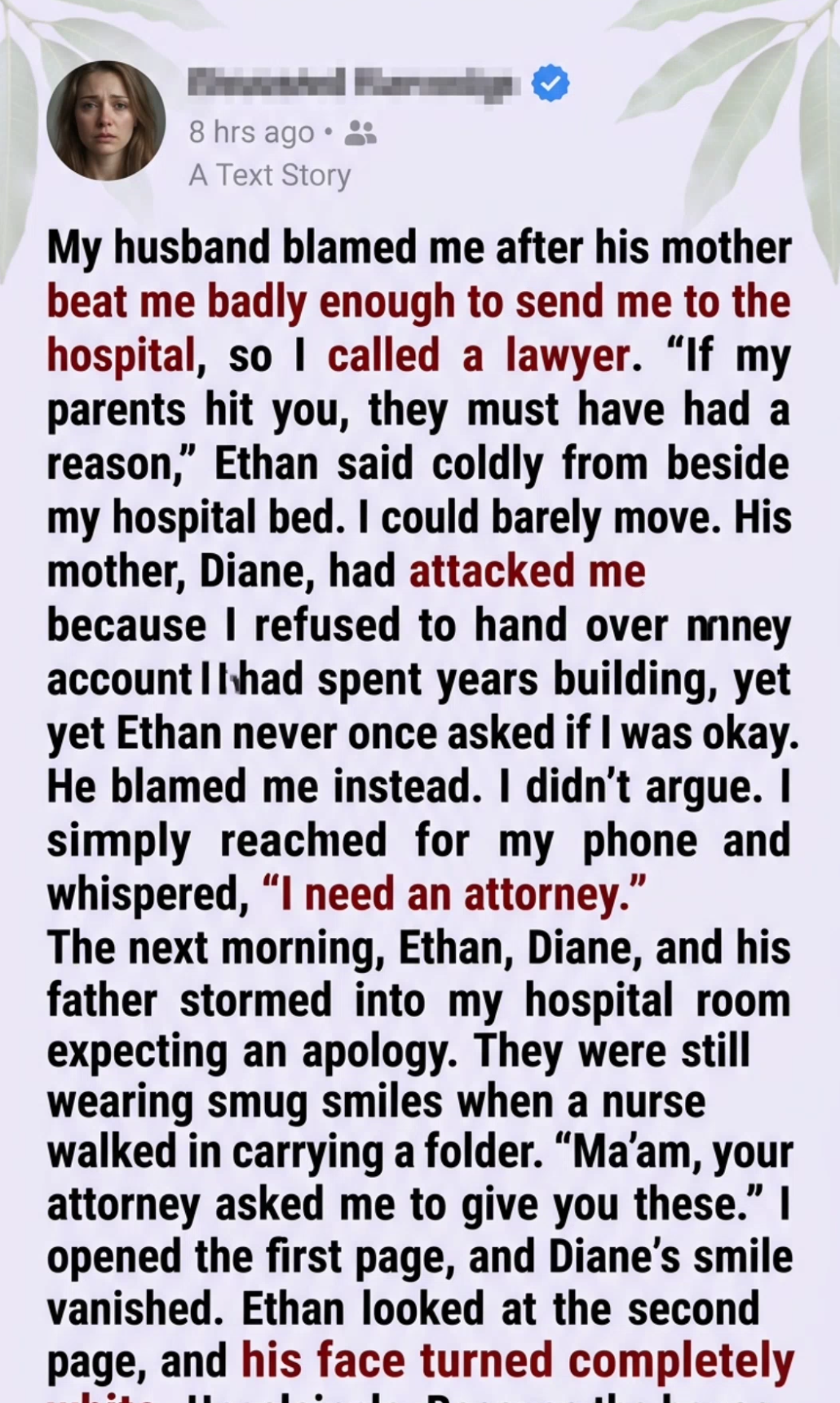
“If my parents hit you, they must have had a reason.”
My husband, Ethan, said those words while standing beside my hospital bed.
I had a split lip, bruises across my arms, and several fractured ribs. Every breath hurt. My left wrist was wrapped in a thick bandage, and the doctor had warned me not to move too much.
Yet Ethan wasn’t asking whether I was in pain.
He wasn’t asking what had happened.
He was defending his mother.
Diane had attacked me because I refused to give her money from an investment account I had built over twelve years. She had come into my home demanding access to it, and when I refused, the argument became violent.
I looked at Ethan.
“You saw what she did.”
He folded his arms.
“You shouldn’t have provoked her.”
I didn’t cry.
I didn’t argue.
I simply reached for my phone and called the only person I knew would listen without making excuses.
“I need an attorney,” I whispered.
The following morning, Ethan arrived with his mother and father.
They entered my hospital room wearing expressions that suggested I was the one who owed them an apology.
Diane even carried a handbag as though she were visiting a relative for an ordinary family lunch.
Then a nurse walked in holding a folder.
“Mrs. Carter? Your attorney asked me to make sure you received these documents.”
I opened the first page.
Diane’s smile disappeared.
Ethan glanced at the second page.
His face turned completely white.
Because the house they had been treating as their family property had never belonged to them.
And the documents inside that folder were about to expose a much bigger problem than they had imagined.
My name is Rachel Carter. I was forty-one when this happened.
I had been married to Ethan for nine years.
We didn’t have children, but we had built what I thought was a stable life together.
I worked as a financial operations manager for a regional healthcare company. Ethan managed a construction supply business with his father, George.
His mother, Diane, had retired several years earlier and spent much of her time visiting friends, shopping, and involving herself in her sons’ lives.
Ethan was an only child.
His parents were extremely close to him, sometimes to the point where I felt our marriage came second.
At first, I accepted that as part of his family culture.
Diane often called during dinner. She expected Ethan to visit every weekend. She commented on my cooking, my clothes, and how I arranged our home.
I tried to be patient.
I believed that relationships required compromise.
But there was one subject I never compromised on: my money.
Before I met Ethan, I had started an investment account using money from my salary and a small inheritance from my grandmother.
I contributed to it every month.
I invested carefully, avoided unnecessary withdrawals, and gradually built a substantial portfolio.
By the time I married Ethan, the account was worth a little over $400,000.
I kept it separate.
Ethan knew about it, but I never gave him access.
I wasn’t hiding anything. I simply believed that every adult should maintain some financial independence.
My grandmother had taught me that.
“Love someone with your whole heart,” she used to say, “but never give another person control over your ability to stand on your own.”
I thought it was sensible advice.
I didn’t know how important it would become.
The trouble began when Ethan’s father’s business ran into financial difficulties.
George had operated a construction materials company for nearly thirty years. He had built a respectable business, but several large customers delayed payments, and a costly warehouse expansion began putting pressure on the company’s cash flow.
Ethan started working longer hours.
He became irritable and increasingly defensive whenever I asked about our household finances.
Then Diane began making comments about my investment account.
At first, they were subtle.
“You’re lucky you started investing so young,” she said during Sunday dinner.
Then:
“Family money should help family.”
I smiled politely.
“I agree that family should support one another, but my account is part of my retirement planning.”
Diane looked offended.
“Retirement? You’re only forty.”
“That’s why I have time to plan.”
She changed the subject.
A week later, Ethan asked whether I would consider lending his parents $150,000.
I asked what the money was for.
He said it would help the company manage a temporary cash-flow problem.
“Your father has been running that business for decades,” I said. “Why can’t he arrange financing through the company?”
“Banks are making things difficult.”
“Then let’s look at the business accounts and repayment plan.”
Ethan’s expression hardened.
“You always make everything complicated.”
“I am talking about a six-figure loan.”
“It’s my family.”
“And it’s my money.”
He left the room.
For the next several days, he barely spoke to me.
Diane visited on a Thursday afternoon.
I was working from home when the doorbell rang.
She entered without waiting for me to offer her a seat.
“We need to discuss something,” she announced.
I closed my laptop.
“Hello, Diane.”
She ignored the greeting.
“Ethan told me you’re refusing to help us.”
“I haven’t agreed to lend anyone money.”
“Your husband’s family is struggling.”
“I understand that.”
“Then you should help.”
I took a breath.
“I’ve worked for years to build that account. I need to understand exactly what the money would be used for before I consider any financial arrangement.”
Diane laughed.
“You sound like a bank manager.”
“I am being responsible.”
She placed her handbag on the table.
“George and Ethan need $150,000. You have much more than that. You can easily spare it.”
I stared at her.
“You don’t know what I can spare.”
She leaned forward.
“Don’t pretend you’re poor. That account has more money than most people will ever see.”
I felt uncomfortable.
“How much have you and Ethan discussed about my investments?”
“Enough.”
That answer disturbed me.
I had never given Diane account statements.
Ethan must have shared more information than I realized.
She continued.
“We’ve already made plans. The warehouse needs repairs, and George has payments coming due. You need to transfer the money this week.”
I stood.
“No. I am not transferring anything.”
Her face changed.
“What did you say?”
“I said no.”
She began shouting.
“You married into this family. You don’t get to keep everything for yourself.”
“I didn’t marry your business.”
She stepped closer.
“Ethan works himself to death for you.”
“He works for his company.”
“You live in a house his family helped you get.”
I looked at her.
“That isn’t true.”
She ignored me.
“You should be grateful.”
I told her to leave.
She didn’t.
Instead, she reached for my phone, which was lying on the table.
I picked it up before she could take it.
“Don’t touch my things.”
She grabbed my wrist.
I pulled away.
The argument escalated so quickly that I barely understood what was happening.
Diane shoved me against the kitchen counter.
I tried to move past her, but she struck me and pushed me down.
I remember hitting the floor.
I remember trying to protect my head.
I remember calling for help.
Then everything became confused.
When I could finally focus, I was in an ambulance.
At the hospital, the doctors examined me and ordered imaging.
I had several fractured ribs, a fractured wrist, extensive bruising, and a deep cut near my eyebrow.
They kept me overnight for observation.
A police officer came to take a statement.
I explained what had happened as clearly as I could.
I told him that Diane had demanded money, grabbed me, and attacked me after I refused.
He asked whether anyone else had witnessed the incident.
I said no.
But I had security cameras.
The house had a system installed after a series of neighborhood break-ins. One camera covered the kitchen entrance and part of the living area.
I told the officer.
He asked me not to delete or alter anything.
I agreed.
A nurse helped me contact my neighbor, who had a spare key. She secured the house and preserved the camera system until the police could collect the relevant footage through the proper process.
Then I called Ethan.
He arrived nearly two hours later.
I expected him to be frightened.
I expected him to ask what had happened.
Instead, he stood beside the bed and looked irritated.
“Why did you make her so angry?”
I stared at him.
“Your mother attacked me.”
“She said you were screaming at her.”
“I told her to leave.”
“You know how she gets when people disrespect her.”
I felt a coldness spread through my chest.
“Ethan, I am in the hospital.”
He glanced at my bandaged wrist.
Then he said the sentence I would never forget.
“If my parents hit you, they must have had a reason.”
For several seconds, I couldn’t speak.
Then I reached for my phone.
“I need an attorney.”
Ethan laughed bitterly.
“Are you serious?”
“Yes.”
He shook his head and walked out.
The next morning, I contacted a lawyer named Victoria Shaw.
She had helped a colleague with a difficult property dispute several years earlier.
I explained the assault, the financial demands, and Ethan’s response.
She listened carefully.
Then she asked me about the house.
I explained that I had purchased it before marrying Ethan.
My grandmother had left me an inheritance, and I had used part of it, together with my savings, to buy the property.
The title was in my name alone.
Ethan had moved in after we married.
He had contributed toward certain household expenses over the years, but he had never been added to the deed.
Victoria asked whether I had any documents showing the source of the purchase funds.
I told her I did.
She asked me to bring them.
Then she asked another question.
“Has Ethan ever told you that his family owns the house?”
I hesitated.
“He says they helped us get started.”
“Did they provide money toward the purchase?”
“No. My grandmother’s inheritance covered most of it. I paid the remainder.”
Victoria paused.
“Then we need to review the title, the purchase records, and any financial agreements carefully. Do not assume his family has an ownership interest simply because they say they do.”
I agreed.
She also explained that the assault, the marriage, and the property dispute were separate legal matters that needed to be handled correctly.
She recommended preserving all evidence, requesting the security footage, documenting my injuries, and avoiding direct arguments with Ethan or Diane.
I followed her advice.
The folder arrived at my hospital room the following morning.
Victoria had arranged for a colleague to deliver several documents while she handled the initial legal filings.
The first document was a certified copy of the property title.
It showed that I was the sole registered owner.
The second was the original purchase record, including bank statements tracing the funds from my grandmother’s estate and my personal savings.
The third was a declaration I had signed before marriage, prepared after my grandmother’s death, confirming that the property had been acquired with my separate funds.
Ethan had signed a separate acknowledgment during our marriage confirming that he understood the house was my separate property.
I had almost forgotten about that document.
Victoria had found it among the records.
The final document was a notice concerning the assault and the request for appropriate protective measures.
The nurse placed the folder beside me.
I was reading the first page when the door opened.
Ethan entered.
Diane followed.
George came behind them.
They looked prepared for an argument.
Diane was smiling.
“Well, Rachel,” she said. “I hope you’ve had time to calm down.”
I looked at her.
Ethan noticed the folder.
“What’s that?”
“My attorney sent it.”
Diane gave a dismissive laugh.
“An attorney? For a family disagreement?”
I turned the first document toward her.
“Read it.”
She glanced at the title.
Her smile faded.
Ethan picked up the second page.
He read the property acknowledgment.
Then he looked at the signature.
His face turned white.
“What is this?”
“Your acknowledgment that the house belongs to me.”
He looked at his father.
George took the paper and examined it.
“This doesn’t mean anything,” he said.
“It was signed and witnessed,” I replied.
Diane placed the document on the bed.
“You’re trying to throw my son out of his own home?”
“It’s not his home.”
Ethan looked furious.
“You’re going to do this after everything we’ve been through?”
I stared at him.
“Your mother beat me badly enough to put me in the hospital. You blamed me. And now you’re concerned about where you will live?”
Diane interrupted.
“She wouldn’t have touched you if you hadn’t insulted her.”
I pressed the call button.
A nurse entered.
“Is everything okay?”
I looked at her.
“I need these visitors to leave.”
Ethan stepped forward.
“Rachel, don’t be ridiculous.”
The nurse stood between us.
“Sir, you need to step back.”
Diane began shouting.
George tried to pull her toward the door.
Ethan looked at me one last time.
“You’ll regret this.”
I didn’t answer.
The nurse escorted them out.
When the door closed, I felt my whole body begin to shake.
I was exhausted.
But I was no longer confused about what I needed to do.
The police investigation continued.
The security footage showed Diane entering the house, demanding something from me, and physically attacking me after I refused.
The footage was not perfect, but it supported the timeline I had given the officer.
My medical records documented the injuries.
My neighbor also provided a statement confirming that she had heard shouting and had called emergency services after receiving my request for help.
Diane was interviewed.
She initially claimed that I had fallen during an argument.
But the footage and medical evidence contradicted important parts of her account.
The matter proceeded through the appropriate legal process.
I did not try to negotiate privately with her.
I did not accept money in exchange for withdrawing my statement.
I wanted the incident handled lawfully.
Ethan’s position became increasingly difficult.
He had told the police that he wasn’t present during the assault, which was true. But he had also sent messages afterward blaming me and encouraging me not to involve the authorities.
Those messages became part of the evidence concerning his response and the pressure I was receiving.
Victoria also began the process of ending the marriage.
She filed the necessary papers and requested that the court address temporary living arrangements and financial responsibilities.
Because the house was in my name and had been acquired before the marriage using documented separate funds, I had a strong basis to seek exclusive possession.
However, Victoria warned me that the final treatment of property and any possible claims would depend on the applicable law and the full financial history.
She never promised an automatic outcome.
She promised to build the strongest case supported by the documents.
Ethan tried to contact me repeatedly.
At first, he sent angry messages.
You are destroying this family.
Then:
My mother has never been in trouble before. You need to stop.
Later, his tone changed.
Can we talk? I think we’ve both made mistakes.
I didn’t respond.
He eventually sent a longer message.
He said he was under pressure because of his father’s business. He admitted that his mother had become increasingly obsessed with my investment account.
He also admitted that he had told her more about my finances than I had realized.
He said he never expected her to become violent.
I read the message twice.
Then I sent it to Victoria.
I didn’t answer him.
The financial investigation revealed something else.
For nearly a year, Ethan had been trying to convince his parents that I would eventually contribute money to the construction business.
He had told them that my investment account was large enough to rescue the company if necessary.
He had also discussed the possibility of using the house as security for a business loan.
I had never agreed to that.
In fact, the property records showed no such loan had been completed.
But the discovery explained why Diane had become so aggressive.
She had believed the money was available.
Ethan had encouraged that belief.
When I refused, he had not protected me.
He had blamed me.
Victoria obtained financial records showing that Ethan and his father had been discussing ways to restructure the business.
Some of those discussions involved my assets.
None gave them the right to use my money or property without my consent.
The documents also showed that Ethan had been aware of the separate-property acknowledgment he had signed.
His claims that the house belonged to his family were not supported by the records.
Several months later, the divorce proceedings reached a settlement conference.
Ethan arrived with his attorney.
Diane was not present.
Victoria laid out the relevant documents.
The property title.
The purchase records.
The acknowledgment signed by Ethan.
The medical records.
The security footage.
The messages.
Ethan’s attorney reviewed everything carefully.
The house was not treated as a shared asset simply because Ethan had lived there.
The parties negotiated the remaining financial matters, including household expenses, personal property, and any claims connected to the marriage.
I retained the house.
Ethan was given a reasonable period to collect his belongings and arrange alternative accommodation.
The investment account remained mine.
There was no basis for his parents to claim it.
The divorce was eventually finalized.
The assault case proceeded separately, and Diane faced the legal consequences determined through that process.
I did not attend every hearing.
Some days, I simply couldn’t bear to see her.
But I provided the evidence when required and allowed the authorities to handle the case.
The first evening I returned home after the hospital, I stood in the kitchen for a long time.
The counter where Diane had shoved me had been repaired.
The broken glass had been replaced.
The house looked exactly as it had before.
But I felt different.
I had once believed that marriage meant protecting one another no matter what.
I had believed that Ethan would stand beside me when something terrible happened.
Instead, he had chosen his mother over the truth.
I walked upstairs and opened the cabinet where I kept my grandmother’s old photographs.
There was one of her sitting in a garden, smiling at the camera.
I remembered her advice about financial independence.
I remembered how she had encouraged me to study, work, and save.
I had built that account slowly.
I had purchased the house before I met Ethan.
I had spent years creating a secure life.
And I had nearly allowed someone else’s demands to make me feel guilty for protecting it.
I sat on the floor and cried.
Not because I missed Ethan.
Because I was finally allowing myself to grieve the marriage I had believed I had.
A year later, I was living peacefully in my house.
I had returned to work and taken a few weeks of vacation to recover properly.
I started seeing a counselor to help process the assault and the end of my marriage.
I also reconnected with friends I had gradually lost touch with during the relationship.
I learned to enjoy ordinary things again.
Cooking dinner without waiting for an argument.
Sleeping without listening for the sound of Ethan’s keys.
Making financial decisions without someone telling me that my money belonged to their family.
One afternoon, I received a message from Ethan.
It was short.
I know I failed you. I should have protected you.
I read it.
Then I put the phone down.
I didn’t feel the need to respond.
An apology can acknowledge what happened, but it cannot automatically restore trust.
And I no longer wanted a marriage in which my safety depended on whether someone else chose to defend me.
Diane never returned to my home.
Ethan eventually moved away for work.
His parents’ business continued operating, although it went through a difficult restructuring.
I heard about those developments through mutual acquaintances, but I stopped following their lives.
I had enough to focus on in my own.
Sometimes people ask why I didn’t simply forgive Diane and move on.
My answer is simple.
Forgiveness is personal.
Safety is not negotiable.
I can choose not to carry anger every day. I can wish someone a better future without allowing them access to my home, my money, or my life.
And I can accept that a marriage has ended without believing that I failed.
The hospital room was where I finally understood the difference between being related to someone and being protected by someone.
Ethan had stood beside my bed and blamed me for his mother’s violence.
He expected me to apologize.
He expected me to remain quiet.
He expected me to keep providing the financial security his family had come to believe they deserved.
But I reached for my phone instead.
I called an attorney.
And that decision changed everything.
The house remained mine.
The money I had spent twelve years building remained mine.
Most importantly, my future belonged to me again.
THE END.