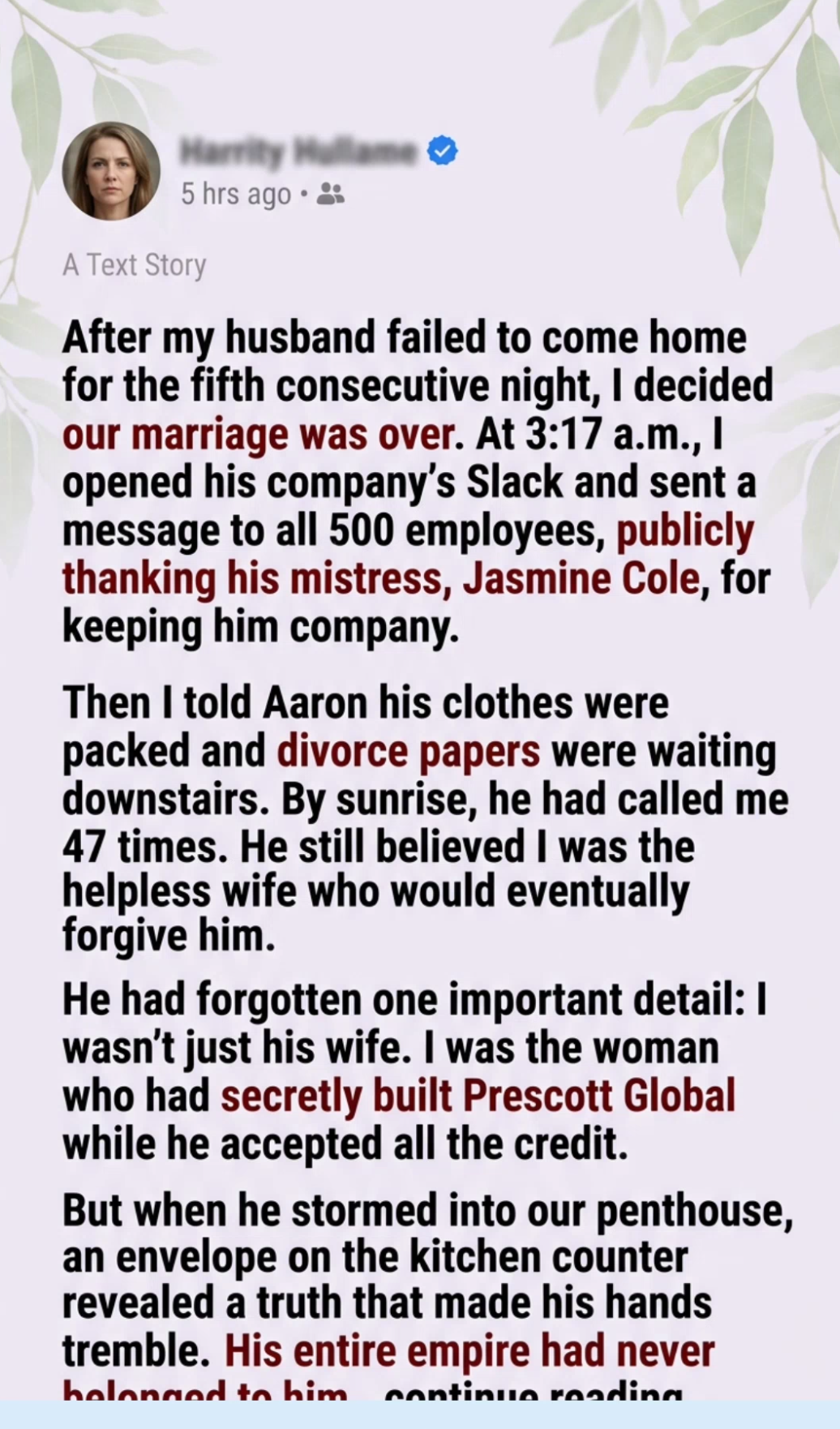
At 3:17 in the morning, I stopped waiting for my husband to come home.
I sat alone in our penthouse, wearing an old sweater, staring at the untouched dinner on the kitchen island.
Five nights.
Five consecutive nights without Aaron coming home.
His explanations had become predictable.
Late meetings.
An urgent client dinner.
A business emergency.
A flight that had been delayed.
And, finally, no explanation at all.
I had called him the first night.
He didn’t answer.
I texted him the second night.
He replied that he was busy.
By the third night, I had stopped asking questions.
On the fourth night, I discovered a photograph on social media.
Aaron was standing outside a luxury hotel with a woman in a black dress.
Her name was Jasmine Cole.
She was his executive assistant.
His right hand at work.
The woman who had once called me Mrs. Prescott with a smile so polite it almost sounded affectionate.
In the photograph, Aaron’s hand rested on her waist.
The caption read:
Some people make even the longest workdays worth it.
I stared at the picture for a long time.
Then I closed the application.
I didn’t cry.
I didn’t throw anything.
I didn’t call his mother.
Instead, I walked into the bedroom, opened the wardrobe, and began taking his clothes off the hangers.
By 3:17 a.m., every suit, shirt, pair of shoes, and personal belonging had been packed into boxes.
I placed the boxes near the private elevator.
Then I went to my laptop.
Aaron’s company used Slack for internal communication. I had access because I was still listed as a founding director and a member of the executive oversight team.
I opened the company-wide channel.
Five hundred employees could read it.
I typed a message.
Good morning, everyone. Before the day begins, I would like to publicly thank Jasmine Cole for keeping my husband, Aaron Prescott, company during the five nights he has chosen not to return home. I hope the two of you enjoyed your time together. Aaron’s personal belongings are packed, and the divorce papers are waiting downstairs. I wish everyone at Prescott Global a productive morning.
I read it once.
Then I pressed send.
The message appeared beneath my name.
For several seconds, the screen remained quiet.
Then the notifications began.
One employee reacted with a surprised emoji.
Another sent a private message asking whether the announcement was real.
Someone deleted a reply before I could read it.
Then Jasmine’s status changed to offline.
I closed the laptop.
My name is Eleanor Prescott.
I was thirty-nine years old, and for nearly thirteen years I had been married to Aaron.
Most people believed Aaron had built Prescott Global from nothing.
He was the face of the company.
He appeared in business magazines, gave interviews, attended conferences, and stood beside politicians and investors at charity events.
He had a polished smile and a talent for making complicated ideas sound simple.
He was also very good at taking credit.
But Prescott Global had not started with Aaron.
It had started with me.
Thirteen years earlier, I had been working as a financial analyst at a small technology company. I had developed a software platform designed to help mid-sized businesses manage international purchasing, supplier payments, and shipping schedules.
At the time, most companies still relied on disconnected systems and endless spreadsheets.
I believed there was a better way.
I spent evenings building prototypes, interviewing business owners, and studying the problems they faced.
My original concept was called Northstar.
Aaron and I were dating then.
He worked in corporate sales and was excellent at presenting ideas. When he saw my early prototype, he encouraged me to turn it into a business.
“You understand the system,” he told me. “I understand how to sell it. We could build something enormous.”
I believed him.
We started with a small office above a printing shop.
I designed the product, handled the technical development, negotiated with suppliers, and created the financial model.
Aaron handled sales presentations and investor meetings.
Our first client was a regional manufacturing company.
The second was a logistics firm.
By the end of the first year, we had enough revenue to hire five employees.
The business grew.
We changed the name to Prescott Global because Aaron believed it sounded more established.
I didn’t object.
At the time, I thought the company was ours.
We incorporated the business carefully. My holding company owned the original software intellectual property and licensed it to the operating company. The structure had been designed with professional legal and financial advice because we needed to protect the technology if the business ever failed.
I was the majority owner of the holding company.
The operating company had investors, directors, and executives, but the licensing agreement gave my holding company important rights over the core platform.
Aaron knew the structure existed.
He had signed the relevant documents.
What he never understood was how much control those agreements gave me.
As the company expanded, Aaron became increasingly interested in the public side of the business.
He wanted interviews.
He wanted awards.
He wanted his photograph on the company’s website.
I didn’t mind at first.
I preferred working behind the scenes.
I enjoyed building systems, solving problems, and developing new products.
But over time, Aaron began introducing himself as the founder.
At first, I corrected him privately.
Then I stopped.
It seemed easier to let people believe what they wanted.
I never imagined that the man I had married would eventually use my silence as evidence that I had no power.
The first major warning came when Prescott Global secured a contract with a large international distributor.
Aaron received a business award for the deal.
He gave a speech thanking the leadership team.
He did not mention me.
I was sitting at the back of the ballroom, listening to him describe the company’s early struggles as if he had carried the entire business on his shoulders.
Afterward, I congratulated him.
He smiled.
“You know how these things work. People need a face they can recognize.”
I nodded.
But something inside me had shifted.
Then came Jasmine.
She joined the company as an executive assistant and quickly became indispensable to Aaron.
She organized his calendar, arranged travel, managed his correspondence, and accompanied him to business dinners.
I met her at a company anniversary event.
She was attractive, confident, and very attentive to Aaron.
When she introduced herself, she held my hand a little too long.
“It’s wonderful to finally meet you,” she said. “Aaron talks about you all the time.”
I smiled.
“Does he?”
She laughed.
“Oh, mostly about how busy you are.”
I didn’t think much of it then.
Over the next year, she began appearing in photographs from business trips.
She was always beside Aaron.
Sometimes they were at conferences.
Sometimes at restaurants.
Sometimes in hotel lobbies.
When I asked him about it, he became irritated.
“She’s my assistant, Eleanor. It’s her job to travel with me.”
I accepted that explanation.
Until the hotel photograph.
And then the fifth night.
At 6:42 a.m., my phone began ringing.
Aaron.
I let it ring.
He called again.
Then again.
By 7:15, I had forty-seven missed calls.
He finally sent a message.
What the hell did you do?
I replied:
I told the truth.
His response came immediately.
Delete it. Now.
I didn’t.
At 7:30, my lawyer arrived.
Her name was Catherine Wells.
She had represented me in several business matters over the years and knew the corporate structure better than almost anyone outside the company.
She placed a folder on the kitchen island.
“Are you ready?”
I looked toward the boxes beside the elevator.
“Yes.”
She opened the folder.
Inside were divorce papers, a preliminary financial disclosure request, and a notice regarding the company’s intellectual-property licensing arrangements.
I had not prepared these documents overnight.
I had spent months reviewing the business structure, collecting financial records, and documenting transactions that had begun to concern me.
Aaron had been moving money between company accounts.
Some transfers were legitimate.
Others had no clear business purpose.
There were payments to a consulting company that appeared to have no employees.
There were unusually large travel expenses.
And there were invoices connected to a luxury apartment in another city.
I had initially assumed the apartment belonged to a client or was being used for temporary business accommodation.
Then I discovered that Jasmine had been staying there.
The apartment was leased through a company Aaron controlled.
The expenses had been charged to Prescott Global.
I had also found several payments to Jasmine’s personal account, described as consulting fees.
She was already a salaried executive assistant.
No consulting agreement existed in the records I reviewed.
I had not yet reached a conclusion about whether the payments were fraudulent, but they were serious enough to require an independent investigation.
Catherine had advised me not to accuse anyone publicly of financial misconduct before the facts were verified.
That was why my Slack message mentioned only what I could personally support.
Aaron had been absent for five nights.
Jasmine had been with him.
And I was ending the marriage.
At 8:12 a.m., the private elevator opened.
Aaron stepped out.
He was wearing yesterday’s suit, his tie loose, and his expression furious.
“What is wrong with you?”
I was standing beside the kitchen island.
“Good morning.”
“Don’t you dare say good morning to me.”
He pointed toward the boxes.
“What is all this?”
“Your belongings.”
“You can’t throw me out of my own home.”
I looked at him.
“This apartment is owned by my holding company. You have been living here under our marital arrangement. The legal process will determine what happens next.”
He laughed.
“You’re bluffing.”
Catherine closed her folder.
“Mr. Prescott, I’m Catherine Wells. I’ve been retained by Eleanor. You should direct any legal questions to your attorney.”
Aaron stared at her.
Then he looked at me.
“You hired a lawyer?”
“Yes.”
“Over what? A few nights away?”
I turned my laptop toward him.
The photograph was still open.
He stared at it.
Then he looked away.
“Jasmine and I were working.”
“At a hotel?”
“It’s not what you think.”
“Then explain it.”
He rubbed his forehead.
“Eleanor, we have a company to run. I can’t spend every evening reporting to you.”
“I didn’t ask you to report to me. I asked you to come home.”
He scoffed.
“You’ve been acting like a stranger for months. You’re never interested in the business anymore.”
I looked at him.
“I built the business.”
He gave a dismissive laugh.
“You built a prototype. I turned it into a global company.”
Catherine looked up from her documents.
“Mr. Prescott, I would be careful about making statements regarding ownership before reviewing the corporate records.”
Aaron ignored her.
He stepped closer to me.
“You think those employees care about you? They know me. They respect me. I’m the one who signs their checks.”
I took a breath.
“That’s what you believe.”
He looked confused.
Then his phone rang.
It was a call from the company’s chief operating officer.
Aaron answered immediately.
“What?”
I couldn’t hear the other side, but I could see his expression changing.
“What do you mean the board meeting is moved?”
A pause.
“Why?”
Another pause.
His eyes moved toward Catherine.
Then toward me.
“Who authorized that?”
He listened.
Finally, he ended the call.
“What have you done?”
I didn’t answer.
Catherine spoke instead.
“The board has been notified of a governance review. The company will continue operating normally. No employee salaries or customer contracts are being interrupted.”
Aaron turned toward her.
“You can’t do that.”
“It’s already been done.”
He looked at me again.
“You’re trying to destroy the company.”
“No. I’m trying to protect it.”
He laughed.
“You couldn’t run this company without me.”
I opened the second folder.
Inside were copies of the original incorporation documents, the intellectual-property license, and the agreements governing the operating company’s use of the Northstar platform.
I placed them on the counter.
“Do you remember signing these?”
He glanced at the pages.
“Of course. We signed hundreds of documents.”
“Then you remember that Northstar belongs to my holding company.”
He frowned.
“So?”
“So the operating company licenses the core platform. It doesn’t own it.”
He looked at the first page again.
His expression began to change.
“You’re not serious.”
“The license agreement has conditions. One of them requires the company to maintain accurate financial reporting and comply with the agreed governance provisions.”
He flipped through the pages.
“That’s standard legal language.”
“Yes. And the company has obligations under it.”
He looked at Catherine.
“What is this supposed to mean?”
She answered calmly.
“It means that any material breach of the agreement must be reviewed under the contract. No decision has been made about termination. The company has been notified that an independent review is underway.”
Aaron looked back at me.
“You’re threatening to shut down the software?”
“No. I’m making sure it isn’t used to hide questionable transactions.”
He dropped the papers.
“You can’t take Prescott Global away from me.”
I held his gaze.
“I never gave it to you.”
For the first time that morning, he had nothing to say.
But the envelope on the counter was not the final surprise.
Catherine opened it.
Inside was a report prepared by an independent accounting firm.
The report had been commissioned after I discovered the unusual payments.
It did not claim that Aaron had stolen money.
It identified transactions that required explanation, including consulting payments, travel expenses, and transfers between related companies.
The total amount under review was significant.
More importantly, the report showed that several payments had been authorized using credentials assigned to Aaron.
He stared at the pages.
“Where did you get this?”
“From the company’s accounting records,” I replied.
“You had no right to access those.”
“I was a director with authorized access.”
He turned to Catherine.
“This is confidential.”
“Yes,” she said. “Which is why it has been provided to the independent reviewers and the appropriate board members, not published publicly.”
Aaron’s phone rang again.
This time, it was Jasmine.
He declined the call.
A moment later, a message appeared on his screen.
He read it.
Then he looked at me.
“Did you contact her?”
“No.”
“What did you tell her?”
“Nothing.”
He stared at the message for several seconds.
Then he turned the phone face down.
I didn’t need to know what she had written.
The company had already begun reviewing the payments, and Jasmine had been asked to provide documentation for the consulting fees.
Aaron sat down.
For the first time, he looked genuinely frightened.
“What happens now?”
Catherine answered.
“The divorce proceedings will continue separately from the corporate review. You should obtain independent legal advice immediately. The company will follow its governance procedures.”
He looked at me.
“Eleanor, we can fix this.”
I felt an unexpected sadness.
There had been a time when I would have given anything to hear him say those words.
But now they sounded less like love and more like fear.
“Fix what?”
“Our marriage. The company. Everything.”
“You had five nights to come home. You had months to tell me the truth. You had years to acknowledge what I contributed.”
He looked down.
“I made mistakes.”
“You made choices.”
He reached for my hand.
I moved it away.
“Don’t.”
He stood.
“Are you really ending thirteen years over Jasmine?”
“No. I’m ending thirteen years because I finally understand what those years became.”
He looked toward the boxes.
Then he left.
The elevator doors closed behind him.
I stood in the kitchen for a long time.
Catherine quietly gathered the documents.
“You did well,” she said.
I shook my head.
“I don’t feel like I did anything well.”
“That’s because this is still happening.”
She was right.
The next several weeks were difficult.
The Slack message caused enormous discussion inside the company.
Some employees were shocked.
Others had suspected something was wrong between Aaron and me.
A few worried about the company’s future.
The board issued a statement asking employees to remain focused on their work while the independent review proceeded.
I sent a separate message to the staff.
I explained that the company would continue operating, that payroll and customer services were unaffected, and that no employee should feel pressured to take sides in a personal matter.
I also apologized for using the company communication platform to announce a private marital issue.
It was the first time I had publicly acknowledged that I had allowed my emotions to enter a professional space.
I didn’t regret telling the truth.
But I recognized that the employees deserved stability, not a front-row seat to my divorce.
The board appointed an independent committee to review the financial transactions.
Aaron was temporarily removed from direct oversight of certain payment approvals while the review was underway.
Jasmine was placed on administrative leave pending an examination of her consulting arrangements.
Neither decision was a finding of guilt.
Both were precautionary steps.
The accounting review eventually established that several payments had been improperly classified and lacked the required supporting documentation.
Some expenses were personal.
Some related to the apartment.
Others were legitimate business costs that had been recorded incorrectly.
The company required repayment of certain personal expenses and introduced tighter approval controls.
Aaron was not immediately dismissed.
The board considered his role in the company’s growth, his employment agreement, and the findings of the investigation.
After several meetings, he agreed to step down as chief executive while the company transitioned to a new leadership structure.
He retained a financial interest subject to the company’s existing agreements and the outcome of the divorce settlement.
Jasmine resigned before the review was completed.
The company did not publicly discuss her departure.
I didn’t celebrate.
There were employees who had worked with Aaron for years and respected him. Some were confused. Others were angry.
They deserved a company that could continue without becoming a battlefield.
I returned to the office more regularly.
I met with department heads, listened to staff concerns, and began working with the board on a long-term leadership plan.
The first few months were exhausting.
I had to learn how to be visible.
For years, I had been comfortable letting other people speak for the company.
Now employees needed to know who was making decisions.
I began attending weekly operations meetings.
I visited regional offices.
I spoke with clients.
I explained the company’s history and the structure of the intellectual-property agreements.
I also made one important change.
The company’s internal recognition program began highlighting the work of engineers, analysts, customer-service employees, and operations teams rather than focusing almost exclusively on executive achievements.
At the first company-wide meeting, I stood on the stage where Aaron had given so many speeches.
I looked across the room.
“Prescott Global was built by people who solved problems every day,” I said. “Some of those people work in this room. Others work in offices hundreds of miles away. Our success has never belonged to one person.”
I paused.
“I want us to build a company where credit follows contribution, where leadership comes with accountability, and where nobody has to be related to an executive to have their work recognized.”
The applause was not overwhelming.
It was genuine.
And that meant more to me.
The divorce took nearly a year to finalize.
Aaron initially argued that the company was marital property because he had been its public leader throughout our marriage.
My lawyers presented the incorporation records, ownership documents, licensing agreements, and financial history.
The court reviewed the relevant assets and obligations under the applicable law.
The settlement was complicated, but the original ownership of the intellectual property and the holding company was recognized according to the documented structure.
Aaron received the financial interests he was entitled to under the settlement, but he did not gain ownership of the core technology simply because he had been its public face.
The penthouse was sold as part of the overall financial settlement.
I moved into a smaller apartment overlooking a quiet park.
It wasn’t as impressive.
But I loved waking up there.
There was no private elevator, no enormous kitchen, and no expensive artwork chosen to impress visitors.
There was a little balcony where I drank coffee in the morning.
There were books stacked beside the sofa.
And there was silence that didn’t feel like punishment.
Almost a year after the divorce, I received a message from Aaron.
Can we talk?
I considered ignoring it.
Then I agreed to meet him at a café.
He arrived looking older.
His hair was shorter, and he wore a simple jacket instead of one of the expensive suits he used to favor.
We ordered coffee.
For a while, neither of us spoke.
Finally, he said, “I didn’t think you would actually leave.”
I looked at him.
“Why?”
“Because you always stayed.”
“That was my mistake.”
He nodded.
“I thought you were happy letting me lead.”
“I was happy building something with you. I wasn’t happy watching you erase my contribution.”
He looked down.
“I know.”
He told me that he and Jasmine were no longer together.
He said the relationship had become difficult after the company review and that they had eventually gone their separate ways.
I didn’t ask for details.
Then he said something I hadn’t expected.
“I used to think the company was mine because everyone treated me like it was mine.”
I stirred my coffee.
“And now?”
“Now I understand that people were following the person standing on the stage, not necessarily the person who built the foundation.”
I looked at him.
“That sounds like something you should have understood years ago.”
He nodded.
“I know.”
He asked whether I ever regretted building the company with him.
I thought about it.
There were moments I regretted trusting him with so much.
There were years I wished I had spoken up sooner.
But I didn’t regret building Northstar.
I didn’t regret creating something useful.
And I didn’t regret the people whose lives had improved because the company existed.
“No,” I finally said. “I regret allowing you to convince me that my work mattered less because I didn’t stand in front of the cameras.”
He looked at his hands.
“I am sorry.”
This time, I believed he meant it.
But an apology didn’t mean we belonged together.
I thanked him for saying it.
Then I finished my coffee and left.
Several months later, Prescott Global announced a new leadership team.
The company continued expanding, but it was more disciplined.
The accounting controls were stronger.
The board was more independent.
The original software platform remained in place, and the engineering teams began developing a new version that I had wanted to build for years.
I was appointed executive chair of the company.
I didn’t take the position to prove anything to Aaron.
I took it because I knew the business, understood its history, and believed it deserved responsible leadership.
On the day the announcement became public, I received a message from an employee who had been with us since the first office above the printing shop.
It read:
I remember when you used to bring coffee to the engineers at midnight because you were testing the first version. I’m glad people finally know how much you did.
I read it twice.
Then I saved it.
That evening, I went home and made dinner for myself.
There was no expensive celebration.
No champagne.
No crowd of executives.
Just a quiet meal in a small apartment.
I thought about the woman I had been thirteen years earlier, sitting beside Aaron in that little office, believing they were building a future together.
She had been ambitious.
She had been trusting.
She had believed love meant sharing the credit as naturally as sharing the work.
I wished I could tell her that partnership should never require one person to disappear.
At 3:17 a.m., I had sent a message because I finally had nothing left to hide.
But the real turning point hadn’t been the public announcement.
It had been the moment I stopped waiting for my husband to recognize the woman he had married.
I had spent years building a company.
I had spent years building a marriage.
Only one of those things had been worth saving.
And when I finally walked away, I discovered that I hadn’t lost the life I thought I had built.
I had finally taken responsibility for the part of it that was always mine.
THE END.