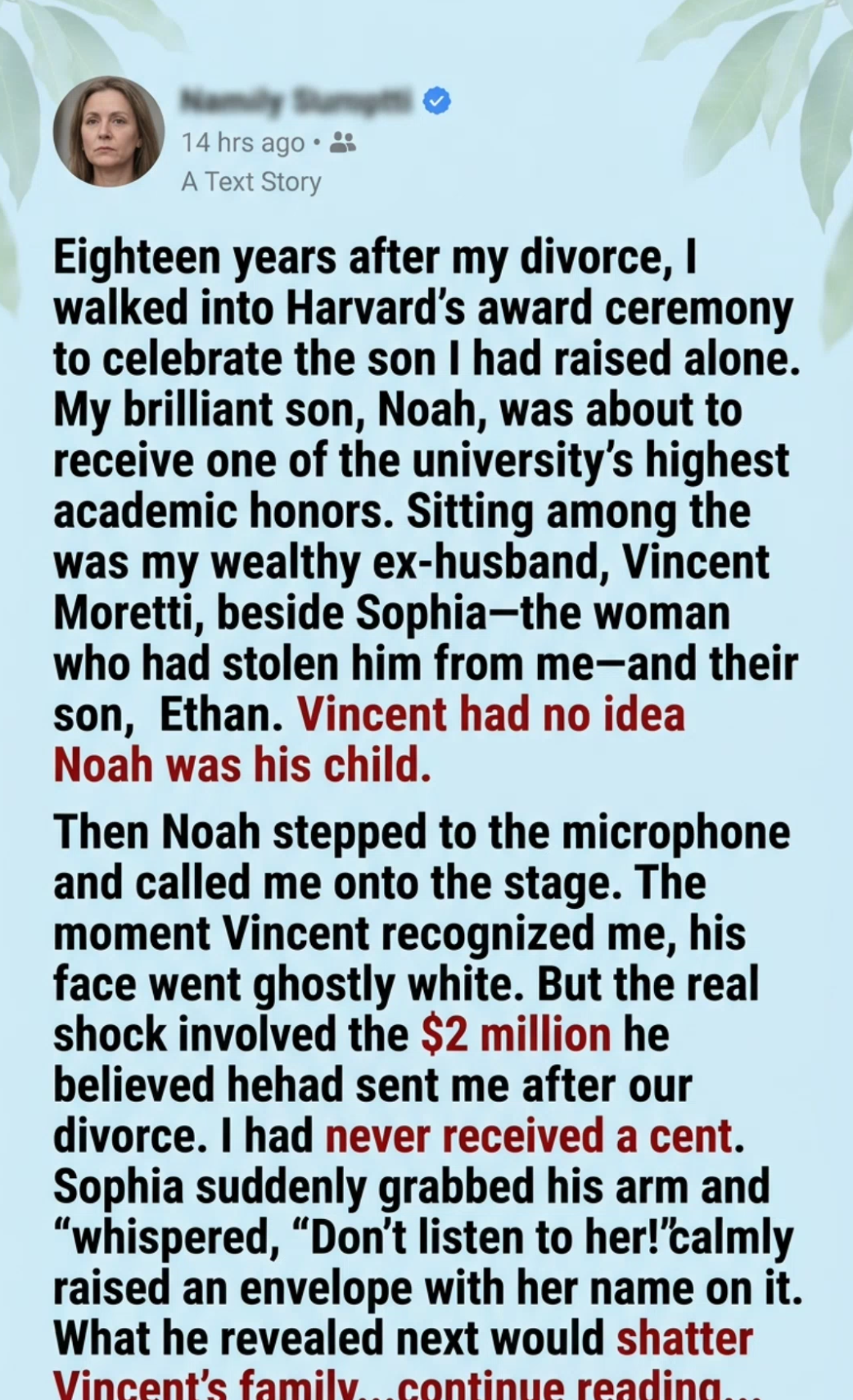
The first time I saw Vincent Moretti in eighteen years, he was sitting in the front section of Harvard’s ceremony hall, wearing a tailored charcoal suit and smiling as if the world had never denied him anything.
Beside him sat Sophia, the woman he had chosen over me, and a young man who looked enough like Vincent to make my chest tighten.
Their son, Ethan.
I was seated several rows behind them, wearing a navy dress I had bought on sale and carrying a small handbag that had belonged to my mother. My hands were trembling, but I kept them folded in my lap.
I hadn’t come to see Vincent.
I had come to celebrate Noah.
My son was about to receive one of Harvard’s highest academic honors, and after eighteen years of raising him alone, I wanted to be there when he heard his name called.
I had imagined this day a thousand times. I had imagined the photographs, the applause, the proud smile on his face.
I had never imagined that the man who abandoned us would be sitting only a few rows away.
My name is Margaret Ellis. I was twenty-six when I married Vincent, and twenty-seven when I learned that the man I loved had been having an affair with Sophia Bennett, a woman from his professional circle.
At the time, Vincent was ambitious but not yet wealthy. He was building a financial consulting business, working long hours and constantly talking about the future.
I supported him through those years.
I worked as an administrative assistant at a medical office, managed our household, and often took extra shifts so he could invest more money into his company.
When Noah was born, I believed our family was finally complete.
But Vincent changed.
He began traveling more frequently. His phone was always turned face down. He started criticizing the way I dressed and the people I spent time with.
Then, one evening, he came home and told me he wanted a divorce.
“I don’t think we’re happy anymore,” he said.
I was holding Noah, who was only a few months old.
“Is there someone else?”
Vincent looked at the floor.
“That’s not the point.”
It was the point.
Sophia was already part of his life. She had been attending business events with him, and people had begun whispering about their relationship before I knew the truth.
I asked Vincent whether he intended to remain involved in Noah’s life.
He sighed.
“Margaret, I don’t want to argue. I’ll make sure you’re financially comfortable.”
I didn’t ask him to stay.
I only asked him not to disappear from his son’s life.
He promised he wouldn’t.
That promise lasted less than a year.
The divorce was finalized when Noah was still an infant. Vincent’s attorney handled most of the paperwork, while I relied on a local family lawyer who had limited time and resources.
Vincent told me he wanted a clean separation.
He said he would pay a settlement of $2 million, allowing me to buy a home, raise Noah comfortably, and move forward without depending on him.
I was stunned by the amount.
“Two million?” I asked.
“It’s fair,” he replied. “I don’t want you struggling.”
The settlement documents were prepared, and Vincent told me his financial team would arrange the transfer.
I signed the agreement after my lawyer reviewed the terms.
Then I waited.
Weeks passed.
When I asked Vincent about the money, he told me the transfer had already been completed.
“Your bank should have received it,” he said.
I checked.
Nothing.
I called my lawyer, who contacted Vincent’s legal representative. They requested proof of payment, but the response was that the transfer had been processed through the financial department.
I was told to allow more time.
More time became months.
Eventually, I received a short letter stating that Vincent’s obligations under the settlement had been fulfilled.
The letter included a transaction reference, but no bank confirmation showing that the money had reached my account.
I was young, exhausted, and caring for a baby. I didn’t understand the financial arrangements well enough to challenge the paperwork.
My lawyer eventually advised me that pursuing the matter could become expensive and complicated.
I had two choices: spend money I didn’t have fighting a wealthy man with a team of attorneys, or find a way to support my child.
I chose Noah.
I moved into a small rented apartment and found a better-paying administrative position. I worked during the day and took bookkeeping jobs in the evenings.
My mother helped when she could.
Sometimes, when Noah was sick, she stayed with him so I could go to work. When he started school, she helped with his homework.
We didn’t have expensive holidays or designer clothes.
But Noah never went hungry, never missed school, and never doubted that he was loved.
I kept Vincent’s name out of our daily conversations.
When Noah was old enough to ask about his father, I told him the truth without turning it into a weapon.
“Your father and I couldn’t make our marriage work,” I said. “He chose a different life. That doesn’t mean there’s anything wrong with you.”
“Does he know about me?”
“Yes.”
“Why doesn’t he visit?”
I didn’t have a good answer.
I only told him that adults sometimes make decisions they later regret, but children should never believe those decisions are their fault.
Noah grew up curious, thoughtful, and unusually disciplined.
He loved mathematics and books. He spent hours at the public library, often returning home with more books than his backpack could comfortably carry.
When he was twelve, he won a statewide science competition.
At fifteen, he earned a scholarship to a respected preparatory school.
At seventeen, he received an offer from Harvard.
I remember the morning the acceptance email arrived.
Noah read it twice, then turned his laptop toward me.
“Mom,” he whispered. “I got in.”
I stared at the screen.
Then I started crying.
He wrapped his arms around me.
“We did it,” he said.
I knew what he meant.
We had done it together.
He received substantial financial aid and academic scholarships. I still contributed what I could, taking additional bookkeeping clients and carefully managing every expense.
Noah never complained.
When he received an invitation to attend the university’s academic award ceremony, he told me that he wanted me to sit in the front section.
I laughed.
“I’m happy anywhere, sweetheart.”
“No,” he said. “You’ve spent eighteen years putting everyone else first. This day belongs to you too.”
He had no idea that his father would be attending.
The university had invited Vincent as a donor and business supporter. His company had recently contributed to a research program, and he was listed among the guests.
I learned about his attendance only after arriving and seeing the printed seating arrangement.
For a moment, I considered leaving.
Then I looked at the photograph on my phone: Noah in his graduation gown, smiling with the same expression he had worn when he received his acceptance letter.
I stayed.
The ceremony began with speeches and introductions.
Vincent looked comfortable. He shook hands with university officials and spoke to people around him.
Sophia wore an expensive cream-colored dress. Ethan sat beside her, checking his phone.
I wondered whether they knew anything about Noah.
Perhaps Vincent had told them he had a son from his first marriage. Perhaps he had told them nothing.
I had never met Ethan, and I had no reason to blame him for his father’s decisions.
Then the presenter announced Noah’s name.
The hall erupted in applause.
Noah walked toward the stage, wearing his black academic gown. He accepted his award and shook hands with the university president.
He was composed, smiling, and confident.
I wiped my eyes.
Then he approached the microphone.
“Before I say anything about this award,” he began, “I want to recognize the person who made it possible for me to stand here.”
He looked directly toward my seat.
“My mother.”
The applause grew louder.
I smiled, thinking he would simply thank me from the stage.
Instead, he said, “Mom, would you please come up here?”
My heart stopped.
I looked around, unsure whether he was speaking to me.
He smiled.
“Yes, you. Please.”
I stood.
The audience applauded as I walked toward the stage. My knees felt weak, and I held the railing as I climbed the steps.
Noah reached out and took my hand.
Then he turned toward the audience.
“This is Margaret Ellis,” he said. “She raised me alone. She worked multiple jobs, sacrificed opportunities, and never allowed me to believe that my circumstances determined my future.”
I looked at him, smiling through tears.
“She never told me that I was owed anything. She taught me that if I wanted something meaningful, I had to work for it.”
Then he paused.
“But there is something else I want to say today.”
He turned slightly toward the audience.
“My father is here.”
A silence spread through the room.
Vincent’s smile disappeared.
Noah looked directly at him.
“Mr. Vincent Moretti.”
Vincent slowly stood.
For a moment, he seemed unable to understand what was happening.
Then his eyes moved from Noah to me.
His face went pale.
He recognized me immediately.
“Margaret?” he whispered.
I didn’t answer.
Noah continued.
“Some people here may know my father as a successful businessman. I know very little about him personally. He left when I was a baby, and for most of my life, I believed that was simply the decision he had made.”
Vincent took a step forward.
“Noah, we should talk privately.”
Noah raised one hand.
“Please let me finish.”
His voice was calm.
“After my parents divorced, my father agreed to a financial settlement of $2 million. He told my mother the payment had been completed. She waited. She asked questions. She tried to resolve it through the people representing him.”
Vincent’s expression changed.
“That’s not true,” he said.
Noah looked toward him.
“Then perhaps you can explain why she never received the money.”
The room became completely silent.
Vincent turned toward Sophia.
She was gripping his arm.
“Don’t listen to her,” she whispered urgently. “This is ridiculous. He’s trying to embarrass you.”
But Noah was not finished.
He reached into a folder and removed an envelope.
It was cream-colored, with a printed name on the front.
Sophia Bennett.
Vincent stared at it.
“What is that?” he demanded.
Noah held it up.
“Something that was sent to my mother several months ago by mistake.”
I looked at the envelope.
I had never seen it before.
Noah explained that he had been helping me organize old financial documents when we discovered that the settlement had never been properly reconciled.
He had suggested consulting an independent financial investigator.
At first, I resisted.
I didn’t want to reopen eighteen years of pain.
But Noah was determined to understand what had happened.
He found a retired accountant through a university legal clinic. The accountant agreed to review the paperwork and help us identify the relevant records.
The investigation took months.
They discovered that the settlement had been authorized, but the payment had been directed to an account that did not belong to me.
It was an account controlled by a small financial services company.
The company had been established shortly before the divorce.
Its registered director was Sophia Bennett.
Noah explained that the account had received the $2 million settlement payment, but the records provided to me afterward contained a reference number that made it appear as though the money had been sent to my bank.
The transfer confirmation had been altered before it was included in the paperwork.
That discovery had led to a formal investigation.
The envelope in Noah’s hand contained a copy of correspondence obtained through the investigation. It showed that Sophia had received a request for confirmation of the funds years earlier.
She had responded that the money had been distributed according to Vincent’s instructions.
The final page was a statement from the financial institution confirming the destination account.
Vincent stared at the documents.
“That’s impossible,” he said.
Sophia released his arm.
“Vincent, we need to leave.”
He turned toward her.
“Did you know about this?”
She looked around the hall.
“Not here.”
“Did you know?”
Her silence was more revealing than any answer.
Vincent’s voice grew louder.
“You told me the settlement had been paid.”
Sophia’s expression hardened.
“It was paid.”
“To Margaret?”
She looked away.
The audience remained completely still.
Noah lowered the envelope.
“I didn’t bring this here to demand money from you,” he said. “I brought it because my mother spent eighteen years believing she had no choice but to accept what happened.”
He turned toward me.
“She worked when she was sick. She stayed awake when I needed help. She paid for my education with money she earned herself. She never told me how difficult those years were until I became old enough to understand.”
He took my hand again.
“I don’t need a father to give me a future. My mother already gave me one.”
I couldn’t hold back my tears.
Vincent looked as though someone had taken the ground from beneath him.
“Margaret,” he said, “I didn’t know.”
I finally looked at him.
“You didn’t know the money never reached me?”
He nodded quickly.
“I thought it had been transferred. Sophia handled the financial arrangements. I trusted her.”
I stared at him.
“You trusted her with the money you promised your child and his mother?”
He lowered his head.
“I was told everything was completed.”
“Did you ever check?”
He didn’t answer.
That silence was enough.
For eighteen years, he had never called to ask whether I had received the money. He had never asked whether Noah had a stable home, whether he needed school supplies, or whether I was managing.
He had simply accepted the version of events that allowed him to move forward without responsibility.
Sophia suddenly stepped toward the stage.
“This is a private financial dispute,” she said. “It has no place at a university ceremony.”
Noah looked at her.
“You’re right. It should have been handled privately. My mother tried that for eighteen years.”
A university official approached the stage and quietly asked everyone to remain calm.
Noah handed the envelope to the official, who arranged for the documents to be secured and passed to the appropriate representatives.
The ceremony continued after a short interruption.
Vincent and Sophia left the hall separately.
Ethan remained seated for several minutes, looking confused and embarrassed. When he finally stood, he approached the stage.
He looked at Noah.
“I didn’t know,” he said quietly.
Noah nodded.
“I believe you.”
Ethan glanced at me.
“I’m sorry.”
I didn’t know what to say, so I simply nodded.
He hadn’t stolen anything. He had been raised inside a family whose history he had never been told.
I wasn’t going to make him responsible for his parents’ choices.
After the ceremony, Noah and I went outside.
He hugged me beneath the university’s old stone archway.
“I’m sorry you had to see him,” he said.
I shook my head.
“Don’t apologize. You gave me something I never thought I’d have.”
“What?”
“The chance to know that I wasn’t imagining what happened.”
He held me tightly.
For the first time in eighteen years, I no longer felt like the woman who had been left behind.
I felt like the woman who had survived.
The financial investigation continued for several months.
The records were examined by independent specialists, and the matter was eventually referred to the appropriate authorities. Vincent’s legal team requested copies of the original transaction records, and Sophia was required to answer questions about the company and the account.
The investigation did not produce an immediate settlement.
There were complicated financial records, disputed explanations, and legal procedures that took time.
But the evidence established that the $2 million had not been transferred to my personal account.
Vincent eventually acknowledged that he had never personally verified the payment.
He also learned that the company controlled by Sophia had used part of the funds for business expenses and investments.
He was devastated.
Not because he suddenly understood what it meant to raise a child alone, but because he discovered that someone he had trusted had concealed a major financial transaction from him.
Their marriage deteriorated rapidly.
Ethan moved out for a while, needing distance from the conflict.
Vincent contacted me several times.
His first messages were defensive.
His later ones were different.
He asked whether we could meet.
I agreed once, in a public café, with my lawyer aware of the arrangement.
He looked older than I remembered.
“I owe you an apology,” he said.
I waited.
“I should have checked the payment. I should have made sure you and Noah were taken care of. I let someone else handle something that was my responsibility.”
“Yes,” I said.
He looked down.
“I missed eighteen years.”
“You did.”
“I can’t get them back.”
“No.”
He rubbed his forehead.
“Does Noah hate me?”
I thought about the boy who had once asked why his father never visited.
“I can’t answer that for him. But you should understand something. He didn’t grow up waiting for you. He grew up because I was there.”
Vincent nodded.
He didn’t ask me to forgive him again.
He didn’t ask me to persuade Noah to meet him.
For once, he listened.
The financial matter was eventually resolved through a negotiated agreement supervised by the parties’ legal representatives. The settlement funds were traced, and a substantial portion was recovered through the process. Additional compensation and legal costs were addressed separately.
It did not erase the years I had spent struggling.
It did not give Noah back the father who had missed his childhood.
But it gave me something I had been denied for far too long: an acknowledgment that the money had never reached me, and that the responsibility for correcting the situation could no longer be avoided.
I used part of the recovered funds to pay off my remaining debts and establish a secure retirement account.
I also donated a portion to a scholarship program for students raised by single parents.
Noah insisted on helping me choose the organization.
“Mom,” he said, “there are other kids who need someone to believe in them.”
I smiled.
“Then let’s make sure they have that.”
A few months later, Noah invited me to dinner.
He had received an offer to begin a research fellowship, and he wanted to celebrate.
We sat at a small restaurant near the university. No cameras. No speeches. No wealthy guests.
Just the two of us.
He raised his glass.
“To the person who never gave up.”
I looked at him and thought about the years behind us.
The small apartment.
The late shifts.
The school uniforms I had repaired.
The scholarships we had applied for.
The nights I had cried quietly after he fell asleep because I was afraid I wouldn’t be able to give him enough.
I raised my glass.
“To the person who made every sacrifice worth it.”
That evening, I finally understood something.
Vincent had once believed that the $2 million settlement was the most important thing he had left behind.
But the truth was much simpler.
He had left behind a child.
And that child had grown into a remarkable man without his money, without his guidance, and without his approval.
I had not raised Noah to become a weapon against his father.
I had raised him to become someone who could stand in a room full of powerful people and speak the truth without losing his dignity.
That was the real achievement.
And when I think about the moment Noah called me onto that stage, I no longer remember Vincent’s pale face or Sophia’s desperate whisper.
I remember my son’s hand reaching for mine.
I remember the applause.
And I remember hearing him say the words I had waited eighteen years to know were true:
“Everything I am began with my mother.”
THE END.