My sister wore white to my ex-husband’s funeral.
Not cream. Not pale gray. White.
She stood beside his expensive mahogany coffin, accepting condolences as though she had been married to Daniel for decades instead of four months.
Her name was Vanessa. She was three years younger than me, beautifully dressed, and completely comfortable in the attention.
I stood near the back of the church, holding my mother’s hand.
I hadn’t planned to attend the funeral. Daniel and I had been divorced for six years, and our marriage had ended painfully. But when I heard he had died suddenly at forty-three, I couldn’t pretend that the news meant nothing.
I had once loved him.
I had once believed we would grow old together.
And despite everything that had happened between us, I was saddened that his life had ended so young.
Vanessa noticed me near the entrance.
She walked over, holding a tissue that didn’t appear to have been used.
“Well,” she said, looking me up and down. “I wasn’t sure you’d come.”
“I came to pay my respects.”
She gave a small smile.
“That’s generous of you.”
I didn’t respond.
She leaned closer.
“Daniel was happy with me. You should know that.”
I looked at her.
“I’m glad he wasn’t alone.”
Her smile faltered slightly.
Then she turned and walked back toward the people gathered around the coffin.
My mother squeezed my hand.
“Don’t let her upset you, Emily.”
“I’m not upset.”
But I was remembering.
I was remembering the man Daniel had been before money changed everything.
And I was remembering the sister who had once promised she would never betray me.
Daniel and I had been married for nine years.
When we first met, he was a young architect working for a small commercial design firm. He was talented, hardworking, and constantly sketching ideas on napkins.
I worked as a purchasing coordinator for a manufacturing company.
We rented a small apartment, shared one old car, and celebrated every little success.
When Daniel landed his first major commercial project, I bought him a secondhand drafting table.
When he started his own firm, I helped him organize invoices, contact suppliers, and prepare presentation folders.
I wasn’t an architect, but I believed in him.
For years, we built our lives together.
Then his company began winning larger contracts.
He hired more employees, moved into a modern office, and eventually began designing hotels, luxury residences, and commercial developments.
The money followed.
At first, I was happy for him.
I remembered the nights he had worked until two in the morning. I remembered the stress of wondering whether we could pay our rent.
But as his success grew, his personality changed.
He began traveling with investors and attending private events. He became obsessed with appearances.
He criticized my clothes.
He complained that I wasn’t comfortable around wealthy people.
He started saying things like, “You don’t understand the world I’m operating in anymore.”
I tried to adjust.
I bought better clothes, attended events, and learned to make conversation with people who discussed investments over dinner.
But nothing seemed to satisfy him.
Then Vanessa began appearing at our family gatherings.
She was charming, confident, and always seemed to know exactly what to say.
She had recently left a marketing position and was trying to establish herself as a luxury property consultant.
Daniel offered to introduce her to some business contacts.
I thought nothing of it.
She was my sister.
He was my husband.
I trusted them both.
The first time I suspected something was wrong, I found a message on Daniel’s tablet.
It wasn’t explicit.
It was simply a conversation about a private dinner, followed by a message from Vanessa:
I wish I could spend every evening with you.
I confronted Daniel that night.
He called it harmless flirting.
I confronted Vanessa the following morning.
She cried and said she had been lonely, confused, and foolish.
She promised it would never happen again.
I wanted to believe her.
For a few months, things appeared to improve.
Then I discovered they were still meeting.
The final confrontation happened in our kitchen.
Daniel didn’t deny it.
He simply said he had fallen in love with someone else.
I asked whether he meant my sister.
He nodded.
I remember looking at the man I had helped build a life with and feeling as though I had never truly known him.
Vanessa eventually moved into a furnished apartment Daniel had arranged.
Our divorce took several months.
I received a fair settlement after the financial accounts and marital property were reviewed. I didn’t try to take his business, and I didn’t ask for more than I was legally entitled to.
I moved into a small townhouse and rebuilt my life.
Vanessa stopped speaking to me.
My parents tried to keep the family together, but I couldn’t pretend nothing had happened.
For six years, I heard occasional updates about Daniel.
His company continued growing.
He purchased a waterfront property, invested in commercial developments, and became known as a wealthy and influential businessman.
Vanessa enjoyed the lifestyle.
She posted photographs from expensive holidays, charity dinners, and private events.
I stopped looking.
I had a job, a small circle of friends, and a life that was finally peaceful.
Then, four months before his death, Daniel and Vanessa married.
I learned about it from a cousin.
I wasn’t invited.
I didn’t expect to be.
And then, suddenly, Daniel was gone.
The funeral took place on a rainy Thursday.
The cause of death was a sudden medical emergency. His family had said it happened at home, and there had been no warning.
I didn’t ask for details.
I offered my condolences to his parents and left before the reception.
Three weeks later, I received a call from an attorney.
His name was Martin Hale, and he had represented Daniel for many years.
“Ms. Carter, I’m contacting you because your name appears in a document related to Mr. Daniel’s estate.”
I was surprised.
“Why would my name be there? We divorced years ago.”
“I understand. The document is a personal letter, and there are also some matters concerning an earlier financial agreement. I would appreciate your attendance at the formal estate meeting.”
“Does Vanessa know?”
“She has been informed of the meeting.”
I hesitated.
“I don’t want to create any problems.”
“Your presence was specifically requested.”
I agreed.
The meeting was scheduled for the following Tuesday at Martin’s office.
I arrived ten minutes early.
Vanessa was already there.
She wore a black designer suit, large sunglasses, and a gold bracelet I recognized from Daniel’s last birthday photographs.
She looked up when I entered.
“Oh,” she said. “You’re actually coming.”
“Apparently, I’m expected.”
She smiled.
“Well, I suppose Daniel wanted to make things complicated one last time.”
I took a seat across from her.
She placed her handbag on the table.
“I’ve been handling everything since he died. The house, the company, the staff. It’s been exhausting.”
I nodded politely.
She leaned back.
“At least the estate will be settled today.”
Martin entered carrying several folders.
He greeted us and asked everyone to take their seats.
Vanessa moved into the chair closest to him.
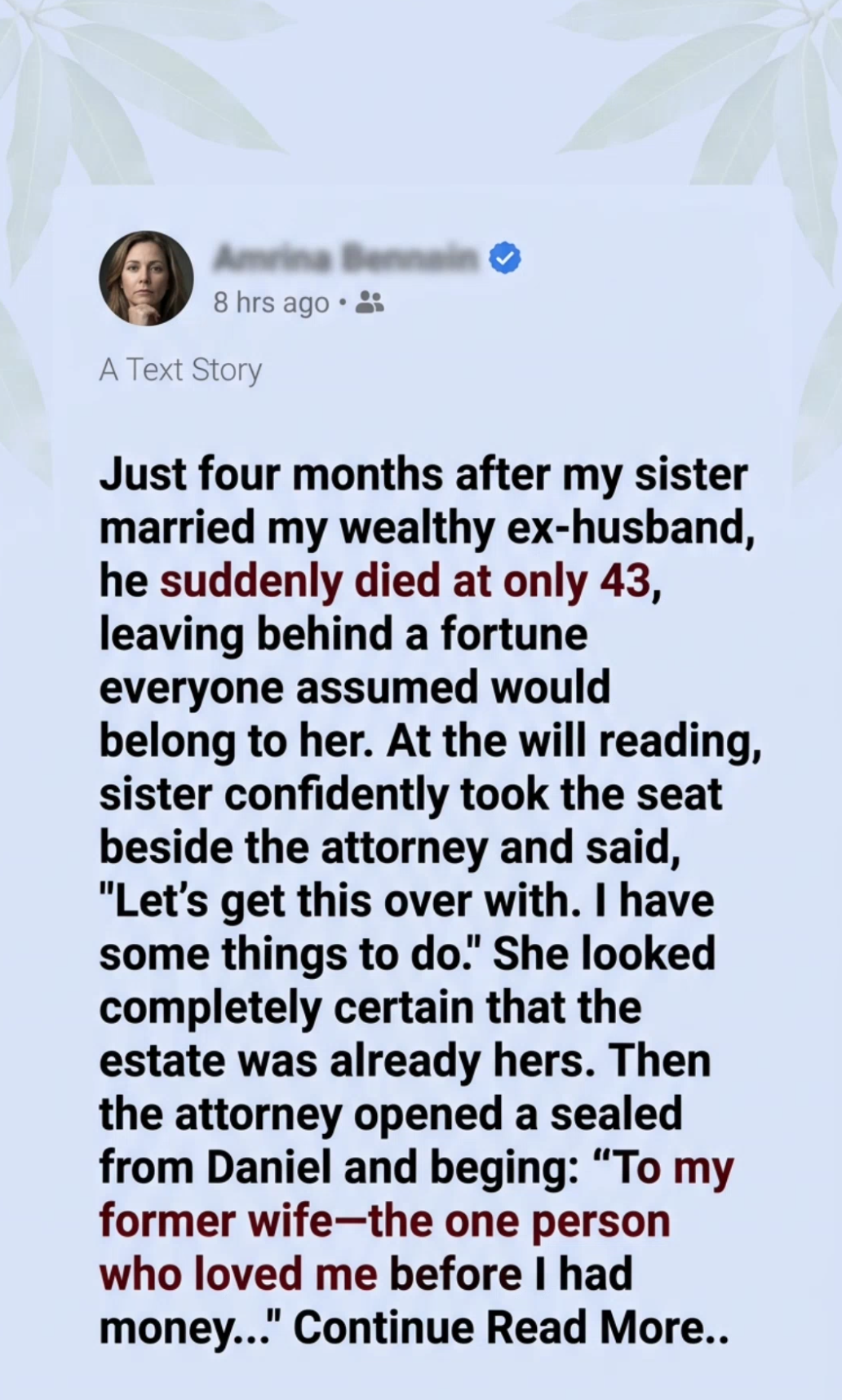
“Let’s get this over with,” she said. “I have some things to do.”
Martin didn’t react.
He opened the main folder and began explaining the estate administration process.
Daniel had owned several properties, shares in his architectural firm, investment accounts, and other business interests.
The estate was substantial.
Vanessa listened with an expression of satisfaction.
When Martin mentioned that the assets would need to be valued and reviewed, she interrupted.
“There’s no need to explain every detail. I’m the surviving spouse.”
Martin looked at her.
“Your status as surviving spouse is important, Mrs. Moretti, but the distribution must follow the executed estate documents and applicable law.”
She frowned.
“Of course.”
He continued.
There were specific gifts to family members, charitable contributions, business succession arrangements, and instructions for the remaining assets.
Vanessa grew impatient.
“Can we get to the part that concerns me?”
Martin closed one folder.
“Yes.”
He removed a sealed envelope from a separate file.
The paper was old, cream-colored, and marked with Daniel’s handwriting.
He looked at me.
“Before I read this, I need to explain that Mr. Moretti left specific instructions that the letter be read in the presence of Emily Carter.”
Vanessa turned toward me.
“What?”
Martin repeated the instruction.
Vanessa gave a short laugh.
“This is absurd. Emily is his ex-wife.”
Martin carefully broke the seal.
Then he began reading.
“To my former wife—the one person who loved me before I had money…”
I felt my throat tighten.
I hadn’t heard Daniel’s handwriting described that way in years.
Martin continued.
“Emily,
If this letter is being read, I am no longer alive, and I have probably left behind more questions than answers.
I know you may not want to hear from me. I know I gave you every reason to close the door on our past.
But there is something I should have told you while I was still able to look you in the eyes.
When we divorced, I allowed you to believe that our marriage had ended because I had fallen out of love with you.
That was not the whole truth.
I was ashamed of the person I had become, and I was too weak to admit it.
I allowed money and success to convince me that I deserved a different life. I hurt the person who had supported me before I had anything to offer.
I hurt you twice—first as your husband, and then as your sister’s lover.
I cannot undo that.
But I can tell you that I never forgot the years when we had very little and still found reasons to be happy.”
I stared at the table.
Martin paused briefly.
Then he continued.
“I remember the old apartment. I remember the secondhand drafting table you bought me. I remember you staying awake to help me prepare proposals when I was certain my business would fail.
I remember all of it.
When I became wealthy, I convinced myself that the people around me valued me for what I could provide. I mistook attention for loyalty and comfort for happiness.
I was wrong.
I don’t expect forgiveness.
I only want you to know that you were never insignificant in my life.
Daniel.”
Martin lowered the letter.
The room was silent.
Vanessa shifted in her chair.
“That’s very touching,” she said. “But what does it have to do with the estate?”
Martin opened another document.
“Mr. Moretti also left a separate set of instructions concerning the Moretti Foundation.”
Vanessa straightened.
“The foundation belongs to the family.”
“Yes. It is a charitable organization funded through the estate.”
“Then I assume I’ll be chairing it.”
Martin looked at her.
“That is not what the documents say.”
Her smile disappeared.
He explained that Daniel had established the foundation several years earlier to support vocational education and housing assistance for people facing financial hardship.
The foundation had its own board and independent governance structure.
Daniel had appointed a professional director and several community representatives.
He had also included a provision requiring the board to select an independent chair who had experience managing budgets and community programs.
My name appeared on the list of people the board was asked to consider.
Vanessa stared.
“Why her?”
Martin answered carefully.
“Because Mr. Moretti had observed her volunteer work with a housing support organization. He believed she understood the practical needs of families receiving assistance.”
I looked at him.
I had volunteered with a community housing program for several years, helping people complete applications, organize budgets, and access emergency support.
Daniel had known about it.
I hadn’t realized he had been paying attention.
Vanessa’s expression hardened.
“She has no business being involved in his foundation.”
Martin placed another document on the table.
“Mrs. Moretti, the foundation’s chair is appointed by its independent board. The position is not an inheritance, and it does not belong automatically to the surviving spouse.”
Vanessa folded her arms.
“Then what exactly do I inherit?”
Martin turned to the next section.
Daniel had left Vanessa the right to occupy the waterfront residence for a limited period, along with certain personal belongings and a defined financial provision.
But he had not left her unrestricted control of his business or the entire estate.
His company shares were placed under a succession arrangement designed to protect the employees and preserve the firm’s operations.
The remaining assets were distributed through the estate plan.
Vanessa’s face grew pale.
“That’s not possible.”
Martin continued explaining.
The estate included charitable commitments, business obligations, and provisions for Daniel’s parents. Several assets were held in trusts with restrictions that had existed long before his second marriage.
Vanessa interrupted.
“He told me everything would be mine.”
Martin looked at her.
“I can only explain what he signed.”
She turned toward me.
“You knew about this?”
“No.”
“You’re lying.”
I shook my head.
“I came here because the attorney asked me to.”
Vanessa stood.
“This is ridiculous. He was my husband. I was the one who took care of him.”
Martin remained calm.
“Please sit down. There are additional documents that need to be reviewed.”
She sat, but her hands were shaking.
The most surprising part came after the formal reading.
Martin asked me to remain for a private conversation.
Vanessa was invited to speak with her own attorney before discussing the remaining administrative matters.
When the room was empty, Martin placed a second folder in front of me.
“This concerns a property you may remember,” he said.
I looked at the address.
It was a small apartment building Daniel and I had purchased during our marriage.
We had sold it several years after our divorce, or so I had believed.
I told Martin that I had no interest in reopening old financial matters.
He nodded.
“Understood. But this is not a claim against you. It’s a question of documentation.”
He explained that Daniel had retained a minority interest in a property investment partnership that had been established during our marriage.
The partnership had later sold several buildings and reinvested the proceeds.
My name appeared in an old agreement because I had helped provide the original deposit.
After the divorce, the interest had been addressed through the financial settlement, but one part of the partnership’s records had never been properly updated.
Daniel had left instructions for the estate to investigate and correct the record.
I frowned.
“Does that mean I own something?”
“It means we need to determine whether the original settlement fully addressed your interest. I don’t want to speculate before the accounting is complete.”
He showed me the relevant documents.
The records indicated that a small amount of money might still be owed to me from a distribution that had been delayed during the partnership’s restructuring.
It wasn’t a fortune.
It wasn’t even close to Daniel’s wealth.
But it was mine if the accounting confirmed it.
I asked Martin to send everything to my attorney.
He agreed.
Then he handed me one final envelope.
“Daniel asked that you receive this privately.”
I opened it after returning home.
Inside was a photograph of us from our wedding day.
We were standing outside the church, laughing because it had started raining before the photographer finished.
On the back, Daniel had written:
I hope you found the peaceful life I was too selfish to help you build.
I sat at my kitchen table for a long time.
I didn’t cry because I wanted him back.
I cried because I remembered the young man in the photograph.
The man who had once been excited about a secondhand drafting table.
The man who had promised that success would never change him.
I wondered whether he had thought about that promise during his final months.
The months that followed were complicated.
Vanessa challenged parts of the estate plan, arguing that Daniel had verbally promised her greater control.
The estate’s attorneys reviewed the claims, and the court process proceeded according to the applicable rules.
The foundation continued operating under its independent board.
I was invited to meet with the board, but I did not immediately accept the chair position.
I wanted to understand the responsibilities and make sure I wasn’t being drawn into a family dispute.
The board members were professional and direct.
They explained that Daniel’s charitable work had been largely private. He had funded vocational training programs, emergency housing grants, and apprenticeships for people who could not afford further education.
He had never put his name on every project.
Some of the staff had known about his involvement.
Others had not.
One director told me that Daniel had once attended a workshop and spent an entire afternoon listening to young people describe their difficulties finding work.
“He didn’t speak much,” she said. “But he remembered their names.”
I thought about the man I had known before his success.
Perhaps that part of him had never disappeared completely.
I accepted the position after reviewing the governance documents and receiving independent advice.
I made one condition.
“I don’t want the foundation used to advertise Daniel’s generosity or defend his reputation. I want it to do the work it was created to do.”
The board agreed.
We began by reviewing every active program and ensuring that the funds were being used appropriately.
I visited a vocational training center where young adults were learning electrical installation, welding, and building maintenance.
One student, a nineteen-year-old named Marcus, told me he had nearly dropped out of school because his family couldn’t afford transportation.
The foundation had helped cover his training costs.
He showed me a certificate he had earned.
“I want to open my own repair business one day,” he said.
I smiled.
“I hope you do.”
That evening, I understood why Daniel had left me the letter.
Perhaps he had wanted to apologize.
Perhaps he had wanted to recognize the person I had been before his wealth changed our marriage.
But I didn’t need to turn his final words into proof that he had become a good man.
He had made choices that hurt people.
He had betrayed me.
He had betrayed my sister.
He had also created something that could help others.
Both things could be true.
Almost a year after Daniel’s death, Vanessa contacted me.
I almost didn’t answer.
When I did, she sounded exhausted.
“Emily, can we meet?”
I agreed to a short meeting at a café.
She arrived without her usual designer handbag and wore a simple gray sweater.
For a while, neither of us spoke.
Then she said, “I didn’t know the estate was arranged that way.”
I stirred my coffee.
“What did you expect?”
She looked down.
“I thought I would inherit everything.”
“Daniel’s business was complicated. I don’t think anyone could have taken control of everything immediately.”
She sighed.
“He told me I would never have to worry about money.”
I didn’t answer.
She looked at me.
“Did he leave you something?”
I considered telling her about the old partnership distribution, but I didn’t owe her an accounting of my finances.
“There’s a matter being reviewed by the estate.”
She nodded.
Then she said something I hadn’t expected.
“I was jealous of you.”
I looked up.
“Why?”
“Because he talked about you.”
I felt a small ache in my chest.
“Even when we were married, he sometimes mentioned the years before the company became successful. He talked about how you helped him. I hated hearing it.”
I waited.
“After we got married, I thought being his wife would make me feel secure. But he was always working. He was always worried about the company. And when he got sick, I realized I didn’t know how to help him with anything.”
She wiped her eyes.
“I thought I had won something when he chose me. I didn’t understand what I had destroyed.”
I looked at her for a long time.
I could have reminded her that she had made her choices.
I could have listed every lie, every family gathering, every painful memory.
Instead, I said, “You can’t undo what happened.”
She nodded.
“I know.”
“And I can’t go back to being your sister the way we were before.”
“I know that too.”
We finished our coffee.
Before leaving, she asked whether I hated her.
I thought carefully.
“No,” I said. “But I don’t trust you.”
She accepted that answer.
For the first time in years, neither of us pretended that everything was fine.
I eventually received the remaining distribution from the old partnership after the estate’s accounting was completed.
It wasn’t life-changing money, but it was a fair correction of something that should have been resolved years earlier.
I placed most of it into savings and used a small portion to renovate my mother’s kitchen.
She was getting older, and I wanted her to have a safer, more comfortable space.
When I told her, she asked whether Daniel’s money had anything to do with it.
I explained the situation.
She looked at me and said, “Your father would have liked that you used it for something practical.”
I smiled.
“That’s what I thought.”
On the second anniversary of Daniel’s death, I attended a foundation event.
There were no expensive decorations, no grand speeches, and no attempt to turn the evening into a celebration of wealth.
The students who had completed their training programs spoke about their plans.
One young woman had secured an apprenticeship with a construction company.
A single father had completed a certification course that allowed him to earn more stable wages.
A former shelter resident had found permanent employment and moved into an apartment with her daughter.
I stood at the back of the room, listening.
For the first time, I felt comfortable being connected to Daniel’s legacy.
Not because I wanted to be remembered as his former wife.
Not because I wanted to prove anything to Vanessa.
But because the work mattered.
After the event, Martin approached me.
“Daniel would have been pleased with the direction the foundation has taken.”
I looked at the people gathering their coats and talking about their next steps.
“I think he would have liked seeing them succeed.”
Martin nodded.
Then he said, “He also wanted me to tell you something else.”
I looked at him.
“What?”
“He said that if you ever asked whether he regretted divorcing you, I should tell you that he regretted the way he treated you far more than he regretted the divorce itself.”
I didn’t know what to say.
I thought about the letter, the photograph, and the years we had spent building a life that eventually fell apart.
Then I nodded.
“Thank you for telling me.”
I walked outside.
The evening air was cool, and the streetlights had just come on.
I didn’t feel victorious.
I didn’t feel wealthy.
I didn’t feel as though I had won something from my sister.
I simply felt finished with a chapter of my life that had once seemed impossible to close.
Daniel’s fortune had not made me happy.
His final letter had not erased the betrayal.
And Vanessa’s disappointment had not repaired our family.
But the work we were doing through the foundation had given something useful to the world.
That was enough.
Sometimes the greatest surprise in a person’s final wishes isn’t the money they leave behind.
It’s the truth they finally find the courage to acknowledge.
And sometimes the most important inheritance isn’t a house, a business, or a bank account.
It’s the chance to turn something painful into something that helps another person begin again.
THE END.