The last thing my mother said to me before I drove away was, “Don’t forget to water my plant.”
I remember nodding.
I remember checking my phone because one of my children had sent me a message.
I remember telling her the nursing home would call if she needed anything.
What I don’t remember is looking her in the eyes.
That is the part that has stayed with me.
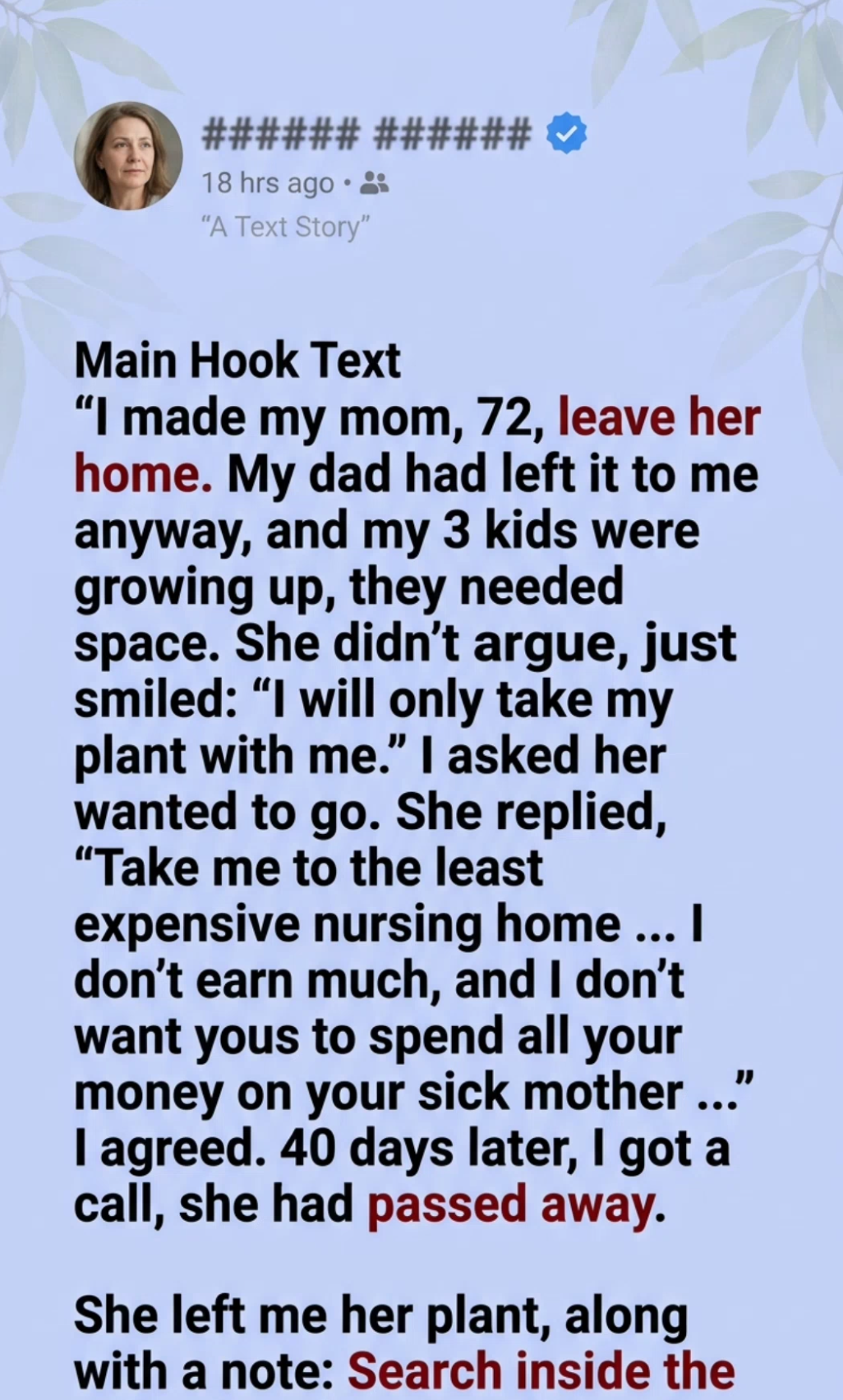
My mother was seventy-two years old when I made her leave the house where she had lived for nearly forty years. I told myself I had good reasons. My three children were growing up, they needed their own rooms, and the house was becoming crowded.
My father had left the property to me when he died.
I had the legal right to live there.
And, at the time, I believed that meant I had the right to decide who else could stay.
My mother never argued.
She simply smiled and said she would take her plant.
I wish I had understood that smile.
My name is Peter. I was forty-three when everything happened.
My wife, Laura, and I had three children: Ethan, who was sixteen, Sophie, who was thirteen, and Ben, who was ten.
We lived in a two-story house that my parents had bought when I was a child. It wasn’t luxurious, but it had a large backyard, a covered porch, and a kitchen where my mother had cooked thousands of meals.
After my father died, I inherited the property.
My mother continued living there because she had nowhere else to go. At first, I thought it was the natural thing to do. She had raised me, and I was grateful for everything she had done.
But over the years, our arrangement became difficult.
My children wanted privacy. My mother woke early and played the radio while preparing breakfast. She kept family photographs on every shelf, and she had a habit of asking the children whether they had finished their homework.
Laura felt that the house never truly belonged to us.
She didn’t dislike my mother, but she wanted to make decisions without having to consider another adult’s feelings.
There were arguments about the kitchen, the laundry, the television, and even the temperature of the heating system.
I usually stayed out of them.
I told myself that if I didn’t take sides, things would eventually settle down.
They didn’t.
My mother had also developed problems with her joints. Some mornings, she struggled to climb the stairs. She moved more slowly and occasionally forgot where she had placed things.
She was not helpless, but she needed more assistance than before.
Laura began saying we should consider another arrangement.
“Your mother needs more care than we can give her,” she told me one evening.
I knew she had a point.
My job involved long hours, the children had activities, and Laura was already managing most of the household.
Then one Saturday, while we were eating breakfast, Laura brought it up again.
“We need the spare room,” she said. “Ethan needs somewhere quiet to study, and Ben is still sharing with him.”
I looked toward the hallway.
My mother was watering a plant beside the kitchen window.
“She’s been here for years,” I replied.
“And we’ve been waiting for years to have our own space.”
I didn’t answer.
A few days later, I began looking at nursing homes.
I told myself I was researching possibilities.
But I had already made my decision.
My mother had one plant that she loved more than anything else in the house.
It was a large peace lily in a faded blue ceramic pot.
She had received it from my father on their thirtieth wedding anniversary.
He had brought it home in the back seat of his old car, wrapped in brown paper and tied with a piece of string.
My mother had laughed at him.
“You know flowers die, don’t you?”
My father had replied, “Then we’ll get something that stays.”
The plant had been moved from one windowsill to another over the years. My mother had cared for it through summers, winters, illnesses, and family celebrations.
When my father became sick, she placed it beside his favorite chair.
After he died, she moved it to the kitchen window.
Sometimes I caught her talking to it while she watered the soil.
I thought it was an old person’s habit.
I never asked what she said.
The afternoon I told her she needed to move out, she was sitting at the dining table, folding clean towels.
“Mom, can we talk?”
She looked up.
“Of course, sweetheart.”
I sat across from her.
“We’ve been having some difficulties with the house.”
She folded another towel.
“What kind of difficulties?”
“The children need more space. Laura and I need to make some changes. And I think it might be better if you moved somewhere with people who can help you.”
She stopped folding.
For several seconds, she didn’t speak.
Then she asked, “Have you found somewhere?”
I felt uncomfortable.
“I’ve looked at a few places. There are nursing homes nearby.”
She nodded.
I expected her to become upset.
I expected questions about why she couldn’t stay, or whether I was planning to sell the house.
Instead, she looked toward the kitchen window.
“I will only take my plant with me.”
I frowned.
“Your plant?”
She nodded.
“The one your father gave me.”
I tried to smile.
“Mom, you can take more than that.”
She shook her head.
“No. The rest of the things can stay.”
I felt a strange mixture of relief and guilt.
“Where would you like to go?”
She looked directly at me.
“Take me to the least expensive nursing home. I know you don’t earn much, and I don’t want you spending all your money on your sick mother.”
I didn’t know what to say.
I told her we would find somewhere suitable.
She smiled again.
“Whatever you think is best, Peter.”
That evening, I called several facilities.
One was too expensive.
Another had a waiting list.
The third was an older residential care home on the edge of town. It wasn’t beautiful, but it had a room available and the monthly fee was lower than the others.
I arranged a visit.
My mother came with me.
She walked slowly through the corridors, looking at the small rooms and shared dining area.
A woman in a wheelchair was watching television near the entrance. An elderly man sat by a window, reading a newspaper.
My mother looked at the garden.
“Is there somewhere I can sit outside?”
The manager showed her a small courtyard with a few benches.
My mother nodded.
“This will do.”
I asked whether she was sure.
She looked at me.
“Peter, I don’t need a palace.”
I signed the paperwork the following week.
Moving day arrived on a rainy Thursday.
My mother packed a few clothes, her medications, a small photograph of my father, and the peace lily.
I offered to bring more belongings.
She refused.
“Someone else can use them.”
The children were at school when we left.
Laura helped carry the plant to the car.
My mother held it carefully in her lap during the drive.
She didn’t complain about the weather or the distance.
At the nursing home, a staff member named Mrs. Harris showed us to her room.
It was small, with a single bed, a wardrobe, a bedside table, and a window overlooking the courtyard.
My mother placed the plant on the windowsill.
She stepped back and looked at it.
“There,” she said. “It will get enough light.”
I carried her suitcase into the wardrobe.
Then I checked my phone.
I had several messages from work.
I told my mother I needed to leave soon.
She reached for my hand.
“Thank you for bringing me, sweetheart.”
I felt awkward.
“Call me if you need anything.”
“I will.”
I turned toward the door.
Then she said, “Peter?”
I looked back.
“Yes?”
“Don’t forget to water my plant if you ever bring it home.”
I laughed lightly.
“Why would I bring it home?”
She smiled.
“Just in case.”
I didn’t understand.
I kissed her forehead and left.
I didn’t know that would be the last time I saw her alive.
The first week passed without incident.
The nursing home called once to tell me my mother had settled in.
She had eaten her meals, taken her medication, and spent time in the courtyard.
I was relieved.
I visited the following Sunday.
She was sitting beside the window with a blanket over her knees.
“How are you, Mom?”
“Very well.”
“Are they treating you properly?”
“Everyone is kind.”
I noticed the peace lily.
It had been placed on a small wooden stand beside the window.
“Looks like your plant is doing well,” I said.
She smiled.
“It likes the light.”
We talked for twenty minutes.
She asked about the children, and I told her Ethan had started preparing for his exams.
She asked whether Sophie was still taking piano lessons.
I told her Ben had joined a football team.
She listened carefully.
Then she asked whether Laura was feeling better after her recent cold.
I said yes.
She didn’t ask why I hadn’t visited sooner.
She didn’t complain about being lonely.
When I left, she said she loved me.
I replied, “Love you too, Mom.”
I meant it.
But I still didn’t understand how much those words would matter later.
The second week was busy.
Work became demanding, Ben had football practice, and Sophie needed help preparing for a school performance.
I told myself I would visit on Sunday.
On Sunday, something came up.
The following week, I called twice.
My mother sounded tired, but she said she was fine.
I asked whether she needed anything.
She said she had everything.
I promised to visit soon.
Then I didn’t.
Not because I had stopped caring.
At least, that’s what I told myself.
I was simply busy.
I had responsibilities.
I had a family.
I had a house to manage.
I kept forgetting that my mother had spent most of her life putting those same responsibilities aside whenever I needed her.
Forty days after I moved her into the nursing home, my phone rang.
I was in the office, reviewing a report.
The caller ID showed the nursing home’s number.
I answered.
“Hello?”
A woman’s voice came through.
“Mr. Ellis? This is Mrs. Harris from Greenfield Care Home.”
My stomach tightened.
“Is everything all right?”
There was a pause.
“I’m very sorry. Your mother became unwell early this morning. The medical team tried to help her, but she passed away shortly afterward.”
I stopped breathing for a moment.
“What?”
“I’m so sorry.”
I stood up.
“Are you sure?”
There was another silence.
“Yes, Mr. Ellis.”
I sat down.
I couldn’t hear anything except the sound of my own heartbeat.
I asked what had happened.
Mrs. Harris explained that my mother had developed complications from an infection. Her condition had deteriorated quickly.
They had contacted the appropriate medical services.
She had not suffered for long.
I asked whether she had been alone.
Mrs. Harris paused.
“No. One of our nurses was with her. She was holding your mother’s hand.”
I thanked her.
Then I hung up.
I sat at my desk for a long time.
My mother was dead.
And I hadn’t visited her in more than two weeks.
The funeral was small.
A few relatives came. Some former neighbors attended. The nursing home sent a card signed by several staff members.
My children cried.
Even Ethan, who had been acting distant and grown-up for months, stood beside the coffin with tears running down his face.
Laura held my arm.
I barely spoke.
After the funeral, Mrs. Harris approached me.
“Mr. Ellis, your mother asked us to give you something if anything happened to her.”
She handed me a small envelope.
My name was written on the front in my mother’s handwriting.
I held it but didn’t open it.
Then Mrs. Harris gave me a second item.
It was the peace lily.
The blue pot had a small crack near the bottom, but the plant looked healthy.
“She wanted you to have this,” Mrs. Harris said.
I nodded.
“Thank you for looking after her.”
Mrs. Harris smiled sadly.
“Your mother was a lovely woman. She talked about you every day.”
I looked down.
“What did she say?”
“She told us about your childhood. She said you were always asking questions and that your father used to pretend he knew every answer.”
I almost smiled.
Then Mrs. Harris added something I wasn’t expecting.
“She also said she hoped you wouldn’t blame yourself for not visiting more often.”
I looked at her.
“She said that?”
“Yes. She said you had a family of your own and that she didn’t want to become another burden.”
I couldn’t speak.
I carried the plant to my car.
For the first time, I wondered whether my mother had understood exactly what I was doing when I moved her out.
And whether she had chosen not to make it harder for me.
I placed the peace lily in the kitchen window.
It looked smaller than I remembered.
Maybe because the house was so large.
Maybe because I had never noticed how much space it had occupied before.
For three days, I left the envelope unopened.
I told myself I wasn’t ready.
On the fourth evening, I sat at the kitchen table after everyone had gone to bed.
I opened it.
Inside was a handwritten letter and a small photograph.
The photograph showed my parents standing in front of the house on the day they bought it.
My father was holding a set of keys.
My mother was laughing.
On the back, she had written:
The happiest day we thought we could afford.
I unfolded the letter.
“Dear Peter,
If you are reading this, I suppose I am no longer there to remind you to eat properly or to ask whether the children have finished their homework.
I hope you are all well.
I know you have been worried about money. I know raising three children is expensive, and I know you have been trying to make the house work for everyone.
Please don’t think I left because I didn’t want to stay.
I left because I could see that my presence was making life difficult for you and Laura.
I have lived a long life, Peter. I had a good husband, a wonderful son, and three grandchildren who made me laugh more than they know.
I don’t need a big room or expensive furniture.
I only wanted to keep the plant because your father gave it to me on a day when we had very little money, but he wanted me to have something beautiful.
He always said a home wasn’t measured by how many rooms it had.
He said it was measured by how much love people were willing to give one another.
I hope you remember that.
Love,
Mom.”
I stopped reading.
The letter wasn’t finished.
There was another page.
It said:
“There’s something I never told you.
When your father became ill, he worried about what would happen to the house. He knew he was leaving it to you, but he also knew I might need help someday.
He didn’t want you to feel responsible for everything, so he made arrangements that I could receive a small monthly payment from an account he had set aside.
The account was in my name, and I never used much of it.
I had planned to keep it for emergencies.
After I moved into the care home, I used some of that money to pay my own expenses.
I didn’t want you to feel that you had to choose between your children and me.
There is still enough left to cover the funeral and a little more.
I have asked the bank to send the remaining balance to you.
Please use it for the children.
And, Peter, don’t feel guilty about the plant.
It belongs with you now.
Water it when you remember.
Love,
Mom.”
I lowered the pages.
My mother had not been waiting for me to pay her bills.
She had not expected me to support her.
She had quietly used the money my father had left her to protect me from expenses I had never even known about.
I had assumed she was a financial burden.
In reality, she had been trying to make sure I didn’t feel one.
But the letter had another surprise.
A small paper was folded inside the envelope.
It was a bank statement showing the balance of the account.
There was enough money to cover the funeral and a modest amount beyond it.
It wasn’t a fortune.
It wasn’t some hidden inheritance that would change our lives.
It was simply the savings of a woman who had spent years putting a little aside whenever she could.
I began crying.
I thought about the way she had held that plant during the drive.
The way she had asked for the least expensive nursing home.
The way she had thanked me for bringing her there.
And I understood something painful.
She had known she was being sent away.
But she had still tried to make me feel better about it.
The following morning, I took the letter to Laura.
She read it quietly.
When she finished, she looked at me.
“Peter, I didn’t know about the account.”
“Neither did I.”
She looked toward the kitchen window.
“She must have been so lonely.”
I didn’t answer.
Laura folded the letter carefully and placed it on the table.
“I thought she was unhappy living here,” she said. “I didn’t realize how much she was trying not to trouble us.”
I rubbed my face.
“I should have visited more.”
Laura sat beside me.
“Yes,” she said softly. “You should have.”
It hurt to hear it.
But I needed to hear it.
We didn’t blame each other.
We had both been part of the decision, and neither of us could pretend otherwise.
That afternoon, I called my mother’s former neighbor, Mrs. Bennett.
She had known my parents for decades.
When I told her about the letter, she was quiet for a long time.
Then she said, “Your mother loved you more than she knew how to explain.”
I asked whether she had ever mentioned the money.
Mrs. Bennett said no.
But she remembered my mother visiting her one afternoon shortly before moving.
“She told me she was worried about you,” Mrs. Bennett said.
“About me?”
“She said you had too much on your shoulders. She wanted to make things easier for you.”
I closed my eyes.
Even after I had made her leave, she had been worried about me.
A week later, I brought the peace lily to the garden center.
I wanted to make sure I was caring for it properly.
The woman who helped me examined the leaves and checked the soil.
“It’s a healthy plant,” she said. “It just needs consistent watering and indirect sunlight.”
I nodded.
“That’s what my mother used to say.”
The woman smiled.
“Then your mother knew what she was doing.”
I asked whether the plant could be repotted.
She explained that it would eventually need a larger container, but there was no rush.
I bought a bag of fresh soil and took it home.
That evening, I removed the plant from its blue pot.
The roots were tightly packed, and the soil was dry near the bottom.
As I loosened it, I noticed something wrapped in a small piece of plastic.
At first, I thought it was a stone.
Then I carefully pulled it free.
It was a little metal key.
I stared at it.
My mother had written, Search inside the soil.
I returned to the envelope and checked the letter again.
There was no mention of a key.
I called Mrs. Bennett.
She was quiet when I described it.
Then she said, “Oh, Peter. I wondered whether she would leave that for you.”
I gripped the phone.
“What is it?”
“Your father had a small metal box in the shed. He kept important papers in it. Your mother used to tell me she wanted you to have it someday.”
I looked toward the window.
“Do you know where it is?”
“Not exactly. But your father always kept it behind the old tool cabinet.”
The next morning, I went into the shed.
I hadn’t opened it in years.
It smelled of old wood, dust, and machine oil.
I moved the tool cabinet away from the wall.
Behind it was a narrow wooden shelf.
And on the shelf sat a small metal box.
The key fit.
Inside were several documents, a few photographs, and a notebook in my father’s handwriting.
There was no fortune.
No secret property.
No dramatic revelation about a hidden business.
There were simply records of the decisions my parents had made while raising me.
My father’s first paycheck after he became a supervisor.
A receipt for the secondhand bicycle he had bought me when I was twelve.
The original papers showing the purchase of the house.
And a notebook with a list of expenses my parents had carefully recorded over the years.
On the final page, my father had written:
If Peter ever has children, I hope he understands that raising a family is not about giving them everything. It is about making sure they never doubt they are loved.
Below that, my mother had added a sentence in her own handwriting:
And if I am not here to remind him, tell him that children remember the little things.
I sat on the shed floor for a long time.
The house had been left to me.
But my parents had spent their lives building something far more valuable than the property.
They had built a family.
And I had allowed the demands of everyday life to make me forget that.
The following Sunday, I gathered my children in the kitchen.
I placed the photographs on the table.
I told them about their grandmother’s plant, the letter, and the little box.
I didn’t hide what had happened.
I told them that I had asked their grandmother to leave because I thought the house was too crowded. I explained that I had made the decision too quickly and had failed to consider how lonely she might feel.
Ethan looked down at the table.
“I thought Grandma wanted to move.”
I shook my head.
“She didn’t.”
Sophie began crying.
“Why didn’t we visit her more?”
I took her hand.
“Because I didn’t make it important enough. That was my mistake.”
Ben looked toward the plant.
“Can we keep it?”
“Yes,” I said. “It’s going to stay right here.”
Then I told them something else.
“We can’t change what happened. But we can decide what kind of family we want to be from now on.”
We agreed that the children would help care for the plant.
Ethan would check the soil every Saturday.
Sophie would remove dead leaves.
Ben would make sure it received enough light.
They took the responsibility seriously.
The peace lily became part of our routine.
And slowly, the house began to feel different.
We moved some furniture. We made space for family photographs. Laura suggested turning the small room beside the kitchen into a quiet reading room instead of another storage area.
We placed one of my mother’s favorite chairs beside the window.
Not because we were trying to pretend she was still there.
Because she had belonged there.
Several months later, I visited the nursing home.
I wanted to thank Mrs. Harris properly and ask about the people who had cared for my mother.
She showed me the small room where my mother had lived.
The windowsill was empty.
The courtyard looked peaceful.
I stood outside for a moment, remembering the day I had left her there.
Mrs. Harris joined me.
“Your mother was very grateful,” she said.
I looked at her.
“Did she ever say she wanted to come home?”
Mrs. Harris thought for a moment.
“She said she missed her kitchen. She missed her garden. But she never spoke badly about you.”
I looked down.
“She should have.”
Mrs. Harris gently shook her head.
“She understood that you were trying to manage your own family. She just wished you had more time to sit with her.”
Those words stayed with me.
Not more money.
Not a bigger room.
Not a better nursing home.
More time.
I thanked her and walked out into the courtyard.
There was a small peace lily near the entrance.
I asked whether I could leave a donation toward its care.
Mrs. Harris smiled.
“Your mother would have liked that.”
It has been two years since my mother died.
The peace lily is still in our kitchen.
It has grown larger, and every spring it produces new white flowers.
Sometimes I stand beside it and remember my mother watering it in the morning.
I remember how she would turn the pot slightly so every leaf received light.
I remember my father’s words about a home being measured by love.
And I remember the letter.
I still regret asking her to leave.
I regret the visits I postponed and the conversations I never had.
I cannot undo those forty days.
I cannot drive back to the nursing home and ask her to come home.
But I can do something with what she left behind.
I can make sure my children understand that people are not inconveniences simply because they grow older.
I can make room for the people who once made room for me.
And I can remember that the most important things in a home are not the number of bedrooms, the size of the kitchen, or the value of the property.
They are the people who feel welcome inside it.
Last Sunday, Ben came into the kitchen holding a small watering can.
“Is it time for Grandma’s plant?” he asked.
I looked at the leaves.
“Yes, buddy. Just a little water.”
He carefully poured it into the soil.
Then he looked at me.
“Do you think Grandma can see it?”
I swallowed.
“I don’t know, sweetheart.”
He thought for a moment.
“I think she’d like that we take care of it.”
I put my hand on his shoulder.
“I think so too.”
That evening, after the children had gone upstairs, I took my mother’s photograph from the shelf.
She was smiling in the picture, standing beside my father in front of the house.
I placed it next to the peace lily.
Then I whispered something I should have said much sooner.
“I’m sorry, Mom. I should have made more room for you.”
The plant stood quietly in the window.
A new white flower had opened that morning.
And for the first time, I understood why my mother had insisted on taking only that one thing with her.
It wasn’t just a plant.
It was a piece of the life she and my father had built together.
It was a reminder that love doesn’t always ask to be repaid.
Sometimes it simply asks to be remembered.
THE END.